English
 Español
 عربى
عربىContent
- 1 Product Overview
- 2 Why the Four-Grid Structure Matters
- 3 Material Advantages of PE and PP
- 4 Performance in Takeaway and Delivery Conditions
- 5 Advantages Over Conventional Takeaway Containers
- 6 Advanced Manufacturing Processes
- 7 Quality Assurance and Certification Strength
- 8 Customization for Food Brands and OEM Buyers
- 9 Environmental Responsibility and Green Production
- 10 Applications in Hot Pot and Beyond
- 11 How the Container Improves Brand Experience
- 12 Operational Benefits for Restaurants and Distributors
- 13 Manufacturing Strength of Yuqian Packaging Technology
- 14 Food Safety and Consumer Confidence
- 15 Selection Guide for Buyers
- 16 Q&A Section
- 16.1 What is the PE/PP four-grid plastic hot pot container mainly used for?
- 16.2 Why is the four-grid design better than a single-compartment bowl?
- 16.3 What materials are used for this container?
- 16.4 Is the container safe for food contact?
- 16.5 Can the container be customized?
- 16.6 What are the standard dimensions of the product?
- 16.7 What certifications support the manufacturer’s quality strength?
- 16.8 How does the product support restaurant operations?
- 16.9 Is the container suitable only for hot pot?
- 16.10 How does the company support environmental responsibility?
- 17 Conclusion
- 18 References
- 19 Product: PE/PP four-grid plastic hot pot container
In the fast-growing takeaway and food delivery market, packaging is no longer a simple carrier for food. It has become a visible part of product quality, dining comfort, food safety, operational efficiency, and brand experience. The PE/PP four-grid plastic hot pot container is designed for restaurants, hot pot chains, catering distributors, meal-kit providers, and food packaging buyers who need a practical container that can separate multiple ingredients while maintaining strength, hygiene, and convenience. With a square four-compartment structure, food-grade PE and PP material options, high transparency, stable shape, and customizable specifications, this container offers a reliable packaging solution for hot pot meals, mixed dishes, sauces, snacks, cold dishes, and takeaway sets.
Unlike ordinary single-compartment takeaway bowls, the four-grid design allows different ingredients or seasonings to be placed in one container without mixing. This is especially valuable for hot pot dining, where vegetables, meats, tofu products, noodles, seafood, condiments, and dipping sauces often need to be separated for freshness, presentation, and hygiene. The container helps catering businesses improve packing efficiency and gives consumers a cleaner, more organized dining experience. For food brands that want to provide a professional and memorable takeaway service, this type of divided plastic container can be a powerful upgrade.
The product is manufactured from high-quality food-grade raw materials and is designed to be non-toxic, odorless, durable, and resistant to low-temperature conditions. It maintains a stable shape in cold environments, is not easy to deform, and provides good toughness for transportation and handling. Its transparent appearance improves food visibility, allowing customers to see ingredients clearly before opening the package. This visual transparency supports consumer confidence and enhances the perceived value of the meal.
Yuqian Packaging Technology (Jiangsu) Co., Ltd. focuses on the research, development, production, and sales of food packaging materials and containers. Established in 2010 and located in Taizhou City, Jiangsu Province, the company operates a production facility of about 30,000 square meters. With certifications including QS national industrial product production license, ISO9001 quality management system certification, BRC certification, German authoritative safety DIN certification, and EU ROHS+ testing, the company has built a strong foundation for supplying reliable food packaging products to customers in competitive domestic and international markets.
PE/PP four-grid plastic hot pot container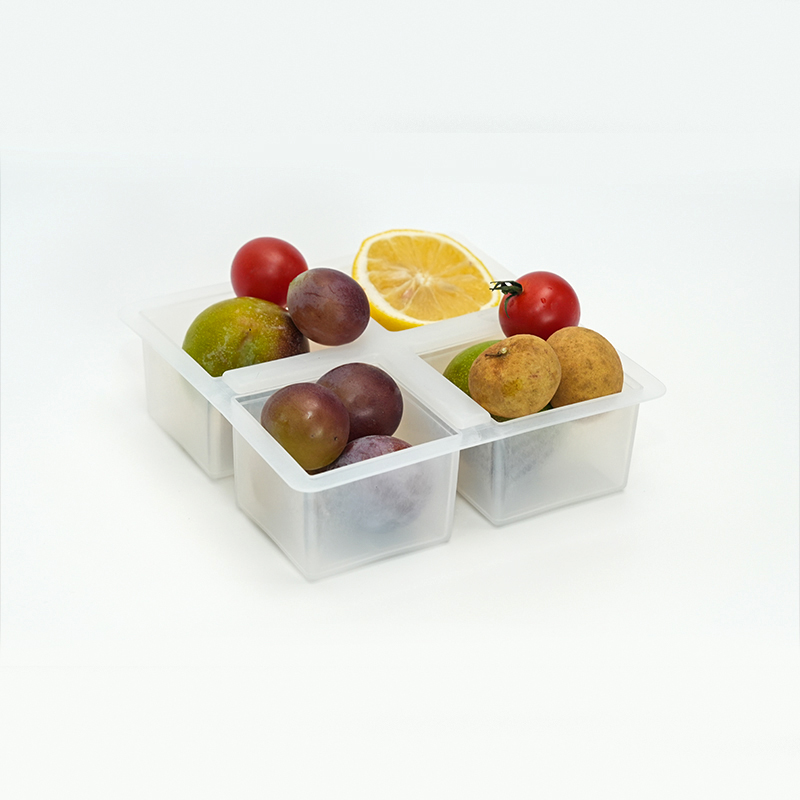
Product Overview
The PE/PP four-grid plastic hot pot container is a divided takeaway bowl developed for hot pot ingredients and multi-item food packaging. It is made from PE, PP, or suitable combinations selected according to the customer’s application requirements. PE, or polyethylene, is known for flexibility, toughness, and low-temperature resistance. PP, or polypropylene, is widely used in food containers because of its heat resistance, chemical stability, light weight, and safe contact performance. By using high-quality food-grade materials, the container provides practical performance for a variety of catering environments.
The standard product shown in the provided product information is a hotpot box with a length of 145 mm, a width of 145 mm, a height of 46 mm, and a grammage of 74.5 g. Its compact square shape is easy to stack, store, transport, and display. The four-grid layout creates separate zones that help prevent cross-contamination between different foods. For hot pot restaurants, this means sliced meat, vegetables, mushrooms, and sauces can be packed together without losing their individual character. For prepared meal brands, it can be used for balanced meals, sample packs, tasting sets, cold salads, seasoning combinations, or assorted snacks.
The container is designed for commercial efficiency. It can support standardized portion control, reduce the need for multiple small packages, simplify assembly in busy kitchens, and help delivery staff carry meals more safely. When compared with using several separate cups or bowls, a single four-grid container can reduce packing steps and make the final product easier for customers to manage. This advantage is important for high-volume restaurants where speed and consistency directly affect customer satisfaction.
| Item | Specification or Feature | Practical Value |
| Product Type | PE/PP four-grid plastic hot pot container | Suitable for separated ingredients, sauces, and takeaway meal combinations |
| Standard Size | 145 mm length, 145 mm width, 46 mm height | Compact square shape for stacking, packing, and delivery |
| Grammage | 74.5 g | Balanced strength and material efficiency |
| Material Options | Food-grade PE and PP | Good toughness, safety, and performance stability |
| Design | Four separate grids | Keeps different foods divided and improves presentation |
| Main Features | Low-temperature resistance, toughness, non-toxic, odorless | Reliable for catering storage, handling, and delivery |
| Appearance | High transparency | Improves food visibility and customer trust |
| Customization | Multiple sizes and design solutions available | Supports restaurant, chain, and private-label packaging needs |
| Certifications | QS, ISO9001, BRC, DIN, EU ROHS+ testing | Supports quality assurance and market compliance |
Why the Four-Grid Structure Matters
Hot pot is built around variety. Customers often enjoy combining several ingredients, textures, and flavors in one meal. However, packaging these items for takeaway can be challenging. If different foods are mixed too early, they may absorb unwanted moisture, lose texture, or affect each other’s taste. Sauces may leak onto vegetables, meat may stain noodles, and delicate ingredients may be crushed or softened. A divided container solves these problems by creating independent spaces within one package.
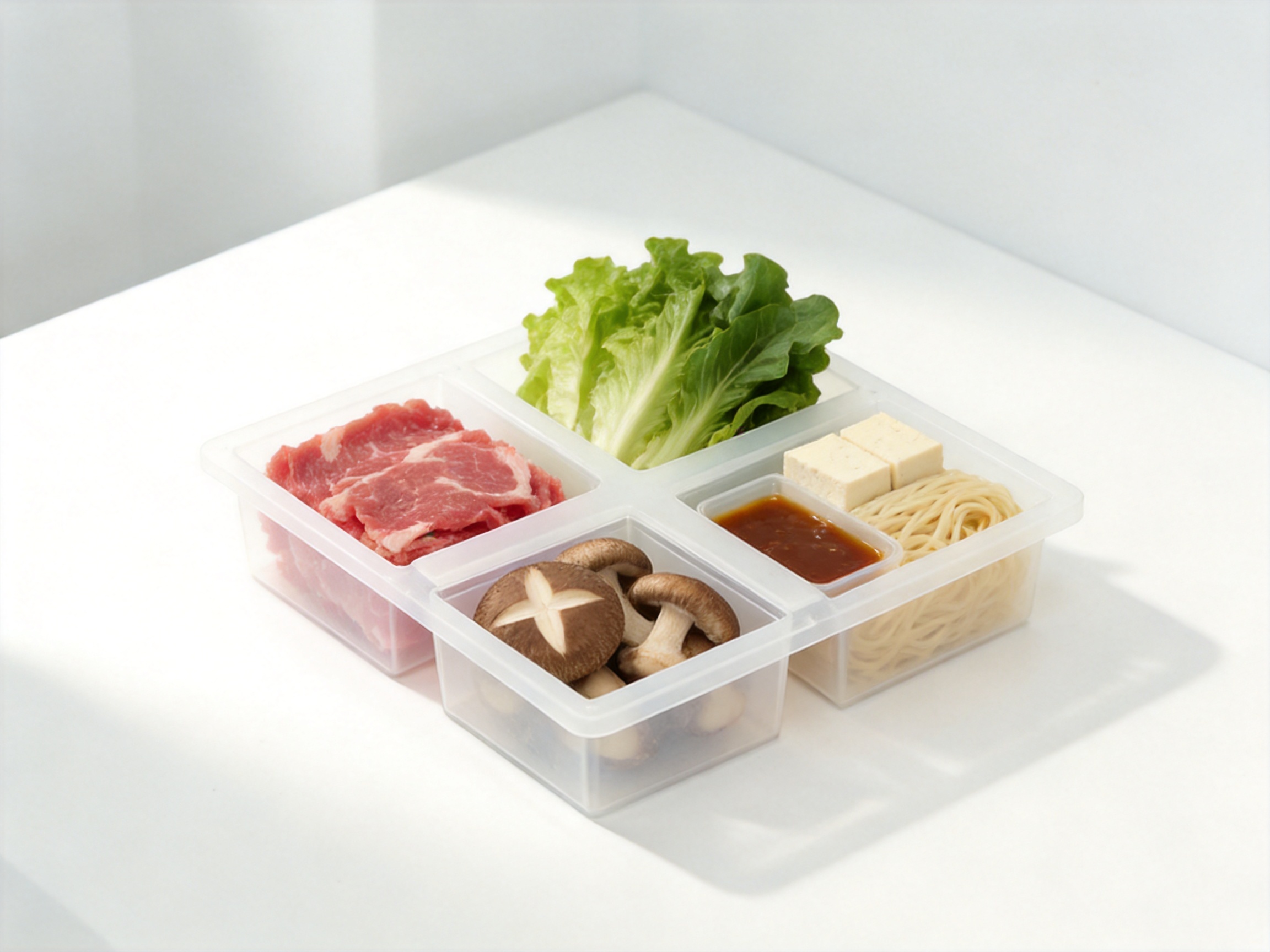
The four-grid structure is one of the container’s most important competitive advantages. It offers organization without requiring four separate packages. Each grid can be assigned to a different ingredient type, such as leafy vegetables, mushrooms, meat slices, and dipping sauce. This makes the meal look neat and appetizing when opened. For customers, the experience feels closer to an in-store serving style because the ingredients remain visually distinct. For restaurants, the package helps communicate attention to detail and quality.
Compared with ordinary round bowls or single-box containers, the four-grid layout improves both functionality and product value. Single-compartment bowls may be cheaper in simple applications, but they cannot provide the same level of separation. Multiple small cups can provide separation, but they increase labor, material use, storage complexity, and the possibility of missing items during packing. The four-grid container balances separation, convenience, and cost control in one integrated package.
This design is also useful beyond hot pot. Many food businesses now sell meal combinations, children’s meals, fruit assortments, dessert selections, tasting menus, and sauce sets. The divided structure supports portion control and allows brands to create more attractive product formats. In retail foodservice, visual presentation matters. When food is clearly arranged, customers are more likely to perceive it as fresh, safe, and worth its price.
Material Advantages of PE and PP
The selection of PE and PP materials gives the container strong practical performance. PE is valued for its toughness, flexibility, and low-temperature resistance. These properties are important when containers need to be stored in refrigerated environments, transported in cold weather, or handled in fast-paced distribution systems. A container that becomes brittle in low temperatures may crack during delivery, but a material with good low-temperature resistance helps reduce this risk.
PP is commonly used in food packaging because it offers a good combination of heat resistance, dimensional stability, light weight, and chemical resistance. It can withstand many foodservice conditions and is suitable for applications where the package must maintain its shape during filling, sealing, stacking, and delivery. PP also has a relatively clean appearance and can be made into transparent or semi-transparent containers depending on formulation and process requirements.
Food-grade PE and PP are non-toxic and odorless when properly selected and processed. This is essential for food packaging because the container should not affect the taste, smell, or safety of the food. For hot pot ingredients, where aroma and freshness are central to the dining experience, odorless packaging is particularly important. Customers should smell the food, not the container.
Another advantage is chemical stability. Hot pot meals may include spicy seasonings, oils, salt, vinegar-based sauces, and various aromatic ingredients. Packaging materials must resist interaction with these contents under recommended use conditions. Properly manufactured PE/PP containers help protect food quality and keep the package stable during normal handling and storage.
From a sustainability perspective, PE and PP are also widely recognized recyclable plastic types in many waste management systems. While recycling infrastructure varies by region, using common polymer families can support material recovery more effectively than using complex mixed-material packaging that is difficult to separate. The company also pays attention to the development of biodegradable and recyclable container solutions, supporting the long-term direction of greener food packaging.
Performance in Takeaway and Delivery Conditions
Takeaway packaging must perform under real-world pressure. Containers are filled quickly, stacked with other packages, placed in bags, carried by delivery personnel, exposed to temperature changes, and finally opened by customers. A package that looks acceptable in a catalog but fails in actual delivery can damage customer trust. The PE/PP four-grid hot pot container is designed with toughness and shape stability to meet these practical demands.
Low-temperature resistance is a key benefit. In winter or refrigerated logistics, some plastic containers may become less flexible and more likely to crack. This container uses materials selected for stable performance in cooler conditions. It can maintain its shape and is not easy to deform or break. This provides value for hot pot restaurants that may prepare ingredients in advance, store chilled foods, or deliver meals in cold weather.
The container also supports efficient stacking. A stable shape helps reduce the risk of leaning, collapsing, or shifting during storage and delivery. For restaurants and distributors, stackability improves warehouse utilization and makes daily operation easier. For customers, stable packaging reduces the chance of messy food presentation after transport.
Good toughness helps the container withstand pressure and handling. In high-volume restaurants, workers may move quickly and package products continuously. Containers must tolerate normal squeezing, loading, and carrying without cracking. A tough container reduces waste, lowers replacement costs, and helps maintain consistent service quality.
Transparency is another performance feature because it supports visual inspection. Kitchen staff can check whether each compartment is correctly filled without fully opening or disturbing the contents. Customers can see the ingredients clearly, which improves confidence and reduces complaints about missing items. For food brands, transparency also turns the food itself into part of the marketing presentation.
Advantages Over Conventional Takeaway Containers
The PE/PP four-grid plastic hot pot container offers several advantages compared with conventional single-compartment bowls, low-quality disposable trays, and loosely assembled multi-cup packages. The first advantage is integrated separation. Instead of packing several foods in one mixed space or using multiple independent containers, the four-grid design provides organized separation in a single unit. This improves hygiene, presentation, and packing speed.
The second advantage is material reliability. Low-grade plastic containers may have odor, poor transparency, rough edges, weak structure, or inconsistent thickness. Such defects can negatively affect the consumer experience and may create safety concerns. This product uses high-quality food-grade raw materials and is manufactured under quality management systems that help ensure cleaner, more consistent results.
The third advantage is customization potential. Catering brands increasingly require packaging that matches their menu, portion size, and market positioning. A hot pot chain may need one size for individual meals and another for family sets. A sauce supplier may need deeper compartments. A prepared food company may need a different color or structure. The manufacturer can provide customized solutions with multiple sizes, helping customers build packaging around their actual business model rather than forcing them to adapt to standard commodity products.
The fourth advantage is certification support. In competitive markets, especially where distributors and chain restaurants have strict supplier audits, certifications matter. The company has passed QS, ISO9001, BRC, DIN, and EU ROHS+ related testing or certification systems. These credentials help demonstrate that the manufacturing operation takes safety, quality, and compliance seriously. While every customer should confirm requirements for their local market and product use, working with a certified manufacturer can reduce sourcing uncertainty.
The fifth advantage is professional manufacturing experience. The company has been active in food packaging since 2010 and operates a large production facility. Experience matters because packaging production requires stable raw material control, mold precision, forming consistency, hygiene management, inspection procedures, and efficient logistics. A supplier with established systems can better support repeat orders, private-label projects, and long-term cooperation.
Advanced Manufacturing Processes
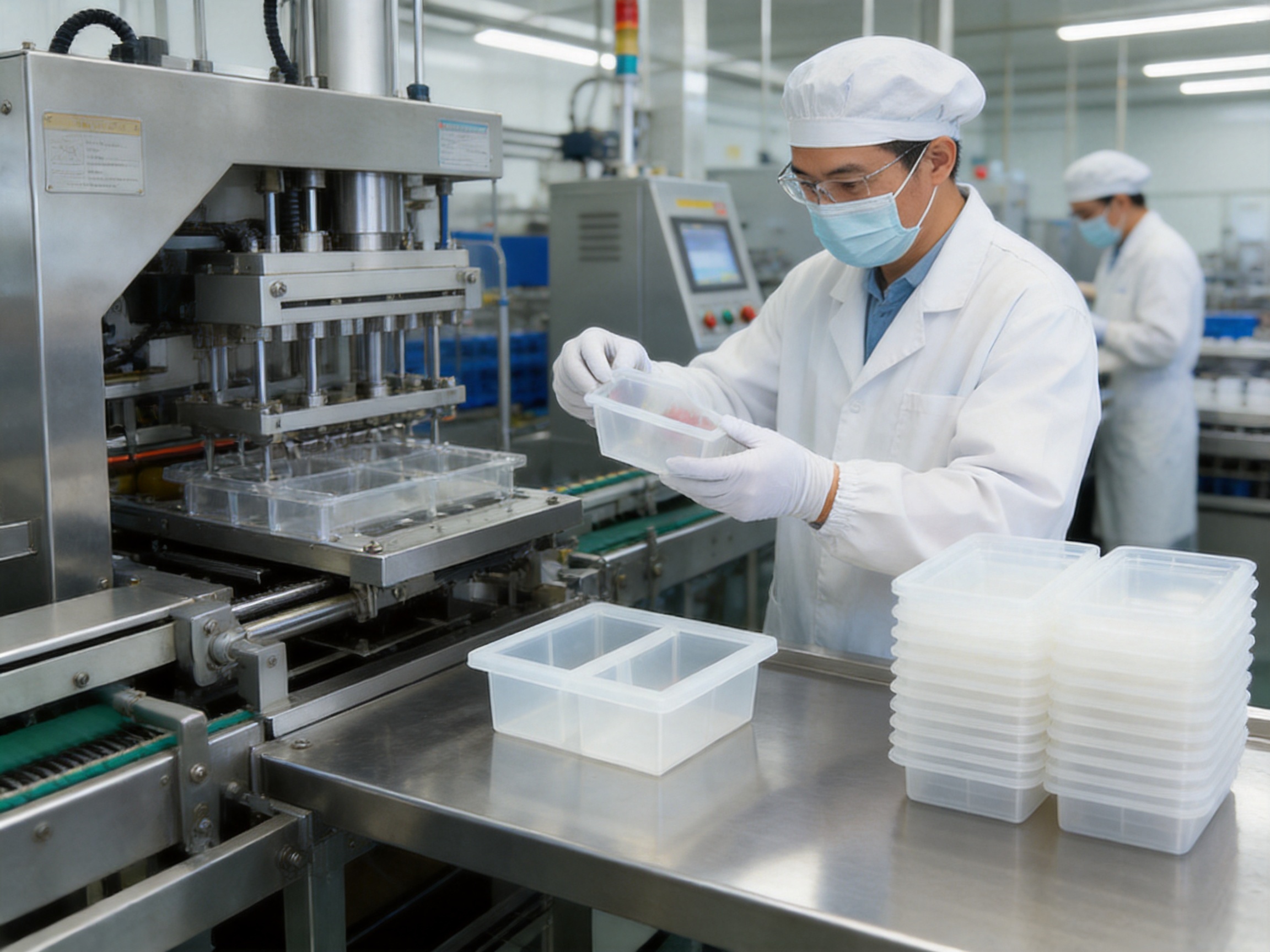
High-quality food packaging is the result of controlled manufacturing, not only material selection. The production of PE/PP plastic containers requires careful coordination between design, raw material preparation, mold development, forming, trimming, inspection, packing, and shipment. Each step affects final product performance. Yuqian Packaging Technology (Jiangsu) Co., Ltd. has developed production and quality control capabilities to support consistent container manufacturing for customers in the foodservice and packaging sectors.
The process begins with product design and engineering. The four-grid structure must be practical, visually balanced, and strong enough for commercial use. Engineers consider the thickness distribution, corner strength, compartment depth, stackability, demolding performance, and compatibility with related lids or sealing systems. A container that is too thin may deform; one that is too heavy may waste material and increase cost. Good design finds the correct balance between performance and efficiency.
Mold precision is essential. The shape of the container, the clarity of the edges, the uniformity of the compartments, and the consistency of the dimensions depend heavily on mold quality. Advanced mold design also helps improve production speed and reduce defect rates. For customers ordering customized products, mold development is a key step because it determines whether the final package will match the desired appearance and functional requirements.
Raw material control is another important factor. Food-grade PE and PP materials must be selected according to safety, performance, and appearance requirements. Materials need stable melt behavior, suitable toughness, and compliance with food-contact expectations. Before production, raw materials are managed to reduce contamination and maintain consistency. This is especially important for transparent containers because impurities or uneven material quality can be more visible.
During forming, process parameters such as temperature, pressure, cycle time, cooling, and material flow must be controlled. If the temperature is too low, the product may have poor forming detail; if it is too high, material properties may be affected. Uneven cooling can cause warping, while unstable pressure can create thickness variation. A professional manufacturer monitors these process conditions to maintain stable product quality across batches.
Trimming and finishing influence both appearance and safety. Food packaging should have smooth edges and clean shapes. Rough edges can reduce user comfort and create a lower-quality impression. Proper finishing also supports better stacking and lid fit. After forming and trimming, products undergo inspection to check dimensions, weight, appearance, strength, and cleanliness. Products that do not meet standards are separated according to quality procedures.
Packing is also part of the manufacturing system. Clean and organized packaging protects finished containers from dust, deformation, and transportation damage. For food packaging products, the storage and packing environment must be managed carefully. Good packing practices help customers receive products that are ready for efficient use in restaurants, factories, or distribution centers.
Quality Assurance and Certification Strength
Quality assurance is one of the most important reasons to choose a professional manufacturer rather than a low-cost, unknown supplier. Food packaging is directly related to consumer safety and brand reputation. If a container cracks, has an odor, leaks, deforms, or contains visible impurities, the restaurant may face complaints and financial loss. A stable quality management system reduces these risks.
The company has passed the QS national industrial product production license, showing that it meets recognized production requirements for industrial product manufacturing in its operating environment. ISO9001 quality management system certification indicates that the company follows structured quality management principles, including process control, documentation, corrective actions, and continuous improvement. BRC certification is widely recognized in industries connected with food safety and packaging supply chains. DIN certification and EU ROHS+ testing further support the company’s commitment to safety and compliance.
Quality control begins before production. Raw materials are evaluated and selected based on food-grade requirements and product performance. During production, operators and quality inspectors monitor forming quality, appearance, weight, dimensions, and structural stability. Finished products are checked before packing and shipment. This layered inspection approach helps prevent defects from reaching customers.
The company’s research and development team, composed of experienced designers and engineers, also supports quality improvement. Product performance can be optimized through material testing, structural adjustment, and process refinement. For example, if a customer needs improved low-temperature performance, better stacking, or a more distinctive compartment arrangement, the technical team can evaluate design changes and propose solutions.
Quality assurance also includes traceability and communication. In long-term OEM cooperation, customers need confidence that each batch will match the approved sample. Professional production records, inspection procedures, and customer service support make this possible. When buyers work with a capable manufacturer, they are not simply purchasing containers; they are building a supply relationship that supports stable business growth.
Customization for Food Brands and OEM Buyers
Customization is a major advantage for restaurants, chain stores, wholesalers, and private-label packaging buyers. Foodservice companies increasingly want packaging that reflects their menu and brand positioning. A standard container may solve basic packaging needs, but a customized container can improve market competitiveness, operational efficiency, and customer loyalty.
The PE/PP four-grid hot pot container can be customized in several ways depending on customer requirements and production feasibility. Size adjustment is one common option. Different menus require different capacities. A premium hot pot meal may need larger compartments for meat and vegetables, while a snack or sauce set may need smaller grids. By changing length, width, height, and grid layout, the container can be adapted to specific food combinations.
Material selection can also be adjusted. Some customers prioritize heat resistance, while others need improved low-temperature toughness or enhanced transparency. Depending on the intended use, PE, PP, or suitable material formulations can be considered. Color and transparency can also influence the customer experience. Clear containers highlight freshness, while colored options may support brand identity or product differentiation.
OEM service is especially valuable for distributors and food brands that want exclusive packaging. The manufacturer can support customers from sample making to mass production. This full-process service reduces development complexity for buyers who may not have internal packaging engineering teams. Customers can communicate product goals, and the manufacturer can provide technical suggestions based on production experience.
For chain restaurants, customized packaging supports standardization. Every store can use the same package, which helps control portion size, presentation, and delivery quality. For regional food brands, distinctive packaging can help products stand out on delivery platforms and retail shelves. For wholesalers, customized specifications can match market demand and create stronger customer loyalty.
Environmental Responsibility and Green Production
Environmental awareness is reshaping the food packaging industry. Consumers, regulators, and foodservice businesses are paying closer attention to material selection, waste reduction, recyclability, and responsible manufacturing. The PE/PP four-grid plastic hot pot container responds to these trends by using practical food-grade materials and supporting more efficient packaging formats.
One environmental advantage of the four-grid design is that it can reduce the need for multiple separate packages. Instead of using four small containers for different ingredients, one divided container can perform the same separation function. This may simplify packaging use and reduce packing waste in certain applications. It can also reduce the number of lids, labels, and handling steps required in a takeaway meal system.
The company actively responds to environmental protection policies and follows the principle of green production. It uses environmentally conscious PE and PP material choices and works to reduce energy consumption and waste emissions during manufacturing. Efficient production planning, process control, and material management all contribute to lower waste rates. When fewer defective products are produced, less material and energy are wasted.
The company is also committed to the research and development of biodegradable and recyclable hot pot containers. This direction is important because the future of food packaging will likely include a combination of recyclable plastics, biodegradable materials, reusable systems, and improved collection infrastructure. By investing in research and development, the manufacturer prepares to meet changing market and regulatory demands.
It is important to recognize that sustainability is not achieved by material claims alone. It requires a full system approach, including product design, material efficiency, manufacturing control, logistics, customer education, and end-of-life management. A durable container that prevents leakage, reduces food waste, and uses material efficiently can contribute to more responsible foodservice operations. For businesses seeking greener packaging strategies, working with a manufacturer that understands both performance and environmental responsibility is essential.
Applications in Hot Pot and Beyond
Although the container is designed with hot pot service in mind, its practical applications are much broader. The four-grid layout makes it suitable for any food product that benefits from separation. Hot pot restaurants can use it for ingredient sets, sauce combinations, individual meal kits, and chilled prepared ingredients. The container allows customers to cook or combine ingredients at home while keeping everything organized.
Meal-prep companies can use the container for balanced meals. One grid can hold protein, another vegetables, another carbohydrates, and another sauce or garnish. This layout supports portion control and helps customers understand the composition of the meal. For health-focused brands, a divided transparent container can communicate freshness and nutritional balance.
Snack brands can use the container for mixed assortments such as nuts, dried fruit, candies, crackers, or tasting sets. Bakeries and dessert shops can package small cakes, toppings, fruit, and cream separately. Cold dish suppliers can use it for salads, pickled vegetables, appetizers, and dipping sauces. Supermarkets and convenience stores can display ready-to-eat combinations with a neat visual layout.
Catering companies can use the container for event meals, sampling activities, and buffet-style takeaway sets. Because the container is lightweight and stackable, it is practical for high-volume service. Food distributors can also use it for test packs or promotional product kits. The four-grid structure gives businesses flexibility to create new menu formats and improve product presentation.
In all these applications, the same core benefits apply: separation, cleanliness, visibility, toughness, and convenience. This makes the container a versatile tool for food packaging innovation.
How the Container Improves Brand Experience
Packaging is often the first physical contact between a food brand and a takeaway customer. Before tasting the meal, the customer sees and handles the container. A clean, transparent, well-structured package creates a positive first impression. It tells the customer that the business cares about hygiene, organization, and quality. The PE/PP four-grid hot pot container supports this impression through its neat layout and reliable appearance.
For hot pot brands, the package can help preserve the ritual and excitement of dining. Hot pot is not only food; it is an experience of choosing, combining, and enjoying variety. When ingredients are separated in four grids, the customer can see the variety clearly and decide how to use each item. This increases interaction and makes the takeaway experience more enjoyable.
For premium food brands, visual transparency is especially valuable. Fresh vegetables, colorful sauces, meat slices, and carefully prepared ingredients can be displayed attractively. Instead of hiding food inside opaque packaging, the container allows the meal itself to become a visual selling point. This can improve customer satisfaction and encourage repeat purchases.
The container also reduces confusion. Customers can identify ingredients easily, and restaurant staff can check order accuracy more quickly. This is useful for delivery platforms, where incorrect or missing items can lead to negative reviews. By organizing the meal in a logical way, the container helps reduce mistakes and improve the perceived professionalism of the business.
Customization can further strengthen the brand experience. With appropriate size, shape, color, or packaging combination, food brands can create a consistent visual identity. Even without complex decoration, a high-quality container can make the meal feel more valuable and trustworthy.
Operational Benefits for Restaurants and Distributors
Restaurants operate under pressure. During peak hours, staff must prepare orders quickly, accurately, and safely. Packaging that simplifies workflow can directly improve efficiency. The four-grid hot pot container supports faster packing because multiple ingredients can be placed in one unit. Staff do not need to search for several different small containers or assemble many separate packages.
Standardized compartments also help with portion control. If each grid is assigned a specific ingredient type, staff can follow a clear packing routine. This reduces variation between orders and helps control food cost. Consistent portioning is important for both customer satisfaction and profitability.
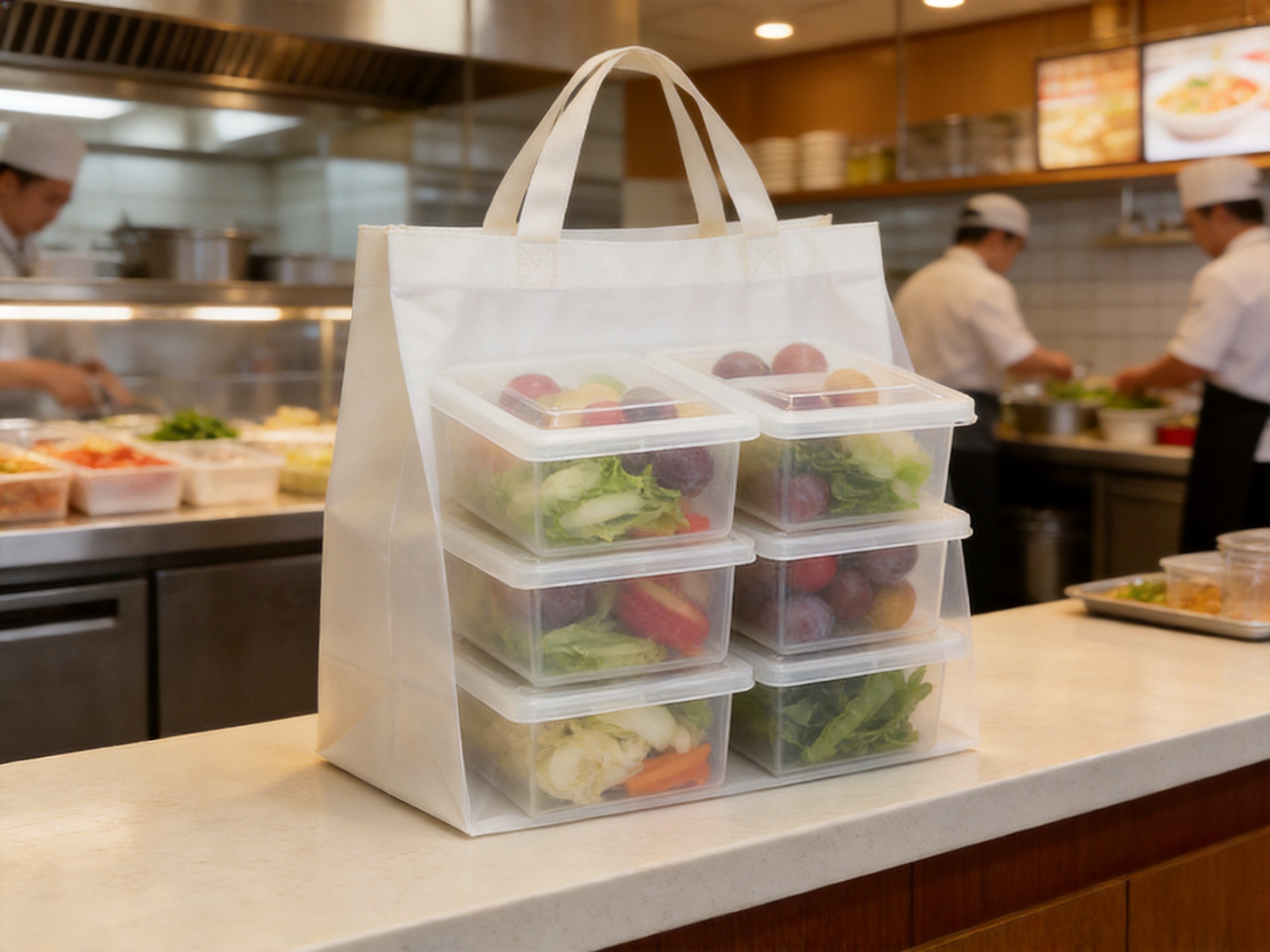
For distributors and wholesalers, the container’s stackable shape helps optimize storage and transportation. Square containers use space efficiently compared with irregular shapes. Stable stacking can reduce warehouse clutter and simplify picking operations. Because the product is lightweight, it is also convenient for bulk handling.
Durability reduces loss. Containers that crack, deform, or fail during transport create waste and complaints. A stronger PE/PP container helps protect the food and reduce replacement costs. Over time, reliable packaging can save money even if the unit price is not the lowest in the market. The real cost of packaging includes damage rates, labor efficiency, customer complaints, and brand reputation.
For OEM buyers, the manufacturer’s ability to provide sample making and mass production is a major operational advantage. Buyers can test the package before committing to large orders. Once the design is confirmed, the manufacturer can support scalable production. This reduces sourcing risk and helps customers launch new products more smoothly.
Manufacturing Strength of Yuqian Packaging Technology
Yuqian Packaging Technology (Jiangsu) Co., Ltd. has developed strong manufacturing capabilities in food packaging since its establishment in 2010. Located in Taizhou City, Jiangsu Province, the company benefits from an industrial environment with access to logistics, materials, and manufacturing talent. Its 30,000-square-meter plant provides the space needed for production lines, quality control, warehousing, and development activities.
The company is a high-tech enterprise focusing on new food packaging materials and products. This positioning is important because the packaging industry is changing quickly. Customers require safer materials, better performance, attractive design, environmental responsibility, and faster customization. A manufacturer with research and development capability can respond to these changes more effectively than a simple trading company or low-end production workshop.
The company’s technical team includes experienced designers and engineers who explore new structures, materials, and processes. For the PE/PP four-grid hot pot container, this means the product can be improved according to customer feedback and market trends. Partition design, container transparency, stacking performance, toughness, and size options can all be optimized through engineering work.
The company has also established a Shanghai branch to improve service quality and expand business channels. This shows a commitment to customer communication and market development. For customers, stronger service channels can mean quicker response, better project coordination, and more convenient business cooperation.
Manufacturing strength is not only about machines. It includes management, training, inspection, supply chain coordination, environmental responsibility, and customer service. The company’s certification background and long-term focus on food packaging demonstrate a systematic approach. For buyers looking for a stable OEM hot pot container manufacturer or factory partner, these strengths are valuable.
Food Safety and Consumer Confidence
Food safety is a central requirement for any disposable food packaging container. Consumers expect packaging to protect food without introducing odor, contamination, or harmful interaction. Restaurants and distributors must choose packaging suppliers carefully because unsafe or poor-quality packaging can damage both health and reputation.
The PE/PP four-grid hot pot container is made from food-grade raw materials and is designed to be non-toxic and odorless. The material selection supports safe contact with food under intended use conditions. The container’s clean appearance and transparent structure also support consumer confidence because customers can inspect the contents visually.
Compartment separation contributes to hygiene. Foods that should remain separate can be packed separately within the same container. This helps prevent sauces from spreading, allergens from mixing accidentally in certain controlled applications, and textures from being damaged. While restaurants must still follow proper food safety practices, suitable packaging supports safer handling and better organization.
The company’s certifications provide additional assurance. A certified quality system helps ensure that production processes are controlled and continuously improved. For foodservice chains, supermarkets, and international buyers, such certifications may be important during supplier evaluation. They show that the manufacturer is prepared to meet formal quality expectations rather than relying only on verbal promises.
Consumer confidence also depends on consistency. Customers expect the same quality each time they order. If the packaging looks different, cracks unexpectedly, or smells unusual, trust declines. Stable manufacturing and inspection help ensure that each batch of containers performs as expected.
Selection Guide for Buyers
When choosing a PE/PP four-grid plastic hot pot container, buyers should consider several factors. The first is food type. If the package will hold oily, spicy, chilled, or warm ingredients, the material and structure should be suitable for those conditions. Buyers should communicate the intended contents and handling process clearly to the manufacturer.
The second factor is capacity. The standard 145 mm by 145 mm by 46 mm container is suitable for many applications, but some menus may require larger or smaller compartments. Portion size should match customer expectations and food cost targets. A container that is too large may make portions look insufficient, while one that is too small may cause packing difficulty.
The third factor is delivery environment. If the product will be used in cold regions or refrigerated supply chains, low-temperature resistance becomes especially important. If containers will be stacked heavily, structural strength and thickness distribution should be evaluated. If appearance is critical, transparency and surface finish should be prioritized.
The fourth factor is lid or sealing compatibility. A container must work together with its closure system. Buyers should confirm whether they need matching lids, film sealing, or other packaging accessories. Proper fit helps prevent leakage, contamination, and delivery damage.
The fifth factor is supplier capability. Buyers should evaluate whether the manufacturer has certifications, production scale, customization ability, sample support, and quality control systems. Choosing a professional factory may reduce long-term sourcing risk and provide better technical support.
Q&A Section
What is the PE/PP four-grid plastic hot pot container mainly used for?
It is mainly used for packaging hot pot ingredients, sauces, meal combinations, snacks, cold dishes, and other foods that need to be separated in one convenient container. The four-grid structure keeps different items organized and improves presentation.
Why is the four-grid design better than a single-compartment bowl?
A single-compartment bowl mixes foods together, which may affect taste, texture, hygiene, and appearance. The four-grid design separates ingredients or seasonings while keeping them in one package, improving convenience and customer experience.
What materials are used for this container?
The container is made from food-grade PE and PP material options. PE provides toughness and low-temperature resistance, while PP offers heat resistance, chemical stability, and food packaging suitability.
Is the container safe for food contact?
The product is made from high-quality food-grade raw materials and is designed to be non-toxic and odorless. The manufacturer also operates under quality and safety-related certification systems that support reliable food packaging production.
Can the container be customized?
Yes. The manufacturer can provide customized solutions with multiple sizes and design options. Customers may discuss compartment layout, size, material choice, transparency, and other requirements depending on production feasibility.
What are the standard dimensions of the product?
The listed hotpot box specification is 145 mm in length, 145 mm in width, 46 mm in height, and 74.5 g in grammage.
What certifications support the manufacturer’s quality strength?
The company has passed certifications and testing systems including QS national industrial product production license, ISO9001 quality management system certification, BRC certification, German authoritative safety DIN certification, and EU ROHS+ testing.
How does the product support restaurant operations?
It helps restaurants pack multiple ingredients in one container, improve portion control, reduce packing complexity, enhance presentation, and support efficient takeaway and delivery service.
Is the container suitable only for hot pot?
No. It can also be used for meal-prep sets, snacks, desserts, cold dishes, sauce combinations, supermarket ready-to-eat products, and catering assortments.
How does the company support environmental responsibility?
The company follows green production principles, uses environmentally conscious PE and PP materials, works to reduce energy consumption and waste emissions, and continues research into biodegradable and recyclable hot pot container solutions.
Conclusion
The PE/PP four-grid plastic hot pot container is a practical and competitive solution for modern takeaway food packaging. Its four-compartment structure solves a real problem in hot pot and multi-item foodservice by keeping ingredients separated, clean, visible, and convenient. Its food-grade PE and PP material options provide low-temperature resistance, toughness, stability, odorless performance, and reliable handling for delivery and storage conditions.
Compared with ordinary disposable bowls or multiple small packages, this container offers better organization, improved presentation, efficient packing, and stronger consumer appeal. It helps restaurants reduce packing complexity, supports standardized portions, and gives customers a more enjoyable dining experience. For food brands, the transparent divided design can enhance product value and strengthen brand trust.
The manufacturer’s strengths further increase the product’s value. With a 30,000-square-meter production facility, research and development capability, experienced engineers, quality management systems, customization service, and recognized certifications, Yuqian Packaging Technology (Jiangsu) Co., Ltd. is well positioned to serve OEM buyers, restaurants, distributors, and packaging brands. Its focus on green production and future-oriented material development also aligns with the changing expectations of the food packaging market.
For businesses seeking a durable, safe, customizable, and visually appealing disposable food packaging container, the PE/PP four-grid plastic hot pot container offers a strong balance of function, quality, and commercial value. It is not simply a package; it is a tool for better food presentation, smoother operations, safer handling, and stronger customer satisfaction.
References
International Organization for Standardization. ISO 9001 Quality Management Systems: Requirements.
British Retail Consortium. Global Standard for Packaging Materials.
European Commission. Guidance on Materials and Articles Intended to Come into Contact with Food.
German Institute for Standardization. DIN Standards for Safety and Industrial Quality Applications.
Plastics Industry Association. Polypropylene and Polyethylene Material Characteristics in Food Packaging.
Food Packaging Forum. Scientific and Regulatory Considerations for Food Contact Materials.
United Nations Environment Programme. Single-Use Plastic Packaging and Sustainable Material Management.
China National Industrial Product Production License System. Quality and Safety Requirements for Industrial Product Manufacturing.