English
 Español
 عربى
Content
- 1 1. Product Overview
- 2 2. Why the Four-Grid Design Matters
- 3 3. Material Advantages of PE and PP
- 4 4. Main Product Advantages Over Ordinary Containers
- 5 5. Applications in the Food Service Industry
- 6 6. Manufacturing Strength and Production Capability
- 7 7. Quality and Certification Framework
- 8 8. Environmental Responsibility and Sustainable Development
- 9 9. Customization and OEM Services
- 10 10. Operational Benefits for Food Businesses
- 11 11. Comparison with Alternative Packaging Solutions
- 12 12. Recommended Purchasing and Development Process
- 13 13. Careful Use and Storage Recommendations
- 14 14. Why Choose an Experienced Manufacturer
- 15 15. Future Development of Divided Food Packaging
- 16 16. Frequently Asked Questions
- 16.1 16.1 What is a PE/PP four-grid plastic hot pot container?
- 16.2 16.2 What are the standard dimensions?
- 16.3 16.3 Can the four compartments have different sizes?
- 16.4 16.4 Is the container suitable for frozen or chilled hot pot ingredients?
- 16.5 16.5 Is the container food-safe?
- 16.6 16.6 Is the container transparent?
- 16.7 16.7 Can the container be used for foods other than hot pot ingredients?
- 16.8 16.8 Can a lid or sealing film be supplied?
- 16.9 16.9 Does the manufacturer provide OEM services?
- 16.10 16.10 What certifications are associated with the production facility?
- 16.11 16.11 Can the product support environmentally responsible packaging goals?
- 16.12 16.12 How can a buyer begin a custom project?
- 17 17. Conclusion
- 18 References
- 19 Product: PE/PP four-grid plastic hot pot container
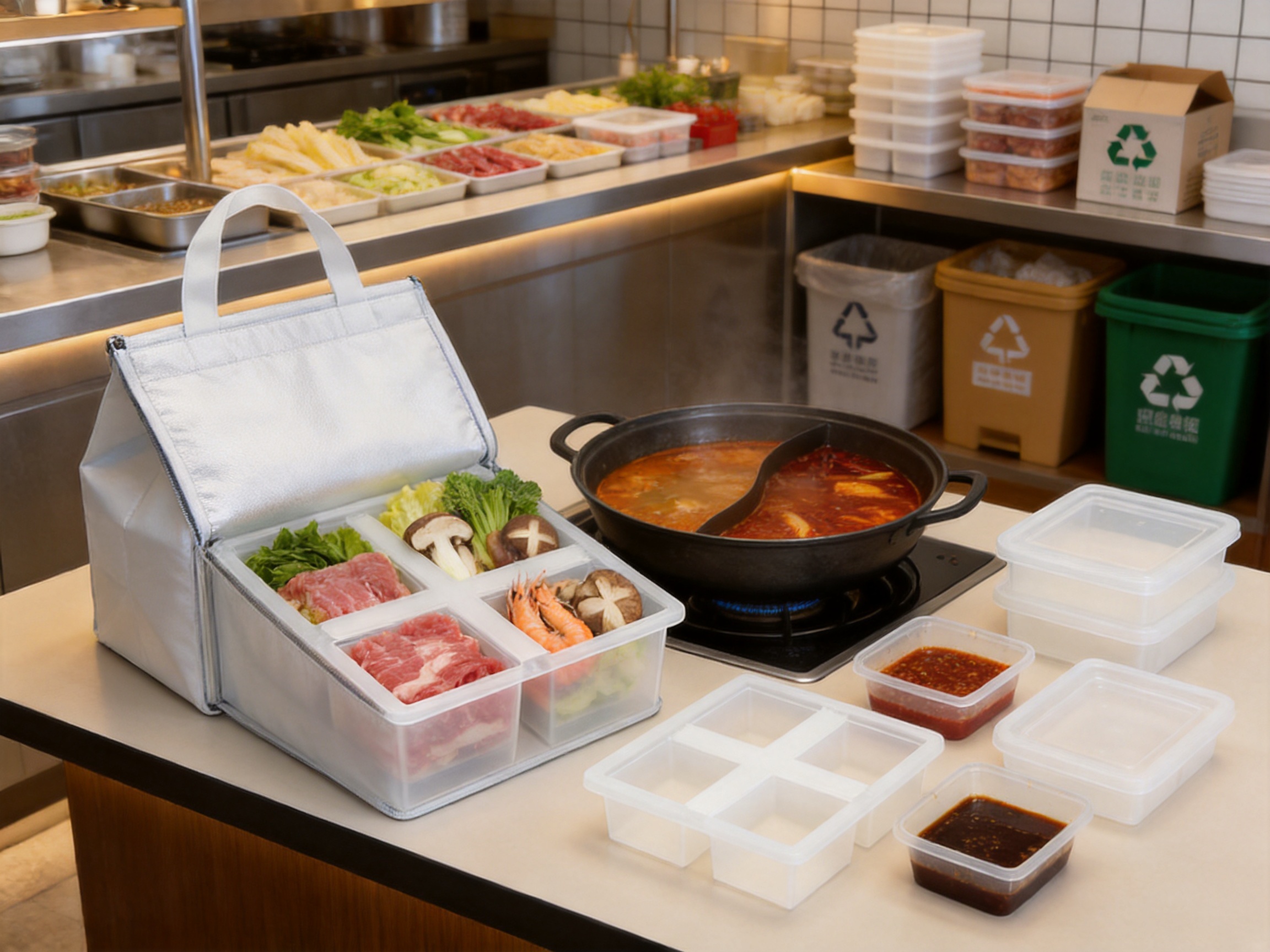
The rapid development of takeaway dining, hot pot delivery, meal preparation, and portion-controlled food service has created a strong demand for packaging that is safe, durable, attractive, and convenient. Food businesses need containers that can protect ingredients during transportation while also supporting efficient preparation, clear product presentation, and reliable customer service. The PE/PP four-grid plastic hot pot container is designed to meet these requirements through a combination of food-grade materials, a functional divided structure, stable performance, and flexible customization options.
Unlike a basic single-compartment box, the four-grid hot pot container enables restaurants, food manufacturers, supermarkets, and delivery companies to separate several ingredients, sauces, seasonings, or side dishes in one compact package. This design supports better hygiene and organization while helping customers enjoy a more convenient dining experience. The container can be used for hot pot ingredients, prepared meals, cooking kits, vegetables, seafood, meat portions, condiments, and other takeaway food applications.
Manufactured from PE or PP materials, the container provides a practical balance of toughness, low-temperature resistance, chemical stability, and food-contact suitability. Its structure is resistant to ordinary impact during packing and transportation, while its transparent appearance makes the contents easy to identify. This combination gives the product advantages over ordinary packaging products that may be fragile, difficult to organize, or visually unattractive.
1. Product Overview
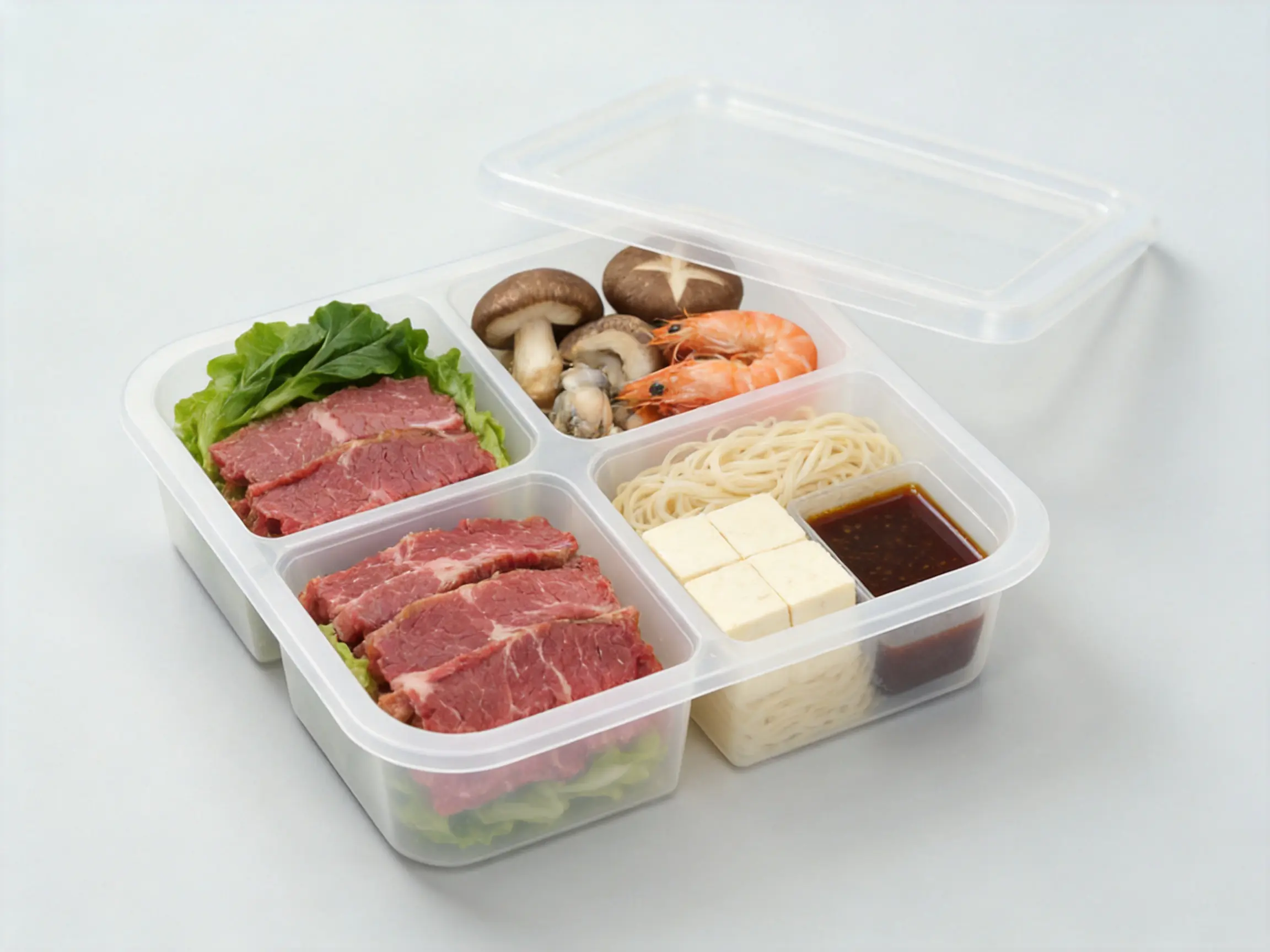
The PE/PP four-grid plastic hot pot container is a divided food packaging solution developed for businesses that need multiple food sections in one container. The four compartments can be used independently or as part of a complete hot pot meal package. For example, one section may contain meat, another may hold vegetables, a third may be used for mushrooms or seafood, and the fourth may contain seasoning, dipping sauce, or a small side dish.
The container is manufactured with food-grade PE or PP raw materials. These materials are widely used in food packaging because of their toughness, stability, and compatibility with a wide range of food products. The selected material can be matched to the intended application, filling temperature, storage conditions, and customer requirements.
The four-grid design is especially suitable for takeaway hot pot businesses. It allows ingredients to remain separated during delivery, reducing unnecessary contact between different food categories. It can also improve the appearance of a meal kit by giving every ingredient its own clearly defined space. For retailers and caterers, this organized appearance can make portion control, product inspection, and order fulfillment more efficient.
The standard product dimensions are approximately 145 millimeters in length, 145 millimeters in width, and 46 millimeters in height, with a product weight of approximately 74.5 grams. Customized dimensions, weights, compartment arrangements, colors, and packaging configurations may be developed for different applications and order requirements.
| Product Feature | Specification or Benefit |
| Product type | Four-grid plastic hot pot container |
| Main materials | Food-grade PE or PP |
| Standard length | 145 mm |
| Standard width | 145 mm |
| Standard height | 46 mm |
| Approximate grammage | 74.5 g |
| Compartment structure | Four separate grids |
| Typical applications | Hot pot ingredients, sauces, prepared meals, vegetables, seafood, meat, and takeaway food |
| Available services | OEM production, size customization, design support, sampling, and mass production |
The product is intended to offer reliable performance without unnecessary complexity. Its practical dimensions make it suitable for food preparation, display, storage, and delivery. The square format also supports efficient stacking and packing, helping businesses make better use of storage and transportation space.
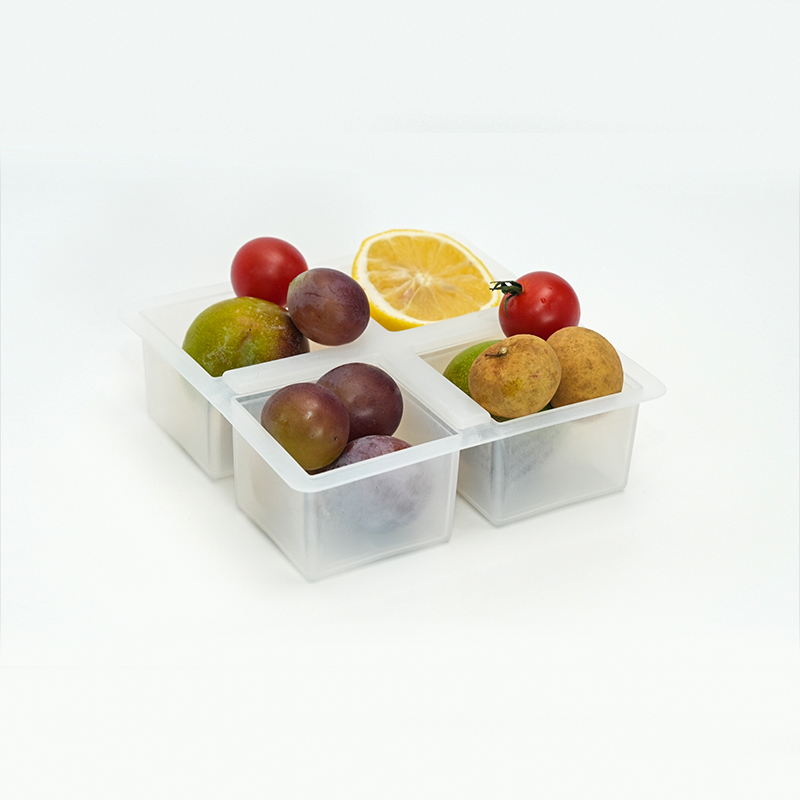
PE/PP four-grid plastic hot pot container
2. Why the Four-Grid Design Matters
Food packaging is not simply a container for holding products. Its structure can influence food safety, visual presentation, preparation efficiency, and customer satisfaction. A divided container gives food businesses a way to manage these factors in one package.
2.1 Separation of Ingredients
The four individual compartments help keep different ingredients separated. This can be important when a meal includes raw and cooked components, ingredients with different textures, or products that should not mix before cooking. Separating food can also reduce the transfer of moisture, color, flavor, and odor between ingredients.
For hot pot meal kits, the design enables a restaurant to prepare a complete selection of ingredients in one package. Customers can immediately see which items are included and can add them to the cooking process in an organized sequence. For food retailers, the compartment structure supports accurate portioning and consistent product presentation across different orders.
2.2 Improved Hygiene and Organization
When ingredients are loosely packed together, they may shift during transportation and come into contact with one another. This can create a less attractive presentation and may make handling more difficult. The four-grid design provides a defined space for each food component, helping maintain order from the packing line to the customer’s table.
The container can also help food operators establish standardized packing procedures. Staff members can assign specific ingredients to specific sections, making it easier to check whether every order is complete. This reduces packing errors and helps improve production consistency during busy periods.
2.3 Better Product Presentation
High-transparency PE or PP material allows consumers to view the food without opening the package. This visibility can increase confidence in the quality and freshness of the contents. It also allows the colors and shapes of the ingredients to contribute to the product’s visual appeal.
For restaurants and retail brands, attractive food presentation can support stronger shelf appeal and better customer recognition. The container creates a neat framework for arranging different ingredients, making the product look more complete and professional than a plain, undivided package.
2.4 Convenient Dining and Delivery
A four-grid package can simplify the delivery of complete hot pot sets and combination meals. Instead of using several small containers, a food business can place multiple ingredients into one coordinated package. This can reduce the number of individual items that staff need to handle, label, and deliver.
For customers, a single organized package is easier to carry, store, open, and prepare. The container is also suitable for meal services in which convenience and speed are important, including takeaway restaurants, cloud kitchens, supermarkets, food courts, catering companies, and prepared-food counters.
3. Material Advantages of PE and PP
The container is produced using PE or PP, two commonly used polymers for food packaging applications. Each material has useful characteristics, and the most appropriate option can be selected according to the customer’s performance requirements and production plan.
3.1 Low-Temperature Resistance
Hot pot ingredients are often stored or transported under chilled conditions. Packaging used in this environment must retain its shape and toughness rather than becoming excessively brittle. PE and suitable PP formulations can provide dependable performance at low temperatures, helping the container resist cracking or deformation during ordinary cold-chain handling.
Low-temperature stability is especially important for seafood, meat, frozen ingredients, vegetables, and prepared hot pot combinations. A container that remains stable in cold conditions can protect the product more effectively and reduce the likelihood of leakage, breakage, or damaged packaging during delivery.
3.2 Good Toughness and Impact Resistance
Food packaging may be exposed to stacking, loading, unloading, transportation vibration, and repeated handling. A material with good toughness can absorb ordinary impact and maintain its structural integrity. PE and PP are valued for this balance of light weight and durability.
Compared with fragile packaging materials, the plastic container is less likely to break during routine logistics operations. This can help reduce product loss and improve the reliability of delivery. Its toughness also supports automated or semi-automated packing processes in which containers need to be moved and positioned efficiently.
3.3 Chemical Stability
Hot pot ingredients and sauces can contain salt, oil, spices, acids, or other food components that may affect unsuitable packaging materials. PE and PP generally provide useful chemical stability for a wide range of food applications. This helps the container maintain its performance when used with common ingredients and seasonings.
Material selection should still be matched to the specific food product and intended conditions. A professional manufacturer can evaluate the customer’s application, recommend a suitable material, and confirm the performance requirements through product testing and quality control procedures.
3.4 Food-Contact Suitability
The use of food-grade raw materials is a fundamental requirement for disposable food packaging. The container is developed with attention to food-contact safety, material quality, and production hygiene. Proper raw material management helps reduce the risk of contamination and supports compliance with customer and market requirements.
The product information indicates that the manufacturing operation has passed QS national industrial product production license requirements, ISO9001 quality management system certification, BRC certification, German DIN safety certification, and EU RoHS+ testing. These certifications and testing activities provide evidence of a structured approach to quality, safety, and environmental management.
4. Main Product Advantages Over Ordinary Containers
The PE/PP four-grid hot pot container offers several practical advantages compared with basic single-compartment food boxes, low-strength plastic packaging, and poorly organized multi-container solutions.
4.1 One Container for Multiple Ingredients
A standard single-compartment container may require businesses to use several packages when a meal includes different ingredients. This increases material consumption, packing time, labeling requirements, and the possibility of missing or misplaced items. The four-grid design combines several sections into one coordinated package.
This does not mean that every product must use all four compartments in the same way. Businesses can use the grids for a range of combinations, including meat and vegetables, seafood and sauces, noodle ingredients and toppings, or different flavor profiles. The flexible layout makes the container suitable for both standardized menu items and customized meal kits.
4.2 Stronger Organization Than Loose Packaging
Loose bags or unstructured packaging may allow ingredients to move during transport. The divided container creates a more orderly arrangement and gives each product a defined position. This can improve the customer’s first impression and make the package easier to inspect before opening.
4.3 Better Visual Appeal
Transparent material gives customers a direct view of the food inside. When combined with a clean four-grid structure, transparency creates a presentation that can look fresh, modern, and professional. Businesses can also explore customized colors or matching lids to improve brand consistency while retaining useful product visibility.
4.4 Lightweight but Durable Construction
The container is designed to be light enough for economical handling and transportation while retaining the toughness needed for everyday use. This balance can help food companies manage logistics costs without sacrificing basic package protection.
4.5 Flexible Customization
Different food businesses have different packaging requirements. Some may need a shallow tray for ingredients, while others may need a taller container for larger portions. Some customers may request alternative compartment sizes, modified dimensions, customized colors, or specific lid configurations.
OEM production allows the manufacturer to provide customized solutions instead of limiting customers to a single standard format. The development process can include design discussion, sample production, testing, approval, tooling coordination, and mass production. This flexibility is valuable for catering brands that want packaging aligned with their menu structure and operating model.
5. Applications in the Food Service Industry
The product is suitable for many applications beyond traditional hot pot restaurants. Its divided structure and food-grade material make it adaptable to different prepared-food and takeaway scenarios.
5.1 Takeaway Hot Pot Sets
The most direct application is the packaging of hot pot ingredients for home preparation. Restaurants can use the container to package meat, seafood, vegetables, tofu, mushrooms, noodles, and sauces in a visually organized format. A complete set can be delivered with fewer separate packages, helping simplify the order for both the restaurant and the customer.
5.2 Ready-to-Cook Meal Kits
Meal kit providers can use the four grids to prepare ingredients that customers will cook at home. Separate compartments help preserve the identity of each component and make the cooking instructions easier to follow. The clear structure also enables customers to check the kit contents quickly.
5.3 Prepared Food and Combination Meals
The container can hold several side dishes, toppings, condiments, or meal components in one package. It may be used for rice meal combinations, vegetable assortments, salad toppings, snack selections, and other food products requiring separation.
5.4 Supermarkets and Fresh Food Counters
Retail food departments can use the container for portioned ingredients and ready-to-cook products. Transparent packaging supports product identification and display, while the square form can help improve shelf organization. The compact format is suitable for chilled product areas and prepared food counters, subject to the appropriate storage and product-use conditions.
5.5 Catering and Institutional Food Service
Catering companies, cafeterias, company dining services, and event organizers may need to distribute food portions consistently. A divided container can support the distribution of condiments, side dishes, ingredients, and meal components while reducing the need for multiple small containers.
5.6 Food Delivery Platforms and Cloud Kitchens
Cloud kitchens and delivery-focused businesses often depend on fast order assembly and reliable transportation. A standardized four-grid container can help employees pack multiple ingredients quickly and verify order completeness. Its transparent construction can also make the delivery package easier to identify during dispatch.
6. Manufacturing Strength and Production Capability
The performance of a food container depends not only on its design and material but also on the consistency of the manufacturing process. A well-designed mold cannot compensate for unstable raw materials, inaccurate processing, poor inspection, or inadequate production management. For this reason, the manufacturer’s technical capability and quality system are central to the product’s value.
Yuqian Packaging Technology (Jiangsu) Co., Ltd. is a high-tech enterprise engaged in the research, development, production, and sales of new food packaging materials and products. Established in 2010, the company is located in Taizhou City, Jiangsu Province, China, and operates a plant area of approximately 30,000 square meters.
6.1 Integrated Research and Development
The company has a research and development team composed of experienced designers and engineers. This team focuses on new designs, material applications, production methods, and product improvements. For the PE/PP four-grid hot pot container, research and development can address factors such as compartment proportions, wall thickness, stacking behavior, lid compatibility, transparency, rigidity, and customer-specific requirements.
An integrated development team allows product ideas to be evaluated from both a design and manufacturing perspective. This helps reduce the risk of creating a product that looks attractive but is difficult to produce consistently. It also enables the manufacturer to consider the customer’s complete application, including filling, storage, transport, display, and disposal.
6.2 Controlled Raw Material Selection
Food packaging begins with the selection of suitable raw materials. The use of high-quality food-grade PE and PP helps establish a reliable foundation for product safety and performance. Material control can include supplier evaluation, incoming material inspection, identification management, and storage procedures.
Consistent raw materials are important for maintaining transparency, toughness, dimensions, color, and processing stability. When materials are carefully controlled, the manufacturer can better manage production variation and achieve more consistent results across different batches.
6.3 Advanced Forming and Processing
The container is produced through industrial plastic processing methods that shape the selected material into a precise four-grid structure. The manufacturing process must control temperature, pressure, timing, cooling, and mold conditions to ensure that the finished product meets dimensional and appearance requirements.
Stable processing helps prevent common defects such as uneven walls, warping, incomplete forming, excessive flash, rough edges, poor transparency, or inconsistent compartment dimensions. Production parameters can be adjusted according to the selected material and product design.
In addition to the forming stage, proper trimming and finishing are important. Food containers should have clean edges and a consistent opening area so that lids, sealing films, or additional packaging components can be applied effectively. Accurate finishing also improves handling safety for workers and customers.
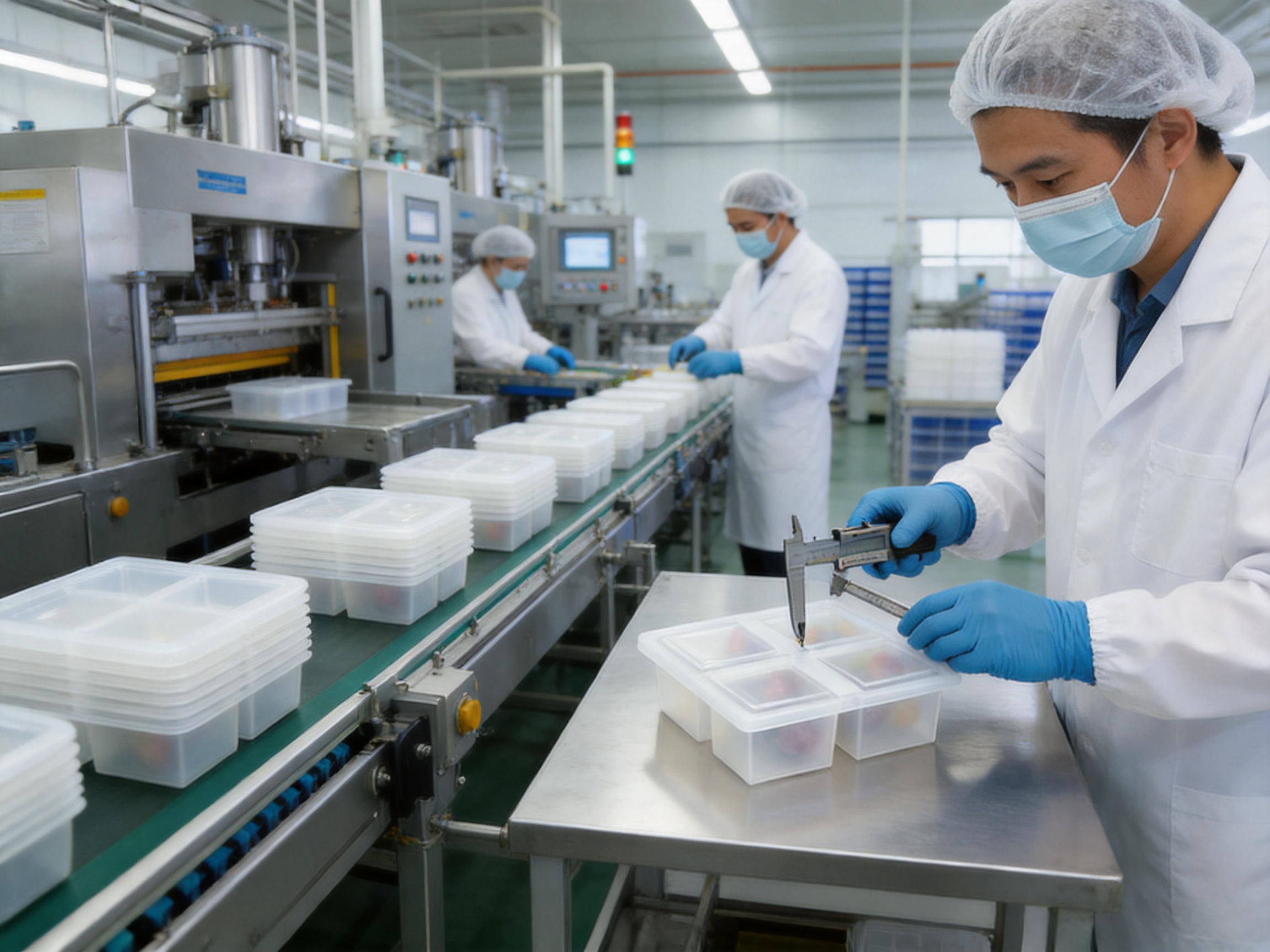
6.4 Quality Inspection at Multiple Stages
A professional quality system should not rely only on final inspection. Quality can be managed at multiple stages, beginning with raw material control and continuing through production, in-process checks, finished product inspection, and shipment preparation.
For the four-grid container, inspection items may include dimensions, weight, wall condition, compartment formation, transparency, edge quality, deformation resistance, packaging cleanliness, and compatibility with the customer’s specified lid or sealing method. The exact inspection plan can be adjusted according to product specifications and customer requirements.
6.5 Flexible Production Lines
OEM customers often require different dimensions, colors, weights, designs, and order quantities. Flexible production lines allow the manufacturer to respond to these requirements more effectively. Instead of offering only one fixed product, the company can support development from initial samples through scaled production.
Flexible manufacturing is also beneficial when customers need to test a new menu, launch a private-label product, or adjust a package for a regional market. The ability to coordinate sampling and mass production within one supply chain can reduce communication delays and improve project efficiency.
6.6 Supply Chain Coordination
Reliable packaging supply requires more than a functioning production machine. Raw materials, molds, inspection, warehousing, packing, and shipment must be coordinated. Efficient supply chain management helps the manufacturer respond quickly to customer orders and maintain stable delivery schedules.
For food businesses, packaging delays can affect menu launches, promotional campaigns, seasonal products, and daily operations. A manufacturer with established production and supply chain capabilities can help customers reduce these risks through better planning and communication.
7. Quality and Certification Framework
Food packaging customers increasingly require documented quality systems and compliance information. Certifications do not replace product-specific evaluation, but they demonstrate that a manufacturer has established formal procedures for managing quality, safety, and production responsibilities.
7.1 QS National Industrial Product Production License
The company has passed the QS national industrial product production license requirements. This indicates that the production operation has been evaluated under the relevant national industrial product management framework. For buyers, such qualification can provide additional confidence when selecting a supplier for food packaging products.
7.2 ISO9001 Quality Management System
ISO9001 emphasizes systematic quality management, documented procedures, customer focus, process control, corrective action, and continuous improvement. Applying this type of management system can help a manufacturer maintain consistency across product development, procurement, production, inspection, and customer service.
7.3 BRC Certification
BRC certification is widely recognized in the food and packaging sectors. It reflects attention to product safety, operational control, traceability, hygiene, and risk management. For customers serving international food markets, certification under a recognized standard can support supplier evaluation and compliance processes.
7.4 DIN Safety Certification
The company has also passed German authoritative safety DIN certification. This supports the company’s ability to address safety and quality expectations associated with demanding international markets. Customers should confirm the exact scope of applicable certification for their specific product and destination market.
7.5 EU RoHS+ Testing
EU RoHS+ testing reflects attention to restricted substances and environmental requirements. Although the precise compliance obligations depend on the final product, market, and application, environmental testing helps demonstrate a broader commitment to responsible material and production management.
8. Environmental Responsibility and Sustainable Development
Disposable food packaging must address both practical performance and environmental responsibility. PE and PP are widely used materials, but responsible packaging development requires attention to material efficiency, production waste, energy use, recyclability, and end-of-life management.
The company actively responds to environmental protection policies and promotes green production. This includes efforts to reduce energy consumption and waste emissions during manufacturing. Efficient processing and controlled material usage can reduce unnecessary waste while maintaining product quality.
The company is also committed to researching biodegradable and recyclable hot pot containers. This direction is important because the packaging industry is under increasing pressure to provide solutions that support a more circular use of resources. The development of improved materials must balance environmental benefits with food safety, mechanical performance, storage stability, and commercial feasibility.
8.1 Material Efficiency
A lightweight container that provides sufficient strength can reduce the amount of raw material used per package. However, reducing weight must not lead to excessive deformation or package failure. The appropriate approach is to optimize the design, wall structure, forming conditions, and material selection together.
8.2 Production Waste Reduction
Accurate process control can help reduce defective products and unnecessary scrap. Consistent molds, stable temperature control, proper trimming, and effective inspection all contribute to better material utilization. Where permitted by the applicable food-contact and production requirements, suitable process waste may be managed through controlled recycling procedures.
8.3 Recyclability Considerations
PE and PP are recognized as recyclable plastic families in many waste management systems. Actual recyclability depends on local collection infrastructure, contamination levels, labeling, material combinations, and consumer behavior. Businesses can support better outcomes by selecting appropriate material structures, avoiding unnecessary combinations, and providing clear disposal information where relevant.
8.4 Balanced Sustainability
Sustainable packaging should protect food effectively. Preventing food waste is also an important environmental consideration. A container that reduces leakage, damage, and spoilage may help preserve the resources used to produce the food. The goal is to achieve a balanced solution that considers material use, product protection, production efficiency, and end-of-life management.
9. Customization and OEM Services
Customization is a major advantage for food brands that want packaging to match a specific menu, portion size, or sales channel. A standard product may be suitable for many applications, but OEM development can provide a closer fit for specialized requirements.
9.1 Customized Dimensions
Customers may request different lengths, widths, or heights depending on the ingredients and storage conditions. A shallow design may be appropriate for thinly arranged vegetables, while a deeper format may be better for larger meat portions or mixed ingredients. Customized dimensions can also help customers optimize shelf space, delivery bags, and storage equipment.
9.2 Customized Compartment Proportions
Although the standard product uses four grids, the relative size of each compartment can be considered during product development. A customer may need one larger section for a main ingredient and three smaller sections for sauces or side dishes. Alternatively, all four grids may be designed with similar capacity for balanced ingredient portions.
9.3 Color and Appearance Options
Color can support product identification and brand communication. Customers may request clear, translucent, or colored materials according to their packaging strategy. Appearance options should be evaluated alongside transparency, food-contact requirements, printing needs, and production feasibility.
9.4 Lid and Sealing Compatibility
A container performs best when its lid or sealing system is correctly matched. Customers may require snap-on lids, heat-sealing films, or other closure formats. During development, the manufacturer can consider the opening design, rim structure, sealing surface, stacking requirements, and transportation conditions.
9.5 Sample Development
Sample development allows customers to evaluate the container before placing a large order. Samples can be reviewed for size, fit, appearance, filling volume, stacking performance, sealing, and use in actual delivery conditions. Feedback from the sample stage can then be incorporated into the final product design.
9.6 Mass Production Support
After the design is approved, the manufacturer can coordinate tooling, raw materials, production scheduling, inspection, packing, and shipment. Providing a full service from sample making to mass production helps reduce the number of suppliers involved and simplifies communication for the customer.
10. Operational Benefits for Food Businesses
Packaging affects daily restaurant operations in ways that are sometimes overlooked. A well-designed container can help improve packing speed, reduce errors, and create a more consistent workflow.
10.1 Faster Order Assembly
The four-grid format gives staff a clear packing structure. Once ingredients are assigned to the appropriate compartments, workers can prepare orders more quickly and consistently. This is especially useful during peak periods when many takeaway orders must be completed within a short time.
10.2 Easier Inventory Planning
A standardized container supports more predictable ingredient portions. When each compartment has a defined function, businesses can estimate how much material is required for different menu combinations. This can assist purchasing, preparation, and production planning.
10.3 Reduced Packaging Complexity
Using one divided container instead of multiple small packages may simplify labeling, storage, and order management. It can also reduce the number of loose items inside a delivery bag. The result is a cleaner and more organized customer experience.
10.4 Improved Brand Presentation
Customers often judge a takeaway order before tasting it. A transparent, organized package can communicate care and quality. Businesses can further enhance the presentation through custom labels, printed sleeves, sealing films, or coordinated outer packaging, depending on the selected design and market requirements.
10.5 Better Transportation Stability
The square format can support efficient stacking, while the tough PE or PP material helps the container withstand ordinary handling. A stable package can reduce the risk of ingredients shifting or packages collapsing during transport. However, businesses should select suitable external cartons, bags, and temperature conditions for the specific delivery system.
11. Comparison with Alternative Packaging Solutions
Every packaging material has strengths and limitations. The best choice depends on the food product, storage temperature, delivery distance, filling method, customer expectations, and disposal infrastructure. The PE/PP four-grid container is particularly strong when separation, visibility, toughness, and flexible production are priorities.
| Packaging Option | Typical Strength | Potential Limitation | Four-Grid PE/PP Advantage |
| Single-compartment plastic box | Simple structure and low design complexity | Ingredients may mix and require several boxes | Separates four food components in one package |
| Several small containers | Independent ingredient storage | More packaging pieces, packing time, and handling | Provides multiple sections in a coordinated format |
| Paper-based tray | Paper appearance and possible fiber content | May have lower moisture or oil resistance without additional treatment | Offers strong moisture tolerance and transparent visibility |
| Rigid glass container | Premium appearance and high rigidity | Heavy and vulnerable to breakage | Lightweight, tough, and easier to transport |
| Thin low-strength plastic bag | Low material use and flexible storage | Limited structure and poor organization | Provides defined compartments and better presentation |
| Foam packaging | Light weight and cushioning | Environmental and recycling concerns in many markets | Supports PE/PP material management and recyclable development |
This comparison does not mean that the four-grid container is suitable for every food product. Instead, it demonstrates why the product is valuable for applications requiring a combination of separation, clear presentation, toughness, and efficient handling.
12. Recommended Purchasing and Development Process
For buyers considering an OEM hot pot container, a structured development process can help achieve the best result.
12.1 Define the Application
The first step is to identify the food products that will be packed. Buyers should consider ingredient type, portion size, moisture content, oil content, storage temperature, filling temperature, delivery time, and expected handling conditions.
12.2 Confirm the Required Capacity
The number and size of compartments should match the intended menu. Buyers should determine whether all four grids require equal capacity or whether one or more sections should be larger. It is also important to consider how the container will fit inside delivery bags, cartons, shelves, or refrigerators.
12.3 Select the Material
PE and PP may provide different combinations of rigidity, low-temperature performance, transparency, and processing characteristics. The manufacturer can recommend a suitable option after reviewing the application. Customers should communicate any requirements related to food-contact compliance, market regulations, temperature conditions, and recycling goals.
12.4 Evaluate Sealing and Closure Requirements
The packaging may use a lid, sealing film, or another closure system. Buyers should assess leak resistance, opening convenience, tamper evidence, stacking, and compatibility with the filling line. A properly matched closure is essential for maintaining package performance during transportation.
12.5 Review Samples
Sample evaluation should include actual ingredients where possible. Buyers can check portion fit, appearance, handling, stability, stacking, sealing, and performance after storage or transport simulation. This stage is an opportunity to identify improvements before production tooling and large-scale manufacturing are finalized.
12.6 Confirm Quality Standards
Customers should discuss inspection requirements, certificates, test reports, documentation, and applicable market regulations with the supplier. Clear specifications help both parties understand acceptance criteria and reduce misunderstandings during mass production.
12.7 Plan Production and Delivery
Order quantity, delivery schedule, packaging method, labeling, carton dimensions, and shipment arrangements should be agreed in advance. Early planning allows the manufacturer to coordinate raw materials and production capacity more effectively.
13. Careful Use and Storage Recommendations
Although PE and PP containers are designed for practical food packaging applications, correct use remains important. Customers should confirm whether the specific container is suitable for hot filling, reheating, freezing, or microwave use. These conditions depend on the material formulation, product design, closure system, and relevant testing.
Food operators should avoid overfilling the compartments. Sufficient space can help prevent ingredients from pressing against the lid or spilling during closure. The container should be stored in a clean, dry environment and protected from excessive heat, sharp objects, and conditions outside the intended application range.
During transportation, containers should be stacked according to their structural strength and packaging instructions. Excessive compression or uneven loading may cause deformation even when the container itself has good toughness. Businesses should conduct delivery trials to confirm performance under their actual logistics conditions.
14. Why Choose an Experienced Manufacturer
Selecting a packaging supplier involves more than comparing unit prices. A reliable manufacturer can influence product safety, delivery stability, customization success, and long-term operating costs.
An experienced manufacturer understands how raw materials, mold design, forming parameters, inspection methods, and packaging logistics affect the final product. This knowledge helps customers avoid common problems such as inconsistent dimensions, poor lid fit, weak edges, unstable stacking, or delays in sample approval.
Yuqian Packaging Technology (Jiangsu) Co., Ltd. has focused on plastic packaging containers since its establishment. Its capabilities include research and development, product design, manufacturing, quality control, OEM services, and supply chain coordination. The company’s production base in Jiangsu provides an integrated environment for developing and manufacturing food packaging products.
The company also established a Shanghai branch in January 2019 to improve service quality and expand business channels. This broader operating structure supports communication with customers and contributes to the company’s ability to serve domestic and international markets.
For buyers, the key advantage is the availability of a complete service process. Instead of purchasing a standard product without technical support, customers can discuss their application, request samples, evaluate design options, and proceed to mass production through one professional supplier.
15. Future Development of Divided Food Packaging
The demand for divided food packaging is expected to remain strong as food delivery, home cooking, prepared meals, and portion-controlled products continue to develop. Consumers increasingly value convenience, cleanliness, attractive presentation, and easy preparation. Food businesses need packaging that supports these expectations while also helping them operate efficiently.
Future product development may focus on thinner but stronger structures, improved sealing systems, more efficient stacking, recyclable material options, biodegradable alternatives, and designs tailored to specific cuisines. Digital manufacturing and improved quality monitoring may also help manufacturers provide greater consistency and more flexible customization.
Another important trend is the integration of packaging with complete meal solutions. A container may be designed not only to hold ingredients but also to support a cooking sequence, portion guidance, nutrition planning, or product branding. The four-grid format is well positioned for this development because it already provides a clear organizational structure.
As environmental expectations increase, manufacturers and customers will need to consider the entire packaging life cycle. This includes raw material selection, production efficiency, transportation, use, collection, recycling, and disposal. Responsible design should combine product performance with realistic environmental improvements.
16. Frequently Asked Questions
16.1 What is a PE/PP four-grid plastic hot pot container?
It is a food packaging container made from PE or PP and divided into four separate compartments. It is designed to hold different hot pot ingredients, sauces, seasonings, side dishes, or prepared food components in one organized package.
16.2 What are the standard dimensions?
The standard product information lists dimensions of approximately 145 millimeters in length, 145 millimeters in width, and 46 millimeters in height. The approximate weight is 74.5 grams. Customized dimensions can be discussed according to the customer’s product and production requirements.
16.3 Can the four compartments have different sizes?
Yes. OEM development can consider different compartment proportions, depending on the intended ingredients and portion sizes. Customers should provide detailed capacity and use requirements so that the design can be evaluated properly.
16.4 Is the container suitable for frozen or chilled hot pot ingredients?
The product is designed with low-temperature resistance and good toughness, making it suitable for many chilled or cold-storage applications. The final suitability should be confirmed according to the selected material, food product, storage temperature, and relevant testing requirements.
16.5 Is the container food-safe?
The product is manufactured from food-grade PE or PP raw materials and is described as non-toxic and odorless. The manufacturing operation has obtained or passed several quality and safety certifications and tests. Buyers should confirm the specific compliance documents required for their market and application.
16.6 Is the container transparent?
High-transparency material can be used to improve product visibility and presentation. Transparency helps customers inspect the contents without opening the package. Customized colors or appearance options may also be discussed for specific branding requirements.
16.7 Can the container be used for foods other than hot pot ingredients?
Yes. Potential applications include prepared meals, vegetables, seafood, meat portions, sauces, condiments, meal kits, snacks, catering products, supermarket food, and other products that benefit from separated compartments.
16.8 Can a lid or sealing film be supplied?
The container can be evaluated for compatibility with suitable lids or sealing films. Customers should discuss closure requirements, leak resistance, filling conditions, stacking, and transportation with the manufacturer before finalizing the design.
16.9 Does the manufacturer provide OEM services?
Yes. The company provides customized solutions that may include product design, sample making, size development, material selection, and mass production. The exact service scope depends on the project requirements.
16.10 What certifications are associated with the production facility?
The company information lists the QS national industrial product production license, ISO9001 quality management system certification, BRC certification, German DIN safety certification, and EU RoHS+ testing. Customers should request current documentation and confirm the scope relevant to their order.
16.11 Can the product support environmentally responsible packaging goals?
PE and PP can support material-efficiency and recycling strategies in markets with appropriate collection systems. The company also works on biodegradable and recyclable hot pot container development. Environmental suitability depends on the final material, local waste infrastructure, product contamination, and customer disposal practices.
16.12 How can a buyer begin a custom project?
A buyer can begin by providing the intended application, ingredient types, portion sizes, required dimensions, storage conditions, lid or sealing requirements, estimated order quantity, target market, and preferred appearance. The manufacturer can then evaluate the project, recommend a solution, and arrange sample development.
17. Conclusion
The PE/PP four-grid plastic hot pot container is a versatile packaging solution for modern takeaway and prepared-food businesses. Its four-compartment structure separates ingredients, improves organization, supports attractive presentation, and simplifies the delivery of complete meal combinations. Food-grade PE or PP materials provide a useful balance of low-temperature resistance, toughness, light weight, chemical stability, and practical durability.
Compared with ordinary single-compartment boxes or multiple small containers, the four-grid design can improve packing efficiency and customer convenience. Its transparent appearance helps display the contents, while the compact square form supports stacking, storage, and transportation. Customizable dimensions, compartment proportions, colors, materials, and sealing solutions allow the container to be adapted to different menus and business models.
The manufacturing strength behind the product is equally important. Research and development expertise, controlled raw materials, advanced forming processes, multi-stage inspection, flexible production lines, and supply chain management help provide consistent products and responsive OEM service. Quality certifications and testing further demonstrate a structured approach to safety and operational control.
With continuing investment in recyclable and biodegradable packaging research, the company is also addressing the changing environmental expectations of the food packaging industry. For restaurants, supermarkets, meal-kit providers, caterers, food manufacturers, and delivery businesses seeking a practical divided container, the PE/PP four-grid hot pot container offers a strong combination of performance, presentation, customization, and manufacturing support.
References
1. Product specification information for PE/PP four-grid plastic hot pot containers, including dimensions, weight, material characteristics, and application details.
2. ISO 9001, Quality Management Systems—Requirements.
3. BRC Global Standard for Packaging Materials, principles concerning product safety, quality management, hygiene, and process control.
4. General food-contact packaging safety principles for plastic materials used with prepared and takeaway foods.
5. DIN-related product safety and quality management guidance for manufactured packaging products.
6. EU RoHS-related restricted-substance management and environmental compliance principles.
7. General design and engineering practices for recyclable, lightweight, and resource-efficient food packaging.