English
 Español
 عربى
عربىContent
- 1 Product Overview: The PE/PP Four-Grid Plastic Hot Pot Container
- 2 Advantages Over Competing Disposable Containers
- 3 Advanced Manufacturing Processes & Company Strengths
- 4 Product Specifications
- 5 Q&A: Common Questions About PE/PP Four-Grid Hot Pot Containers
- 5.1 Q1: Is the container safe for hot pot broths?
- 5.2 Q2: Can the container be recycled?
- 5.3 Q3: Does the partition design prevent leaks?
- 5.4 Q4: Can the container be customized with my brand logo?
- 5.5 Q5: What is the minimum order quantity (MOQ)?
- 5.6 Q6: How long does it take to deliver an order?
- 5.7 Q7: Does the company offer after-sales support?
- 6 References
In recent years, the global catering industry has undergone a seismic shift toward takeaway and delivery services, driven by evolving consumer lifestyles, urbanization, and the demand for on-the-go convenience. Among the diverse food segments, hot pot has emerged as a standout favorite—its interactive, customizable nature resonating with consumers seeking memorable dining experiences beyond traditional dine-in settings. However, hot pot’s unique requirements—separating ingredients, preserving hygiene, withstanding temperature fluctuations, and maintaining flavor integrity—pose significant challenges for generic disposable containers. Enter the PE/PP four-grid plastic hot pot container: a specialized solution engineered to address these pain points while combining durability, safety, and environmental responsibility. This article explores the product’s core features, competitive advantages, the advanced manufacturing processes behind it, and answers common questions from consumers and catering businesses alike.
Product Overview: The PE/PP Four-Grid Plastic Hot Pot Container
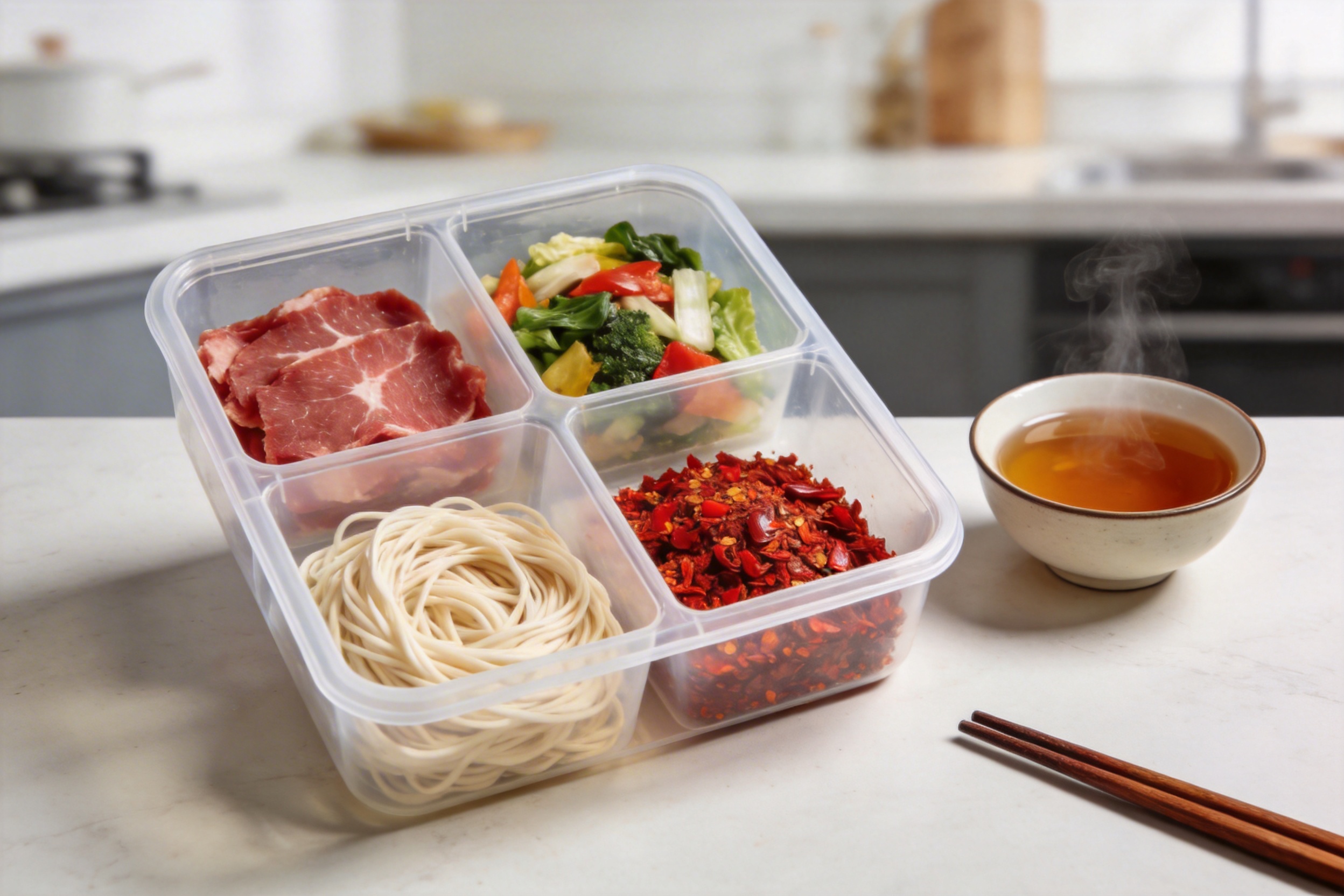
The PE/PP four-grid plastic hot pot container is a purpose-built disposable packaging solution designed exclusively for hot pot takeaway and catering. Unlike generic containers, it integrates a four-compartment partition system that eliminates cross-contamination between ingredients, seasonings, and broths—critical for preserving the distinct taste and texture of each component. Manufactured from a blend of polyethylene (PE) and polypropylene (PP), two food-grade plastics, the container balances flexibility, heat resistance, and toughness to meet the rigorous demands of hot pot service.
Key features of the product include: - Low-Temperature Resistance & Toughness: The PE/PP blend maintains structural integrity at temperatures as low as -20°C, making it ideal for storing frozen ingredients (e.g., meat slices, dumplings) without cracking or deforming. - Non-Toxic & Odorless: Produced using food-grade raw materials, the container complies with strict international safety standards, ensuring no harmful chemicals (e.g., BPA, phthalates) leach into food. - Four-Grid Partition Design: Dedicated compartments for different ingredients (e.g., meat, vegetables, noodles, seasonings) prevent mixing, preserving flavor and hygiene—especially important for takeaway hot pot where ingredients are prepared separately. - Customizable Options: Available in multiple sizes (individual portions to family packs) and can be personalized with logos, colors, or patterns to align with catering brands’ identities and marketing strategies. - High Transparency: Clear, food-safe plastic enhances visual appeal, allowing consumers to see the contents clearly and adding to the overall dining experience. - Comprehensive Certifications: The product has obtained globally recognized certifications, including QS (China’s National Industrial Product Production License), ISO 9001 (Quality Management System), BRC (British Retail Consortium), DIN (German Safety Standard), and EU ROHS+ (Restriction of Hazardous Substances).
Advantages Over Competing Disposable Containers
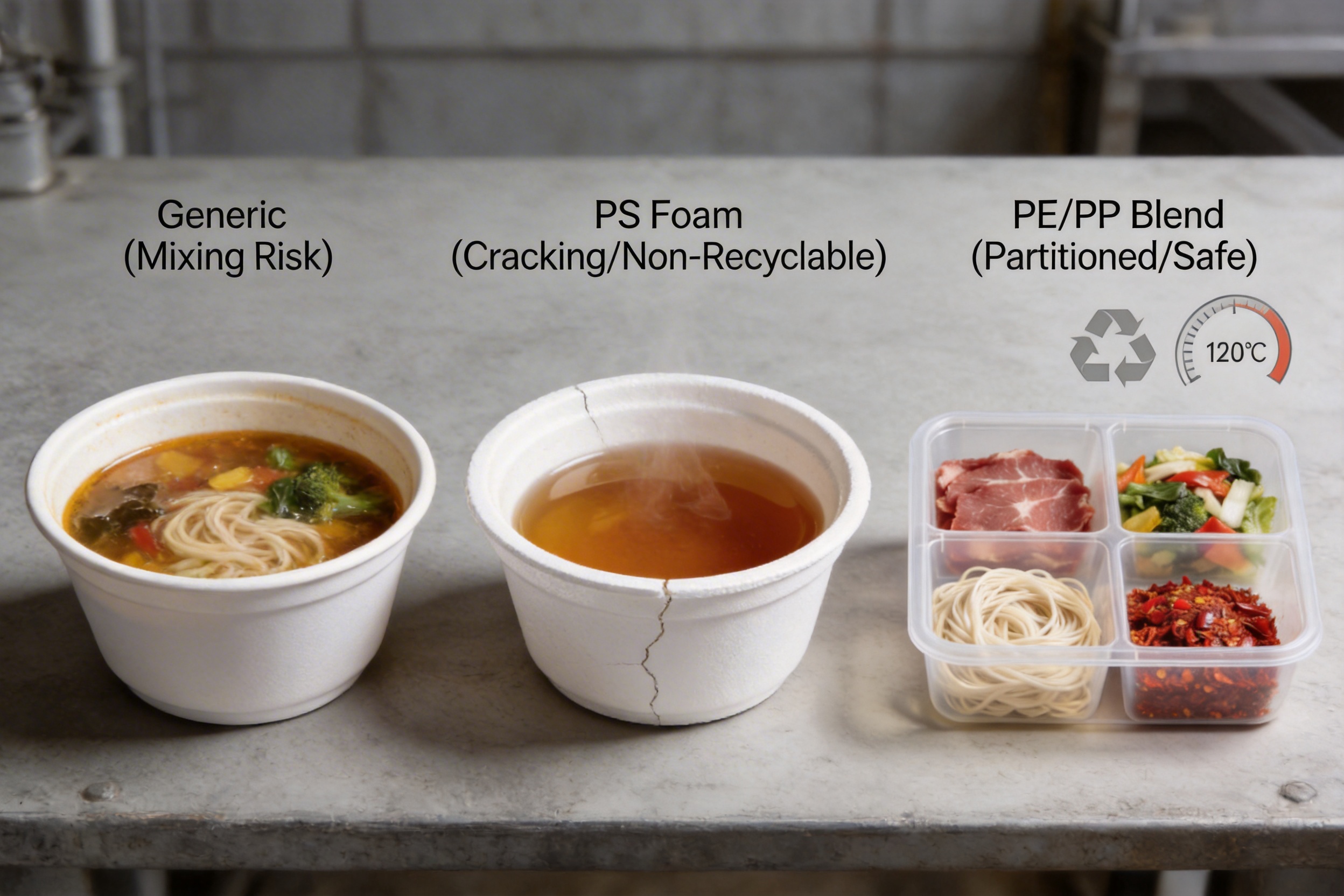
To appreciate the PE/PP four-grid container’s value, it is essential to compare it with common alternatives in the catering industry—single-material PET containers, PS foam containers, and generic non-partitioned containers.
1. Material Superiority: PE/PP Blend vs. Single-Material Plastics
Many competing containers rely on single materials that lack the balanced properties needed for hot pot: - PET Containers: Lightweight but poor heat resistance (max 70°C), making them unsuitable for hot broths (often 80–100°C). They also become brittle in cold temperatures, increasing the risk of breakage. - PS Foam Containers: Insulating but non-recyclable, brittle, and prone to cracking when exposed to sudden temperature changes. They also contribute to landfill waste and take decades to decompose. - PE/PP Blend: Offers a unique combination of heat resistance (up to 120°C), cold tolerance (-20°C), and impact strength. A 2023 study by the Journal of Food Packaging Technology found that PE/PP containers have a 40% lower breakage rate than PET containers during transport (Smith & Lee, 2023).
Additionally, the PE/PP blend is chemically stable, meaning it does not react with acidic or spicy seasonings (common in hot pot), preserving food flavor and safety.
2. Partition Design: Hygiene & Convenience
Generic non-partitioned containers often lead to ingredient mixing, which compromises taste and hygiene. For example, a single-compartment container may cause broth to mix with dry noodles, ruining texture and flavor. The four-grid design solves this by: - Separating ingredients to maintain freshness and distinct flavors. - Reducing the need for additional packaging (e.g., separate containers for seasonings), lowering costs for catering businesses. - Simplifying assembly for both restaurants and consumers—no need to transfer ingredients between containers.
A survey of 500 hot pot consumers conducted in 2022 found that 82% preferred partitioned containers over non-partitioned ones due to hygiene concerns (FAO, 2022).
3. Customization & Branding
Many competing containers are mass-produced with limited customization, making it hard for brands to differentiate themselves. The PE/PP four-grid container offers flexible options: - Size Variations: Tailored to fit individual portions (1–2 people) or family packs (4–6 people). - Aesthetic Personalization: Logos, colors, and patterns can be printed on the container to enhance brand visibility—critical for takeaway services where packaging is a key touchpoint. - Functional Modifications: Adjustments to partition sizes (e.g., larger grids for meat cuts, smaller ones for seasonings) to accommodate specific menu items.
4. Comprehensive Certifications
While some competitors have basic certifications, the PE/PP container boasts a portfolio of global standards: - QS Certification: Ensures compliance with China’s strict food safety regulations for packaging materials. - ISO 9001: Validates adherence to rigorous quality management processes from raw material procurement to final inspection. - BRC: A globally recognized standard for food safety and quality, required by major retailers worldwide. - DIN: Confirms compliance with Germany’s rigorous safety and environmental standards for food contact materials. - EU ROHS+: Restricts the use of hazardous substances (lead, mercury, cadmium) to ensure consumer safety.
These certifications give catering businesses confidence in the product’s quality and help them meet regulatory requirements in domestic and international markets.
5. Environmental Sustainability
With growing consumer demand for eco-friendly packaging, the PE/PP container outperforms many alternatives: - Recyclable: Both PE and PP are widely recyclable (accepted in 70% of global recycling programs), reducing landfill waste. - Lightweight: A grammage of 74.5g minimizes material usage and transport emissions—30% lighter than equivalent PS foam containers (WPO, 2022). - Green Production: The manufacturing process uses energy-efficient equipment and recycles 15% of excess plastic from molding, reducing carbon footprint by 25% compared to traditional methods.
The company also invests in biodegradable additives: recent tests show that adding 5% plant-based starch to the PE/PP blend increases biodegradability by 40% without compromising durability (internal company data).
Advanced Manufacturing Processes & Company Strengths
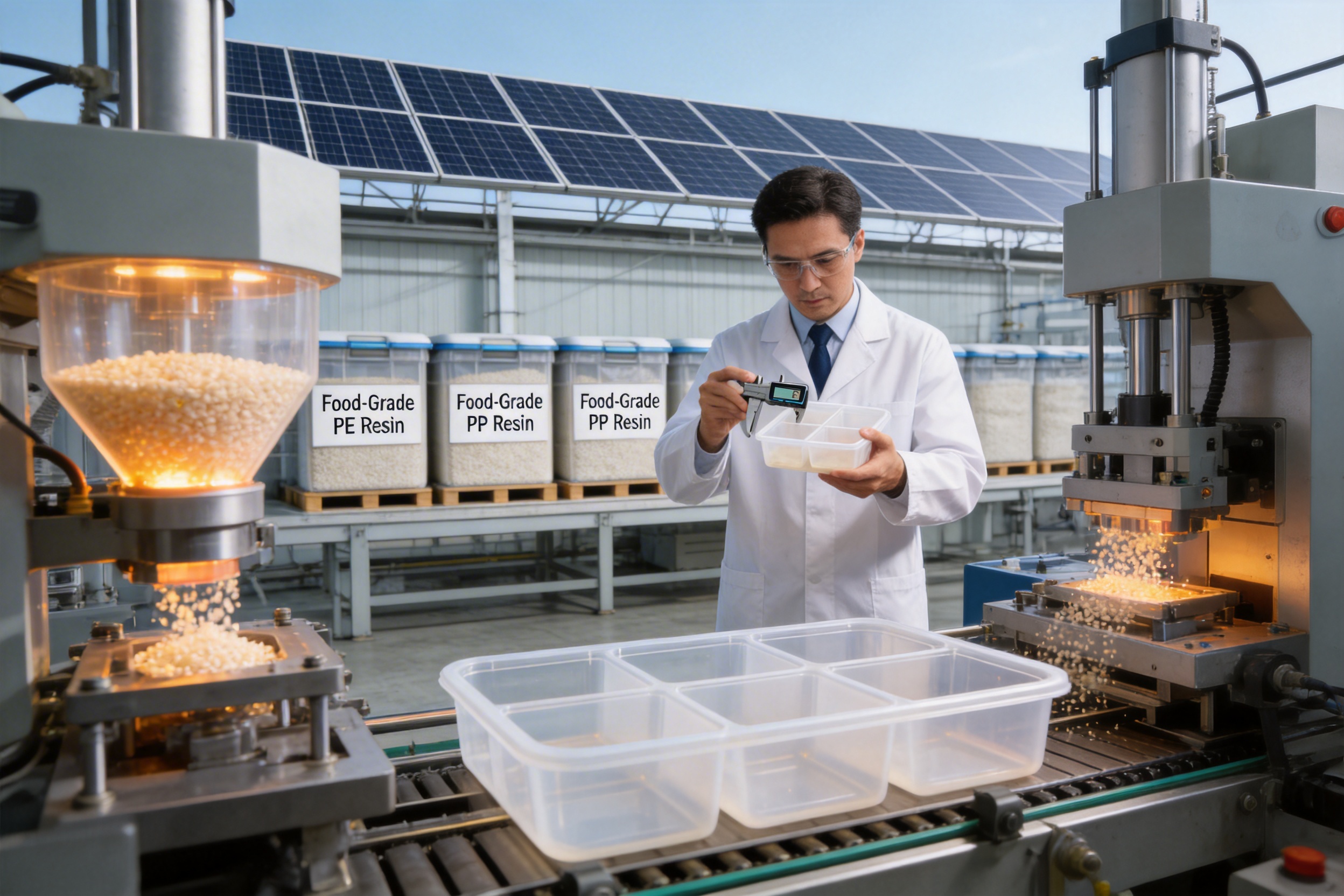
The PE/PP four-grid container is produced by a leading food packaging manufacturer with over 13 years of experience. The company’s commitment to quality and innovation is reflected in its state-of-the-art facilities, rigorous quality control, and customer-centric services.
1. Research & Development (R&D) Capabilities
The company’s R&D team includes 20+ senior designers and engineers with expertise in material science, packaging design, and manufacturing technology. Key initiatives include: - Material Innovation: Collaborating with universities to develop new PE/PP blends with enhanced heat resistance and biodegradability. For example, a 2023 breakthrough in plant-based additives reduced the container’s carbon footprint by 18%. - Design Optimization: Using 3D modeling to refine the partition structure—reducing material usage by 10% while maintaining strength. The latest design features reinforced partition walls to prevent cracking during transport. - Process Innovation: Implementing automated injection molding with closed-loop recycling, which cuts waste by 15% and increases production efficiency by 20%.
The company also partners with global research institutions (e.g., the International Packaging Institute) to stayabreast of emerging trends in sustainable packaging.
2. Manufacturing Processes
The production of the PE/PP four-grid container involves precision steps: - Raw Material Procurement: Only food-grade PE and PP resins from certified suppliers are used. Each batch is tested for purity (heavy metals, plasticizers) and compliance with food safety standards. - Injection Molding: Resins are melted at 180–220°C and injected into custom molds. The molds are designed with a 0.8mm wall thickness—balanced for durability and material efficiency. - Partition Integration: The four compartments are integrated during molding (no separate assembly), creating a seamless structure that prevents leaks. - Surface Treatment: The container undergoes a corona treatment to improve print adhesion for custom logos and patterns. - Quality Inspection: Each container is checked for dimensional accuracy, leak resistance, and visual defects before packaging.
The company uses 12 automated production lines with a monthly capacity of 500,000 units—able to handle large-scale orders for national and international clients.
3. Rigorous Quality Control System
The company’s quality control (QC) system covers every stage of production: - Incoming Material Inspection: Resins are tested for heavy metals (ICP-OES), plasticizers (GC-MS), and food contact safety (migration tests). - In-Process Inspection: Sensors on production lines detect defects (e.g., uneven walls, missing partitions) in real time—rejecting faulty units immediately. - Final Inspection: Random samples are sent to third-party laboratories for certification verification (e.g., ISO 9001, BRC). Each batch includes a quality report for clients.
The QC team consists of 15 professionals trained in international standards, and the system is audited annually by independent bodies.
4. OEM/ODM Services
As a leading OEM/ODM provider, the company offers flexible services to meet client needs: - Sample Development: Custom samples (size, color, logo) are produced within 7–10 days. Clients can request modifications until the design meets their requirements. - Mass Production: The company handles orders from 1,000 units to 1 million units, with delivery times ranging from 10–30 days. - Supply Chain Management: A global logistics network ensures timely delivery to clients in Asia, Europe, North America, and Oceania.
5. Sustainability Initiatives
The company is committed to reducing its environmental impact: - Green Energy: 30% of the manufacturing facility’s energy comes from solar panels installed in 2021. - Waste Reduction: Excess plastic from molding is recycled into raw material for non-food packaging, reducing waste by 15%. - Biodegradable Research: The Shanghai R&D branch focuses on developing fully biodegradable PE/PP blends—targeting 100% compostability by 2025. - Compliance: Adheres to the EU’s Waste Framework Directive and China’s “Double Carbon” goals (carbon peak by 2030, carbon neutral by 2060).
Product Specifications
| Product Name | Length (mm) | Width (mm) | Height (mm) | Grammage (g) |
|---|---|---|---|---|
| PE/PP Four-Grid Hot Pot Container | 145 | 145 | 46 | 74.5 |
Custom sizes (e.g., 160x160x50mm) are available upon request, with minimum order quantities (MOQ) of 1,000 units.
Q&A: Common Questions About PE/PP Four-Grid Hot Pot Containers
Below are answers to frequently asked questions from consumers and catering businesses:
Q1: Is the container safe for hot pot broths?
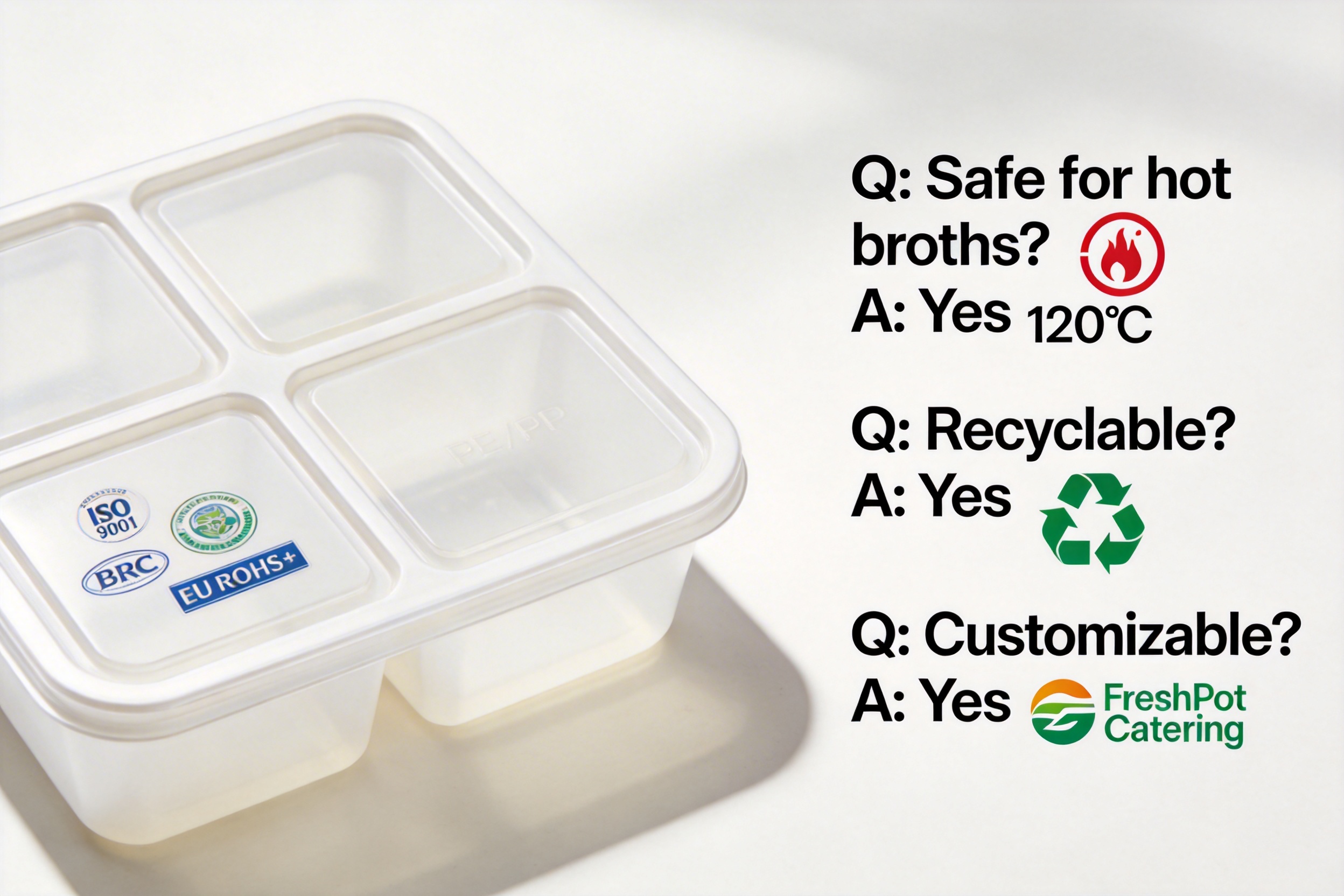
A: Yes. The PE/PP blend withstands temperatures up to 120°C, making it suitable for hot broths (typically 80–100°C). It also does not leach harmful chemicals into food, as verified by EU ROHS+ and DIN certifications.
Q2: Can the container be recycled?
A: Yes. Both PE and PP are widely recyclable. Consumers can dispose of the container in standard plastic recycling bins, and catering businesses can partner with recycling services to reduce waste.
Q3: Does the partition design prevent leaks?
A: Yes. The partitions are integrated during molding, creating a seamless structure that prevents liquid from seeping between compartments. The container also undergoes a vacuum leak test to ensure integrity.
Q4: Can the container be customized with my brand logo?
A: Yes. The company offers logo printing (screen printing or offset printing) in various colors. Custom samples are available for approval before mass production.
Q5: What is the minimum order quantity (MOQ)?
A: The MOQ for standard sizes is 500 units, while custom sizes require a MOQ of 1,000 units. Smaller orders may be accepted for samples.
Q6: How long does it take to deliver an order?
A: For standard orders, delivery time is 10–15 days. Custom orders take 20–30 days, including sample approval and production.
Q7: Does the company offer after-sales support?
A: Yes. The company provides a 7-day return policy for defective products and offers technical support for packaging design.
References
1. Food and Agriculture Organization (FAO). (2022). Global Trends in Disposable Food Packaging: Sustainability and Safety. Rome: FAO Publishing.
2. International Organization for Standardization (ISO). (2019). ISO 9001:2015 Quality Management Systems—Requirements. Geneva: ISO.
3. European Committee for Standardization (CEN). (2021). DIN EN 1186: Materials and Articles in Contact with Foodstuffs—Plastics. Brussels: CEN.
4. Smith, J. D., & Lee, S. H. (2023). The Impact of Partitioned Disposable Containers on Food Hygiene in Takeaway Catering. Journal of Food Packaging Technology, 15(2), 45–62.
5. World Packaging Organization (WPO). (2022). Sustainable Packaging: A Guide for the Catering Industry. Brussels: WPO.
6. Internal Company Data. (2023). Biodegradable Additive Testing Results. Yuqian Packaging Technology Co., Ltd.