English
 Español
 عربى
عربىContent
- 1 Why the Cup Lid Is Critical to Beverage Packaging
- 2 Product Overview: PP Plastic One-Piece Cup Lid
- 3 Advantages of Food-Grade Polypropylene
- 4 Integrated Sealing Structure and Consumer Convenience
- 5 Product Appearance and Customization Options
- 6 How Injection Molding Supports Product Consistency
- 7 Manufacturing Strengths and Quality Management
- 8 Advantages Compared with Common Alternative Lid Solutions
- 9 Stackability, Storage, and Logistics Efficiency
- 10 Brand Development Through Customized Packaging
- 11 Environmental Considerations in Disposable Packaging
- 12 Applications Across Foodservice and Beverage Operations
- 13 Recommended Customer Development Process
- 14 Packaging Design and Transportation Protection
- 15 Why Work with an Experienced OEM Manufacturer
- 16 Ordering and Customization Information
- 17 Frequently Asked Questions
- 17.1 What material is used for the one-piece cup lid?
- 17.2 What cup size does the listed product fit?
- 17.3 Can the lid be used with a straw?
- 17.4 What colors are available?
- 17.5 What is the approximate weight of the lid?
- 17.6 Is the PP lid recyclable?
- 17.7 Can the plug hole or leak-proof structure be customized?
- 17.8 Are the lids stackable?
- 17.9 How does the one-piece structure compare with a separate plug design?
- 17.10 Can the lids be used for hot beverages?
- 17.11 What certifications and tests are associated with the manufacturer?
- 17.12 What information should be provided for a quotation?
- 18 Conclusion
- 19 References
- 20 Product: PP plastic one-piece cup lid
In modern foodservice, beverage packaging must do much more than hold a drink. It must protect the product, support convenient consumption, preserve the visual identity of a brand, withstand transportation, and respond to growing environmental expectations. The lid is one of the most important components in this packaging system because it directly affects leak prevention, drinking comfort, cup compatibility, stacking efficiency, and the overall customer experience.
PP plastic one-piece cup lids provide a practical solution for takeaway beverages, cafés, restaurants, catering operations, convenience stores, and beverage brands. Manufactured from food-grade polypropylene, these lids combine a lightweight structure with useful mechanical strength, chemical resistance, heat tolerance, and recyclability. Their integrated sealing design helps reduce splashing and leakage while their dual-purpose plug hole supports direct drinking or the use of a straw.
Yuqian Packaging Technology (Jiangsu) Co., Ltd. develops and manufactures PP injection molded cup lids for customers seeking reliable disposable food packaging and flexible customization. With advanced production equipment, professional mold technology, quality management systems, and experience in food packaging materials, the company can provide cup lid solutions for different cup designs, beverage types, branding requirements, and distribution environments.
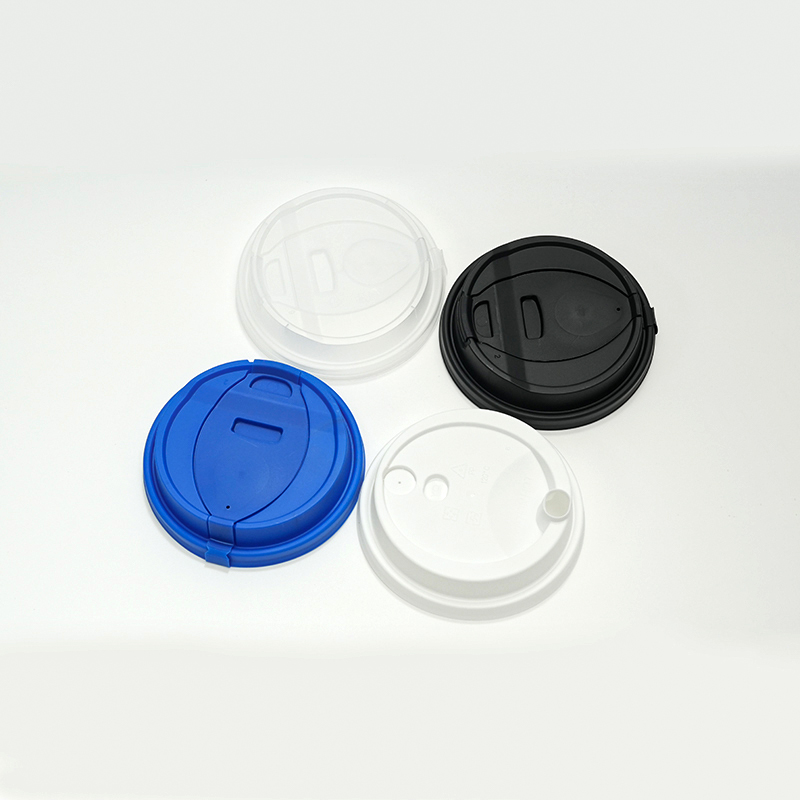
PP plastic one-piece cup lid
Why the Cup Lid Is Critical to Beverage Packaging
A cup lid may appear to be a simple accessory, but its performance has a direct effect on how consumers perceive a beverage product. If a lid does not fit securely, liquid can leak into a vehicle, bag, delivery container, or work area. If the drinking opening is poorly designed, the beverage may flow too quickly, splash, or become difficult to consume. If the lid is too flexible, it may deform during stacking or transportation. If the material is not suitable for food contact, it may create safety and quality concerns.
For these reasons, beverage packaging manufacturers must consider several factors at the same time. The lid needs to match the cup rim accurately, maintain structural stability, provide a comfortable drinking experience, and remain efficient to produce. It should also support the operational requirements of beverage businesses, including fast assembly, convenient storage, bulk transportation, and consistent appearance across large orders.
The PP one-piece cup lid addresses these requirements through an integrated structure. Instead of relying on multiple separate lid components, the lid incorporates the sealing body and drinking plug into one molded unit. This reduces the number of loose components, simplifies handling, and creates a cleaner appearance. It also makes the product easier to store and distribute in large quantities.
The integrated construction is particularly useful for takeaway beverages. Workers can place the lid on the cup quickly, while consumers can drink directly from the opening or use a straw when preferred. This flexibility makes the lid suitable for water, tea, coffee, fruit drinks, milk beverages, juice, soft drinks, and many other takeaway products, subject to the appropriate application and temperature requirements.
Product Overview: PP Plastic One-Piece Cup Lid
The PP plastic one-piece cup lid is an injection molded lid designed for beverage cups with a 90 mm caliber. Its main structure is formed from food-grade polypropylene, a material widely used in food packaging because of its light weight, durability, chemical resistance, and processing efficiency.
The product is available in several configurations, including a glossy one-piece lid, a frosted one-piece lid, and a big-mouth one-piece lid. Each version is designed to offer a different balance of appearance, drinking comfort, opening size, and brand presentation. Transparent and white options are available as standard choices, while selected versions can also be supplied in black, green, purple, gold, and other customized colors.
The dual-purpose plug hole is one of the product’s main functional features. It supports direct drinking while also allowing a straw to be inserted. This gives consumers more flexibility and allows foodservice operators to use the same lid for different beverage formats. The plug design can also be developed in different colors and shapes to support visual differentiation and brand communication.
The sealing structure is designed to fit tightly with the cup body. A properly engineered fit helps limit liquid splashing and leakage during carrying, handling, and short-distance transportation. The precise performance of the finished lid depends on the matching cup dimensions, rim design, beverage characteristics, and operating conditions, but the one-piece configuration provides a strong foundation for dependable packaging performance.
Available Product Specifications
| Lid Type | Caliber | Approximate Weight | Available Colors |
|---|---|---|---|
| Glossy one-piece lid | 90 mm | 5 g | Transparent, white |
| Frosted one-piece lid | 90 mm | 5 g | White, transparent |
| Big-mouth one-piece lid | 90 mm | 5 g | Transparent, white, black, green, purple, gold |
The stated specifications provide a convenient starting point for product selection. Before mass production, customers should confirm the exact cup rim dimensions, lid fit, beverage temperature, filling method, stacking conditions, and transportation requirements. Sample testing is recommended to verify compatibility with the customer’s specific cup body and operating process.
Advantages of Food-Grade Polypropylene
Material selection strongly influences the performance and commercial value of a disposable cup lid. Polypropylene, commonly abbreviated as PP, is widely used in food packaging because it offers a useful combination of safety, processability, rigidity, and cost efficiency. When the appropriate food-contact grade is selected and processed under controlled conditions, PP is suitable for many disposable packaging applications.
Food-Contact Suitability
Food-grade PP raw materials are used for the one-piece cup lid. The material is non-toxic and odorless under normal intended use, helping the lid preserve the original characteristics of the beverage. This is particularly important for products such as coffee, tea, milk drinks, fruit beverages, and flavored drinks, where unwanted odor or taste transfer can affect consumer satisfaction.
Material control is only one part of food packaging safety. Clean production conditions, appropriate storage, controlled processing, suitable packaging, and traceable quality procedures are also necessary. A professional manufacturer must manage the entire production chain rather than relying solely on the name of the raw material.
Lightweight but Functional
With an approximate weight of 5 grams for the listed versions, the lid is designed to provide practical functionality without adding unnecessary packaging weight. Lightweight packaging can reduce material consumption, lower transportation weight, and improve the efficiency of warehouse storage. At the same time, the lid must retain enough rigidity to resist deformation during stacking, assembly, and normal carrying.
Chemical Resistance
Polypropylene offers resistance to many common chemicals and beverage ingredients. This helps the lid maintain its structure when used with a broad range of non-alcoholic drinks. The final suitability depends on the beverage formula, temperature, storage time, and contact conditions, but PP is a widely accepted material for many food and beverage packaging applications.
Recyclability
PP can be recycled and reused through suitable collection and recycling systems. This characteristic supports circular material strategies and can help reduce dependence on virgin resources when effective recycling infrastructure is available. However, recyclability also depends on local collection systems, sorting practices, contamination levels, and the availability of suitable recycling facilities.
Using recyclable PP does not automatically guarantee that every lid will be recycled. Responsible packaging design should therefore be combined with clear material identification, appropriate disposal guidance, efficient product design, and cooperation with recycling stakeholders. The use of PP nevertheless gives brands a practical material option for developing more resource-conscious disposable packaging programs.
Integrated Sealing Structure and Consumer Convenience
The one-piece design is engineered around the relationship between the lid, the cup rim, and the drinking opening. A close-fitting sealing structure helps hold the lid in position and reduces the risk of liquid splashing when the cup is moved. This is valuable for takeaway customers who carry drinks while walking, commuting, working, or traveling.
The integrated plug hole improves usability in several ways. Consumers may drink directly from the lid without removing it, which can help maintain beverage temperature and reduce exposure to dust or external contamination. Alternatively, they can insert a straw through the opening. Beverage retailers can therefore use one lid style for multiple customer preferences, simplifying inventory management.
The opening can be developed with different shapes and visual details. A larger drinking opening may be preferred for certain beverages or drinking styles, while a smaller opening may provide a more controlled flow. The design must balance drinking comfort with splash resistance, sealing performance, and the physical requirements of the cup. Through mold adjustment and sample evaluation, manufacturers can help customers select a suitable configuration.
A plug with different colors or shapes can also create a recognizable packaging detail. This may help distinguish beverage categories, identify customized orders, or reinforce a brand’s visual language. Color customization can be applied to the plug, the lid, or both, depending on the selected material and production process.
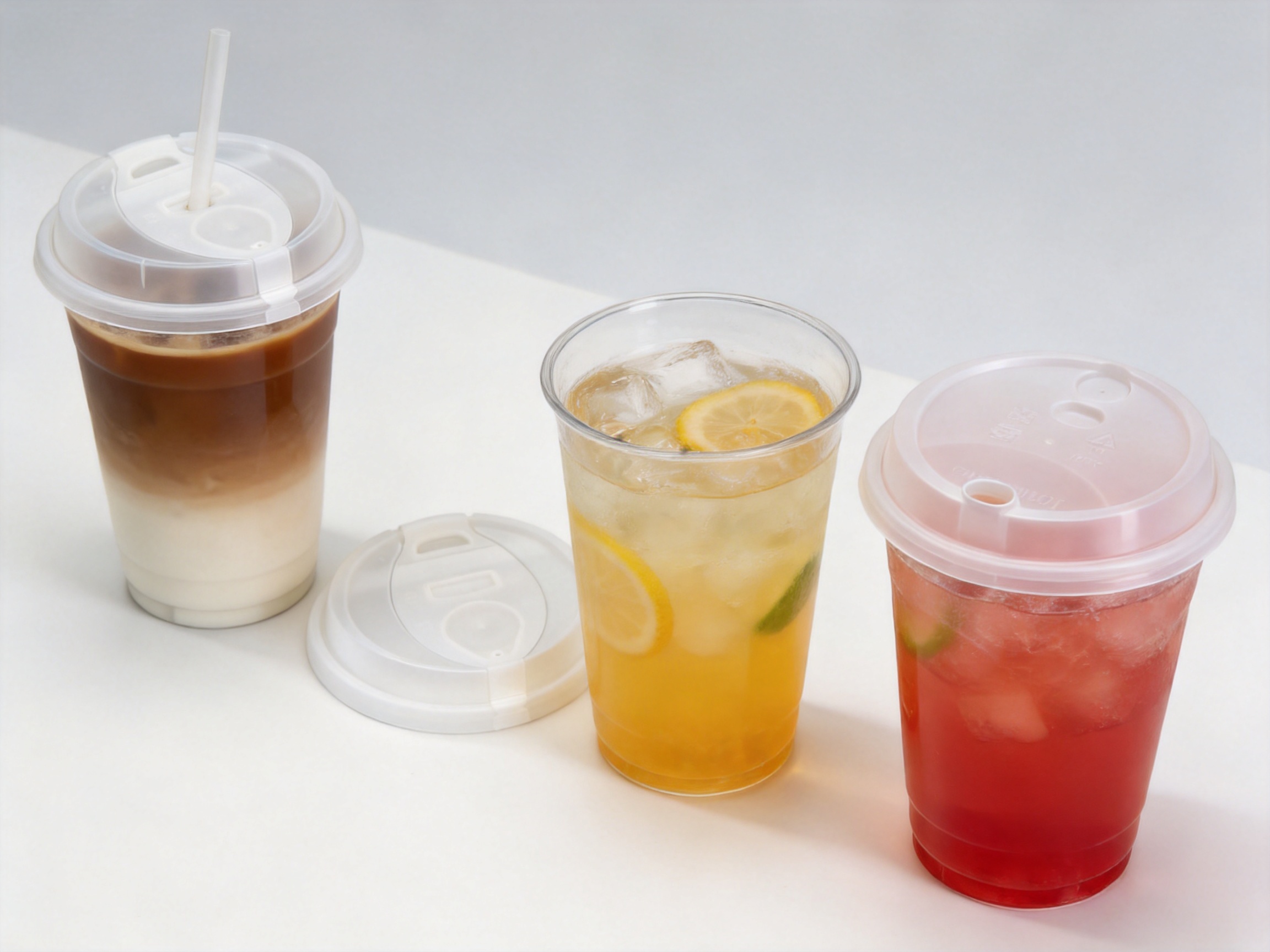
Product Appearance and Customization Options
Appearance has become increasingly important in foodservice packaging. Customers often encounter a beverage first through its packaging, especially when products are displayed in photographs, delivery applications, social media posts, or retail refrigerators. A well-designed lid can complement the cup, improve the perceived quality of the beverage, and create a more consistent brand presentation.
Glossy Finish
The glossy one-piece lid offers a smooth and clean appearance. Transparent or white glossy surfaces can create a simple, modern presentation and allow the cup design or beverage color to remain the visual focus. Glossy surfaces are also easy to coordinate with printed cups, adhesive labels, sleeves, and other packaging accessories.
Frosted Finish
The frosted one-piece lid provides a softer, more subdued appearance. Its visual texture can help create a premium or contemporary presentation, particularly when combined with matte cups or minimalist graphic design. Frosted surfaces may also reduce the visual impact of minor handling marks, although actual appearance depends on the processing method and storage conditions.
Big-Mouth Design
The big-mouth one-piece lid offers a larger opening for customers who prefer a more open drinking experience. It can be used for beverages that benefit from a wider flow path, while still providing the convenience of an integrated lid. The best opening size depends on beverage viscosity, ice content, cup dimensions, and the expected method of consumption.
Color Selection
Standard color options include transparent and white, while the big-mouth version can also be produced in black, green, purple, gold, and other colors subject to production evaluation. Color selection can serve several purposes. It can distinguish product lines, coordinate with seasonal promotions, match a corporate identity, or create a recognizable visual signature for a beverage brand.
When requesting a customized color, customers should provide a suitable color reference and confirm the acceptable tolerance range. The appearance of a color can vary according to the material batch, lighting conditions, surface finish, and the color of the cup beneath the lid. Sample approval before mass production is therefore an important step in achieving consistent results.
How Injection Molding Supports Product Consistency
Injection molding is an efficient manufacturing process for producing large quantities of plastic cup lids with repeatable dimensions. In the process, prepared PP material is heated until it reaches a suitable flow state, injected into a precision mold, cooled, and ejected as a finished component. The process can produce detailed structures such as sealing rings, plug features, opening contours, stacking surfaces, and reinforcement ribs.
For a lid that must fit tightly onto a cup, dimensional consistency is essential. Even a small variation in the sealing area can affect assembly force, retention, leakage resistance, and consumer convenience. Professional mold design and controlled processing help maintain the geometry required for stable performance across production batches.
Mold Design and Engineering
The mold is the foundation of an injection molded lid. Engineers must evaluate the lid’s outer diameter, cup-contact surface, wall thickness, plug geometry, opening shape, draft angles, cooling layout, and ejection method. The design must also allow the molten PP to fill the cavity effectively and cool with limited distortion.
Because the product has an integrated structure, the relationship between the sealing area and the plug opening must be carefully controlled. The mold must reproduce both functions without creating weak points, excessive material concentration, or difficult ejection conditions. A balanced design can improve cycle stability, appearance, and overall production efficiency.
Processing Control
Injection molding parameters can influence the appearance and performance of the lid. Important variables include material drying or preparation requirements, melt temperature, injection speed, holding pressure, cooling time, mold temperature, and ejection timing. These parameters must be adjusted according to the selected PP grade, mold structure, product design, and production environment.
Consistent processing helps reduce common defects such as short shots, flash, sink marks, warpage, color variation, flow marks, and incomplete plug formation. Inspection procedures can identify dimensional or visual deviations before products are packed and shipped. Process records also support traceability and continuous improvement.
Efficient High-Volume Manufacturing
Disposable packaging requires an efficient cost structure because customers often purchase large quantities for daily operations. Injection molding can produce multiple lids in a single cycle when the mold is appropriately configured. This supports high output while maintaining consistent product geometry.
Production efficiency must not come at the expense of safety or quality. A well-managed factory balances cycle time, mold maintenance, material utilization, inspection frequency, packaging speed, and equipment reliability. This approach helps customers receive stable supply rather than simply receiving a low initial quotation.
Manufacturing Strengths and Quality Management
Yuqian Packaging Technology (Jiangsu) Co., Ltd. was established in 2010 and is located in Taizhou City, Jiangsu Province, China. The company operates a plant area of approximately 30,000 square meters and focuses on research and development, manufacturing, and sales of new food packaging materials and products.
The company’s capabilities cover disposable food packaging containers, plastic cups, plastic cup lids, takeaway bowls, disposable straws, recycling bags, peripheral products, and other related packaging solutions. This product range gives customers access to a broader packaging partner rather than a supplier limited to one component.
Advanced production equipment supports the manufacture of injection molded cup lids with repeatable dimensions and stable output. The company’s technical team can work with customers on product structure, mold development, color selection, packaging design, and production planning. This cooperation is particularly useful for brands that need customized packaging rather than generic stock items.
Quality management is supported by certifications and testing referenced in the company’s materials, including a QS national industrial product production license, ISO 9001 quality management system certification, BRC certification, German DIN safety certification, and EU RoHS+ testing. The exact applicability of each certificate or test should be confirmed according to the product, market, material, and current certification scope.
These systems and qualifications provide a framework for controlling raw materials, manufacturing procedures, inspection practices, documentation, and corrective actions. For international customers, formal quality systems can also make supplier evaluation, audit preparation, and product traceability more organized.
Raw Material Management
Reliable product performance begins with stable raw materials. The manufacturer must verify the selected PP grade, color masterbatch, additives, packaging materials, and relevant supplier documentation. Material identification and batch management help reduce the risk of unintended variation and support investigation if a quality issue arises.
For food packaging, material selection should be linked to the intended application. Customers should communicate the beverage type, temperature range, contact duration, and market requirements so that the appropriate material and compliance documentation can be evaluated.
In-Process Inspection
In-process inspection may include checks of product weight, dimensions, appearance, plug formation, sealing geometry, color consistency, and packaging cleanliness. These checks allow production teams to identify deviations at an early stage instead of discovering them only after shipment.
Measurement methods should be defined according to the customer’s technical requirements. A visual inspection may be sufficient for some appearance characteristics, while dimensional features may require calipers, gauges, templates, or other suitable inspection tools. Performance tests can be conducted using matched cups and representative beverages.
Finished Product Control
Before shipment, finished lids should be checked for quantity, packaging integrity, labeling, visible defects, and conformity with approved samples. The packaging method should protect the lids from crushing, dust, moisture, and contamination during storage and transportation.
Packaging is not merely an outer layer. It must maintain product quality throughout the supply chain. Strong protective packaging helps preserve the shape of the lids, while recyclable or biodegradable packaging materials can support a customer’s environmental objectives where technically and commercially appropriate.
Advantages Compared with Common Alternative Lid Solutions
Different beverage businesses have different requirements, and no single lid design is ideal for every application. However, the PP one-piece cup lid offers several practical advantages over certain common alternatives.
Compared with Multi-Component Lids
A multi-component lid may contain separate plugs, inserts, or additional parts. While this construction can provide specialized functionality, it may increase assembly complexity, inventory requirements, and the possibility of lost components. The one-piece design integrates the main functions into a single molded unit, making handling faster and simplifying storage.
Fewer separate components can also create a cleaner presentation. Operators do not need to match a loose plug with every lid, and consumers receive a ready-to-use package. This is valuable in high-volume beverage shops where speed and consistency are important.
Compared with Unsealed Flat Covers
Simple flat covers may be suitable for limited applications, but they may not provide the same level of drinking convenience or splash control. The integrated drinking opening and cup-fitting structure of the PP one-piece lid are designed specifically for takeaway use. The lid can remain on the cup while the customer drinks, helping improve portability.
Compared with Heavier Packaging Materials
Some packaging materials may offer strong structural properties but add unnecessary weight or cost for disposable beverage applications. PP provides a lightweight alternative with useful toughness and processing efficiency. Its low weight can support more efficient transportation and storage while maintaining the functional requirements of a disposable lid.
Compared with Generic Uncustomized Products
Generic lids may be available quickly, but they may offer limited color choices, opening options, or technical support. Customized PP one-piece lids can be adapted to a brand’s visual identity and operating process. Customization may include color, plug shape, opening structure, surface finish, packaging format, and other design details subject to mold and production evaluation.
Stackability, Storage, and Logistics Efficiency
Disposable packaging is often purchased and stored in large quantities. A lid that stacks efficiently can reduce the space required in warehouses, delivery vehicles, kitchens, and beverage preparation areas. The PP one-piece lid is designed to be stackable, supporting organized storage and faster handling.
Stackability also influences the customer’s daily workflow. Operators can keep a large number of lids near the filling station without occupying excessive counter space. Lids can be dispensed more easily, and stock levels can be monitored more clearly. This can reduce unnecessary movement during busy service periods.
During transportation, protective packaging helps prevent deformation and contamination. Carton dimensions, inner bag design, stacking height, and pallet configuration should be considered together. The most suitable packaging method depends on order volume, shipping route, climate, handling conditions, and customer warehouse procedures.
Because the lid is lightweight, transportation efficiency can be improved when products are packed and palletized effectively. Nevertheless, the packaging must provide adequate protection. Excessive compression, high heat, moisture, and improper handling can affect product appearance or shape, so logistics planning remains important even for durable PP components.

Brand Development Through Customized Packaging
Packaging is an important communication tool for beverage brands. A recognizable lid can reinforce the identity of a coffee shop, tea chain, juice bar, catering company, or private-label beverage producer. Color, finish, opening style, and coordinated packaging elements can help a product stand out in a crowded market.
Customization begins with an understanding of the brand’s objectives. A company may want a transparent lid to highlight the beverage, a white lid for a clean appearance, or a dark lid to create a premium contrast. Another business may use different plug colors to distinguish hot drinks from cold drinks, different product sizes, or different beverage categories.
The lid can also be coordinated with cups, sleeves, straws, bowls, bags, labels, and shipping cartons. A consistent packaging system can create a stronger visual impression than isolated customization of one component. Since the manufacturer supplies multiple categories of disposable food packaging, customers may discuss related products as part of a broader procurement program.
Customization should consider both appearance and function. A visually attractive lid must still fit the cup securely, allow comfortable drinking, remain stable during transportation, and meet the customer’s production volume. Technical review and sample testing help ensure that design decisions support the complete user experience.
Environmental Considerations in Disposable Packaging
Environmental performance is now a major consideration in foodservice packaging. Customers, regulators, retailers, and consumers increasingly expect packaging companies to reduce material waste, select more responsible materials, and improve recyclability. The PP one-piece lid contributes to this discussion through its recyclable material option, lightweight design, and integrated structure.
Using less material while retaining functional performance can reduce resource consumption. Lightweight lids also require less energy to transport than heavier alternatives, although the total environmental impact depends on raw material production, manufacturing energy, transportation distance, consumer use, and end-of-life treatment.
The one-piece format may simplify product handling and reduce the number of separate parts entering the waste stream. Clear material identification can support sorting, while compatible packaging materials may make collection systems easier to manage. Businesses should provide disposal guidance that reflects the recycling infrastructure available in their target market.
Yuqian Packaging Technology also emphasizes recyclable or biodegradable packaging materials for product packaging, where suitable. Protective packaging remains essential because damaged products create waste and reduce supply chain efficiency. The goal should be to balance environmental considerations with product protection, food safety, transport reliability, and commercial feasibility.
Customers seeking a more sustainable packaging program should evaluate the complete life cycle rather than focusing on one feature alone. Important questions include whether the lid is accepted by local recycling systems, how much material is used, whether packaging can be reduced without causing damage, and whether the chosen design supports efficient distribution and storage.
Applications Across Foodservice and Beverage Operations
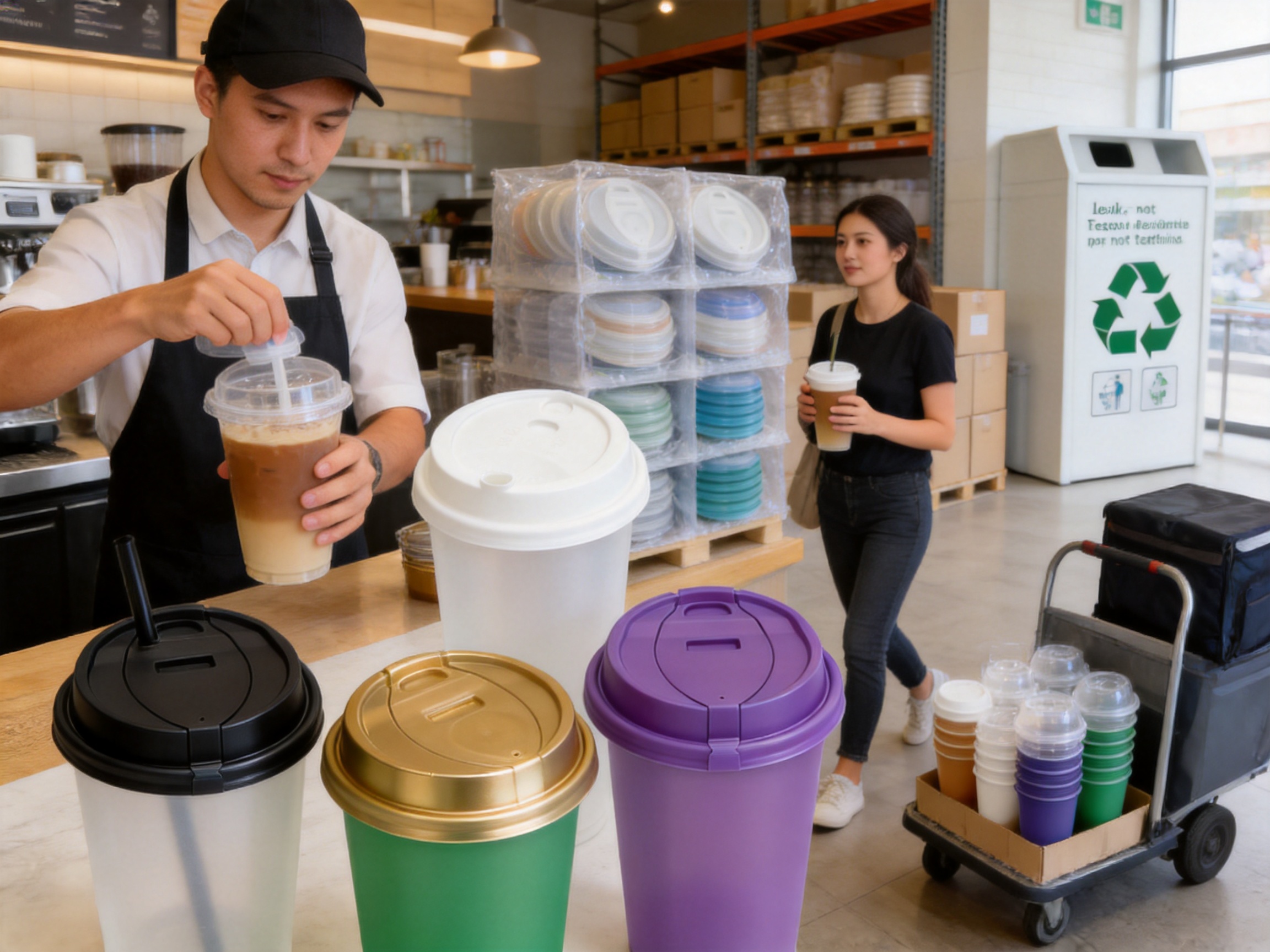
PP plastic one-piece cup lids can serve a wide range of beverage packaging applications. Coffee shops may use them for takeaway coffee, tea, and milk-based drinks. Tea and juice retailers may select a transparent or colored version to complement cold beverages. Restaurants and catering companies may use the lids for delivery orders, event service, or employee meals.
Convenience stores and supermarkets can use the lids with ready-to-drink beverage stations or freshly prepared drinks. Delivery kitchens can benefit from a secure lid structure that helps reduce splashing during short-distance transport. Catering operations may value the stackable structure and easy storage when preparing large quantities of drinks.
The lid may also be incorporated into private-label packaging programs. A distributor can select a standard size and then request specific colors, surface finishes, or packaging quantities for different customers. The availability of OEM services allows the product to be developed around the requirements of a particular market or beverage concept.
Hot and Cold Beverage Planning
Before selecting a lid for hot beverages, customers should verify the applicable temperature range and conduct tests with the actual cup and drink. Hot liquids can affect the dimensional stability, sealing behavior, surface temperature, and consumer handling experience. The cup, lid, sleeve, and carrying method should be evaluated as one system.
For cold beverages, customers should consider ice, condensation, carbonation, viscosity, and the use of straws. The opening should provide a suitable drinking flow while limiting splashing. Testing with representative beverages can help confirm whether the selected lid is appropriate for the intended service environment.
Recommended Customer Development Process
A structured development process helps reduce delays and supports consistent results. The first step is to define the application clearly. Customers should provide the cup caliber, cup material, cup wall structure, beverage type, temperature, filling volume, expected shelf or transport time, and any special sealing requirements.
The next step is product selection. Customers can compare the glossy, frosted, and big-mouth versions according to appearance, drinking style, and operational needs. Standard transparent or white options may be suitable for an initial launch, while customized colors can be considered for brand development or product differentiation.
Sample testing should then be performed using the actual cup body. The lid should be checked for fitting force, retention, leakage, splash resistance, drinking comfort, straw compatibility, and appearance. Testing should take place under realistic conditions, including carrying, stacking, delivery, and temperature exposure where relevant.
If the standard product does not fully meet the requirement, the manufacturer can evaluate design customization. Possible modifications may include the plug shape, drinking opening, surface finish, color, sealing geometry, or packaging format. Technical feasibility, minimum order quantity, tooling requirements, and lead time should be reviewed before approval.
After the sample is confirmed, production documentation should define the approved material, color, dimensions, weight range, appearance standard, packaging method, and inspection requirements. This information provides a reference for future orders and supports consistent quality control.
Packaging Design and Transportation Protection
Good packaging protects the cup lids from external contamination, compression, moisture, and impact. Individual lids are commonly grouped in inner bags or other clean protective units, then placed in cartons suitable for handling and transportation. The exact arrangement should be selected according to order size and shipping conditions.
Recyclable or biodegradable packaging materials may be considered where they provide adequate protection and are compatible with the customer’s environmental goals. Protective packaging should not be reduced so aggressively that it causes deformation or product loss. A damaged shipment may have a greater environmental and financial impact than a well-designed protective package.
Carton labeling should clearly identify the product model, quantity, production information, and customer order details. Clear identification supports warehouse management and helps prevent mixing different lid types or colors. For international shipments, documentation and labeling should be aligned with the destination market’s requirements.
Storage conditions should be clean, dry, and protected from excessive heat and direct sunlight. Products should remain in their original protective packaging until use whenever possible. Proper stock rotation can help maintain orderly inventory and reduce the risk of packaging damage caused by prolonged storage or repeated handling.
Why Work with an Experienced OEM Manufacturer
An experienced OEM manufacturer can provide more than a finished plastic component. The supplier can contribute to product design, mold development, material selection, color matching, sample evaluation, packaging planning, quality control, and production scheduling. This integrated support can reduce the need for customers to coordinate multiple specialized vendors.
Yuqian Packaging Technology combines product development with manufacturing and sales capabilities. Its experience in food packaging allows the company to understand the relationship between a lid and the wider packaging system. Customers can discuss cup compatibility, beverage use, packaging protection, customized appearance, and environmental objectives within one project.
Manufacturing experience is also valuable when a product needs to move from a sample stage to stable mass production. A design that looks satisfactory in a single prototype may require adjustments for cycle time, cooling, ejection, stacking, or automated packaging. A factory with injection molding knowledge can identify these issues early and recommend practical solutions.
Long-term cooperation also benefits from consistent communication. When a customer reorders the same product, archived specifications and approved samples can support continuity. When the customer expands to a new color, cup size, or related packaging product, an established technical relationship can make the development process more efficient.
Ordering and Customization Information
Customers interested in PP plastic one-piece cup lids should prepare the basic technical information before requesting a quotation. This normally includes the cup opening diameter, desired lid type, order quantity, color, surface finish, beverage application, packaging preference, destination market, and expected delivery schedule.
If a customized design is required, customers may also provide drawings, reference samples, logos, color standards, or photographs. The manufacturer can assess whether the requested design can be achieved using an existing mold or whether new tooling is required. Tooling decisions should consider expected annual volume, product life cycle, customization depth, and budget.
Quotation terms may vary according to material grade, color, mold structure, order volume, packaging configuration, inspection requirements, and shipping method. Customers should request a complete commercial and technical confirmation before placing an order. This helps ensure that the agreed product matches the intended application.
For product inquiries, customers may contact Yuqian Packaging Technology (Jiangsu) Co., Ltd. by telephone at 0086 15252423007, by fax at +0523 8608 3698, or by email at [email protected]. The company is located at No. 8 Tongyang Road, Suchen Town, Taizhou City, Jiangsu Province, China.
Frequently Asked Questions
What material is used for the one-piece cup lid?
The lid is manufactured from food-grade polypropylene, commonly known as PP. PP is lightweight, durable, chemically resistant, and recyclable through suitable recycling systems. The exact material grade should be confirmed according to the intended beverage application and destination market.
What cup size does the listed product fit?
The provided product specifications identify a 90 mm caliber. Customers should still verify the exact cup rim dimensions and conduct a fit test because nominal diameter alone may not describe the complete rim profile or sealing geometry.
Can the lid be used with a straw?
Yes. The dual-purpose plug hole is designed to support direct drinking and straw insertion. Customers should test the selected straw diameter and opening configuration to confirm smooth insertion and suitable retention.
What colors are available?
Glossy and frosted versions are listed in transparent and white. The big-mouth version is listed in transparent, white, black, green, purple, and gold. Additional colors may be evaluated for customized orders according to material availability, color standards, and production requirements.
What is the approximate weight of the lid?
The listed versions have an approximate weight of 5 grams each. Actual production weight may be affected by the approved design, material density, color masterbatch, tolerance, and manufacturing conditions. A confirmed weight range should be included in the technical specification for mass production.
Is the PP lid recyclable?
PP is a recyclable plastic material, but whether a used lid is actually recycled depends on local collection, sorting, cleaning, and processing infrastructure. Customers should verify the disposal instructions and recycling acceptance rules in their target market.
Can the plug hole or leak-proof structure be customized?
Customization is available according to user requirements and technical feasibility. The plug shape, opening design, leak-proof solution, color, surface finish, and packaging may be evaluated during development. Samples should be tested with the customer’s actual cup and beverage.
Are the lids stackable?
Yes. The product is designed to be stackable, which supports convenient storage and helps save space in warehouses, beverage shops, catering areas, and delivery operations.
How does the one-piece structure compare with a separate plug design?
The one-piece structure reduces the number of loose components and simplifies handling. It can improve assembly efficiency, reduce the possibility of missing plugs, and provide a clean integrated appearance. Separate-component designs may still be appropriate for specialized applications, so selection should be based on the customer’s functional requirements.
Can the lids be used for hot beverages?
Use with hot beverages should be confirmed through application testing. Customers should evaluate the selected lid with the actual cup, drink temperature, filling process, carrying method, and expected contact time. Technical suitability should be confirmed before commercial use.
What certifications and tests are associated with the manufacturer?
The company’s materials reference a QS national industrial product production license, ISO 9001 quality management system certification, BRC certification, German DIN safety certification, and EU RoHS+ testing. Customers should request current documentation and confirm the scope and applicability of each certification for their product and market.
What information should be provided for a quotation?
Useful information includes the cup caliber, lid style, color, estimated quantity, beverage type, hot or cold application, packaging requirements, destination, customization needs, and desired delivery schedule. Drawings or physical samples are helpful when a special fit or design is required.
Conclusion
The PP plastic one-piece cup lid is a practical solution for beverage businesses that need reliable sealing, convenient drinking, efficient storage, and flexible design options. Its dual-purpose opening supports both direct drinking and straw use, while the integrated structure helps simplify handling and reduce the number of separate components. Food-grade PP provides a useful combination of light weight, strength, chemical resistance, and recyclability.
Compared with basic unsealed covers or more complicated multi-component solutions, the one-piece design offers a balanced combination of convenience and manufacturing efficiency. Glossy, frosted, and big-mouth versions allow customers to choose a suitable appearance and drinking experience. Transparent, white, black, green, purple, gold, and customized color options support different branding strategies.
The product’s value depends not only on its material or appearance but also on the manufacturing process behind it. Precision mold design, controlled injection molding, raw material management, in-process inspection, finished product checks, and protective packaging all contribute to reliable supply. An experienced OEM manufacturer can further support customers with design development, sample testing, customization, and broader disposable food packaging requirements.
For beverage brands, catering companies, distributors, and foodservice operators, selecting the right lid is an important part of building a safe, convenient, and recognizable packaging system. By combining functional design with responsible material selection and professional manufacturing support, PP one-piece cup lids can help businesses improve everyday operations while creating a more consistent customer experience.
References
1. Product specifications and technical information supplied for the PP plastic one-piece cup lid.
2. Internal product information concerning glossy, frosted, and big-mouth 90 mm lid configurations.
3. General technical references on polypropylene properties and food packaging applications.
4. ISO 9001 quality management system principles and manufacturing process control practices.
5. General guidance on recyclable plastic packaging, material identification, and end-of-life management.
6. General injection molding engineering references covering mold design, process control, cooling, and dimensional consistency.
7. Company information supplied for Yuqian Packaging Technology (Jiangsu) Co., Ltd., including manufacturing capabilities, certifications, and food packaging product categories.