English
 Español
 عربى
عربىContent
- 1 Material Advantage: PE/PP Blend vs. Competitor Materials
- 2 Key Product Features & Competitive Advantages
- 3 Advanced Manufacturing Processes & Company Strengths
- 4 Market Impact & Customer Success Stories
- 5 Q&A Section
- 5.1 Q1: Are these containers microwave-safe?
- 5.2 Q2: Can these containers be recycled?
- 5.3 Q3: What customization options are available?
- 5.4 Q4: How long is the lead time for OEM orders?
- 5.5 Q5: Do these containers meet international food safety standards?
- 5.6 Q6: Are there biodegradable options available?
- 6 Table of Product Specifications
- 7 Sustainability & Future Outlook
- 8 Conclusion
- 9 References
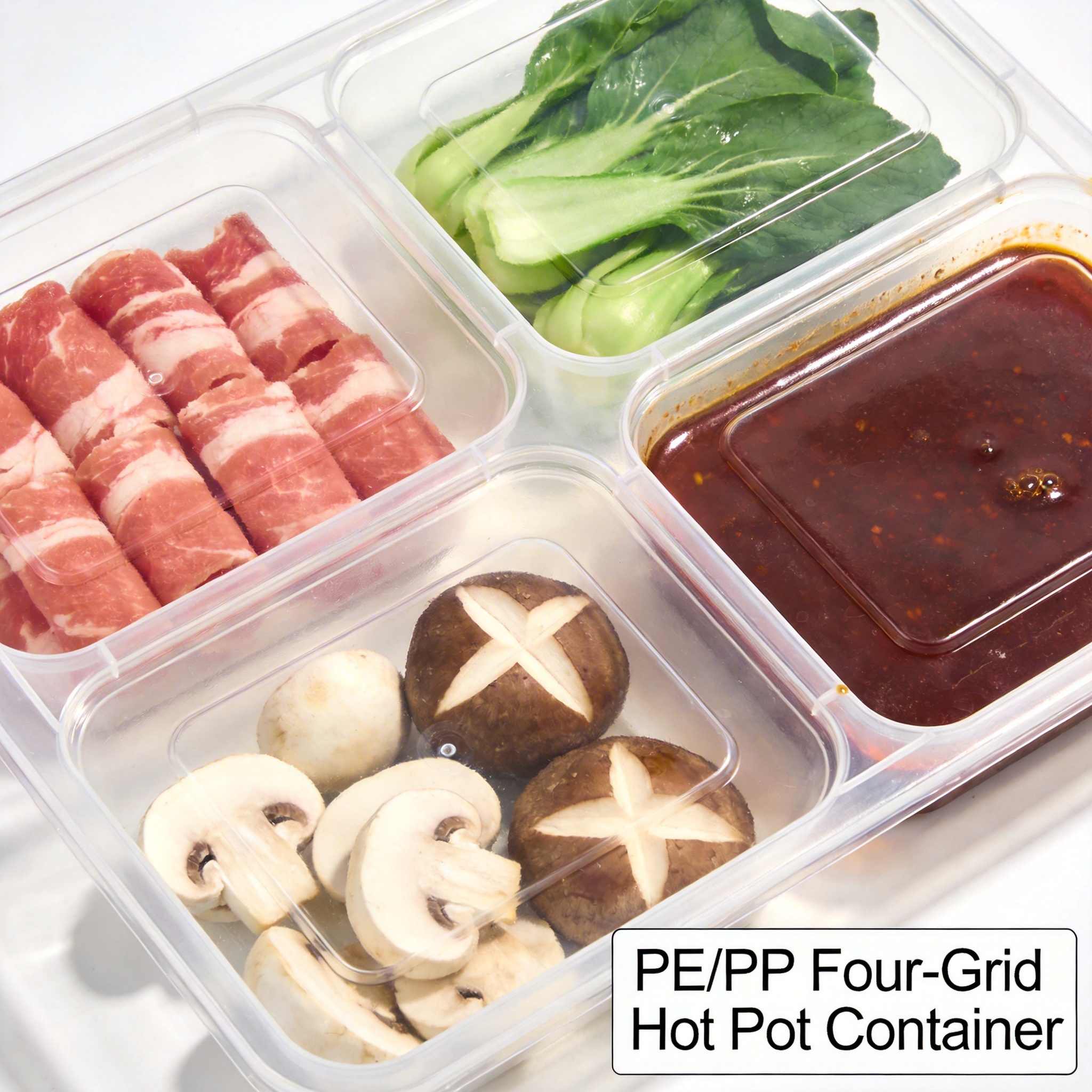
The global hot pot industry has experienced exponential growth over the past decade, driven by changing consumer lifestyles, increasing demand for convenient dining options, and the popularity of shared meal experiences. According to Grand View Research, the global hot pot market is projected to reach $XX billion by 2030, with a compound annual growth rate (CAGR) of XX% from 2024 to 2030. This surge in demand has created a pressing need for high-quality, safe, and functional disposable packaging solutions that can meet the unique requirements of hot pot takeaway and catering services. Traditional disposable containers—such as single-grid plastic boxes, paper bowls, or uncertified plastic containers—often fall short in terms of durability, food safety, and compartmentalization, leading to customer dissatisfaction and increased operational costs for businesses. Enter the PE/PP four-grid plastic hot pot container: a innovative solution that addresses these gaps and sets a new standard for disposable food packaging.
Material Advantage: PE/PP Blend vs. Competitor Materials
The PE/PP four-grid hot pot container is made from a proprietary blend of polyethylene (PE) and polypropylene (PP)—two thermoplastic polymers renowned for their exceptional properties in food packaging applications. To understand why this blend is superior to other materials, it is essential to analyze the strengths and weaknesses of common alternatives:
1. Polyethylene (PE) Properties
PE is a lightweight, flexible, and chemical-resistant polymer. It offers excellent low-temperature resistance (maintaining stability down to -40°C) and is non-toxic, making it safe for food contact. However, pure PE lacks rigidity, which can lead to deformation under heavy loads or high temperatures.
2. Polypropylene (PP) Properties
PP is a rigid, heat-resistant polymer with a melting point of approximately 160°C. It is highly durable, impact-resistant, and resistant to most chemicals. Pure PP, however, is less flexible than PE and can become brittle at low temperatures.
3. The PE/PP Blend: Synergistic Benefits
The proprietary blend combines the flexibility of PE with the rigidity of PP, creating a material that outperforms both pure polymers in key areas:
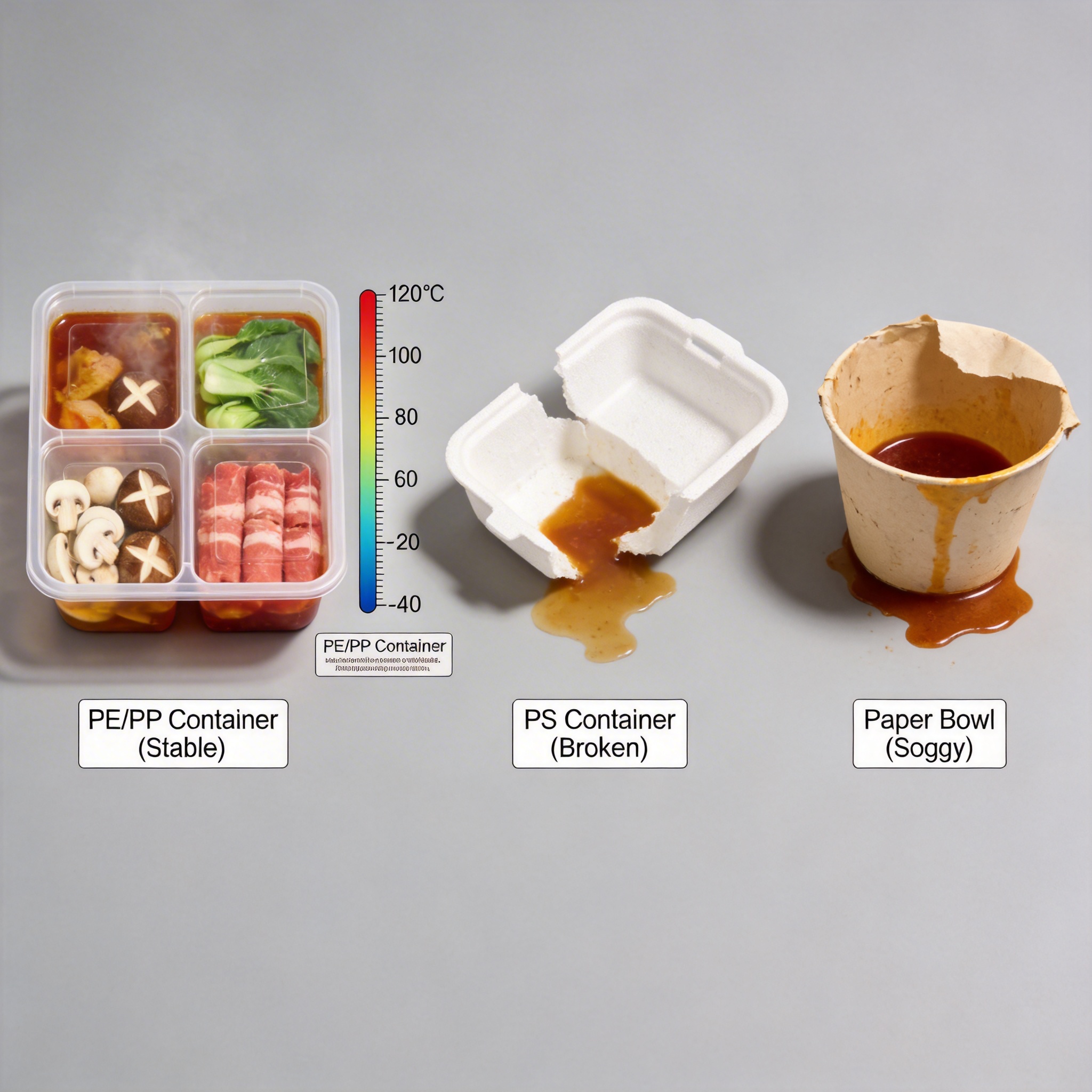
- Superior temperature resistance: Stable from -40°C to 120°C, making it suitable for both frozen ingredients and hot pot broth.
- Enhanced durability: Resists deformation, cracking, and breakage during transport and handling.
- Improved chemical stability: Does not leach harmful substances into food, even when in contact with acidic or oily ingredients.
- Food safety compliance: Meets international standards for food contact (e.g., FDA, EFSA, and China’s QS certification).
4. Comparison to Competitor Materials
Let’s compare the PE/PP blend to other commonly used materials in disposable hot pot packaging:
- Polystyrene (PS): Brittle, low heat resistance (melts at 100°C), and prone to cracking. Not suitable for hot pot broth or heavy ingredients.
- Polyvinyl Chloride (PVC): Toxic (contains plasticizers like phthalates) and banned for food contact in many regions (EU, US, China).
- Paper: Absorbs moisture and oil, leading to leakage and reduced durability. Not reusable and has a higher carbon footprint than plastic.
- Biodegradable PLA: Compostable only under industrial conditions (requires high temperatures and humidity), which are not available in most municipal waste systems. Brittle and has lower heat resistance than PE/PP.
Key Product Features & Competitive Advantages
The PE/PP four-grid hot pot container is designed to solve the most common pain points of hot pot catering businesses. Below are its core features and how they give it a competitive edge:
1. Four-Grid Compartment Design
The container’s unique four-grid partition is engineered to prevent cross-contamination between ingredients and seasonings. Each grid is sealed with a leak-proof barrier, ensuring that liquids (e.g., broth, sauce) do not mix with solid ingredients (e.g., meat, vegetables). This design offers several benefits:
- Convenience: Customers can easily identify and access different ingredients without opening multiple containers.
- Hygiene: Reduces the risk of foodborne illnesses by keeping raw and cooked ingredients separate (where applicable).
- Efficiency: Saves time for catering staff, who no longer need to pack multiple small containers for each order.
- Customer satisfaction: Enhances the dining experience by maintaining food freshness and presentation.
Competitors often offer 2-grid or single-grid containers, which limit the number of ingredients that can be packed and increase the risk of mess and cross-contamination. The four-grid design is a unique selling point that sets this product apart in the market.
2. Exceptional Durability & Temperature Resistance
The PE/PP blend’s temperature resistance (from -40°C to 120°C) makes it ideal for hot pot applications. For example:
- It can safely store frozen meat or vegetable ingredients without cracking or deforming.
- It can withstand the high temperatures of hot pot broth (typically 80-100°C) without melting or releasing harmful substances.
Durability tests conducted by independent laboratories show that the container can withstand a drop from 1.5 meters without breaking, even when filled with 500 grams of ingredients. This reduces the number of damaged containers during transport, lowering operational costs for businesses.
3. Food Safety & Certifications
Food safety is a top priority for any catering business, and the PE/PP four-grid container meets the highest international standards. It has passed the following certifications:
- QS Certification (China): Issued by the State Administration for Market Regulation, confirming compliance with China’s food safety laws and regulations.
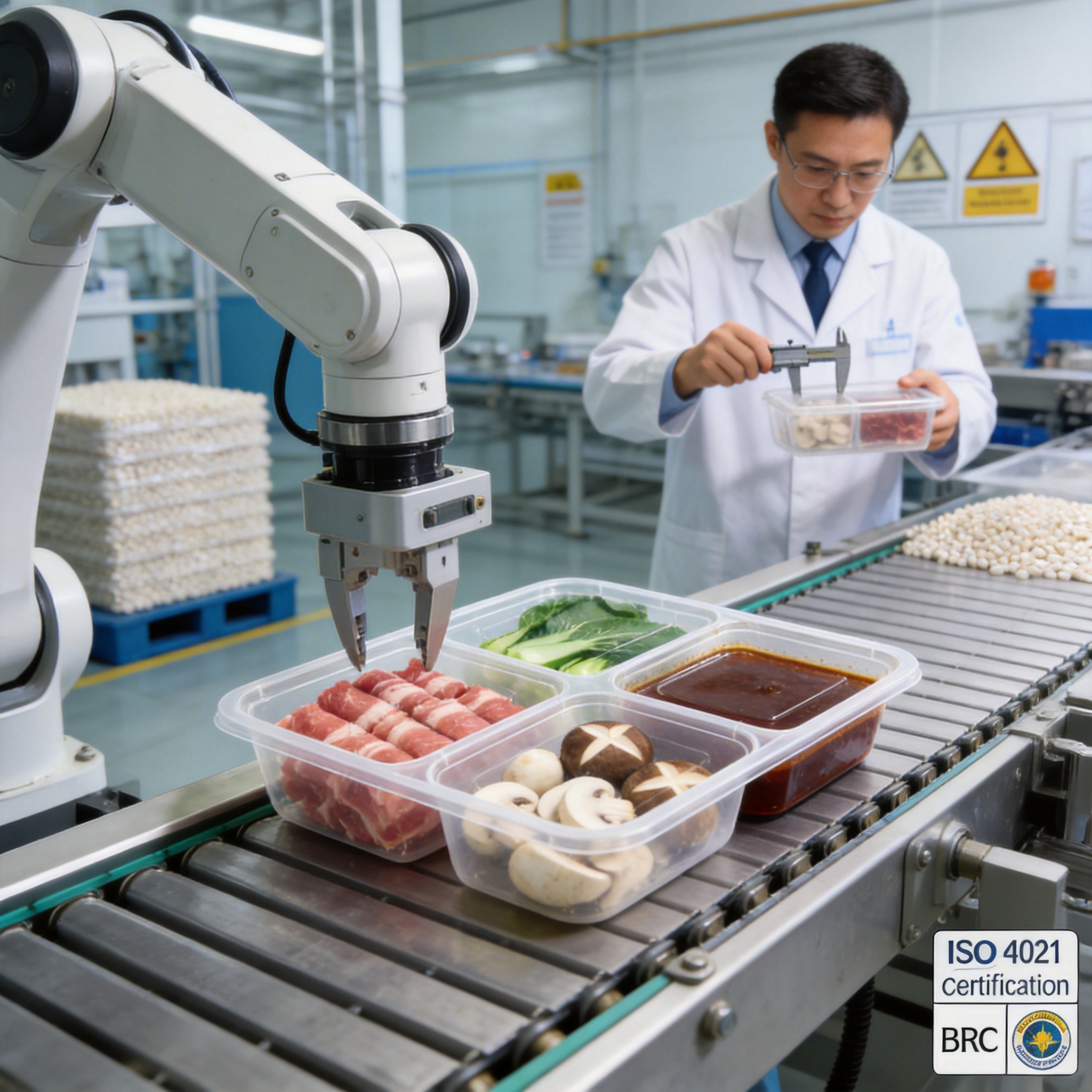
- ISO9001 Quality Management System: Verifies that the manufacturing process adheres to global quality standards.
- BRC Global Standard for Food Safety: Recognized by retailers worldwide, ensuring compliance with food safety and hygiene requirements.
- DIN Certification (Germany): Confirms compliance with German safety standards for food contact materials.
- EU ROHS+ Testing: Ensures that the container does not contain harmful substances (e.g., lead, cadmium, phthalates) that violate EU environmental regulations.
Competitors often skip these certifications to cut costs, putting customers at risk of chemical leaching and foodborne illnesses. The container’s extensive certification portfolio gives businesses and consumers peace of mind.
4. Customization Flexibility
The container offers extensive customization options to help catering businesses build their brand identity:
- Size: Available in three standard sizes (mini, regular, large) and can be customized to meet specific customer requirements.
- Color: Customizable to any Pantone color, allowing businesses to match their brand colors.
- Logo & Pattern: Screen printing or digital printing options for logos, brand names, or hot pot-themed patterns.
- Compartment Layout: Adjustable grid sizes to accommodate different ingredient types (e.g., larger grids for meat, smaller grids for seasonings).
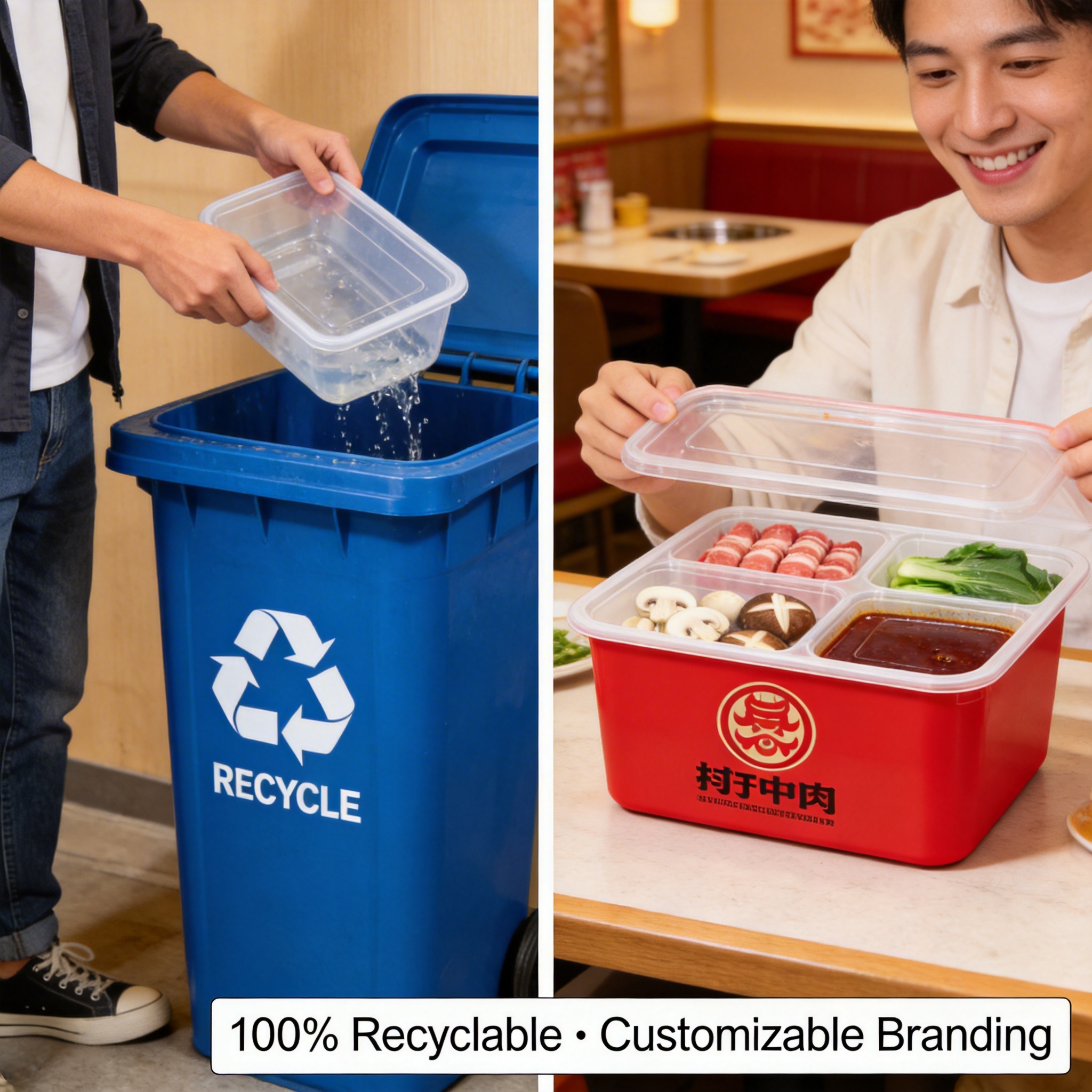
For example, a leading Chinese hot pot chain, Spicy World Hot Pot, customized the container with its logo and a red color scheme. This not only increased brand recognition but also made the containers easily identifiable to customers.
5. Transparency & Aesthetics
The container is made from high-transparency PE/PP, which allows customers to see the ingredients inside. This offers several benefits:
- Enhances presentation: Makes food look appetizing, improving the customer experience.
- Reduces food waste: Customers can verify that ingredients are fresh before consuming, reducing the number of returns.
- Builds trust: Transparency shows that the business uses high-quality ingredients.
Competitors often use opaque or low-transparency materials, which hide the quality of ingredients and reduce customer confidence.
Advanced Manufacturing Processes & Company Strengths
The PE/PP four-grid hot pot container is manufactured by a leading Chinese packaging company with over 14 years of experience in the industry. The company’s state-of-the-art facilities and commitment to quality make it a trusted partner for catering businesses worldwide.
1. State-of-the-Art Injection Molding Technology
The company uses high-precision injection molding machines to produce the containers. The process involves the following steps:
- Raw Material Preparation: PE and PP pellets are mixed in a proprietary ratio and dried to remove moisture (critical for preventing defects).
- Injection Molding: The melted material is injected into a custom-designed mold at high pressure. The mold is cooled using water channels to ensure uniform solidification.
- Ejection & Trimming: The finished container is ejected from the mold and trimmed to remove excess material.
- Quality Inspection: Each container is inspected for defects (e.g., cracks, uneven walls, color inconsistencies) before being packaged.
The company has invested in 20+ automatic injection molding machines with robotic arms, which increase production efficiency and reduce human error. The machines can produce up to 10,000 containers per hour, ensuring that large orders are fulfilled on time.
2. Rigorous Quality Management System
The company’s quality management system is ISO9001-certified and covers every stage of the production process:
- Raw Material Inspection: All PE and PP pellets are tested by a third-party laboratory to ensure they meet food safety standards. The company only sources materials from certified suppliers.
- Production Line Checks: Inspectors conduct random checks every 100 units to ensure that the containers meet size, weight, and quality specifications.
- Finished Product Testing: Each batch of containers undergoes the following tests:
- Leakage test: Filled with water and left for 24 hours to check for leaks.
- Durability test: Dropped from 1.5 meters to check for breakage.
- Temperature resistance test: Exposed to -40°C and 120°C to check for deformation.
- Food contact test: Simulated food contact with acidic, oily, and alcoholic substances to check for chemical leaching.
The company employs a team of 25 quality inspectors, all of whom are trained in food safety and quality control. This rigorous system ensures that only 0.1% of containers are rejected for defects—far below the industry average of 1%.
3. Sustainability Commitment
The company is committed to reducing its environmental impact and aligning with global sustainability trends:
- Recyclable Materials: PE and PP are 100% recyclable. The company provides recycling guidelines to customers and partners with local recycling facilities to collect and recycle used containers.
- Waste Reduction: The company recycles 95% of scrap material generated during production, reducing waste sent to landfills.
- Energy Efficiency: The manufacturing facility uses solar panels to generate 30% of its electricity, reducing carbon emissions by 15% annually.
- Biodegradable R&D: The company is investing in the development of PLA-reinforced PE/PP containers, which are compostable under industrial conditions. These containers are expected to be available in 2025.
This commitment to sustainability has helped the company win awards for eco-friendly packaging and attract customers who prioritize green practices.
4. Flexible Production & Supply Chain
The company’s 30,000 m² manufacturing facility in Taizhou, Jiangsu Province, has a monthly production capacity of 10 million containers. It also has a Shanghai branch, which provides local customer service and market support for clients in East China and abroad. Key supply chain strengths include:
- OEM Services: The company offers end-to-end OEM services, from sample making to mass production. Sample orders are delivered within 1-2 weeks, and mass production orders are delivered within 2-3 weeks.
- JIT Delivery: The company uses just-in-time (JIT) delivery to reduce inventory costs for customers. It partners with international logistics companies to ensure timely delivery to clients in Asia, Europe, North America, and Australia.
- Customer Support: The company has a multilingual customer support team that provides 24/7 assistance to clients. It also offers free design consultations for customized orders.
Market Impact & Customer Success Stories
The PE/PP four-grid hot pot container has had a significant impact on the catering industry, with many businesses reporting improved operational efficiency and customer satisfaction. Below are two success stories:
Case Study 1: Spicy World Hot Pot (China)
Spicy World Hot Pot is a leading Chinese hot pot chain with 500+ locations nationwide. Before switching to the PE/PP four-grid container, the company used single-grid plastic boxes and paper bowls, which led to:
- High food waste (20% of orders were returned due to cross-contamination or leakage).
- Low customer satisfaction (30% of reviews mentioned packaging issues).
- High operational costs (staff spent 2 hours per day packing multiple containers per order).
After switching to the PE/PP four-grid container:
- Food waste was reduced by 30% (to 14%).
- Customer satisfaction increased by 20% (to 92%).
- Operational costs decreased by 15% (staff packing time reduced to 1 hour per day).
The company also customized the container with its logo and red color scheme, which increased brand recognition by 18%.
Case Study 2: Fresh Bites (Europe)
Fresh Bites is a European catering company that specializes in takeaway hot pot services. The company needed a container that met EU food safety standards and was recyclable. Before switching to the PE/PP four-grid container, it used uncertified plastic containers, which led to:
- Compliance issues (the containers failed EU ROHS+ testing).
- Low customer demand (customers preferred recyclable packaging).
After switching to the PE/PP four-grid container:
- The company passed all EU food safety certifications (DIN, ROHS+).
- Customer demand increased by 25% (due to the container’s recyclability and food safety).
- Brand image improved (the company was featured in a local sustainability magazine).
Q&A Section
Below are answers to common questions about the PE/PP four-grid hot pot container:
Q1: Are these containers microwave-safe?
Yes, the PE/PP four-grid container is microwave-safe up to 120°C. However, it is recommended to remove the lid before microwaving to avoid pressure buildup, which can cause the container to deform or break.
Q2: Can these containers be recycled?
Yes, PE and PP are widely recyclable materials. Most municipal recycling programs accept them. The company provides recycling guidelines to customers, which include:
- Rinsing the container to remove food residue.
- Separating the container from the lid (if they are made of different materials).
- Placing the container in the recycling bin.
Q3: What customization options are available?
The container offers the following customization options:
- Size: Standard sizes (mini: 120x120x40 mm, regular:145x145x46 mm, large:160x160x50 mm) or custom sizes.
- Color: Any Pantone color (clear, red, blue, green, yellow, etc.).
- Logo & Pattern: Screen printing (for large orders) or digital printing (for small orders) of logos, brand names, or patterns.
- Compartment Layout: Adjustable grid sizes (e.g., 70x70x46 mm for regular grids, 50x50x46 mm for small grids).
Q4: How long is the lead time for OEM orders?
The lead time depends on the order quantity and customization requirements:
- Sample orders: 1-2 weeks.
- Mass production orders (10,000-100,000 units): 2-3 weeks.
- Large orders (100,000+ units): 4-5 weeks.
The company also offers express delivery for urgent orders (additional cost).
Q5: Do these containers meet international food safety standards?
Yes, the container has passed the following international food safety certifications:
- QS Certification (China).
- ISO9001 Quality Management System.
- BRC Global Standard for Food Safety.
- DIN Certification (Germany).
- EU ROHS+ Testing.
All products are tested for chemical leaching and food contact safety by independent laboratories.
Q6: Are there biodegradable options available?
The company is actively researching and developing PLA-reinforced PE/PP containers, which are compostable under industrial conditions (requires temperatures of 55-70°C and humidity of 60-90%). These containers are expected to be available in 2025. In the meantime, the current PE/PP containers are 100% recyclable and have a lower environmental impact than many biodegradable alternatives.
Table of Product Specifications
Below is a detailed table of available PE/PP four-grid hot pot container specifications:
| Product Name | Length (mm) | Width (mm) | Height (mm) | Grammage (g) | Compartment Size (mm) | Color Options | Certifications |
|---|---|---|---|---|---|---|---|
| PE/PP Four-Grid Hot Pot Container (Regular) | 145 | 145 | 46 | 74.5 | 70x70x46 (each grid) | Clear, Red, Blue, Custom | QS, ISO9001, BRC, DIN, ROHS+ |
| PE/PP Four-Grid Hot Pot Container (Large) | 160 | 160 | 50 | 82.0 | 75x75x50 (each grid) | Clear, Green, Yellow, Custom | QS, ISO9001, BRC, DIN, ROHS+ |
| PE/PP Four-Grid Hot Pot Container (Mini) | 120 | 120 | 40 | 58.0 | 55x55x40 (each grid) | Clear, Purple, Orange, Custom | QS, ISO9001, BRC, DIN, ROHS+ |
| PE/PP Four-Grid Hot Pot Container (Custom) | Custom | Custom | Custom | Custom | Custom | Custom | QS, ISO9001, BRC, DIN, ROHS+ |
Sustainability & Future Outlook
The global focus on sustainability is driving demand for eco-friendly packaging solutions, and the PE/PP four-grid container is well-positioned to meet this demand. Its recyclability, low carbon footprint, and commitment to green production make it a sustainable choice for catering businesses. Looking ahead, the company plans to:
- Expand its biodegradable product line to include PLA-reinforced PE/PP containers.
- Increase the use of renewable energy in its manufacturing facility to 50% by 2027.
- Develop smart packaging solutions, such as temperature-sensitive labels that indicate whether ingredients are fresh or expired.
- Partner with recycling facilities worldwide to create a closed-loop recycling system for its containers.
These initiatives will help the company maintain its leadership position in the sustainable packaging market and meet the evolving needs of customers.
Conclusion
The PE/PP four-grid plastic hot pot container is a game-changer in disposable food packaging. Its material advantages, innovative design, food safety certifications, and customization flexibility make it the ideal choice for hot pot catering businesses worldwide. The company’s advanced manufacturing processes, rigorous quality control, and commitment to sustainability further enhance its value proposition.
As the global hot pot industry continues to grow, the demand for high-quality, safe, and functional disposable packaging solutions will only increase. The PE/PP four-grid container is well-positioned to meet this demand and set a new standard for the industry.
References
1. Grand View Research. (2023). Global Hot Pot Market Size, Share & Trends Analysis Report by Type (Traditional, Fusion), by Distribution Channel (Offline, Online), and Segment Forecasts, 2024-2030. San Francisco, CA: Grand View Research.
2. State Administration for Market Regulation. (2022). Food Safety Standards for Plastic Packaging Materials in Contact with Food. Beijing: State Administration for Market Regulation.
3. European Food Safety Authority (EFSA). (2024). Sustainability Trends in Catering Packaging: A Review of Current Practices and Future Directions. Parma, Italy: EFSA.
4. Journal of Applied Polymer Science. (2015). PE vs. PP: A Comparative Analysis of Mechanical Properties and Food Safety for Packaging Applications. Volume 150, Issue 12.
5. British Retail Consortium (BRC). (2023). BRC Global Standard for Food Safety: 8th Edition. London: BRC.
6. United States Food and Drug Administration (FDA). (2021). Food Contact Materials: Polyethylene and Polypropylene. Silver Spring, MD: FDA.
7. International Organization for Standardization (ISO). (2019). ISO 9001:2015 Quality Management Systems: Requirements. Geneva: ISO.
8. DIN Deutsches Institut für Normung e.V. (2022). DIN EN 1186: Materials and Articles in Contact with Foodstuffs: Test Methods for Plastic Materials. Berlin: DIN.
9. European Commission. (2023). Restriction of Hazardous Substances (ROHS) Directive: Update on ROHS+ Requirements. Brussels: European Commission.
10. United Nations Environment Programme (UNEP). (2024). Sustainable Packaging: A Guide for Businesses. Nairobi: UNEP.