English
 Español
 عربى
عربىContent
- 1 Product Overview: A Four-Grid Container Designed for Hot Pot Takeaway
- 2 Key Product Specifications
- 3 Material Advantages: Why PE and PP Are Suitable for Hot Pot Containers
- 4 Four-Grid Structure: Practical Separation for Better Dining
- 5 Competitive Advantages Over Ordinary Takeaway Containers
- 6 Food Safety and Certification Strength
- 7 Advanced Manufacturing Processes and Production Control
- 8 Research and Development Capability
- 9 Customization for Food Brands and Catering Operators
- 10 Applications in the Hot Pot and Takeaway Market
- 11 Operational Benefits for Restaurants and Distributors
- 12 Environmental Responsibility and Material Efficiency
- 13 Quality Control from Raw Material to Finished Container
- 14 Why Manufacturer Strength Matters for OEM Buyers
- 15 Design Aesthetics and Consumer Experience
- 16 Packaging Performance in Delivery Conditions
- 17 Use Scenarios and Menu Ideas
- 18 Q&A Section
- 18.1 What is the PE/PP four-grid plastic hot pot container mainly used for?
- 18.2 What are the main advantages of the four-grid design?
- 18.3 Why are PE and PP suitable materials for this container?
- 18.4 How does this container compare with ordinary single-compartment takeaway bowls?
- 18.5 Can the container be customized?
- 18.6 What certifications support the manufacturer’s quality capability?
- 18.7 Is the container suitable for chilled food?
- 18.8 How does transparency improve the product’s value?
- 18.9 Why is manufacturer experience important for OEM packaging?
- 18.10 How does the product support environmental responsibility?
- 19 Conclusion: A Specialized Container for the Next Stage of Hot Pot Takeaway
- 20 References
- 21 Product: PE/PP four-grid plastic hot pot container
Hot pot has moved far beyond the boundaries of traditional dine-in restaurants. It is now a popular takeaway, delivery, catering, and ready-to-cook meal format, creating a growing need for packaging that can keep ingredients separated, presentable, hygienic, and convenient. The PE/PP four-grid plastic hot pot container is designed for this modern catering environment. It combines a practical partition structure, food-grade plastic materials, reliable dimensional stability, and a clean transparent appearance to support restaurants, hot pot chains, meal-prep brands, supermarkets, and food delivery operators.
This container belongs to the takeaway bowls category and is developed for applications where multiple ingredients, sauces, soup bases, condiments, or prepared food portions need to be placed in one compact package without mixing. Its four-grid design solves a common problem in hot pot takeaway packaging: customers want variety, but operators need speed, cleanliness, and predictable packing efficiency. By separating four portions in one container, the product improves presentation while simplifying the overall packaging process.
The container is made from PE and PP materials, two widely used plastics in food packaging because of their balance of toughness, chemical stability, low-temperature resistance, impact resistance, and food-contact safety. Compared with ordinary single-compartment takeaway containers, the four-grid hot pot container offers better portion organization and a more premium user experience. Compared with low-quality thin-wall alternatives, it is designed to resist deformation, cracking, odor transfer, and unstable stacking, which are important factors for professional foodservice operations.
Yuqian Packaging Technology (Jiangsu) Co., Ltd. manufactures this product with a focus on food safety, consistency, and customization. Established in 2010 and located in Taizhou City, Jiangsu Province, the company operates a 30,000-square-meter plant and specializes in the research, development, production, and sales of new food packaging materials and products. Its certifications include QS national industrial product production license, ISO9001 quality management system certification, BRC certification, German DIN safety certification, and EU ROHS+ testing, reflecting a strong manufacturing foundation for disposable food packaging containers.
PE/PP four-grid plastic hot pot container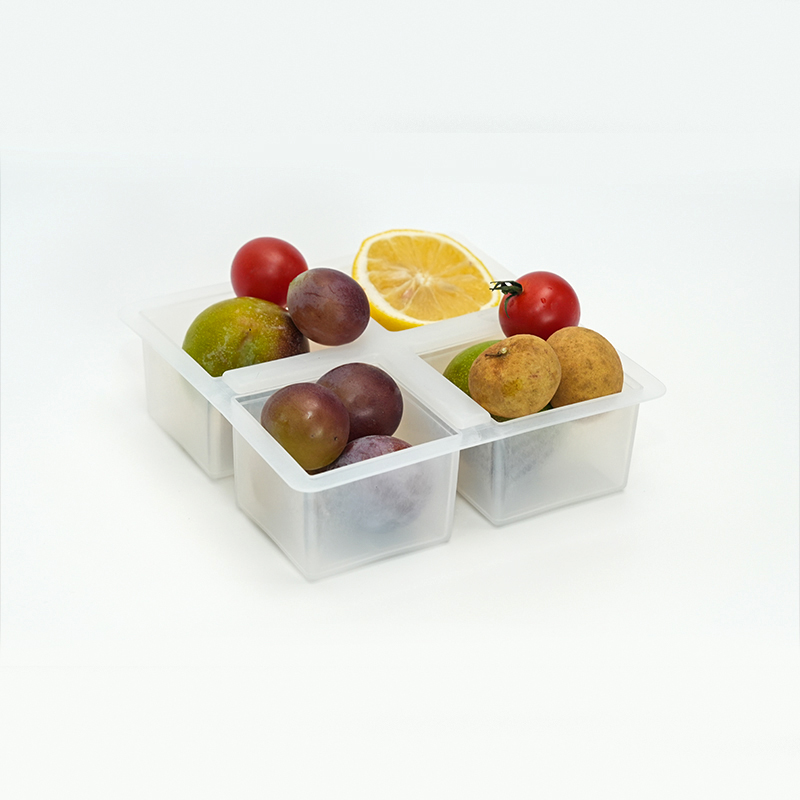
Product Overview: A Four-Grid Container Designed for Hot Pot Takeaway
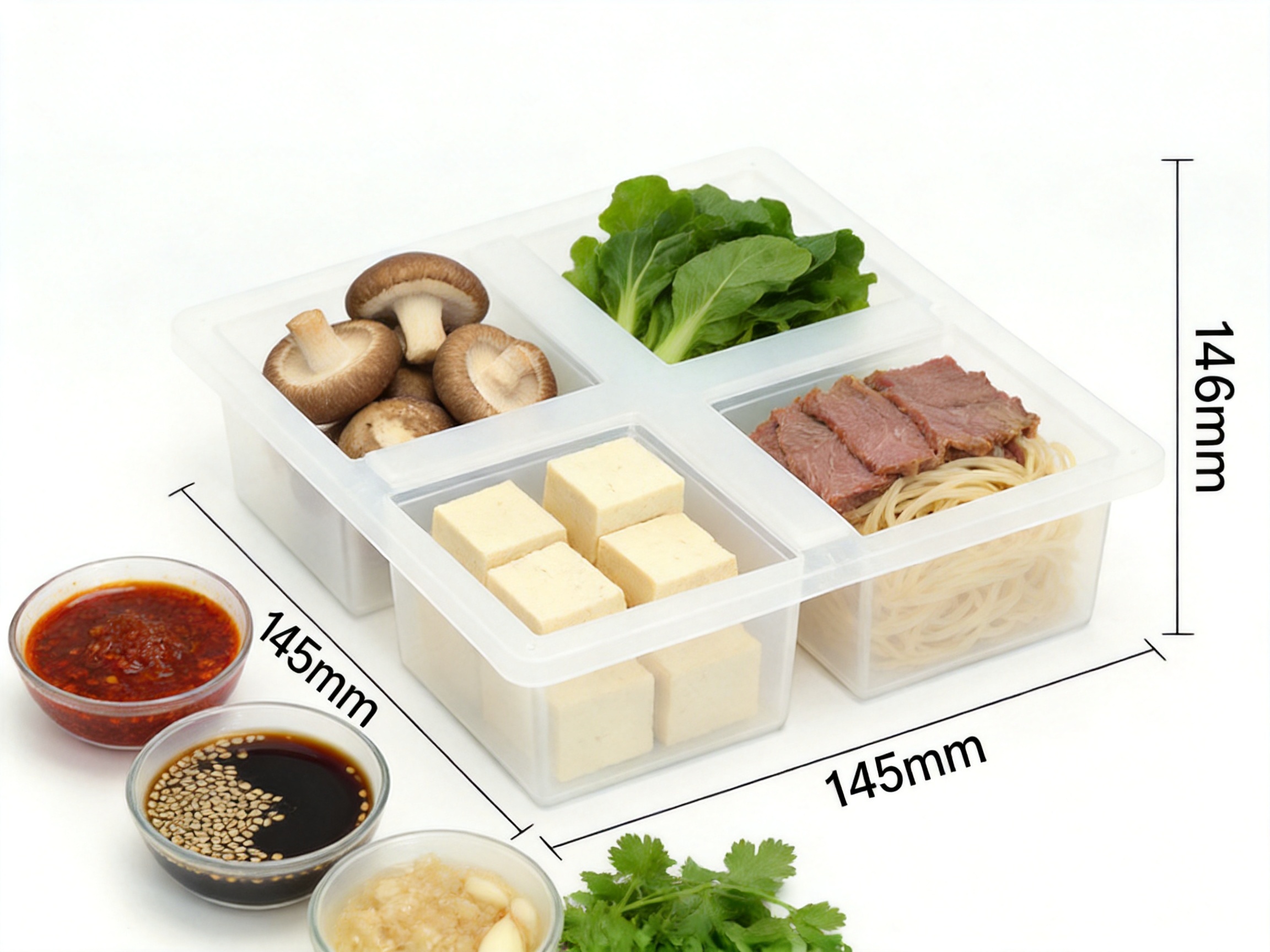
The PE/PP four-grid plastic hot pot container is a square food packaging solution with four internal compartments. The available product specification described in the provided information is 145 mm in length, 145 mm in width, 46 mm in height, and approximately 74.5 g in grammage. This size makes it suitable for sauces, sliced ingredients, side dishes, seasonings, prepared hot pot components, small meal combinations, and promotional tasting sets.
Its four-grid structure is the central design feature. Hot pot service often involves a wide variety of ingredients: vegetables, mushrooms, meat slices, tofu products, seafood, noodles, dipping sauces, spice blends, and soup base components. When these ingredients are packed together without separation, the result may be messy, visually unattractive, or less hygienic. The four-grid format keeps items organized and reduces unwanted contact between different food types.
The container is also designed to support consumer expectations for modern takeaway food packaging. Customers increasingly judge food quality not only by taste but also by packaging appearance, cleanliness, convenience, and perceived safety. A transparent or highly clear container allows customers to view the contents before opening, making the food more attractive and reassuring. For restaurants and food brands, this visibility can enhance presentation and help communicate freshness.
Because the container is made from PE/PP material, it has good toughness and is not easy to deform under normal handling conditions. This is especially important during delivery, when packages may be stacked, carried, tilted, or exposed to changing temperatures. A container that loses shape can create leakage, poor lid fit, or unsatisfactory customer experiences. The PE/PP four-grid hot pot container is developed to maintain a stable shape and offer dependable performance in real operating conditions.
Key Product Specifications
| Product Name | Length | Width | Height | Grammage | Primary Application |
| PE/PP Four-Grid Plastic Hot Pot Container | 145 mm | 145 mm | 46 mm | 74.5 g | Hot pot takeaway, ingredient separation, sauces, side dishes, meal combinations |
The specification reflects a compact yet practical packaging format. The 145 mm by 145 mm square footprint supports efficient stacking, carton packing, storage, and takeaway bag arrangement. The 46 mm height provides enough depth for multiple food portions while keeping the package easy to handle. The 74.5 g grammage indicates a stable container body suitable for professional catering use where packaging must feel secure rather than flimsy.
Material Advantages: Why PE and PP Are Suitable for Hot Pot Containers
PE, or polyethylene, and PP, or polypropylene, are both important food packaging materials. They are valued for their stability, durability, and adaptability in different processing methods. In hot pot packaging, the container must handle ingredients with varying moisture levels, oils, seasonings, and temperatures. PE and PP offer a combination of properties that supports safety and performance.
One of the major advantages is low-temperature resistance. Hot pot takeaway does not only involve warm food; many ingredients are packed chilled or stored in refrigerated environments before consumption. Thin or brittle packaging can crack in cold conditions, especially during transport or when handled quickly by restaurant staff. The PE/PP structure helps the container maintain toughness in lower temperatures, reducing the risk of breakage.
Another advantage is odor neutrality. Food packaging must not introduce unpleasant smells that interfere with the food experience. The product is described as non-toxic and odorless, meeting international food safety expectations. This is particularly relevant for hot pot ingredients because many components have delicate flavors, and packaging odor can negatively affect customer perception.
Chemical stability is also important. Hot pot foods may include chili oil, vinegar-based sauces, garlic condiments, fermented seasonings, and spicy soup bases. Packaging used for such foods must resist interaction with ordinary food acids, oils, and seasonings under appropriate conditions. PE and PP are widely used because they provide reliable compatibility for many foodservice applications.
Compared with some lower-grade disposable packaging, PE/PP containers offer better toughness and more consistent molding. Inferior packaging may become soft, warped, or uneven, especially if production control is weak. A stable PE/PP hot pot container, produced under disciplined manufacturing conditions, helps restaurants avoid problems such as poor stacking, lid mismatch, compartment deformation, and customer complaints.
Four-Grid Structure: Practical Separation for Better Dining
The most visible advantage of this product is its four-grid design. A single container can hold four different ingredients or seasonings at the same time. This is useful for hot pot meal sets, tasting combinations, dipping sauce packages, condiment kits, and prepared ingredient assortments. Instead of using four separate small cups or bowls, operators can use one integrated container, saving packing time and creating a more organized presentation.
For consumers, the four-grid structure improves the eating experience. A customer can identify each ingredient easily, avoid unwanted mixing, and control when to add each item to the soup or meal. This is aligned with the culture of hot pot dining, where individual selection and ingredient timing are part of the enjoyment. The packaging does not merely hold food; it supports the ritual of eating hot pot.
For foodservice operators, separated compartments support accurate portion control. Each grid can be assigned a specific ingredient weight or sauce volume, reducing inconsistency among orders. Portion control is critical for restaurants because it affects cost, customer satisfaction, and kitchen workflow. A four-grid container can standardize packing routines and make staff training easier.
The design also improves hygiene. When raw or semi-prepared ingredients, condiments, and side dishes are packed in a controlled manner, cross-contact can be reduced within the container. While operators must still follow proper food safety procedures, packaging separation provides an additional practical layer of organization. This can be especially useful for delivery hot pot sets that include multiple textures and flavors.
Competitive Advantages Over Ordinary Takeaway Containers
Many standard takeaway bowls are designed for one food type. They may perform well for rice, soup, salad, or noodles, but they are less suited to hot pot packaging where variety is essential. The PE/PP four-grid hot pot container addresses a more specific market need. It allows a brand to offer curated ingredient combinations in one package while keeping food visually appealing and functionally separated.
Compared with multiple single-use sauce cups, a four-grid container may reduce packing complexity. Staff do not need to locate and fill several small containers, match several lids, and place them loosely in a bag. One integrated container is easier to count, seal, stack, and deliver. In a busy takeaway environment, saving even a few seconds per order can improve service speed and reduce errors.
Compared with thin and low-cost alternatives, this container emphasizes good toughness and shape stability. Containers that deform easily can create poor customer experiences. A warped package may look cheap, may not stack securely, and may cause lid separation during transport. Professional hot pot brands need packaging that protects both food and reputation. The PE/PP four-grid structure offers a more reliable solution for operators who care about consistent quality.
Compared with opaque packaging, high-transparency material improves appearance and ornamental value. Visibility is powerful in food sales. When customers can see cleanly separated ingredients, bright vegetables, rich sauces, and neatly arranged portions, they are more likely to perceive freshness and quality. This visual effect is particularly valuable for online food delivery photos, retail displays, and premium takeaway sets.
Compared with generic containers, OEM customization provides a stronger brand fit. Yuqian Packaging Technology can provide customized solutions in multiple sizes according to customer requirements. Custom packaging helps restaurants create differentiated experiences, match product lines, and support brand identity. The ability to develop tailored packaging is a major advantage for chains, supermarkets, catering suppliers, and private-label food companies.
Food Safety and Certification Strength
Food packaging is not only a physical container; it is part of the food safety system. A hot pot container must be produced from suitable raw materials, manufactured under controlled conditions, inspected for quality, and delivered in a way that protects cleanliness. The PE/PP four-grid plastic hot pot container is made from high-quality food-grade raw materials and is described as non-toxic and odorless.
The manufacturing company has passed multiple recognized certifications and testing systems. The QS national industrial product production license supports regulated production. ISO9001 quality management system certification indicates that the company has established systematic quality processes. BRC certification is widely recognized in food-related supply chains and reflects attention to production standards. German DIN safety certification and EU ROHS+ testing further demonstrate a commitment to safety, quality, and compliance expectations.
These certifications matter because buyers of disposable food packaging containers often serve regulated markets. Restaurants, distributors, supermarket chains, and food manufacturers may need to verify that packaging suppliers can meet quality and safety requirements. A supplier with established certifications can reduce procurement risk and provide stronger documentation support.
The company has also established a complete quality management system covering raw material procurement, production processing, and finished product inspection. Every link is expected to follow international standards and customer requirements. Advanced testing equipment and a professional quality inspection team help ensure that each container meets or exceeds customer expectations.
Advanced Manufacturing Processes and Production Control
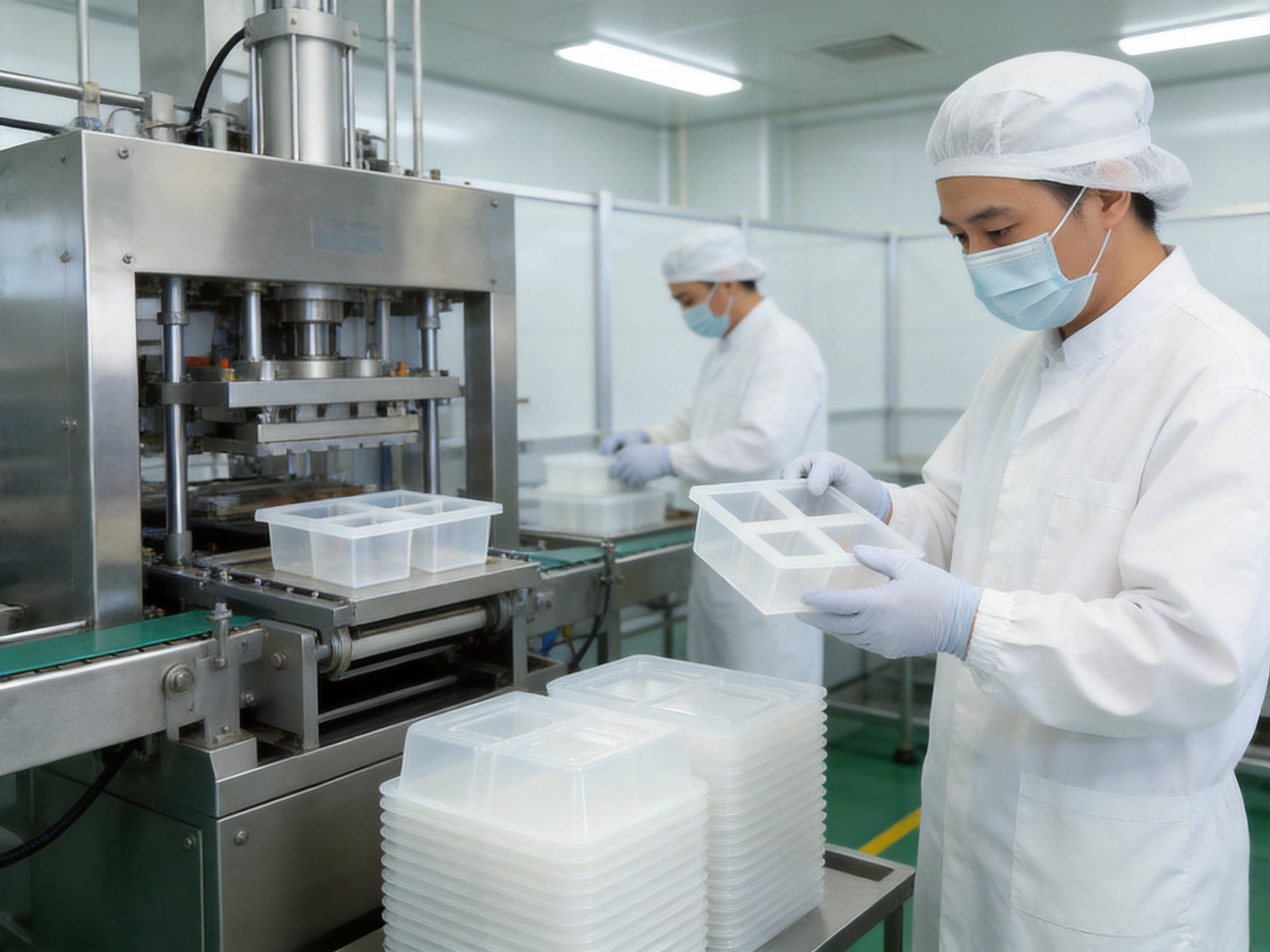
A high-quality plastic food container depends on more than material selection. Manufacturing control determines whether the finished product has consistent dimensions, smooth edges, stable compartments, reliable stacking performance, and attractive appearance. Yuqian Packaging Technology focuses on research, development, production, and sales of new food packaging materials and products, supported by a large production facility and an experienced technical team.
The production process begins with raw material selection. Food-grade PE and PP materials must be chosen according to product performance requirements, safety needs, processing suitability, and customer specifications. Incoming materials are checked to ensure that they meet internal standards before entering production. This stage is important because material inconsistency can cause color variation, brittleness, odor, or unstable molding.
Material preparation and processing are then controlled according to production requirements. For plastic packaging containers, temperature, pressure, mold design, cooling, forming speed, and trimming accuracy can all affect final quality. A well-managed production line reduces defects such as uneven thickness, weak corners, rough edges, surface marks, and dimensional drift. The four-grid structure especially requires stable forming because the internal partition walls must be shaped accurately.
Mold design is another core factor. A four-grid container is more complex than a simple round bowl because it includes multiple compartments, corners, partition intersections, and stacking surfaces. The mold must support smooth demolding, balanced material distribution, and clean compartment definition. A strong research and development team composed of senior designers and engineers helps improve new designs, new materials, and new processes.
Finished product inspection is the final protection layer. Containers can be checked for size, weight, appearance, strength, odor, cleanliness, and packing quantity. Professional quality inspection helps detect issues before shipment and maintains consistency across batches. For customers who require OEM packaging, such control is especially valuable because large-volume orders must remain uniform from the first carton to the last.
Research and Development Capability
The market for disposable food packaging is constantly changing. Consumers want packaging that is safer, more attractive, more convenient, and more environmentally responsible. Foodservice brands want containers that improve efficiency and presentation while controlling cost. The development of the PE/PP four-grid plastic hot pot container reflects this trend toward specialized packaging solutions rather than one-size-fits-all products.
The company has a research and development team made up of experienced designers and engineers. This team explores new designs, new materials, and new processes for PE/PP four-grid plastic hot pot containers. Through continuous innovation, the company has launched hot pot containers with unique partition designs and personalized appearances to meet different consumer needs.
R&D capability is important for OEM customers because packaging often needs adjustment. A restaurant chain may need a different compartment ratio. A supermarket may require a container that fits shelf displays. A meal-kit company may want a structure compatible with automated filling. A regional distributor may need packaging that performs under particular storage and transport conditions. Strong design and engineering support makes these projects more achievable.
Innovation also affects sustainability. The company actively responds to environmental protection policies and follows the principle of green production. It uses environmentally friendly PE and PP materials, works to reduce energy consumption and waste emissions, and is committed to research and development of biodegradable and recyclable hot pot containers. This direction is important as global food packaging buyers increasingly evaluate suppliers by environmental responsibility as well as price and performance.
Customization for Food Brands and Catering Operators
Customization is one of the most valuable services in the disposable food packaging industry. Food brands compete not only through recipes but also through experience. Packaging color, size, transparency, compartment layout, and overall shape can influence customer perception. The PE/PP four-grid plastic hot pot container can be part of a customized packaging system for brands seeking a more distinctive market presence.
Yuqian Packaging Technology provides customized solutions with multiple sizes to meet diverse needs. This capability is important because hot pot operations vary widely. A premium hot pot takeaway set may require larger compartments for sliced meat and vegetables. A sauce-focused brand may prefer smaller equal grids. A school or office meal program may need compact packaging for side dishes. A retail product may require packaging that fits standard shelves and cartons.
Customization can also support operational efficiency. Packaging dimensions should align with filling lines, storage racks, refrigerator space, delivery bags, and outer cartons. If a container looks good but wastes space or stacks poorly, it can increase logistics costs. A supplier with OEM experience can help customers balance visual appeal, material use, strength, and supply chain efficiency.
Personalized packaging may also improve brand recognition. Even without complex decoration, a distinctive compartment layout or container profile can become associated with a food brand. Clear, neat, and stable packaging communicates professionalism. For hot pot businesses, where ingredients are colorful and varied, the right container can turn ordinary takeaway into a more memorable dining experience.
Applications in the Hot Pot and Takeaway Market
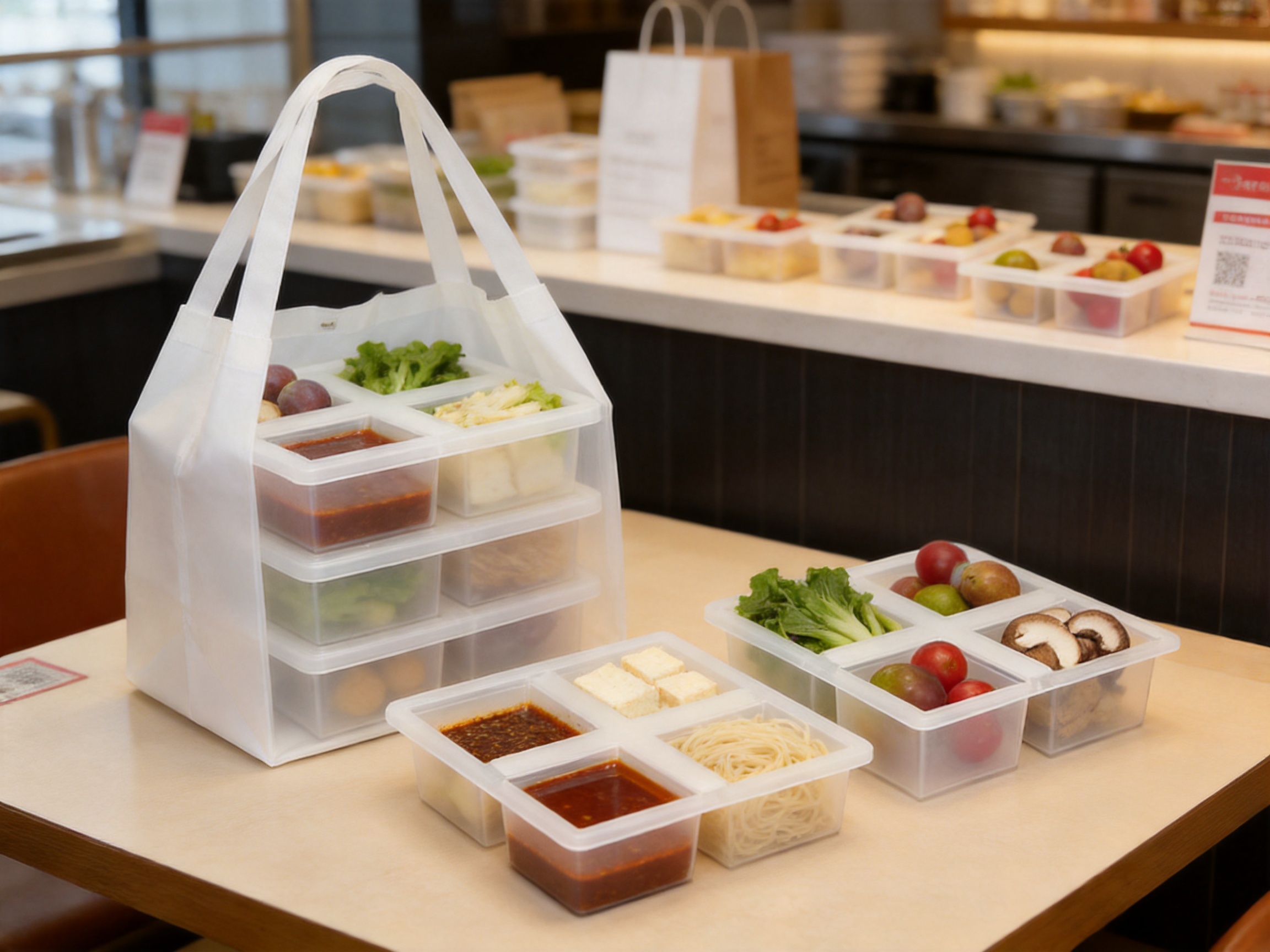
The PE/PP four-grid plastic hot pot container is especially suitable for hot pot delivery and takeaway. It can be used for divided ingredient sets, seasoning combinations, sauce assortments, side dish selections, and ready-to-cook meal components. A restaurant can pack mushrooms, leafy vegetables, tofu, and noodles in one container. Another operator can use it for chili oil, sesame sauce, garlic paste, and chopped herbs. The same packaging format can support many menu structures.
Beyond hot pot, the container may be used for other takeaway foods that benefit from separation. Examples include barbecue side dishes, salad toppings, snack platters, dipping sauces, sushi condiments, lunch box components, fruit assortments, dessert toppings, and prepared meal kits. The key function is controlled separation in a compact package.
Food delivery platforms have increased demand for packaging that remains attractive after transport. Customers often judge delivered meals immediately after opening the bag. If sauces have spilled or ingredients have mixed, the product may receive negative feedback even if the food tastes good. A four-grid container helps preserve order and presentation, which can support better customer satisfaction.
Retail food businesses can also benefit. Supermarkets and convenience stores may use four-grid containers for chilled ready-to-cook hot pot assortments or small combination packs. High transparency helps customers view product contents on the shelf. Clear compartment separation can make products look richer and more carefully prepared, supporting impulse purchasing.
Operational Benefits for Restaurants and Distributors
Restaurants need packaging that supports speed, accuracy, cleanliness, and cost control. The four-grid container helps staff pack multiple items at once. It reduces the need to handle multiple small containers and can simplify inventory management. Instead of stocking many different small cups for every sauce and ingredient, operators may use one versatile container for many menu items.
Stackability is another important operational benefit. A square 145 mm by 145 mm footprint can be efficient for storage and transport. Consistent dimensions help staff arrange containers neatly in preparation areas and delivery bags. Predictable packing reduces clutter during rush periods and helps maintain kitchen organization.
Distributors need products that are consistent, easy to carton, and suitable for broad customer use. The four-grid hot pot container can serve many foodservice categories, making it a flexible inventory item. Its combination of transparency, toughness, and partition design gives distributors a product that appeals to restaurants, catering services, food factories, and retail meal suppliers.
For chain brands, consistency across locations is essential. If every store uses the same container specification, customer experience becomes more uniform. Centralized procurement from a professional OEM manufacturer can reduce variation and ensure that packaging quality remains stable across batches and regions.
Environmental Responsibility and Material Efficiency
Environmental awareness is increasing among consumers and businesses. Disposable food packaging must now balance convenience with responsible material use and end-of-life considerations. PE and PP are widely used plastics with established recycling potential in many systems, depending on local infrastructure. The company is also committed to biodegradable and recyclable packaging research, supporting the long-term direction of greener food packaging.
The four-grid design can contribute to material efficiency by replacing multiple separate small containers in some applications. While exact savings depend on the packing method and menu format, an integrated multi-compartment container may reduce the number of separate lids and bodies needed for certain orders. This can simplify waste handling for consumers and reduce packaging complexity for operators.
Green production is also part of environmental responsibility. The company adheres to the principle of green manufacturing and works to reduce energy consumption and waste emissions in the production process. For buyers, supplier practices matter because sustainability is increasingly evaluated across the entire supply chain, not only at the final product level.
Responsible packaging selection should consider food safety, product protection, material performance, customer experience, and local recycling conditions. A container that prevents spills and food waste can also contribute to sustainability, because wasted food often has a larger environmental impact than packaging itself. Strong, reliable packaging helps protect the resources already invested in food preparation.
Quality Control from Raw Material to Finished Container
Quality control begins before production. Raw materials must be sourced from qualified suppliers and checked for suitability. Food-grade material selection helps ensure that the final container is safe for intended food-contact applications. This step supports the product’s non-toxic and odorless characteristics.
During production, process parameters must be controlled. Temperature, forming pressure, cycle time, trimming accuracy, and cooling conditions can influence container strength and appearance. A four-grid container requires particular attention because each compartment must form cleanly and uniformly. Weak partition points or uneven corners can affect usability.
After production, finished containers are inspected. Common inspection concerns include dimension accuracy, surface cleanliness, wall uniformity, odor, deformation, stacking fit, and weight consistency. The listed grammage of 74.5 g provides a reference for material use and product stability. Consistent grammage helps ensure predictable strength and handling performance.
Packaging and warehousing are also part of quality control. Finished products must be packed to avoid contamination and deformation during storage and transport. Professional carton packing, batch tracking, and warehouse management help ensure that customers receive containers in good condition.
Why Manufacturer Strength Matters for OEM Buyers
OEM buyers need more than a product; they need a reliable manufacturing partner. Disposable food packaging orders often involve strict timelines, large volumes, regulatory requirements, and customized specifications. A supplier without adequate production capacity or quality systems may create delays, inconsistencies, or compliance concerns.
Yuqian Packaging Technology was established in 2010 and has developed experience in food packaging materials and products. Its 30,000-square-meter plant provides a strong production base. The company integrates research and development, production, and sales, enabling it to support customers from concept and sample development to mass production and delivery.
The company’s Shanghai branch, established in January 2019, supports service quality and business channel expansion. For customers, this reflects an effort to improve communication, market response, and service coverage. Effective service is important because packaging projects may require technical consultation, sample revisions, specification confirmation, and after-sales support.
Flexible production lines and efficient supply chain management allow the company to respond quickly to customer needs. This is especially valuable in the foodservice industry, where seasonal promotions, new menu launches, and market demand changes can create urgent packaging requirements. A professional OEM manufacturer can help customers move faster without sacrificing quality control.
Design Aesthetics and Consumer Experience
Packaging design has become an important part of catering culture. Consumers increasingly value not only the food itself but also how it is presented. The PE/PP four-grid plastic hot pot container supports a cleaner and more personalized dining experience by combining separation, visibility, and compact design.
High transparency improves the ornamental value of the product. Bright vegetables, colorful sauces, fresh mushrooms, and neatly sliced ingredients can be displayed clearly. This visual appeal is important for hot pot because variety and abundance are part of the attraction. Good packaging can make a takeaway meal feel more generous and carefully prepared.
The partition design also supports personalization. Restaurants can create themed ingredient sets, regional flavor combinations, spicy and non-spicy sauce assortments, vegetarian packs, children’s portions, or premium add-on kits. The container becomes a flexible tool for menu innovation.
Convenience is another major part of consumer experience. A customer can open one container and access four components without searching through several small cups. The package is easier to store in a refrigerator and easier to place on a dining table. This practical convenience can improve repeat purchase behavior.
Packaging Performance in Delivery Conditions
Delivery creates stress for food packaging. Containers may be stacked, shaken, tilted, compressed, or exposed to outdoor temperatures. Poor packaging can turn a well-prepared meal into a disappointing delivery experience. The PE/PP four-grid hot pot container is designed with toughness and dimensional stability to reduce such risks.
Low-temperature resistance is especially useful for chilled hot pot ingredients. Many ingredients should remain cool until cooked. Packaging that becomes brittle in low-temperature environments can crack during handling. PE/PP material helps maintain toughness and supports cold-chain or refrigerated applications where appropriate.
Good shape retention supports lid compatibility. Although the provided material focuses on the container body, in practical use the relationship between container and lid is critical. A deformed container may fail to seal properly. Stable molding and consistent dimensions help maintain better closure performance when paired with suitable lids.
Impact resistance matters during transport. Delivery riders and logistics workers handle many orders quickly. A container with better toughness is less likely to break from ordinary knocks and pressure. This helps protect food appearance, reduce leakage risk, and maintain customer confidence.
Use Scenarios and Menu Ideas
The four-grid hot pot container can be used creatively across different foodservice formats. A traditional hot pot restaurant may use it for a standard condiment kit containing sesame paste, chopped garlic, scallions, and chili oil. A premium restaurant may use it for four signature dipping sauces. A supermarket may use it for a vegetable combination pack containing mushrooms, greens, tofu, and noodles.
Meal-kit companies can use the container for recipe components that customers cook at home. Four compartments can separate spice mix, dried ingredients, sauce base, and garnish. This organized format helps customers follow cooking instructions and reduces preparation time.
Catering companies can use the container for event service, employee meals, or buffet support. It can hold condiments, toppings, desserts, snacks, or mini side dishes. The transparent design allows staff and guests to identify contents quickly.
Restaurants outside the hot pot category can also adapt the container. For example, a barbecue restaurant can pack pickles, dipping sauce, garlic, and chili powder. A salad shop can pack nuts, dressing, cheese, and dried fruit separately. A dessert brand can pack toppings such as fruit, syrup, pearls, and cookie crumbs. The packaging structure supports many portioned food experiences.
Q&A Section
What is the PE/PP four-grid plastic hot pot container mainly used for?
It is mainly used for hot pot takeaway, ingredient separation, sauce assortments, condiment kits, side dishes, and meal combinations. Its four compartments allow different foods or seasonings to be packed in one container without unwanted mixing.
What are the main advantages of the four-grid design?
The four-grid design improves organization, hygiene, presentation, and portion control. It helps restaurants pack multiple ingredients efficiently and helps customers enjoy a cleaner, more convenient dining experience.
Why are PE and PP suitable materials for this container?
PE and PP are widely used food packaging materials because they offer toughness, low-temperature resistance, chemical stability, odor neutrality, and reliable food-contact performance. These properties make them suitable for hot pot ingredients, sauces, and chilled takeaway applications.
How does this container compare with ordinary single-compartment takeaway bowls?
Single-compartment bowls are suitable for one food type, but they do not separate ingredients. The four-grid hot pot container is better for varied meals, sauce sets, and hot pot combinations because it keeps components organized and visually appealing.
Can the container be customized?
Yes. The manufacturer provides customized solutions in multiple sizes and can support OEM requirements. Customization can include dimensions, compartment design, appearance, and packaging solutions based on customer needs.
What certifications support the manufacturer’s quality capability?
The company has passed QS national industrial product production license, ISO9001 quality management system certification, BRC certification, German DIN safety certification, and EU ROHS+ testing. These certifications support professional food packaging production and quality management.
Is the container suitable for chilled food?
Yes. The product features low-temperature resistance and good toughness, making it suitable for many chilled ingredient and refrigerated takeaway applications when used under proper foodservice conditions.
How does transparency improve the product’s value?
High transparency allows customers to see the food clearly. This improves presentation, communicates freshness, and supports premium takeaway and retail display applications.
Why is manufacturer experience important for OEM packaging?
OEM packaging requires design support, stable production, quality inspection, delivery reliability, and customization capability. An experienced manufacturer with a strong quality system can reduce procurement risk and support long-term supply.
How does the product support environmental responsibility?
The container uses PE/PP materials, and the company follows green production principles while working to reduce energy consumption and waste emissions. It is also committed to research and development of biodegradable and recyclable packaging solutions.
Conclusion: A Specialized Container for the Next Stage of Hot Pot Takeaway
The PE/PP four-grid plastic hot pot container is a practical response to the growth of hot pot takeaway, delivery dining, meal kits, and personalized food packaging. Its four-compartment structure helps separate ingredients, improve hygiene, enhance presentation, and simplify packing. Its PE/PP material provides low-temperature resistance, toughness, odor neutrality, and reliable food-contact suitability.
For restaurants, the container supports faster packing, portion control, cleaner delivery, and stronger menu presentation. For distributors and retail food companies, it offers a versatile product suitable for many food categories. For consumers, it creates a more organized and enjoyable dining experience.
The manufacturing strength behind the product further increases its value. With a 30,000-square-meter production base, an experienced R&D team, advanced quality control, recognized certifications, OEM customization capability, and green production principles, Yuqian Packaging Technology (Jiangsu) Co., Ltd. is positioned to supply professional disposable food packaging solutions for modern catering brands.
As consumers continue to demand convenience, safety, variety, and attractive presentation, specialized packaging will become increasingly important. The PE/PP four-grid plastic hot pot container is not just a container; it is a functional part of the hot pot dining experience, helping foodservice businesses deliver better meals with greater consistency and confidence.
References
1. Food Packaging Materials: Principles, Properties, and Applications. Industry technical literature on polymer packaging and food-contact materials.
2. ISO9001 Quality Management Systems: Requirements and Implementation Guidance. International quality management reference.
3. BRC Global Standard for Packaging Materials. Food packaging safety and quality management reference.
4. Polypropylene and Polyethylene in Food Packaging. Polymer science and packaging engineering reference materials.
5. Sustainable Food Packaging Development: Recycling, Material Efficiency, and Green Manufacturing. Packaging industry environmental reference.