English
 Español
 عربى
عربىContent
- 1 Product Overview
- 2 Why Takeaway Packaging Needs Specialized Carry Bags
- 3 Main Product Features
- 4 Available Types and Application Scenarios
- 5 Advantages Over Ordinary Competitor Bags
- 6 Material Performance and Practical Benefits
- 7 Custom Size Options for Different Order Quantities
- 8 Customized Printing and Brand Exposure
- 9 Manufacturing Strength and Quality Control
- 10 Certifications and Production Reliability
- 11 Research and Development Capabilities
- 12 Environmental Considerations: Recyclable and Reusable Use
- 13 Food Service Hygiene and Clean Presentation
- 14 Operational Efficiency for Restaurants and Beverage Shops
- 15 Compatibility with Disposable Food Packaging Containers
- 16 Design Considerations for Better Bag Performance
- 17 How the Product Supports Brand Differentiation
- 18 Supply Chain Value for Bulk Buyers
- 19 Recommended Buying Process
- 20 Quality Inspection Points
- 21 Q&A Section
- 21.1 What is a PE high-pressure recyclable packaging bag?
- 21.2 Is the bag biodegradable?
- 21.3 What types of products can the bag carry?
- 21.4 Can the bag be customized?
- 21.5 Why is strong sealing important?
- 21.6 How does the bag help with branding?
- 21.7 What makes this product better than ordinary competitor bags?
- 21.8 Who should use this type of packaging bag?
- 21.9 Can the bag be reused by consumers?
- 21.10 What information should buyers provide before ordering?
- 22 Conclusion
- 23 References
PE high-pressure recyclable packaging bags have become an important packaging solution for takeaway drinks, desserts, snacks, light meals, and convenience food service. As food delivery and grab-and-go consumption continue to expand, restaurants, beverage shops, bakeries, coffee chains, supermarkets, and catering brands need packaging that is strong, clean, customizable, convenient, and aligned with responsible material use. A well-designed PE high-pressure recyclable packaging bag is more than a simple carrier; it is a practical tool for order handling, brand communication, operational efficiency, and improved customer experience.
This article focuses on PE high-pressure recyclable packaging bags designed for single-cup, double-cup, four-cup, and multi-item takeaway applications. The bags are made from polyethylene materials with strong sealing performance, smooth surfaces, customizable sizes, durable handles, and recyclable and reusable characteristics. They are especially suitable for beverage chains, milk tea shops, coffee stores, juice bars, dessert shops, fast-food restaurants, and any business that needs reliable takeaway packaging for cups and food containers.
Product Overview
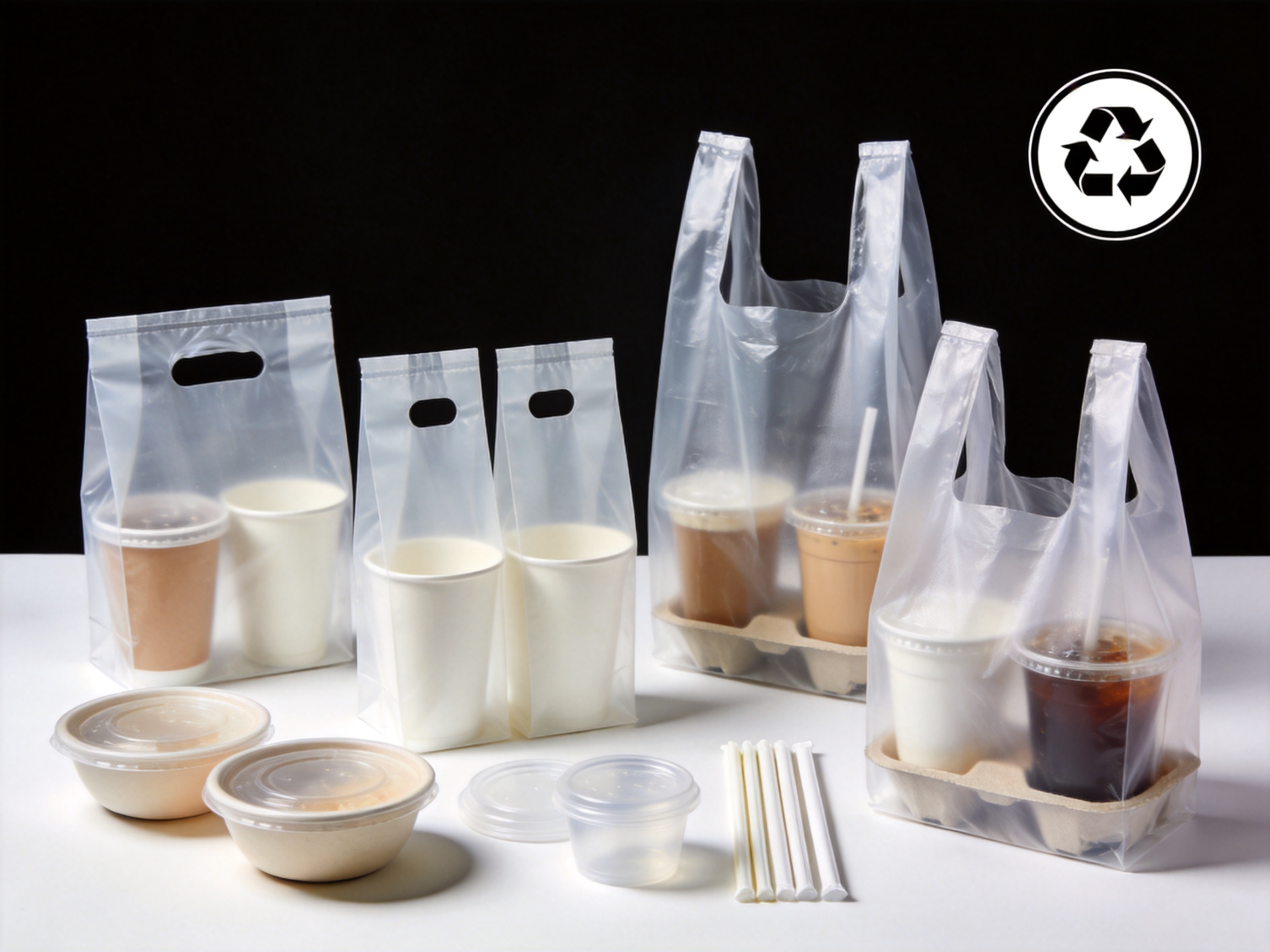
The PE high-pressure recyclable packaging bag is a practical packaging product used to carry beverage cups, takeaway bowls, food boxes, and related disposable food packaging containers. Common styles include single-cup flat bags, double-cup flat bags, single-cup tote bags, double-cup tote bags, four-cup tote bags, and customized carrier structures for different order volumes. The product is designed to keep takeaway items organized, easy to transport, and presentable when delivered to customers.
The core material is PE, a widely used polymer known for flexibility, moisture resistance, smooth texture, and dependable processability. The term “high-pressure” generally refers to the production characteristics associated with low-density polyethylene processing, which can produce flexible, soft, and resilient films suitable for packaging applications. In takeaway packaging, these properties are useful because the bag must be lightweight but strong enough to carry cups, bowls, lids, straws, and small food items without tearing easily.
Unlike ordinary thin bags that may stretch, split, or look rough, a well-manufactured PE high-pressure recyclable packaging bag offers balanced thickness, stable sealing, and comfortable handling. The bag can be manufactured in multiple sizes and shapes according to the client’s packaging needs. For example, a single-cup beverage shop may need a compact flat bag for one drink, while a restaurant delivering family orders may need a larger handle bag that supports multiple bowls or containers.
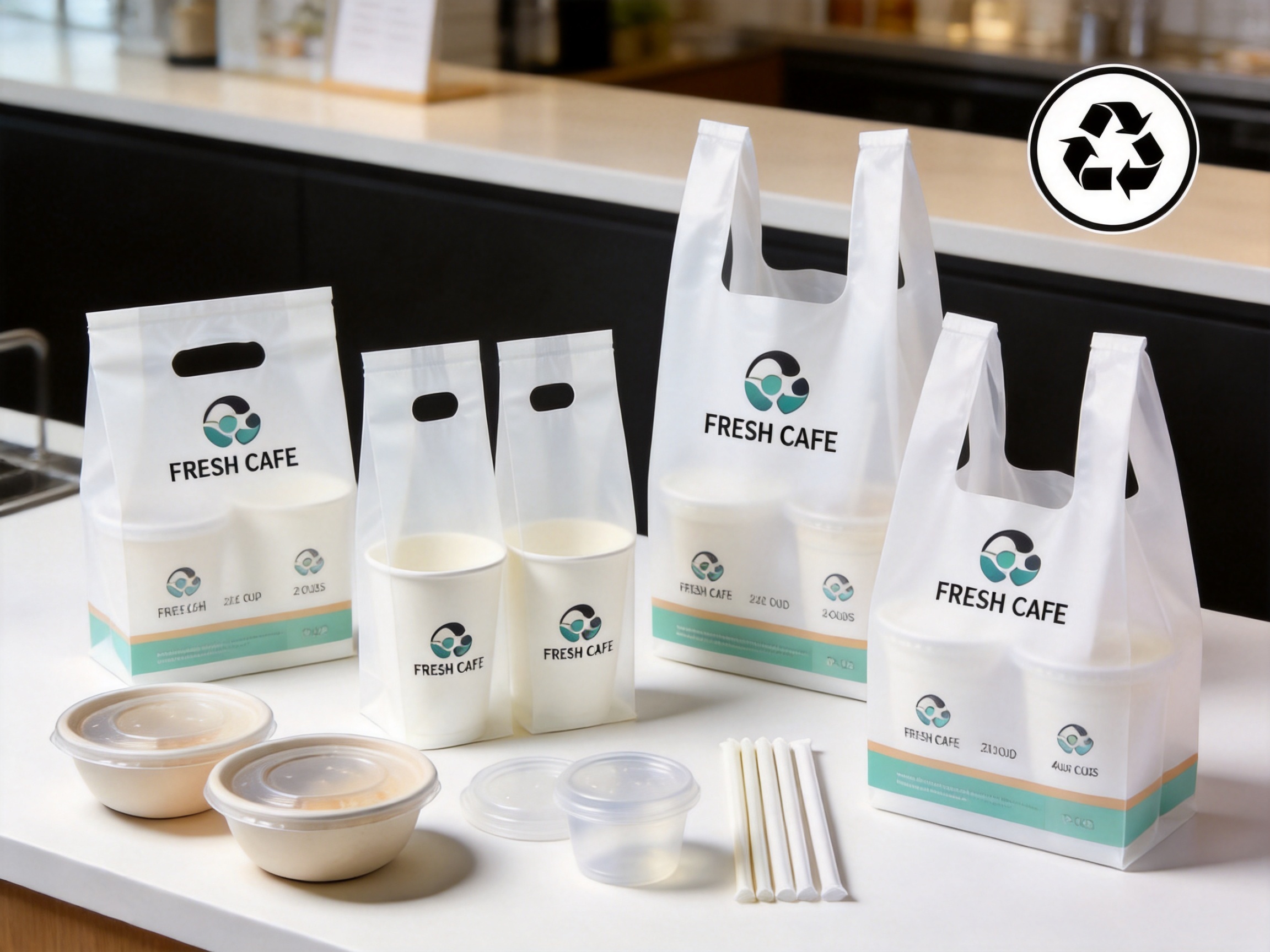
The product is also suitable for customized printing. Businesses can print logos, slogans, seasonal promotions, QR codes, menu highlights, limited-time offers, store information, or visual brand elements on the outer surface. Because the surface is smooth and less likely to absorb stains, printed graphics can appear clean and professional when the bag is properly designed and produced.
Why Takeaway Packaging Needs Specialized Carry Bags
Takeaway packaging faces several challenges. Drinks must remain upright, containers must be protected from contamination, staff must pack orders quickly, and customers expect convenient carrying. A poorly selected bag can lead to spills, broken handles, weak sealing, unpleasant appearance, or negative customer impressions. For beverage and food brands, packaging failure may damage not only the product but also the brand’s reputation.
Specialized PE high-pressure recyclable packaging bags help solve these problems by providing a reliable outer carrying solution. The bag holds packaged items together, reduces direct hand contact with cups or containers, improves order separation, and makes takeaway service more efficient. In busy shops, staff can prepare orders faster when the bag size matches the product format. In delivery operations, couriers benefit from organized packaging that is easier to pick up, carry, and place into insulated delivery boxes.
For consumers, the value is simple: the order is easier to carry, the handle feels dependable, and the packaging appears clean. The customer may not always notice the technical details, but they will notice when a bag breaks or when a drink is inconvenient to transport. This makes the bag a silent but important part of the overall service experience.
Main Product Features
The PE high-pressure recyclable packaging bag offers several features that make it suitable for modern food and beverage packaging. These include environmental friendliness through recyclability and reusability, strong sealing, customizable size, durable handles, smooth external surfaces, and the ability to support branded printing.
First, the bag is recyclable and reusable. Although it is not biodegradable, its recyclability provides an important route for material recovery when collected and handled through proper recycling systems. Reusability also allows consumers to use the bag more than once, reducing the need for immediate disposal after a single trip.
Second, the sealing strength is important for structural stability. Strong heat sealing helps the bag maintain shape and load-bearing performance. Weak sealing is a common problem in low-grade bags, especially around handles, side edges, and bottom seams. A well-controlled sealing process improves safety and user confidence.
Third, size customization allows the bag to match the customer’s actual packaging portfolio. Beverage cups, plastic cup lids, takeaway bowls, disposable straws, and other peripheral products come in different shapes and dimensions. A customized bag can reduce wasted space, improve carrying stability, and create a more polished takeaway presentation.
Fourth, the handle is designed for durability and convenience. The handle must resist tearing when users lift cups or food containers. A comfortable and reinforced handle reduces carrying stress and helps customers transport their purchases more safely.
Fifth, the smooth outer surface helps the bag remain neat and visually appealing. It is not easy to absorb stains, which is valuable in food service environments where condensation, sauces, sugar, coffee, and oil may be present.
Available Types and Application Scenarios
PE high-pressure recyclable packaging bags can be produced in multiple formats. The most common structures include single-cup flat bags, double-cup flat bags, single-cup tote bags, double-cup tote bags, and four-cup tote bags. Each format is designed for a specific ordering situation and customer journey.
A single-cup flat bag is ideal for coffee, milk tea, juice, smoothies, and other beverages sold individually. It keeps one cup protected and makes it easy for customers to take the drink away. A double-cup flat bag is useful when two drinks are purchased together, such as in lunch orders, office orders, or couple purchases. A single-cup tote bag provides a more premium carrying feel and can be used for heavier cups or larger drink sizes. A double-cup tote bag improves order grouping for two beverages or a drink plus a small food item. A four-cup tote bag is suitable for group orders, family orders, office delivery, and promotional beverage sets.
Beyond beverage cups, the bags can also be used with takeaway bowls and food boxes. For example, a noodle shop may use a larger tote-style bag for bowls with sealed lids. A dessert store may pack pudding cups, yogurt cups, or fruit cups in a compact printed bag. A fast-food outlet may use the bag to carry a small meal combination with cups, straws, napkins, and sealed containers.
| Bag Type | Typical Use | Main Advantage | Suitable Business |
|---|---|---|---|
| Single-cup flat bag | One beverage cup | Compact, economical, easy to store | Coffee shops, tea shops, juice bars |
| Double-cup flat bag | Two beverage cups | Improves order grouping and carrying convenience | Milk tea chains, cafes, takeaway counters |
| Single-cup tote bag | One larger drink or premium beverage | Stronger handle feel and better presentation | Specialty beverage brands, dessert shops |
| Double-cup tote bag | Two cups or one cup plus small food item | Balanced capacity and convenient handling | Restaurants, bakeries, beverage stores |
| Four-cup tote bag | Group beverage orders | Supports higher-volume takeaway and delivery | Office delivery, family orders, chain stores |
Advantages Over Ordinary Competitor Bags
Compared with ordinary competitor bags, a high-quality PE high-pressure recyclable packaging bag offers stronger practicality, better customization, more stable processing quality, and improved brand presentation. Many low-cost bags on the market are produced mainly for general use rather than beverage and food service. They may be too thin, poorly sealed, inconsistent in size, or difficult to print clearly. These issues become visible in real takeaway operations.
One major advantage is the balance between flexibility and load-bearing strength. Ordinary bags may feel stiff but tear at the seal, or they may feel soft but stretch excessively under weight. A carefully engineered PE bag can provide flexibility while maintaining enough strength for beverage cups and food containers. This is especially important when cups contain hot coffee, cold milk tea, or liquid-based meals where spills create safety and cleanliness concerns.
Another advantage is size precision. Generic bags are often supplied in standard dimensions that may not fit the brand’s cup and bowl system. If a bag is too large, the cup may tilt and the package may look untidy. If it is too small, staff may struggle to insert the product, slowing service and increasing the risk of damage. Custom sizing helps create a better match between the bag and the disposable food packaging container.
Printing quality is also a key differentiator. Competitor bags may provide limited printing options, inconsistent color control, or surfaces that do not support clean branding. A smooth PE surface produced with good film control supports better visual results. For food and beverage businesses, every takeaway bag becomes a moving advertisement, so reliable printing can create long-term brand exposure.
Durable handles give another competitive edge. Many bags fail at the handle because the stress is concentrated around the hand opening or reinforced area. A better bag design considers handle shape, sealing strength, film thickness, and expected load. This improves customer confidence and reduces complaints.
Finally, recyclable and reusable characteristics support responsible packaging choices. While not biodegradable, the bag can be recycled and reused under appropriate conditions. Compared with low-grade disposable bags that are quickly discarded and difficult to recover, a better-designed recyclable bag supports more thoughtful material use.
Material Performance and Practical Benefits
PE is valued in packaging because it is lightweight, flexible, moisture resistant, and relatively strong in film form. For takeaway operations, these characteristics translate into several practical benefits. The bag can resist moisture from cold drinks, condensation, wet counters, and light exposure to food service liquids. It can also provide a clean barrier between the packaged product and the external environment.
Moisture resistance is particularly important for cold beverages. Ice drinks, milk tea, fruit tea, and bottled juices often generate condensation. Paper-based carriers may soften when wet, while unsuitable plastic materials may become slippery or weak. PE high-pressure recyclable packaging bags maintain flexibility and help protect the product during short-distance carrying and delivery.
The lightweight nature of PE also benefits logistics and storage. Bags can be stacked, packed, and transported efficiently, reducing storage space compared with rigid carriers. This is useful for chain stores and distributors that need to manage high-volume packaging inventory. Lightweight packaging also reduces unnecessary transportation burden while still serving its protective function.
Flexibility helps the bag adapt to different products. A cup may have a dome lid, flat lid, straw hole, sealing film, or sleeve; a bowl may have a raised lid or sealing rim. Flexible PE film can accommodate these differences more easily than rigid outer packaging. When properly sized, the bag wraps around the product without excessive pressure.
Custom Size Options for Different Order Quantities
Custom size availability is one of the strongest advantages of this product. Food and beverage businesses rarely use only one product size. A single store may sell small, medium, and large drinks; hot and cold cups; bowls; boxes; and promotional combinations. If all these products are forced into one standard bag, the result is inefficient and unattractive.
Custom sizing allows each packaging bag to match a defined application. A compact single-cup bag can serve individual customers. A double-cup carrier can fit two standard cups securely. A four-cup tote can support larger orders while maintaining convenience. Larger bags can be developed for bowls, food boxes, or mixed meal sets.
Customization also supports operational efficiency. Staff can quickly choose the correct bag based on the order quantity. This reduces packing time and minimizes confusion during peak business hours. In a busy beverage shop, even a few seconds saved per order can improve throughput and customer satisfaction.
Custom size design can also reduce material waste. A bag that is much larger than necessary uses extra material and creates a loose appearance. A properly sized bag uses material more efficiently while improving product stability. For brands concerned about packaging responsibility, this balance is important.
Customized Printing and Brand Exposure
Packaging is a powerful communication tool. A PE high-pressure recyclable packaging bag can be printed with brand logos, color systems, promotional information, product graphics, slogans, and campaign messages. This transforms a functional carrier into a mobile brand display.
For restaurants and beverage stores, takeaway customers often walk through streets, offices, campuses, shopping centers, and residential areas while carrying their orders. A printed bag can therefore increase brand visibility beyond the point of sale. Compared with plain bags, customized printed bags make the brand easier to remember and help create a more professional image.
Customized printing also supports seasonal campaigns. A beverage brand can print summer fruit tea promotions, winter hot drink messages, holiday designs, anniversary graphics, or limited-edition artwork. Promotional printing encourages repeat purchases and makes packaging part of the marketing plan.
For chain stores, consistency is essential. Printing helps ensure that all locations present the same visual identity. When the bag design matches cups, lids, straws, takeaway bowls, and other peripheral products, the entire packaging system feels unified. This is especially useful for brands trying to build recognition in competitive food service markets.
Manufacturing Strength and Quality Control
The performance of a packaging bag depends not only on material but also on manufacturing control. Yuqian Packaging Technology (Jiangsu) Co., Ltd. was established in 2010 and is located in Taizhou City, Jiangsu Province, China. With a plant area of about 30,000 square meters, the company focuses on research and development, production, and sales of new food packaging materials and products. Its experience in disposable food packaging containers, plastic cups, plastic cup lids, takeaway bowls, disposable straws, recycle bags, peripheral products, and injection film lining cup and bowl boxes gives it a broad understanding of food service packaging systems.
Advanced manufacturing strength begins with material selection. Suitable PE raw materials must be chosen according to film performance requirements such as softness, transparency or color, tensile strength, sealing response, printability, and load-bearing needs. Stable raw material management helps ensure that each production batch performs consistently.
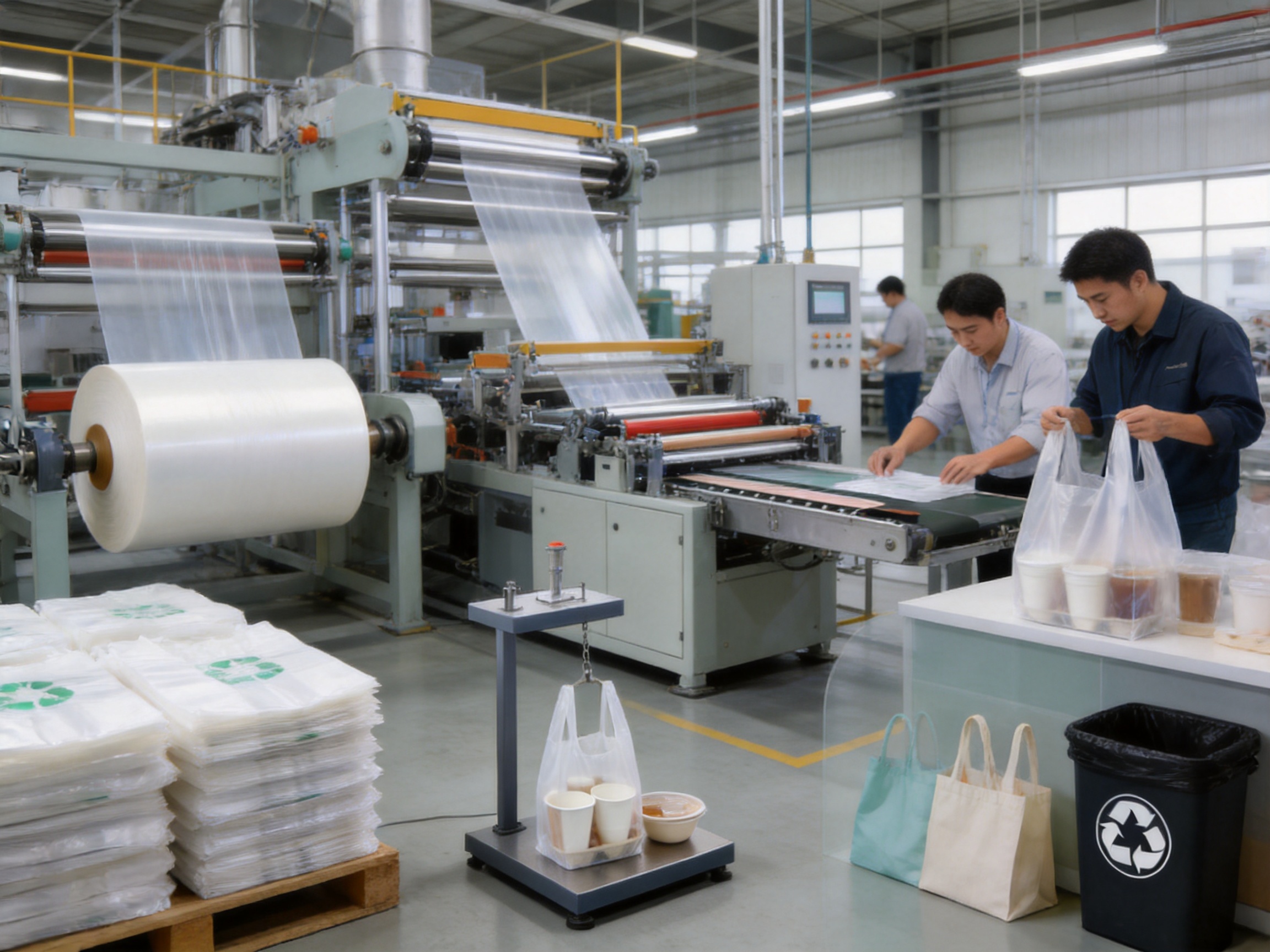
Film production requires careful control of thickness, width, surface smoothness, and mechanical properties. Uneven film may cause weak points, inconsistent printing, or poor sealing. Modern production processes help create stable film quality so that the finished bag can perform reliably in real use.
Cutting and bag-making processes must also be controlled. Dimensions, handle positions, seal width, side edges, and opening design all affect user experience. A small defect in the sealing line can become a failure point when the bag is carrying drinks. Therefore, strict process inspection is necessary.
Printing requires attention to ink adhesion, color consistency, registration, and design clarity. A printed takeaway bag must look good while resisting normal handling. When branding is important, poor printing can reduce the perceived value of the product. Professional production capabilities allow customized designs to be translated into clean finished bags.
Certifications and Production Reliability
Food packaging clients often require reliable production systems and compliance awareness. Yuqian Packaging Technology (Jiangsu) Co., Ltd. has passed important certifications and assessments, including QS national industrial product production license, ISO 9001 quality management system certification, BRC certification, German DIN safety certification, and EU RoHS testing. These credentials reflect the company’s emphasis on systematic management, product safety awareness, and manufacturing discipline.
ISO 9001 certification is especially relevant because it indicates that the company operates under a quality management framework. This helps support consistent production, process documentation, corrective actions, and customer-focused improvement. For business buyers, a quality management system reduces the risk of unstable supply and unpredictable performance.
BRC certification is widely recognized in packaging and food-related supply chains. It reflects attention to hygiene, safety, traceability, and operational control. For food and beverage brands, working with a manufacturer familiar with these requirements can simplify supplier evaluation.
RoHS testing and DIN-related safety certification further demonstrate that the company pays attention to material safety and international expectations. Although exact requirements depend on the target market and application, such certifications provide additional confidence for buyers seeking responsible packaging suppliers.
Research and Development Capabilities
R&D capability is important because packaging needs continue to change. Consumer expectations, delivery platforms, brand design trends, sustainability targets, and food service formats all influence packaging choices. A manufacturer with research and development strength can respond faster to market needs than a supplier that only produces standard items.
For PE high-pressure recyclable packaging bags, R&D may involve improving film strength, optimizing handle design, enhancing seal performance, developing new sizes, adjusting surface treatment for printing, or creating better packaging combinations for cups and bowls. It may also include coordination with related products such as plastic cup lids, disposable straws, takeaway bowls, and injection film lining cups and bowl boxes.
Because the company produces multiple categories of disposable food packaging containers, it can better understand how the bag interacts with the full packaging set. For example, the required bag width may depend on cup lid diameter. The required height may depend on whether a straw is inserted or separately packed. The required handle strength may depend on whether the bag carries drinks, bowls, or mixed items. This system-level knowledge supports better product design.
R&D also supports customization for different markets. A local beverage shop may need economical single-cup bags, while an international chain may require strict color matching, multiple sizes, and coordinated packaging for all stores. A capable manufacturer can develop solutions for both simple and complex requirements.
Environmental Considerations: Recyclable and Reusable Use
The PE high-pressure recyclable packaging bag is non-biodegradable, recyclable, and reusable. This distinction is important. Biodegradable and recyclable are not the same concept. A biodegradable product is designed to break down under certain conditions, while a recyclable product is designed so that material can be collected and processed into new material streams where recycling infrastructure exists. PE is a well-established recyclable plastic in many systems, although actual recycling depends on local collection, sorting, contamination levels, and market conditions.
Reusability adds practical environmental value. If consumers reuse the bag for carrying other items, lunch boxes, small groceries, or household goods, the product’s functional life is extended. A stronger bag is more likely to be reused than a weak one. Therefore, durability is not only a convenience feature but also a sustainability-related feature.
Compared with very thin single-use bags that are easily torn and immediately discarded, a stronger recyclable PE bag can reduce wasteful repeat consumption. When properly designed, it can provide the required carrying function without unnecessary overpackaging. The best approach is balanced: use enough material for safety and reuse potential, but avoid excessive thickness that adds unnecessary resource use.
Businesses can also support environmental communication through printed instructions. For example, the bag can encourage consumers to reuse it or recycle it according to local rules. Clear communication helps customers make better disposal choices.
Food Service Hygiene and Clean Presentation
Clean packaging presentation is essential for food service. A smooth PE surface helps reduce stain absorption and makes the bag appear cleaner during handling. This is useful in restaurants and beverage stores where counters may be exposed to sugar syrup, coffee drops, sauces, water, and condensation.
The bag also helps reduce direct contact with cups and containers after packing. Staff can place sealed beverages or bowls inside the bag, and customers or couriers can carry the bag rather than touching every item. This supports a neater handover process.
A clean-looking bag improves customer perception. Even when the food inside is excellent, poor packaging can create doubts about hygiene and professionalism. On the other hand, a smooth, printed, well-sealed bag contributes to a more reassuring purchase experience.
Operational Efficiency for Restaurants and Beverage Shops
Operational efficiency is a major reason to choose specialized packaging bags. In food service, speed and consistency matter. Staff must pack orders quickly during rush hours while avoiding errors and spills. A packaging bag that is easy to open, easy to fill, and suitable for the product size can reduce handling time.
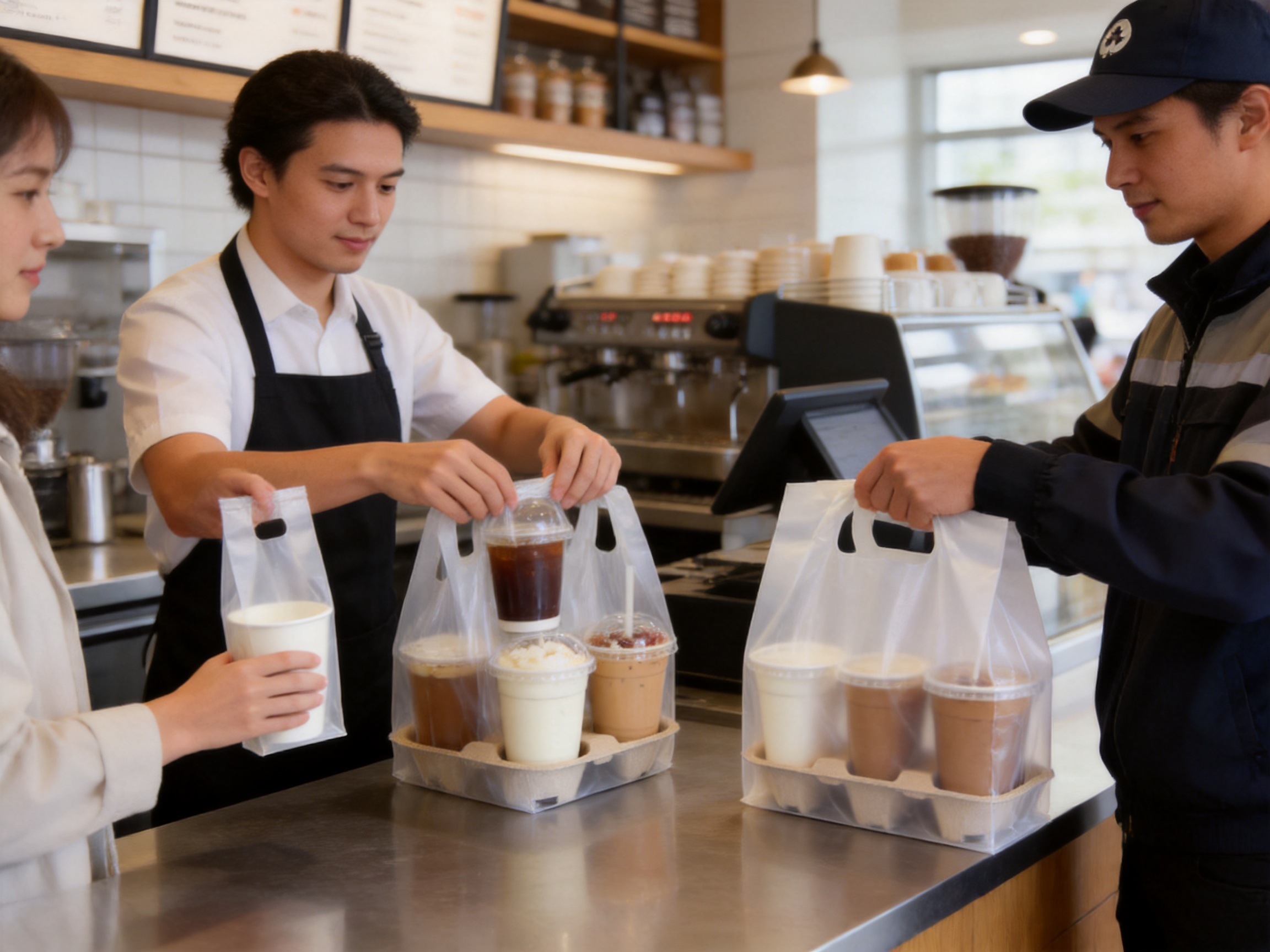
Single-cup and double-cup bags are especially useful at beverage counters. When customers order drinks to go, staff can immediately place them into the correct bag. The customer receives a ready-to-carry product, and the line moves faster. For delivery orders, staff can group items by order number and reduce mix-ups.
Four-cup tote bags are valuable for group orders. Without a suitable carrier, staff may need multiple separate bags, which increases packing time and makes the order harder to manage. A well-designed multi-cup bag improves organization and can reduce the number of individual packaging pieces used.
Custom printed bags also help staff identify brand-approved packaging. In chain operations, standardized packaging simplifies training and inventory management. Employees know which bag to use for which order type, and managers can maintain consistent service standards.
Compatibility with Disposable Food Packaging Containers
The PE high-pressure recyclable packaging bag belongs to a larger disposable food packaging container ecosystem. It works together with plastic cups, plastic cup lids, takeaway bowls, disposable straws, and peripheral products. This compatibility is important because customers experience the packaging system as a whole, not as separate items.
For drinks, the bag must fit the cup and lid combination. If the cup is tall, the bag must provide enough height. If the lid is wide or domed, the bag must allow enough space. If the drink is sealed with injection film lining, the bag must avoid excessive pressure on the top. For bowls, the bag must allow the container to sit securely and remain easy to carry.
A supplier that understands multiple packaging categories can help customers avoid mismatches. For example, if a cup diameter changes, the bag dimensions may also need adjustment. If a new lid style is introduced, the bag opening may need to be modified. Integrated packaging knowledge helps reduce trial-and-error costs.
Design Considerations for Better Bag Performance
Several design factors influence the final performance of a PE high-pressure recyclable packaging bag. These include film thickness, bag width, bag height, gusset design, handle type, seal structure, printing area, and expected load.
Film thickness must be selected according to use. A bag for one small cup may require less material than a bag carrying four drinks. However, reducing thickness too much can lead to tearing or poor presentation. The goal is to achieve efficient material use while maintaining safety.
Bag width and height must match the product. A good fit helps keep items stable. If the bag is too narrow, products are difficult to insert. If too wide, items may shift. Height must allow proper coverage while leaving the handle comfortable to hold.
Handle design is critical. The hand opening must be positioned correctly and reinforced by the surrounding film structure. A comfortable handle improves user experience, especially when carrying cold drinks over a longer distance. For heavier loads, tote-style handles may be more suitable.
Seal structure determines durability. Bottom seals and side seals must withstand the weight and movement of takeaway products. Heat sealing parameters such as temperature, pressure, and dwell time must be controlled during production to avoid weak seals or excessive melting.
Printing area should be designed around the bag’s shape and folds. Logos and promotional messages should remain visible when the bag is filled. A strong design considers real use, not only flat artwork.
How the Product Supports Brand Differentiation
In competitive food and beverage markets, many products look similar. Packaging helps a brand stand out. A customized PE high-pressure recyclable packaging bag can communicate quality, convenience, cleanliness, and personality. This is especially valuable for beverage brands that depend heavily on visual identity.
A printed bag can match cup graphics, straw packaging, store signage, menu boards, and online delivery images. When customers take photos or share drinks on social media, the packaging becomes part of the image. A plain or poor-quality bag may be ignored, but a well-designed bag can enhance the shareability of the product.
Brand differentiation also comes from practical experience. If customers notice that the handle is comfortable, the bag does not tear, and the order is easy to carry, they associate those positive feelings with the brand. Good packaging creates trust through repeated use.
Supply Chain Value for Bulk Buyers
Bulk buyers need more than a product; they need reliable supply, customization support, quality stability, and responsive service. PE high-pressure recyclable packaging bags are often purchased in large quantities by chain beverage stores, distributors, catering suppliers, and food packaging wholesalers. For these buyers, production capacity and consistency are essential.
With a large manufacturing facility and experience in food packaging categories, Yuqian Packaging Technology (Jiangsu) Co., Ltd. is positioned to serve customers requiring stable batch production. The company’s Shanghai branch, established in 2019 to improve service quality and expand business channels, also reflects its market-oriented development.
For buyers, supplier strength reduces risk. A factory with mature production systems can better manage repeated orders, customized specifications, and quality expectations. It can also assist with design refinement, packaging structure selection, and production planning.
In bulk purchasing, even small improvements in bag design can create large operational benefits. A stronger handle can reduce complaints across thousands of orders. A better size can reduce material waste across millions of pieces. A more consistent print can strengthen brand identity across many stores.
Recommended Buying Process
Businesses interested in PE high-pressure recyclable packaging bags should begin by defining their product application. Important information includes cup size, cup diameter, cup height, bowl size, average order quantity, expected load, desired bag style, printing requirements, and storage conditions.
The next step is size selection or custom development. Buyers should test the bag with actual cups, lids, straws, bowls, and food boxes. Real-use testing is important because packaging performance can change when the product is filled, sealed, cold, hot, or wet from condensation.
Printing design should be prepared with production in mind. Logos, colors, and text should be arranged so they remain visible after the bag is filled. Buyers should consider whether they need one-color printing, multi-color printing, seasonal graphics, or full brand customization.
After sample confirmation, buyers can proceed to production. Quality checks should include size, film appearance, seal strength, handle performance, print quality, and packaging count. For repeat orders, specifications should be documented clearly to ensure consistency.
Quality Inspection Points
Professional buyers can evaluate PE high-pressure recyclable packaging bags by checking several key points. The first is film uniformity. The bag should not have obvious thin spots, holes, wrinkles, or uneven surfaces that affect function or appearance.
The second point is sealing strength. Seals should be even and secure. A quick manual test can reveal whether the bottom or side seams split under normal pressure. For heavier bags, more formal load testing may be useful.
The third point is handle durability. The handle area should resist tearing when lifted with the intended load. The hand opening should feel comfortable and not cut into the user’s fingers excessively.
The fourth point is size accuracy. The bag should fit the intended product without excessive looseness or tightness. Consistent sizing helps store staff work quickly.
The fifth point is printing quality. Printed graphics should be clear, properly positioned, and consistent in color. Ink should be suitable for the intended use and should not easily transfer during normal handling.
Q&A Section
What is a PE high-pressure recyclable packaging bag?
It is a flexible polyethylene packaging bag designed for takeaway beverages, food containers, and related disposable food packaging products. It is commonly used for single-cup, double-cup, four-cup, and customized carrying applications.
Is the bag biodegradable?
No. The product is non-biodegradable, but it is recyclable and reusable. Its environmental value comes from material recovery potential and repeated use when handled properly.
What types of products can the bag carry?
It can carry plastic cups, beverage cups with lids, takeaway bowls, small food boxes, desserts, disposable straws, and similar food service items, depending on the selected size and structure.
Can the bag be customized?
Yes. The bag can be customized in size, style, and printing. Common formats include single-cup flat bags, double-cup flat bags, single-cup tote bags, double-cup tote bags, and four-cup tote bags.
Why is strong sealing important?
Strong sealing helps prevent the bag from splitting at the edges, bottom, or handle area. This improves load-bearing performance and reduces the risk of spills or packaging failure.
How does the bag help with branding?
The smooth outer surface supports customized printing, allowing businesses to display logos, promotional information, campaign graphics, and brand messages. This increases brand exposure whenever customers carry takeaway orders.
What makes this product better than ordinary competitor bags?
Compared with ordinary bags, a well-manufactured PE high-pressure recyclable packaging bag offers better size customization, stronger sealing, more durable handles, smoother surfaces, improved print presentation, and better compatibility with food and beverage packaging systems.
Who should use this type of packaging bag?
It is suitable for coffee shops, milk tea stores, juice bars, restaurants, bakeries, dessert shops, fast-food businesses, delivery brands, supermarkets, food packaging distributors, and catering chains.
Can the bag be reused by consumers?
Yes. Because the bag is designed with durability and practical carrying performance, consumers can reuse it for small items, food containers, or daily carrying needs.
What information should buyers provide before ordering?
Buyers should provide product size, cup or bowl dimensions, expected load, order quantity, bag style, film requirements, printing artwork, color requirements, and target application.
Conclusion
The PE high-pressure recyclable packaging bag is a practical, customizable, and brand-friendly solution for modern takeaway food and beverage service. It combines flexible PE material, strong sealing, durable handles, smooth surfaces, and multiple size options to meet the needs of different order volumes. From single-cup beverages to four-cup group orders and takeaway bowls, the product helps businesses improve convenience, presentation, and operational efficiency.
Its advantages over ordinary competitor bags are clear: better fit, stronger structure, more reliable sealing, improved handle durability, cleaner appearance, and stronger customization potential. These qualities matter in real food service environments where speed, safety, cleanliness, and customer experience are essential.
Manufacturing strength further enhances product value. With experience in disposable food packaging containers, plastic cups, lids, bowls, straws, recycle bags, and related products, Yuqian Packaging Technology (Jiangsu) Co., Ltd. can support customers with integrated packaging knowledge, certified quality management, and advanced production capabilities. For businesses seeking a reliable packaging partner, this combination of product performance and manufacturing expertise provides a strong foundation for long-term cooperation.
As takeaway consumption continues to grow, packaging must do more than simply hold a product. It must protect, organize, communicate, and support responsible material use. PE high-pressure recyclable packaging bags meet these needs by offering a balanced solution for food service brands that value practicality, customization, and professional presentation.
References
Robertson, G. L. Food Packaging: Principles and Practice. CRC Press.
Marsh, K., and Bugusu, B. Food Packaging: Roles, Materials, and Environmental Issues. Journal of Food Science.
Coles, R., McDowell, D., and Kirwan, M. J. Food Packaging Technology. Blackwell Publishing.
Yam, K. L. The Wiley Encyclopedia of Packaging Technology. Wiley.
International Organization for Standardization. ISO 9001 Quality Management Systems: Requirements.
British Retail Consortium. Global Standard for Packaging Materials.
European Commission. Guidance on Packaging, Plastic Materials, and Restricted Substances in Consumer Products.