English
 Español
 عربى
عربىContent
- 1 1. Why Cup Lid Performance Matters in Takeaway Beverage Packaging
- 2 2. Product Overview
- 3 3. Patented Leak-Proof Structural Design
- 4 4. Thickened Material for Better Durability
- 5 5. Food-Grade Safety and Material Selection
- 6 6. Lift-Up Lid and Flat Lid Options
- 7 7. Advantages Over Ordinary Competitor Lids
- 8 8. Manufacturing Strengths and Production Capabilities
- 9 9. Advanced Process Control from Raw Material to Finished Product
- 10 10. Certification and Compliance Orientation
- 11 11. Customization for Beverage Brands and Foodservice Operators
- 12 12. Applications Across the Food and Beverage Industry
- 13 13. Operational Benefits for Buyers
- 14 14. Environmental Considerations
- 15 15. Quality Assurance for International OEM Orders
- 16 16. How to Select the Correct Lid
- 17 17. Installation and Use Recommendations
- 18 18. Why Choose a Specialized Packaging Manufacturer
- 19 19. Q&A: Patented Leak-Proof Thickened Plastic Cup Lids
- 19.1 Q1: What is the main function of this cup lid?
- 19.2 Q2: What lid styles are available?
- 19.3 Q3: What cup opening sizes are offered?
- 19.4 Q4: What colors are available?
- 19.5 Q5: Is the material suitable for food packaging?
- 19.6 Q6: Is the lid recyclable?
- 19.7 Q7: How does the thickened design benefit users?
- 19.8 Q8: Can the lids be customized?
- 19.9 Q9: Can the lids be used for hot and cold beverages?
- 19.10 Q10: What certifications and tests are associated with the manufacturer?
- 19.11 Q11: Does the manufacturer provide samples?
- 19.12 Q12: What information should a buyer provide when requesting a quotation?
- 19.13 Q13: What industries can use these lids?
- 19.14 Q14: Can the manufacturer supply other disposable packaging products?
- 19.15 Q15: Does a leak-proof lid eliminate every possible leak?
- 20 20. Conclusion
- 21 References
- 22 Product: Patented leak-proof thickening plastic cup lid
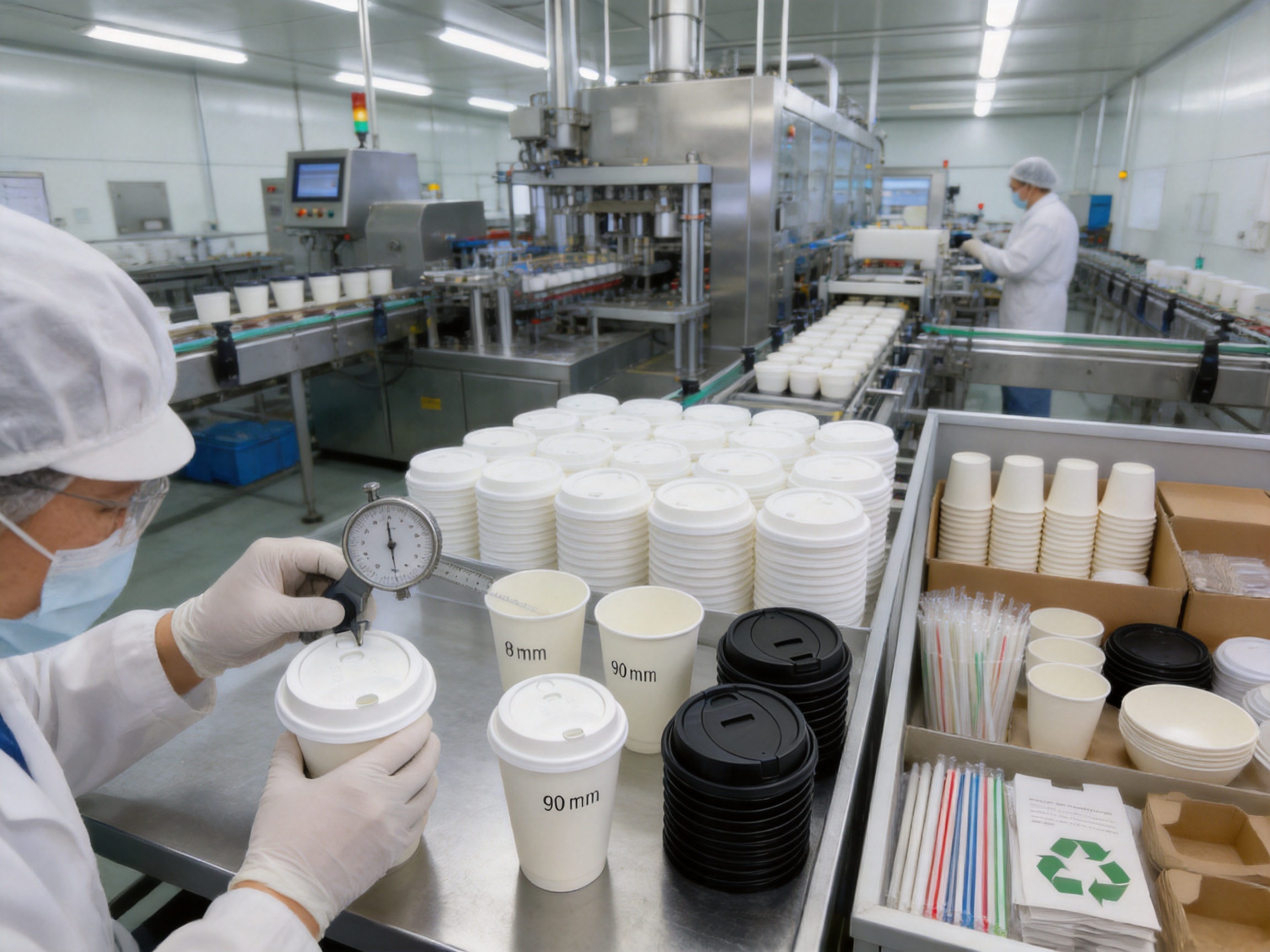
Disposable beverage packaging has become an essential part of cafés, restaurants, catering businesses, takeaway counters, delivery platforms, convenience stores, and event services. As consumers increasingly purchase drinks outside the home, the performance of the cup lid has become just as important as the quality of the beverage itself. A cup may be attractive, correctly sized, and made from food-grade material, but an unreliable lid can still result in leakage, customer complaints, damaged packaging, and a poor overall brand experience.
The patented leak-proof thickened plastic cup lid has been developed to address these challenges. Combining a specialized leak-proof structure with a reinforced plastic design, this lid is intended to improve sealing performance, durability, convenience, and product safety. It is available in both lift-up and flat-lid configurations, with compatible 80 mm and 90 mm calibers. White and black color options allow the lid to suit a wide range of beverage concepts, packaging styles, and brand identities.
Manufactured by Yuqian Packaging Technology (Jiangsu) Co., Ltd., the product reflects the company’s focus on research, development, food packaging production, quality control, and customized OEM services. The manufacturer operates a large production facility in Taizhou, Jiangsu Province, and has developed capabilities covering new food packaging materials and disposable packaging products. Its production and management systems are supported by QS, ISO9001, BRC, German DIN safety, and EU ROHS+ related certifications and testing described in the supplied product information.
This article examines the product’s construction, performance, applications, manufacturing strengths, customization possibilities, quality management approach, and advantages over ordinary thin or poorly fitted cup lids.
1. Why Cup Lid Performance Matters in Takeaway Beverage Packaging
A takeaway beverage must remain stable from the moment it leaves a filling station until it reaches the customer. During this period, the cup may be carried by hand, placed in a delivery bag, stored in a vehicle, moved across uneven surfaces, or exposed to accidental pressure. Every movement creates a potential risk of liquid escaping through the drinking opening, the rim, or the connection between the lid and the cup.
Leakage creates several practical problems. It can stain bags, uniforms, vehicle interiors, tables, and other products in a delivery order. It may soften paper packaging or labels, reducing their appearance and strength. A leaking drink can also cause a customer to believe that the beverage was prepared carelessly, even when the beverage itself is high quality. For foodservice brands, preventing leakage is therefore an important part of protecting customer satisfaction and maintaining a professional image.
Ordinary lids may be produced with minimal material thickness or a basic snap-fit design. These lids can perform adequately under ideal conditions, but their limitations often become visible when the beverage is transported over a longer distance or when the cup is handled roughly. A weak lid may flex, deform, detach from the cup rim, or allow liquid to travel through small gaps.
The patented leak-proof thickening plastic cup lid is designed with these real-world conditions in mind. Its structure focuses on improving the relationship between the lid and the cup, while the thickened material helps provide greater resistance to impact, bending, and deformation. The result is a packaging component intended to offer greater stability during everyday takeaway use.
2. Product Overview
The product is a disposable plastic lid designed for beverage cups. It is offered in two principal configurations: a patented leak-proof thickened plastic lift-up lid and a patented leak-proof thickened plastic flat lid. Both versions are designed to support secure closure and convenient beverage consumption, while allowing buyers to select the form that best suits their serving style.
The lift-up lid is suitable for applications in which consumers prefer an integrated opening that can be raised or accessed conveniently. The flat lid offers a lower-profile appearance and may be appropriate for beverage services that use straws, sealing accessories, or a simple drinking aperture. The availability of both options allows foodservice operators to use a consistent product family across different beverage categories.
The lids are offered in 80 mm and 90 mm calibers. These sizes cover common cup openings, but buyers should confirm the exact cup rim dimensions and fit before placing a production order. A correct match between the lid and the cup is essential for achieving reliable sealing performance.
| Lid Type | Available Caliber | Approximate Gram Weight | Color Options |
| Lift-up Lid | 80 mm / 90 mm | 3.5 g | White / Black |
| Flat Lid | 80 mm / 90 mm | 4 g | White / Black |
The product is positioned as a disposable food packaging component for beverage brands, cafés, restaurants, catering businesses, takeaway shops, and other organizations that need dependable cup closure. It can also be adapted for customized packaging programs in which color, branding, tooling, or other specifications are developed according to customer requirements.
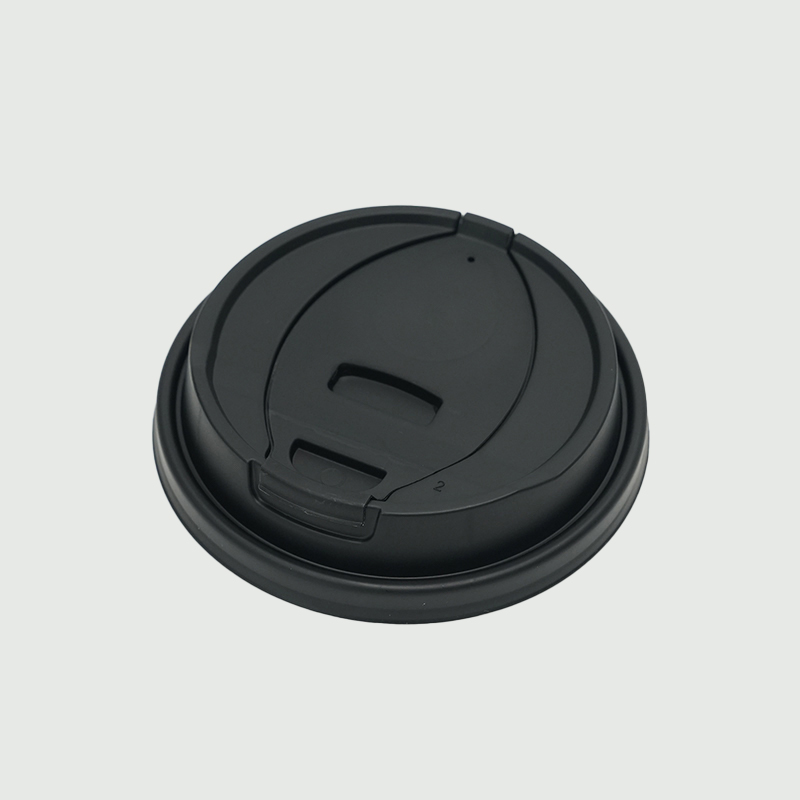
Patented leak-proof thickening plastic cup lid
3. Patented Leak-Proof Structural Design
The most important feature of the product is its leak-proof structural concept. A cup lid must do more than cover the top of the cup. It must create a stable connection with the rim, manage the drinking opening, resist deformation, and remain attached while the package is moved. The patented design is intended to improve these functions through a dedicated structural arrangement rather than relying only on a thin sheet of plastic.
A well-designed leak-proof lid normally depends on several interacting features. These may include the shape of the sealing edge, the precision of the rim-contact area, the stiffness of the lid body, and the control of the opening through which the beverage is consumed. When these elements are designed as a coordinated system, the lid can provide better protection than a basic cover with limited structural reinforcement.
The supplied product information identifies a unique leak-proof structure that is intended to effectively prevent liquid leakage. In practical use, this design can help reduce the chance of liquid escaping when the cup is carried, placed in a delivery carrier, or exposed to normal movement. It also supports a more secure feeling for consumers who drink while walking, commuting, working, or traveling.
Leak-proof performance is especially important for hot drinks, cold drinks, milk tea, fruit beverages, coffee, smoothies, juices, and other takeaway products. Different beverages may have different viscosities, temperatures, and levels of movement during transportation. A lid with a stable sealing structure provides a common protective solution across a broad beverage menu.
The term “leak-proof” should always be understood in relation to correct cup compatibility, proper installation, normal use, and appropriate handling. No disposable lid can eliminate every possible leak caused by an incompatible cup, excessive filling, severe crushing, or improper closure. However, a structurally optimized lid can provide a stronger starting point for reliable packaging performance than an ordinary lid with limited sealing support.
4. Thickened Material for Better Durability
Material thickness directly influences the physical behavior of a plastic lid. A very thin lid may be lightweight, but it can also be more vulnerable to bending, cracking, distortion, and loss of shape. If the lid deforms, the connection between the lid and cup may become less secure. The drinking opening may also become uncomfortable or difficult to use.
The patented product uses thickened plastic material to improve durability and resistance to impact. The additional material helps the lid maintain its shape during handling and transportation. It can also make the lid less likely to collapse when pressed lightly in a takeaway bag or when cups are placed next to one another.
Greater stiffness provides benefits throughout the packaging chain. During production, rigid lids can be easier to stack and handle. During cup filling, they may be less likely to deform when applied. During order assembly, they can remain more stable as staff place the cup into a carrier or bag. During delivery, improved resistance to bending can help preserve the closure between the lid and cup.
The listed gram weights are approximately 3.5 g for the lift-up lid and 4 g for the flat lid. These weights demonstrate that the product remains relatively light while incorporating a reinforced design. For foodservice operators, maintaining a practical balance between performance and material consumption is important. A lid should provide sufficient strength without creating unnecessary packaging weight.
Thickening also contributes to the perception of quality. Consumers often notice when a lid feels weak, flexible, or easily distorted. A more solid lid can communicate care and reliability, especially when combined with a well-formed cup and clear branding. This physical experience can support a beverage brand’s reputation for professional packaging.
5. Food-Grade Safety and Material Selection
Food packaging comes into direct or indirect contact with beverages, so material safety is a fundamental requirement. The product information describes the lids as being made from food-grade raw materials and emphasizes that they are non-toxic and odorless. These characteristics are important because a packaging component should not introduce undesirable odors or create an unacceptable safety concern during normal use.
Odor control is particularly relevant for beverages with delicate aromas, including coffee, tea, fruit drinks, and milk-based products. A strong plastic smell can affect the consumer’s perception of the beverage even when the liquid itself is fresh. Selecting suitable raw materials and controlling production conditions can help reduce this risk.
The manufacturer also describes the product as environmentally friendly and recyclable. Recycling suitability depends on the material composition, local recycling infrastructure, contamination levels, and regional waste management rules. Foodservice buyers should therefore review local disposal requirements and communicate appropriate instructions where necessary. Nevertheless, the use of recyclable plastic materials can support packaging strategies that aim to reduce unnecessary environmental impact.
Material selection is only one part of packaging safety. Clean manufacturing conditions, controlled processing, proper storage, quality inspection, and responsible transportation are also necessary. The company’s described quality system covers multiple stages, from raw material procurement through production, processing, and finished-product inspection. This process-based approach is important because a safe material can still become unsuitable if it is handled or processed incorrectly.
For buyers serving regulated markets, documentation should be confirmed according to the intended application and destination country. Certification records, testing reports, material declarations, and production documentation can help customers evaluate whether a product meets their specific regulatory and procurement requirements.
6. Lift-Up Lid and Flat Lid Options
6.1 Lift-Up Lid
The lift-up lid is designed for convenient drinking access. Its integrated opening can be raised or used according to the specific design of the lid and cup. This format is appropriate for cafés, coffee counters, convenience stores, and takeaway services that want to offer consumers a direct drinking experience without requiring a separate straw.
A lift-up design can also improve convenience during commuting or outdoor use. Consumers can open the drinking area when needed and keep the rest of the lid attached to the cup. This reduces the possibility of misplacing a separate accessory and helps maintain a compact package.
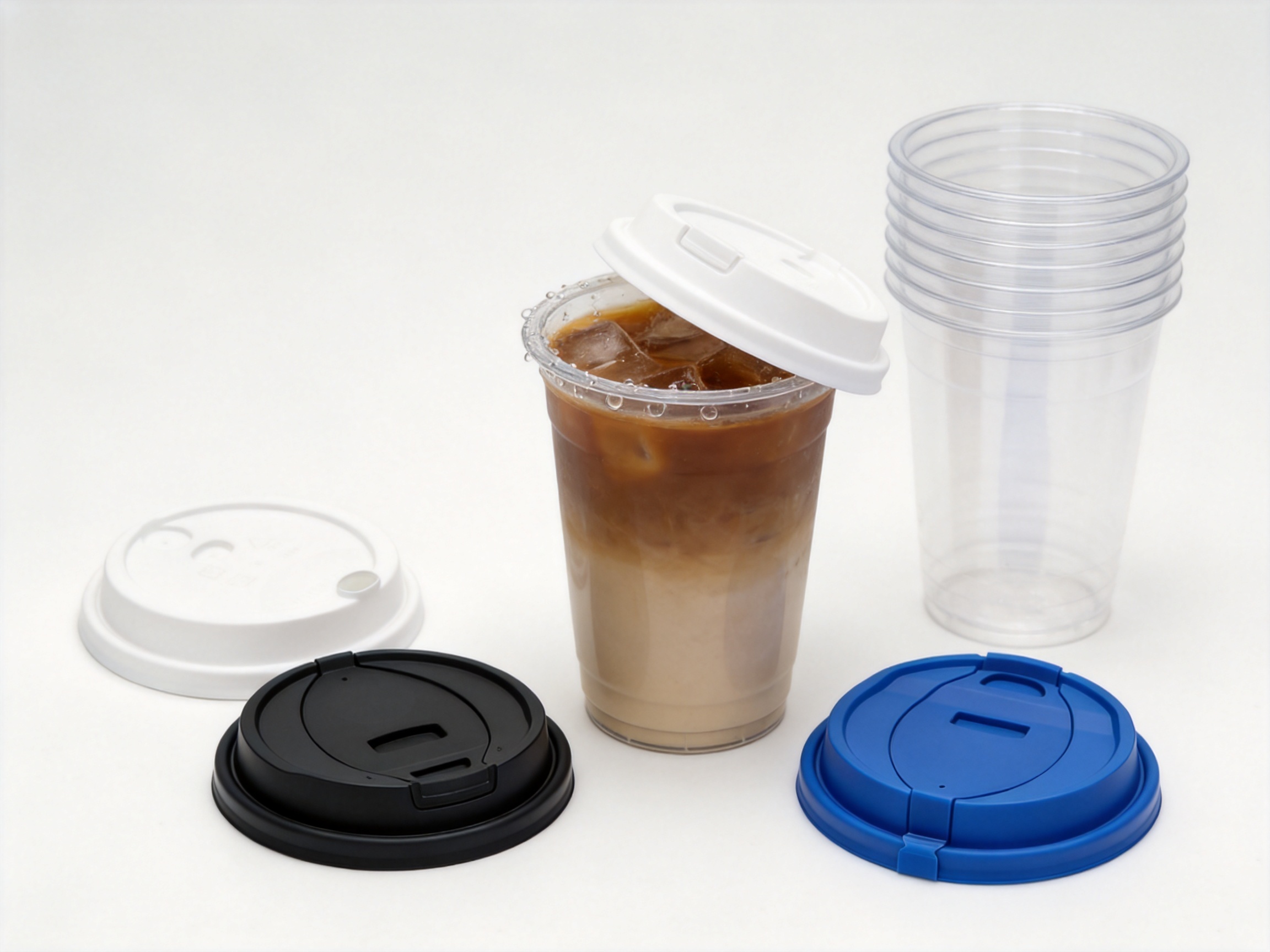
The listed lift-up version weighs approximately 3.5 g and is available in 80 mm and 90 mm calibers. White and black options provide flexibility for different beverage categories. White may create a clean and simple appearance, while black can provide a modern, premium, or high-contrast visual effect.
6.2 Flat Lid
The flat lid provides a lower-profile alternative for operators that prefer a simple and streamlined top surface. It can be used with beverages served through a drinking opening or with disposable straws, depending on the exact lid configuration and customer requirements.
Flat lids are commonly useful for cold drinks, iced beverages, fruit drinks, milk tea, and other products served through straws. They can also support efficient stacking and storage because their shape is designed around a relatively level top surface.
The listed flat version weighs approximately 4 g and is available in the same 80 mm and 90 mm caliber options. Offering a matching lift-up and flat-lid range allows a beverage business to maintain consistent dimensions and colors across multiple product lines.
7. Advantages Over Ordinary Competitor Lids
The patented leak-proof thickened plastic cup lid offers several potential advantages over conventional lids that use a basic structure or insufficient material thickness.
7.1 Improved Leakage Protection
The unique structural concept is intended to create a more dependable barrier against leakage. Compared with a simple cover that depends primarily on a loose fit, a specialized sealing structure can provide more controlled contact between the lid and cup. This is valuable for delivery, takeaway, and mobile consumption.
7.2 Greater Resistance to Deformation
Thickened material helps the lid maintain its geometry. A lid that remains stable is more likely to preserve its connection with the cup rim and keep the drinking opening in the correct position. This can be especially useful when filled cups are packed together or handled repeatedly before reaching the customer.
7.3 More Secure Consumer Experience
Consumers want confidence that they can carry their beverage without constantly checking for spills. A firm, well-fitted lid can reduce anxiety and make the product easier to use in public settings. This simple improvement can influence how customers evaluate the overall service.
7.4 Food-Grade and Odorless Material Positioning
The use of selected food-grade raw materials and the emphasis on non-toxic, odorless characteristics help position the product for professional foodservice applications. This may provide an advantage over low-quality lids that have inconsistent material characteristics or noticeable plastic odors.
7.5 Multiple Formats and Sizes
The availability of lift-up and flat designs in 80 mm and 90 mm calibers simplifies product selection. Buyers can select the configuration that matches their cups and beverage service model without changing to an entirely different supplier or product family.
7.6 Customization Capability
The manufacturer states that the lid can be customized according to customer needs. Customization may be relevant to brand color, packaging coordination, logo application, tooling, product dimensions, or special activities. A customized lid can help a beverage company develop a more recognizable takeaway package.
7.7 Certification and Quality-System Support
The company’s stated QS, ISO9001, BRC, German DIN, and EU ROHS+ related qualifications and testing provide a stronger quality-assurance foundation than a supplier that cannot provide structured documentation. Buyers should request current documents for their exact purchasing program, but the company’s certification orientation demonstrates an awareness of international quality and safety expectations.
8. Manufacturing Strengths and Production Capabilities
Yuqian Packaging Technology (Jiangsu) Co., Ltd. was established in 2010 and is located in Taizhou City, Jiangsu Province, China. The company information describes a plant area of approximately 30,000 square meters and identifies the business as a high-tech enterprise engaged in the research and development, production, and sales of new food packaging materials and products.
The combination of research and development with manufacturing is important for a technical packaging component such as a leak-proof cup lid. Product performance depends not only on the initial design but also on mold accuracy, forming control, material stability, dimensional consistency, and inspection procedures. A company with integrated development and production capabilities can adjust these factors more efficiently than a trading business that depends entirely on outside factories.
The manufacturer reports that it has an R&D team composed of industry experts. This team is described as focusing on technical innovation and quality improvement for patented leak-proof thickened plastic cup lids. Ongoing research into new materials and new processes may help the company respond to changing market needs, including stronger performance, improved production efficiency, and more environmentally responsible packaging options.
A large production site also supports the ability to manage multiple product categories. The company’s listed product range includes plastic cups, plastic cup lids, takeaway bowls, disposable straws, recycle bags, peripheral products, and injection film lining cup and bowl boxes. This broader portfolio can be valuable for buyers seeking coordinated packaging solutions from one supplier.
For a beverage brand, a multi-product packaging supplier can simplify communication, sampling, quality coordination, and order management. It may also make it easier to develop compatible combinations of cups, lids, straws, and other accessories. Consistent packaging relationships can reduce the risk of mismatched dimensions or inconsistent visual appearance across product components.
9. Advanced Process Control from Raw Material to Finished Product
The manufacturer describes a comprehensive quality management approach that begins with raw material procurement and continues through production, processing, and finished-product inspection. This type of process control is essential for disposable food packaging because final performance is influenced by every stage of manufacturing.
9.1 Raw Material Procurement
Raw material control is the foundation of a stable plastic lid. The supplier must select materials appropriate for food packaging and verify that they meet the required specifications. Consistency in material quality supports predictable strength, appearance, forming behavior, and odor characteristics.
Material inspection may include checking documentation, batch information, physical characteristics, and compliance records. A controlled procurement process also helps reduce variation between production runs. This is important for customers who need the same lid to perform consistently over repeated orders.
9.2 Product and Mold Development
Leak-proof performance depends heavily on the precision of the product design and forming tools. The lid must be shaped accurately so that the sealing area, opening, rim interface, and reinforcing features are produced within the required tolerances.
Research and development expertise can help improve the design through testing, adjustment, and process optimization. When a customer requests a customized product, technical cooperation between the buyer and manufacturer is particularly important. Cup dimensions, beverage temperature, filling volume, stacking requirements, branding needs, and delivery conditions may all affect the final design.
9.3 Forming and Processing
During plastic forming, stable processing conditions are required to produce lids with consistent thickness, shape, and surface finish. Variations in temperature, pressure, timing, or material flow can affect the final product. A professional production system therefore relies on controlled equipment settings and trained operators.
For a thickened lid, process control is especially important because the additional material must be distributed effectively throughout the design. Areas that require stiffness and structural support should be formed accurately without compromising the fit or appearance of the product.
9.4 Inspection and Quality Verification
Finished-product inspection helps identify defects before the lids reach the customer. Inspection may evaluate dimensions, weight, color, appearance, opening quality, edge condition, and general structural integrity. Sampling and testing procedures can be developed according to the product specification and customer requirements.
Dimensional inspection is particularly important for 80 mm and 90 mm products because a small difference in the sealing diameter can affect compatibility. Visual inspection can help detect deformation, contamination, incomplete forming, surface defects, or color inconsistency. Functional testing can help confirm that the lid fits the intended cup and remains stable under representative handling conditions.
10. Certification and Compliance Orientation
The company’s information states that its operations and products are associated with several certifications and tests. These include the QS national industrial product production license, ISO9001 Quality Management System certification, BRC certification, German authoritative safety DIN certification, and EU ROHS+ testing.
QS represents a national industrial product production licensing framework in China. ISO9001 is internationally recognized as a quality management system standard. BRC-related certification is widely associated with food safety and quality requirements in the food and packaging supply chain. DIN standards and testing can support product safety and technical conformity in relevant applications. EU ROHS+ testing relates to restrictions and controls concerning certain hazardous substances, depending on the specific test scope.
Certifications should not be treated as a substitute for product-specific evaluation. Buyers should confirm the certificate holder, validity period, applicable factory, product scope, testing standard, and destination-market requirements. Nevertheless, a supplier that actively maintains certification and testing systems demonstrates a structured approach to quality and compliance.
For international buyers, documentation is often a critical part of supplier evaluation. Technical data sheets, material declarations, inspection reports, certificates, sample approvals, and production records can support internal purchasing procedures. The manufacturer’s experience with international quality expectations may help customers organize these documents more efficiently.
11. Customization for Beverage Brands and Foodservice Operators
Customization is one of the product’s stated advantages. Disposable packaging is no longer viewed only as a basic protective item. It is also part of a brand’s visual identity. The cup, lid, straw, bag, and printed label work together to shape the customer’s impression of the business.
The company can customize products according to customer needs, subject to technical feasibility, minimum order requirements, tooling conditions, and agreed specifications. Potential customization areas may include color, surface appearance, dimensional compatibility, packaging method, and coordinated product design. Branding requirements should be discussed during the sample-development stage.
Black and white lids provide a simple starting point for many applications. White can be matched with minimalist, natural, clean, or family-oriented packaging. Black can support premium coffee, modern tea, dessert, or event packaging. Customers with established brand colors may request a customized solution to create stronger visual consistency.
Customization should begin with a clear technical brief. The buyer should identify the cup material, rim diameter, cup volume, beverage type, beverage temperature, drinking method, delivery distance, packaging arrangement, and expected storage conditions. These details help the manufacturer recommend the most suitable lid design and testing method.
Sample testing is an important part of customization. A sample should be fitted to the intended cup and evaluated under realistic conditions. Tests may include filling, closing, carrying, stacking, shaking, bag placement, temperature exposure, and consumer opening. Feedback from these tests can be used to refine the product before mass production.
For promotional events, seasonal campaigns, and new beverage launches, customized lids can help create a distinctive package. A specialized lid may communicate exclusivity and make a product more recognizable in photographs, delivery orders, and customer-generated content.
12. Applications Across the Food and Beverage Industry
12.1 Coffee Shops
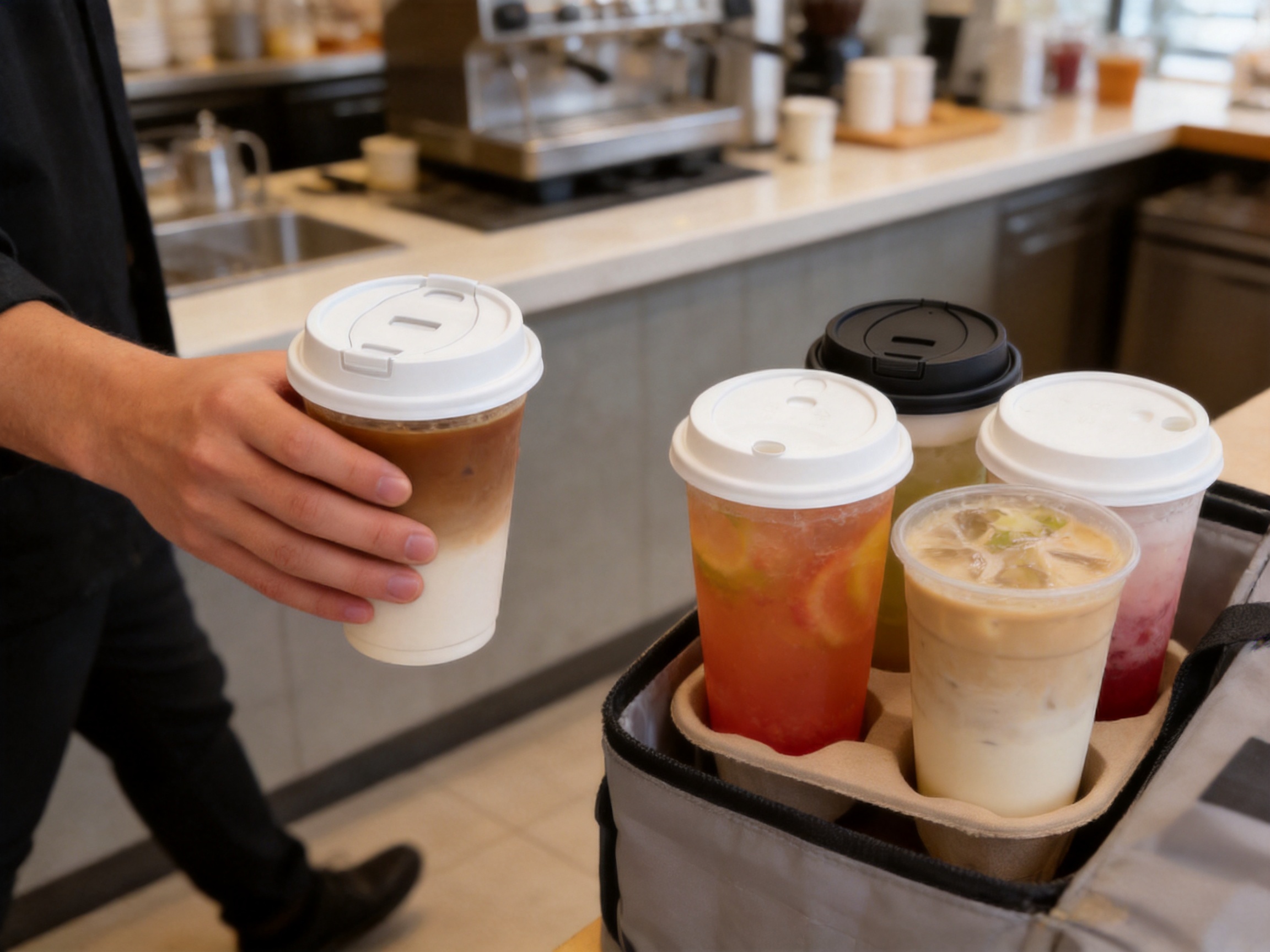
Coffee shops require lids that can support hot and cold beverages while remaining comfortable for customers to carry. The lift-up lid can be considered for direct drinking, while the flat lid may be useful for iced coffee and straw-served drinks. A secure lid is particularly important for customers commuting to work or traveling by car.
12.2 Milk Tea and Specialty Tea Stores
Milk tea, fruit tea, and specialty tea businesses often serve beverages with ice, toppings, or different levels of sweetness. The flat lid format can support straw-based consumption, while the thickened structure can help maintain stability during delivery. Black or white lids can be coordinated with a store’s cup graphics and printed sleeves.
12.3 Juice Bars and Smoothie Businesses
Juices and smoothies are frequently sold for takeaway consumption. Customers may carry them outdoors, place them in bags, or transport them with other food items. A dependable lid helps protect the liquid and reduces the chance of accidental spills. The lid can be used as part of a complete disposable packaging system that includes cups, straws, bags, and labels.
12.4 Restaurants and Quick-Service Food Outlets
Restaurants that provide takeaway drinks need packaging that can be assembled efficiently during busy service periods. A consistent lid range in common calibers can simplify inventory and staff training. The thickened design may also reduce the likelihood of lids being damaged during rapid order preparation.
12.5 Catering and Events
Catering services and events often require large quantities of coordinated disposable packaging. The black and white color options can suit formal gatherings, corporate events, festivals, and promotional activities. Customized products may help event organizers create a unified visual theme.
12.6 Delivery Platforms and Food Distribution
Delivery is one of the most demanding applications for beverage lids because the package may experience repeated movement. A leak-proof design can help protect the beverage and surrounding food items during transportation. While correct cup fit and packing remain essential, a stronger lid can contribute to a more reliable delivery package.
13. Operational Benefits for Buyers
A cup lid is a relatively small component, but its effect on operational efficiency can be significant. When lids fit consistently, staff can close cups more quickly and with less adjustment. This can be valuable during peak hours when orders must be prepared rapidly.
Consistent weight and dimensions also support more predictable purchasing and inventory planning. The listed approximate weights allow buyers to estimate packaging consumption, although actual commercial calculations should be based on confirmed production data. Standardized 80 mm and 90 mm options can help businesses organize their cup and lid inventory by size.
Reduced leakage can lower the indirect cost of customer complaints, refunds, replacement orders, damaged delivery bags, and cleaning. A reliable lid cannot eliminate all handling problems, but it can help reduce failures caused by weak material or unstable closure.
The availability of OEM customization can also reduce the need to coordinate with multiple suppliers. A beverage brand may work with the manufacturer to develop compatible cups, lids, bowls, straws, bags, or other disposable packaging products. This integrated communication can improve packaging consistency and simplify quality feedback.
14. Environmental Considerations
Environmental responsibility is becoming increasingly important in food packaging procurement. The product information states that the material is recyclable and meets environmental standards. Buyers should evaluate this claim in relation to the precise material composition and the waste-management system in their market.
Recyclability is influenced by local collection, sorting, washing, and reprocessing capabilities. A recyclable product may not be recycled in every region if suitable infrastructure is unavailable. Food residue, mixed-material construction, pigments, and small product size can also affect recovery. For this reason, responsible packaging programs should combine material selection with clear disposal guidance and realistic regional assessments.
Material efficiency is another environmental consideration. A thickened lid uses a reinforced design to improve performance, but the goal should be to apply material where it provides meaningful structural value. Research into new materials and processes may help manufacturers balance durability, safety, recyclability, and resource consumption.
Businesses can also reduce environmental impact by improving packaging performance. A lid that prevents leakage may reduce damaged food orders, wasted beverages, replacement packaging, and unnecessary cleaning. Better packaging does not by itself solve the environmental challenges of disposable products, but it can support a more efficient overall system.
15. Quality Assurance for International OEM Orders
International buyers often require more than a product sample. They need confidence that the same quality will be maintained during repeated production. A structured OEM process should therefore include technical confirmation, sample approval, material verification, production inspection, packaging review, and shipment coordination.
The initial inquiry should define the product type, caliber, color, estimated order quantity, cup compatibility, application, and delivery destination. If the customer requires special performance, such as use with hot beverages or extended delivery routes, this should be communicated before sample development.
After the design is confirmed, the buyer and manufacturer can agree on product drawings, specifications, acceptable tolerances, packaging quantities, carton markings, and inspection requirements. A retained reference sample can be useful for comparing future production batches.
During mass production, inspections may focus on appearance, dimensions, fit, weight, color, and structural condition. For customized products, special attention should be paid to visual consistency and the accuracy of any branding elements. Final packaging should protect the lids from dust, moisture, deformation, and damage during transport.
The manufacturer’s described after-sales system includes pre-sales consultation, sample testing, after-sales support, regular communication, and collection of customer feedback. This continuing communication is valuable because packaging performance is often best understood through actual use in cafés, restaurants, and delivery operations.
16. How to Select the Correct Lid
The first step is to identify the cup’s actual top diameter. A nominal cup size does not always guarantee that the rim is exactly 80 mm or 90 mm. The buyer should measure the rim or provide a cup sample to confirm compatibility.
The second step is to choose between the lift-up and flat-lid formats. The lift-up version may be suitable when direct drinking convenience is the priority. The flat version may be more suitable for straw-served beverages or businesses seeking a low-profile lid design.
The third step is to consider beverage conditions. Hot drinks, cold drinks, carbonated beverages, thick smoothies, and drinks containing ice or toppings may place different demands on the lid. The manufacturer can use this information to recommend the appropriate structure and testing approach.
The fourth step is to select color and packaging requirements. White and black are available standard options, while customized colors or branding may require additional development. Buyers should confirm whether the desired appearance is needed for the lid itself, the cup, the straw, or the complete packaging set.
The fifth step is to evaluate order quantity and delivery schedule. Customized products may require tooling, sample approval, and a longer preparation period than standard products. Early communication can help avoid delays when launching a new beverage program or seasonal campaign.
17. Installation and Use Recommendations
The cup should be filled within a reasonable level, leaving sufficient space for the lid and normal movement. Overfilling can force liquid toward the drinking opening and may increase leakage risk, even when the lid is correctly fitted.
Before closing the cup, staff should check that the rim is clean and free from beverage residue, foam, ice, fruit pieces, or other material that could interfere with sealing. The lid should be pressed evenly around the rim until it is fully seated.
After closure, staff should inspect the lid visually and confirm that no section is raised or detached. If the beverage is intended for delivery, the cup should be placed upright in a suitable carrier or bag. Heavy objects should not be placed on top of the drink.
Consumers should carry the cup upright and avoid deliberately squeezing, twisting, or crushing the lid. These recommendations are simple, but they help the product perform as intended and reduce problems caused by incorrect use.
18. Why Choose a Specialized Packaging Manufacturer
Working with a specialized manufacturer can provide advantages over purchasing generic packaging through an unrelated distributor. A specialized company understands the relationship between material selection, cup compatibility, lid structure, forming processes, and foodservice requirements.
Yuqian Packaging Technology (Jiangsu) Co., Ltd. combines product development, manufacturing, sales, and customer service. Its experience in disposable food packaging allows it to address the product as part of a broader packaging system rather than as an isolated component.
The company’s product categories include plastic cups, plastic cup lids, takeaway bowls, disposable straws, recycle bags, peripheral products, and injection film lining cup and bowl boxes. This range demonstrates experience in producing multiple types of food packaging and may support customers that want coordinated sourcing.
The company also established a Shanghai branch in January 2019 to improve service quality and expand business channels. Combined with its Jiangsu manufacturing base, this organizational structure is intended to support communication with domestic and international customers while maintaining production capabilities at the main facility.
For OEM buyers, the ability to communicate directly with a manufacturer’s technical and production teams can shorten the feedback cycle. It can also make it easier to address issues related to dimensions, samples, tooling, packaging, shipment, and future product improvements.
19. Q&A: Patented Leak-Proof Thickened Plastic Cup Lids
Q1: What is the main function of this cup lid?
The main function is to provide a secure, leak-resistant closure for disposable beverage cups. Its patented structural design is intended to reduce liquid leakage, while the thickened plastic body helps improve durability and resistance to deformation.
Q2: What lid styles are available?
The product is available as a lift-up lid and a flat lid. The lift-up lid is designed for convenient direct drinking, while the flat lid can be used for applications involving a drinking opening or straw, depending on the specific configuration.
Q3: What cup opening sizes are offered?
The listed caliber options are 80 mm and 90 mm. Buyers should confirm the exact rim dimensions of their cups before ordering to ensure a proper fit.
Q4: What colors are available?
Standard color options listed for the product are white and black. Customized colors may be discussed with the manufacturer according to project requirements and production feasibility.
Q5: Is the material suitable for food packaging?
The manufacturer describes the product as made from food-grade raw materials and as non-toxic and odorless. Buyers should request the relevant material and compliance documentation for their intended market and application.
Q6: Is the lid recyclable?
The product information states that the material is recyclable and meets environmental standards. Actual recycling depends on the precise material, local collection systems, contamination, and regional regulations. Buyers should confirm disposal guidance for their market.
Q7: How does the thickened design benefit users?
The thickened design helps improve stiffness, durability, and resistance to impact or deformation. This can support a more stable closure during cup handling, stacking, takeaway service, and delivery.
Q8: Can the lids be customized?
Yes. The manufacturer states that customization is available according to customer needs. Possible requirements may include color, dimensions, branding coordination, packaging, or special product development. The exact options should be confirmed during the OEM consultation process.
Q9: Can the lids be used for hot and cold beverages?
The product is intended for beverage packaging, but the suitability of a specific lid should be confirmed according to the beverage temperature, cup material, filling volume, and intended use. Sample testing is recommended for specialized or high-temperature applications.
Q10: What certifications and tests are associated with the manufacturer?
The supplied company information references QS, ISO9001, BRC, German DIN safety certification, and EU ROHS+ testing. Customers should request current documents and verify their scope, validity, and relevance to the intended product order.
Q11: Does the manufacturer provide samples?
The company describes sample testing as part of its customer service process. Buyers can discuss sample availability, cup compatibility, testing requirements, and development procedures with the manufacturer before mass production.
Q12: What information should a buyer provide when requesting a quotation?
A buyer should provide the preferred lid style, caliber, color, cup type, expected order quantity, beverage application, customization needs, packaging requirements, destination country, and desired delivery schedule. Providing a cup sample or accurate rim measurements can improve the quotation and sampling process.
Q13: What industries can use these lids?
Potential users include cafés, milk tea shops, juice bars, smoothie stores, restaurants, catering companies, convenience stores, delivery businesses, event organizers, and foodservice distributors.
Q14: Can the manufacturer supply other disposable packaging products?
The company’s listed product categories include plastic cups, plastic cup lids, takeaway bowls, disposable straws, recycle bags, peripheral products, and injection film lining cup and bowl boxes. Customers can discuss whether coordinated packaging sourcing is available for their project.
Q15: Does a leak-proof lid eliminate every possible leak?
No packaging lid can eliminate leakage caused by an incompatible cup, overfilling, incorrect installation, severe crushing, or extreme handling. The product’s structural design is intended to improve leak resistance, but correct cup matching, proper closure, and appropriate transportation remain essential.
20. Conclusion
The patented leak-proof thickened plastic cup lid is designed to meet the practical demands of modern takeaway beverage packaging. Its key features include a specialized leak-proof structure, reinforced plastic material, food-grade raw material positioning, recyclable material characteristics, two lid styles, two common caliber options, black and white color choices, and customization support.
Compared with ordinary thin or basic-fit lids, the product is intended to provide stronger resistance to leakage, deformation, and everyday handling stress. These benefits can support cafés, restaurants, delivery businesses, caterers, and beverage brands that want to improve packaging reliability and customer convenience.
The manufacturer’s strengths extend beyond the product itself. Established in 2010, Yuqian Packaging Technology (Jiangsu) Co., Ltd. operates a substantial production facility, maintains research and development capabilities, produces several categories of disposable food packaging, and describes a quality-management process covering raw materials, production, processing, and finished-product inspection.
Its stated QS, ISO9001, BRC, German DIN, and EU ROHS+ related certifications and testing provide a foundation for international customer evaluation, while its OEM approach allows packaging to be developed according to specific brand and application requirements. Through sample testing, technical communication, quality control, and after-sales support, the company aims to provide more than a standard commodity lid.
For beverage businesses seeking a more secure, durable, and professional packaging solution, the patented leak-proof thickened plastic cup lid offers a practical option. Correct sizing, suitable cup matching, appropriate filling, and realistic use testing will help buyers obtain the best possible performance from the product.
References
1. Product specification information for patented leak-proof thickened plastic cup lids, including lift-up and flat-lid formats.
2. Manufacturer-provided information concerning food-grade materials, recyclability, customization, and product advantages.
3. Manufacturer-provided company profile for Yuqian Packaging Technology (Jiangsu) Co., Ltd.
4. ISO 9001 quality management system principles and supplier quality-control practices.
5. BRC-related food safety and packaging quality management guidance.
6. General food-contact packaging safety and material-selection principles.
7. General technical considerations for disposable beverage cup and lid compatibility.
8. General packaging sustainability principles concerning recyclable plastics and regional waste-management systems.