English
 Español
 عربى
Content
- 1 1. The Role of a Vented Lid in Modern Food Packaging
- 2 2. Product Overview and Main Specifications
- 3 3. Food-Grade PP Material and Its Functional Benefits
- 4 4. Leak-Reducing Design and Secure Closure
- 5 5. Ventilation Without Sacrificing Practical Protection
- 6 6. Transparency and Presentation Advantages
- 7 7. Durability and Lightweight Construction
- 8 8. Stackability and Storage Efficiency
- 9 9. Manufacturing Process and Quality Control
- 10 10. Advanced OEM and Customization Capabilities
- 11 11. Advantages Compared with Basic Alternative Lids
- 12 12. Environmental Considerations
- 13 13. Foodservice and Commercial Applications
- 14 14. Recommended Evaluation Procedure for Buyers
- 15 15. Quality, Certifications, and Compliance Awareness
- 16 16. Company Manufacturing Strengths
- 17 17. Customer Service and Long-Term Cooperation
- 18 18. Practical Ordering Information
- 19 19. Frequently Asked Questions
- 19.1 Q1: What material is used for the lid?
- 19.2 Q2: What is the listed size of the standard model?
- 19.3 Q3: What is the approximate weight of one lid?
- 19.4 Q4: Is the lid completely airtight?
- 19.5 Q5: Can the lid help reduce leakage?
- 19.6 Q6: Is the lid transparent?
- 19.7 Q7: Can the product be customized?
- 19.8 Q8: Is the lid stackable?
- 19.9 Q9: What certifications or testing does the manufacturer report?
- 19.10 Q10: Can samples be produced before mass production?
- 19.11 Q11: Can the lid be used for hot food?
- 19.12 Q12: How should buyers assess environmental performance?
- 19.13 Q13: What information should be included in an inquiry?
- 20 20. Conclusion
- 21 References
- 22 Product: Clear PP plastic ordinary vented lid
In the takeaway food and beverage industry, a lid is far more than a simple cover. It is an essential part of the customer experience, the package’s functional performance, and the brand’s overall presentation. A well-designed lid must fit securely, help prevent leakage, protect the contents, support convenient handling, and remain stable during transportation. At the same time, food businesses increasingly expect packaging components to be hygienic, attractive, customizable, efficient to manufacture, and aligned with modern environmental expectations.
Clear PP plastic ordinary vented lids are designed to meet these needs. Produced from food-grade polypropylene, these transparent lids combine visibility, durability, sealing performance, and controlled ventilation. They are suitable for takeaway cups, bowls, containers, and other disposable food packaging applications where a dependable closure and clear product presentation are important.
The 179 Regular model described in this article has a 179-millimeter caliber and an approximate gram weight of 8 grams. Its transparent appearance allows customers to see the packaged product while the vented structure helps maintain appropriate air circulation. The product is also suitable for customized production, giving foodservice operators, packaging distributors, and OEM buyers greater flexibility in selecting dimensions, colors, and other specifications.
1. The Role of a Vented Lid in Modern Food Packaging
Takeaway packaging must perform under demanding conditions. A container may be filled with hot soup, freshly prepared noodles, fried food, desserts, drinks, or other products before being transported by hand, vehicle, or delivery service. During this process, the packaging can be exposed to movement, pressure, changes in temperature, and shifting internal air pressure.
A lid that is too thin may deform during use. A lid with a weak sealing edge may loosen or leak. A lid without suitable ventilation may allow steam or pressure to build inside the container, potentially causing deformation, condensation, or difficulty during opening. These issues can reduce customer satisfaction and cause food waste or damage to delivery bags.
The clear PP plastic ordinary vented lid addresses these challenges through a combination of structural strength, sealing design, and ventilation. The lid is intended to hold its shape during ordinary use while maintaining a practical balance between closure security and air circulation. Its transparent design also allows users to identify the contents without removing the lid, which is useful for both foodservice workers and final consumers.
For commercial kitchens, the lid can simplify order preparation because the contents remain visible after closure. For distributors, the stackable design can help reduce storage requirements. For brands, the clean transparent appearance can present the food more effectively and allow the product itself to become part of the visual appeal.
2. Product Overview and Main Specifications
The product is a clear polypropylene plastic ordinary vented lid intended for takeaway packaging applications. It is categorized as a PP takeaway lid or liner and can be used with compatible cups, bowls, and food containers. Its primary color is transparent, although customized color options may be available according to customer requirements and production feasibility.
| Item | Specification |
|---|---|
| Product type | Clear PP plastic ordinary vented lid |
| Application category | PP takeaway lid or liner |
| Listed model | 179 Regular |
| Caliber | 179 millimeters |
| Approximate gram weight | 8 grams |
| Standard color | Transparent |
| Material | Food-grade polypropylene |
| Production type | OEM and customized mass production |
| Key functions | Closure, leakage reduction, visibility, and ventilation |
The specifications above provide a starting point for buyers evaluating compatibility and supply requirements. The 179-millimeter caliber is the listed standard for the model, but packaging projects often require precise matching between the lid and the container rim. For this reason, customers should confirm the outer diameter, inner diameter, rim profile, container material, filling temperature, and intended application before finalizing an order.
The approximate weight of 8 grams reflects a lightweight packaging component that can support efficient transportation and material management. At the same time, the lid is described as thickened and durable, indicating that the design is intended to provide a stronger user experience than extremely thin or poorly controlled alternatives. Actual weight may vary depending on design changes, production tolerances, customization, and packaging requirements.
3. Food-Grade PP Material and Its Functional Benefits
Polypropylene is widely used in food packaging because it offers a useful combination of light weight, chemical stability, impact resistance, and processing flexibility. When food-grade PP raw materials are selected and processed under controlled conditions, the material can be formed into packaging components with consistent dimensions and a clean appearance.
For a takeaway lid, material selection influences several important characteristics. The lid must retain sufficient rigidity during handling, resist ordinary impact, and remain compatible with the packaged food. It must also support high-volume manufacturing with stable molding performance. PP is suitable for these demands because it can be processed efficiently into repeatable shapes while maintaining a favorable strength-to-weight ratio.
The clear appearance of the product is another important material benefit. Transparent packaging allows customers to view the food, check the fill level, and identify the contents. This can be particularly valuable in busy takeaway environments where multiple orders are prepared at the same time. Clear lids can also reduce the need to open containers for visual confirmation, supporting better hygiene and faster order management.
The product information identifies the lid as non-toxic, odorless, and made from food-grade PP raw materials. These properties are important for food-contact packaging, where unwanted odor or material transfer can negatively affect the customer experience. Buyers should always evaluate the final product according to the regulatory requirements of the destination market and the specific food-contact application.
4. Leak-Reducing Design and Secure Closure
Leakage is one of the most common concerns in takeaway packaging. Even a small amount of liquid escaping from a container can stain packaging bags, vehicles, clothing, furniture, or the customer’s hands. A reliable lid therefore contributes directly to the perceived quality of the entire foodservice operation.
The clear PP plastic ordinary vented lid is described as having a leak-proof design and good sealing performance. In practical terms, the lid is intended to engage securely with the compatible container rim. The thickened structure can help the lid maintain its shape during closing, transportation, and ordinary handling. When the dimensions of the lid and container are properly matched, the closure can reduce the risk of accidental opening and leakage.
Sealing performance depends on more than material thickness alone. It also depends on rim geometry, molding accuracy, dimensional consistency, lid flexibility, container compatibility, and the method used by staff to apply the lid. A high-quality manufacturing process helps maintain these factors from one production batch to another.
For buyers, product testing should include practical scenarios such as horizontal storage, moderate shaking, stacking, temperature exposure, and transport simulation. Testing should be performed with the actual container and the intended food or liquid product whenever possible. This helps confirm that the lid performs as expected under real operating conditions.
5. Ventilation Without Sacrificing Practical Protection
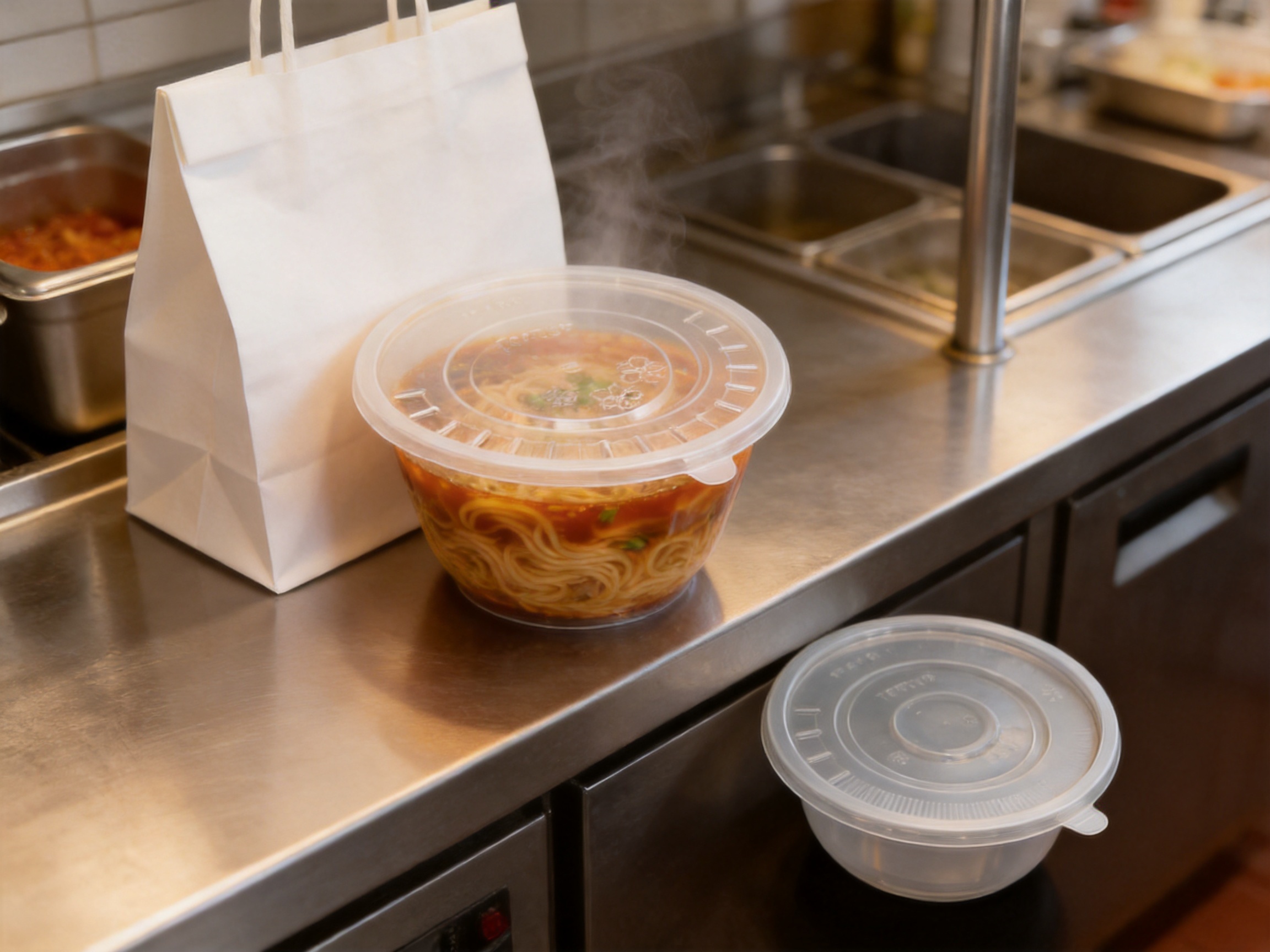
The defining feature of this lid is its ordinary vented structure. Ventilation can be important when packaging hot or freshly prepared food. Steam generated inside a closed container may increase internal pressure and produce condensation. Without a suitable release path, pressure may contribute to lid deformation, difficulty during opening, or an unstable package during transport.
A vented lid allows a certain amount of air circulation while continuing to cover the container. This balance is important. Excessive openings could reduce protection against spills, while an entirely sealed structure may not be suitable for every hot-food application. The vent design is therefore intended to provide practical air movement while maintaining the core function of the lid.
Venting can also help manage moisture. For foods that release steam, controlled ventilation may reduce the accumulation of condensation on the underside of the lid. This can help preserve product appearance, although the result will depend on the food type, temperature, container design, delivery time, and environmental conditions.
It is important to understand that an ordinary vented lid is not a pressure vessel, airtight seal, or guarantee against all leakage. The ventilation system should be evaluated together with the container and the food product. Buyers handling very hot liquids, high-pressure filling systems, or special food applications should conduct suitable compatibility and safety tests before commercial use.
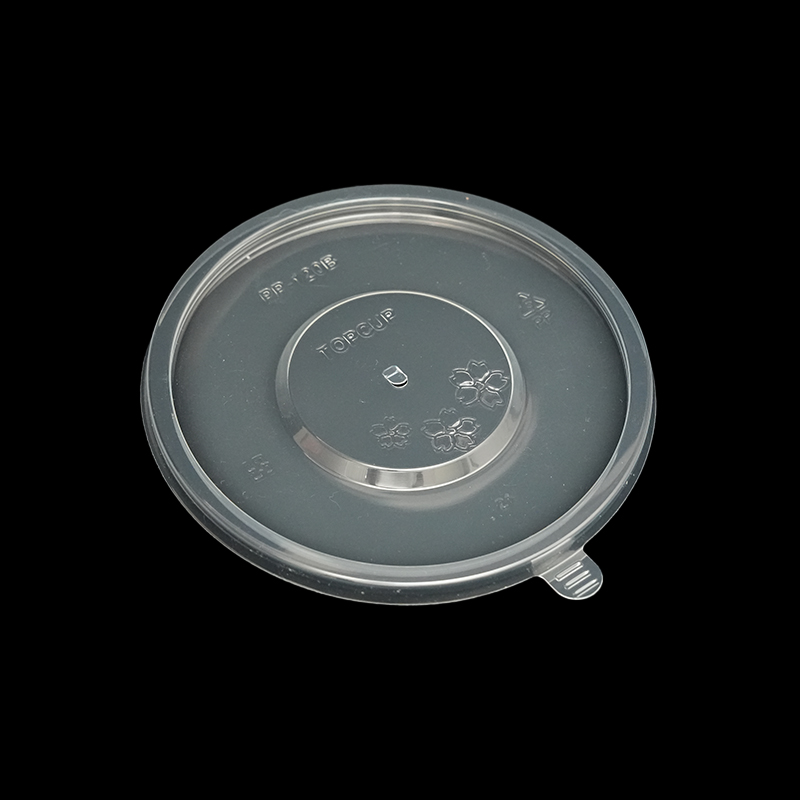
Clear PP plastic ordinary vented lid
6. Transparency and Presentation Advantages
Food packaging has a strong visual role. Customers often make judgments about freshness, cleanliness, portion size, and value before opening a package. A clear lid allows the food to remain visible, helping create a more direct connection between the product and the customer.
For restaurants and catering companies, transparency can improve order accuracy. Staff can quickly check whether the correct food has been placed inside a container without removing the lid. Delivery personnel may also identify orders more easily when labels and visible contents are combined. In self-service or display environments, a transparent lid can make the packaged product more attractive and easier to recognize.
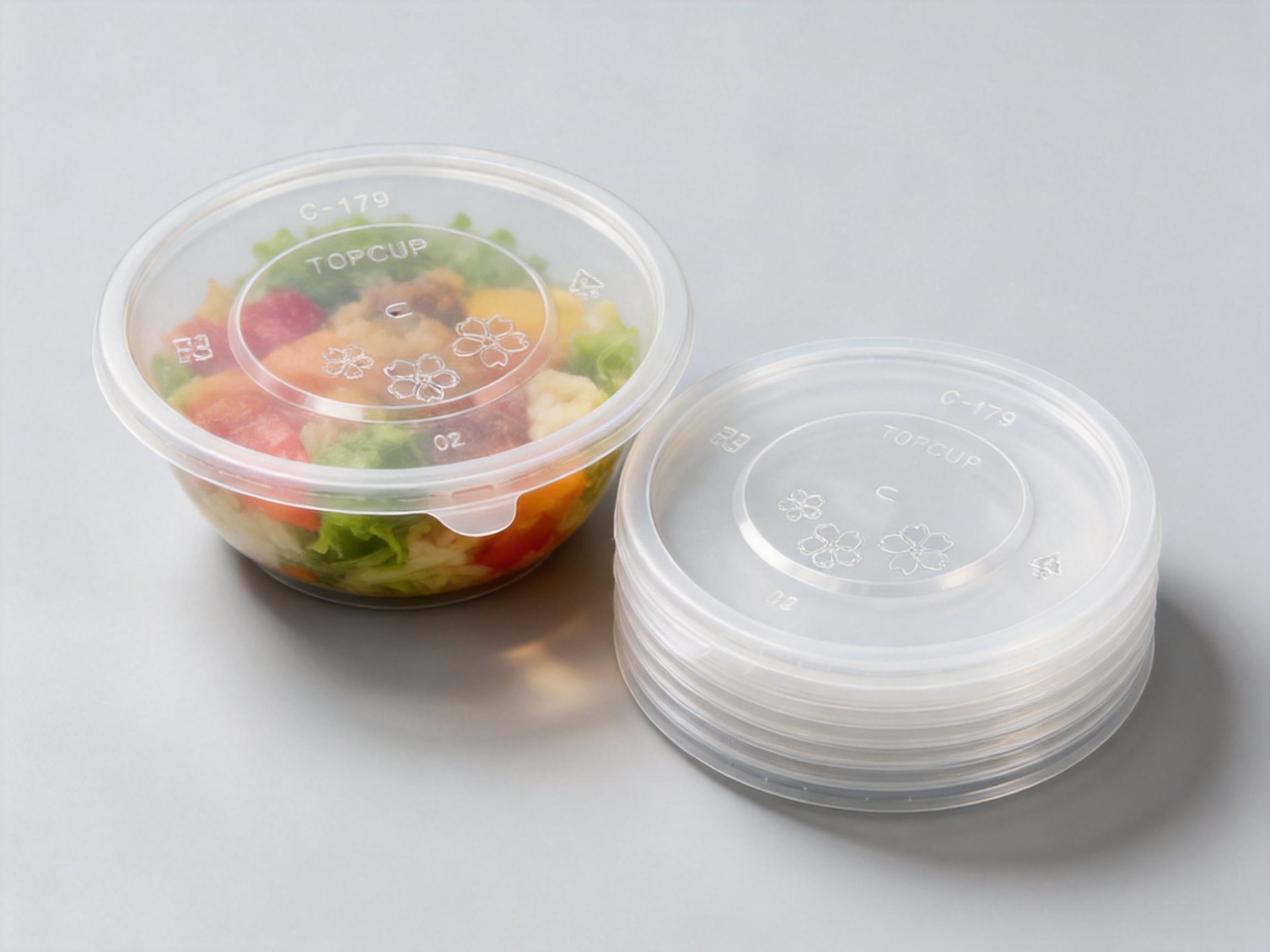
Clear PP also offers a neutral appearance that can suit different brand styles. It can complement colorful food, printed labels, stickers, sleeves, and customized containers without competing with the brand’s visual identity. Companies that want to highlight natural ingredients, layered desserts, colorful toppings, or carefully arranged meals may find transparent packaging particularly useful.
Compared with opaque alternatives, a clear lid provides stronger product visibility. Compared with some rigid transparent materials, PP can offer a practical balance between clarity, weight, flexibility, and cost. The exact level of transparency will depend on the material grade, molding conditions, thickness distribution, and surface quality, which is why process control remains important.
7. Durability and Lightweight Construction
Disposable packaging must be lightweight enough for efficient logistics but durable enough for ordinary use. These objectives can appear contradictory. A lid that uses excessive material may increase shipping weight, storage requirements, and packaging cost. A lid that is too light or poorly formed may bend, crack, or disengage from the container.
The product’s thickened design is intended to provide a more dependable structure while maintaining the advantages of a lightweight PP component. Its approximate 8-gram weight supports efficient handling, while the material’s impact resistance helps it withstand routine movement and contact. The result is a lid designed for everyday foodservice workflows rather than one-time display only.
Durability also contributes to a better customer experience. A lid that remains stable when a container is carried from a restaurant to a home or office can reinforce confidence in the food provider. For delivery businesses, improved lid integrity may help reduce complaints related to spills and damaged orders.
As with any disposable product, performance must be judged according to the intended application. Hot foods, oily foods, acidic foods, frozen products, extended delivery times, and repeated stacking can place different demands on the lid. A responsible purchasing process should match product selection with actual operating conditions.
8. Stackability and Storage Efficiency
Storage space is a significant operational cost in restaurants, food factories, warehouses, and distribution centers. Packaging components that are difficult to organize can occupy excessive shelf space and increase handling time. The clear PP plastic ordinary vented lid is designed to be stackable, allowing multiple lids to be stored in an orderly and space-saving manner.
Stackability supports more efficient inventory management. Employees can count, move, and replenish lids with less effort. Distributors can organize cartons more effectively, and foodservice operators may be able to store greater quantities in a limited back-of-house area. Neatly stacked lids can also help reduce the risk of contamination, bending, and accidental damage during storage.
The practical value of stackability depends on the consistency of the molded shape. If lids vary significantly in height, rim geometry, or ventilation structure, stacks may become unstable. Consistent molding and inspection are therefore essential to the storage advantage. Stable stacking can also improve packing efficiency during shipment from the factory to the customer.
9. Manufacturing Process and Quality Control
Reliable packaging begins with a controlled manufacturing process. A disposable lid may appear simple, but its performance depends on accurate mold design, suitable material preparation, stable processing parameters, cooling control, trimming, inspection, and packing. Small variations in any of these stages can affect fit, sealing, appearance, and durability.
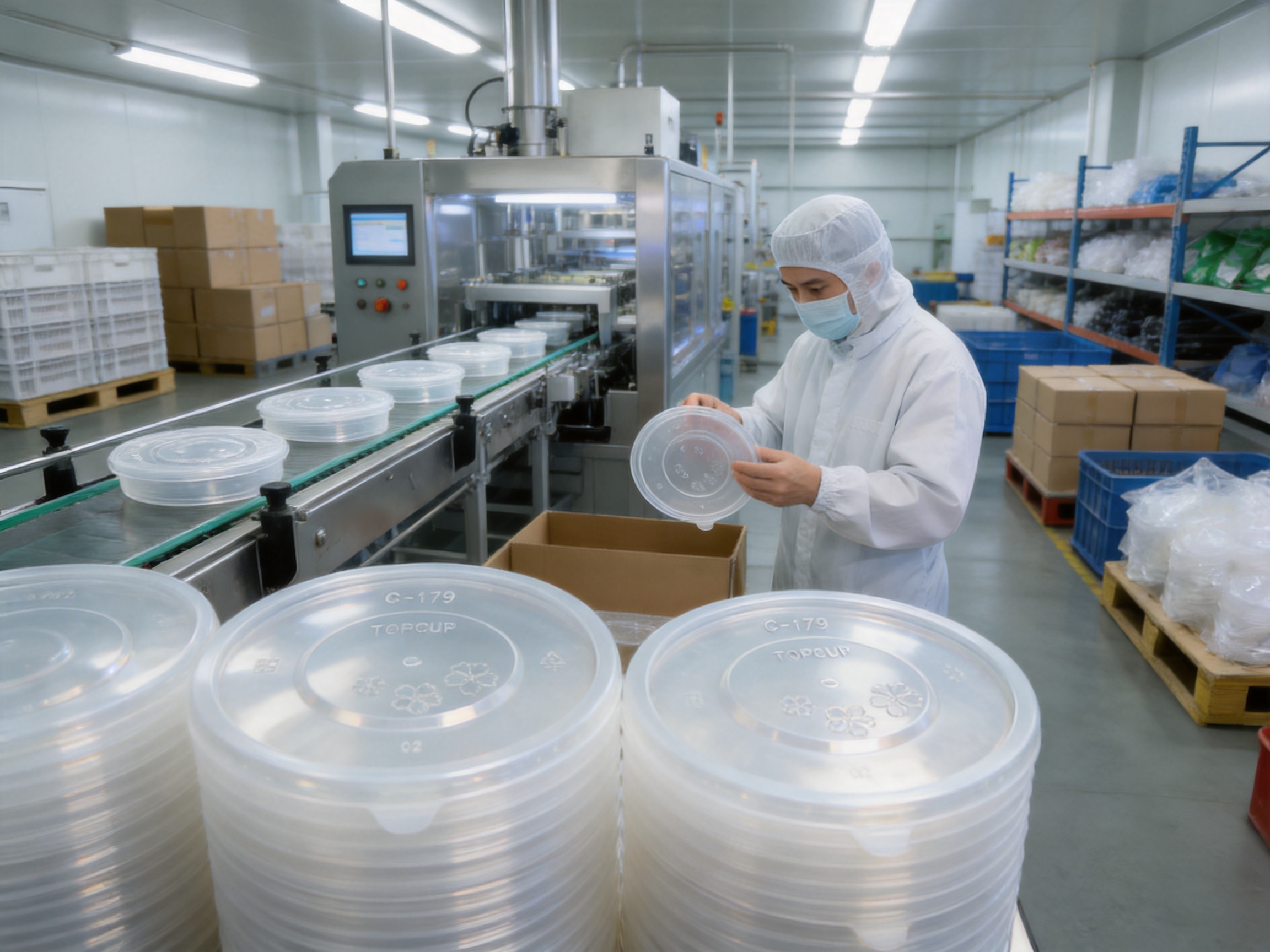
As an experienced OEM manufacturer, Yuqian Packaging Technology operates flexible production lines for food packaging products. The company’s stated capabilities include research and development, production, sales, customized manufacturing, and one-stop service for disposable food packaging. This structure allows product requirements to be considered across the entire process rather than treated as an isolated manufacturing order.
The production process generally begins with the selection and preparation of food-grade PP raw materials. Material handling must be organized to protect cleanliness and maintain consistency. The PP is then processed using suitable forming equipment and molds. During molding, temperature, pressure, cycle time, and cooling conditions influence the final dimensions and surface quality of the lid.
Mold accuracy is especially important for a lid because the sealing edge must correspond closely with the container rim. The ventilation structure must also be formed consistently so that it performs its intended function without creating unnecessary weakness. After forming, lids may undergo trimming, visual inspection, dimensional checks, weight checks, and packing procedures.
Quality control should address both appearance and performance. Visual inspection can identify contamination, deformation, incomplete forming, scratches, flash, discoloration, or other defects. Dimensional inspection can confirm that the caliber and key fit areas remain within the required tolerance. Functional tests can evaluate closure, stacking, ventilation, and resistance to ordinary handling.
The company reports a complete quality management system and certifications or testing that include a QS national industrial product production license, ISO9001 quality management system certification, BRC certification, German DIN safety certification, and EU RoHS-related testing. Buyers should verify the current validity, scope, and applicability of any certification documents for their particular project and destination market.
10. Advanced OEM and Customization Capabilities
Food packaging requirements vary widely among customers. A beverage chain may need a lid matched to a specific cup series. A catering company may require a bowl lid with a particular rim profile. A distributor may want a private-label product, a special color, or a different package quantity. An effective OEM supplier must therefore be able to manage more than standard catalog production.
The company provides customized services according to customer requirements, including possible adjustments to color, caliber, size, shape, and material selection. Customization begins with understanding the application. Important questions include the type of container, the food or beverage being packaged, filling temperature, delivery time, sealing method, storage conditions, stacking needs, branding requirements, and local regulatory expectations.
Sample production is an important stage in customized packaging development. A sample allows the customer to check fit, appearance, opening force, ventilation, stacking, labeling, and compatibility with filling equipment. It also provides an opportunity to identify problems before mass production. When the sample is approved, production specifications can be documented for repeat orders.
Flexible production lines can be particularly valuable for customers with changing demand. Seasonal products, promotional campaigns, new menu items, and regional packaging requirements may all require adjustments. An OEM partner with research and development resources can help convert these requirements into a practical product specification.
Customization does not mean that every feature can be changed without limitation. Any adjustment must be assessed for manufacturability, food-contact suitability, mold requirements, cost, lead time, and performance. A professional supplier should explain these factors clearly and help the customer select an effective balance between design ambition and production reliability.
11. Advantages Compared with Basic Alternative Lids
Many low-cost lids are available in the market, but purchase price alone does not determine total value. A lid that causes leakage, poor fit, breakage, order errors, or excessive waste may create costs that are not visible on the original invoice. The clear PP plastic ordinary vented lid offers several potential advantages over basic, poorly controlled alternatives.
11.1 Better balance of strength and weight
The thickened PP structure is intended to provide more dependable handling than an extremely thin lid, while the lightweight material keeps transport and storage requirements practical. This balance can be useful for high-volume foodservice operations that need both performance and cost awareness.
11.2 Improved product visibility
Transparent construction allows food and beverages to remain visible. This can support presentation, order identification, and customer confidence. Opaque lids may hide the contents and require additional labeling or opening for inspection.
11.3 Ventilation for suitable hot-food applications
The ordinary vented design supports controlled air circulation and can help address steam and pressure concerns. A fully closed basic lid may not provide the same ventilation function, while an excessively open lid may offer less protection against spills.
11.4 Custom production support
Standard low-cost lids may be available only in fixed sizes and colors. OEM production provides greater flexibility for customers who need a particular caliber, shape, color, or packaging configuration. This can be especially valuable when the lid must match an existing container system.
11.5 More consistent quality management
A supplier operating under a documented quality management system can provide a more structured approach to materials, production, inspection, and customer feedback. Consistency is essential when a restaurant chain or distributor places repeat orders across multiple locations.
11.6 One-stop packaging coordination
The company’s wider product range includes plastic cups, plastic cup lids, takeaway bowls, disposable straws, recycle bags, peripheral products, and injection film lining cup and bowl boxes. Access to a broader packaging portfolio can simplify supplier management and make it easier to coordinate compatible components.
12. Environmental Considerations
Environmental responsibility is now an important consideration in disposable food packaging. Businesses, regulators, and consumers are paying closer attention to material selection, production energy use, waste reduction, recyclability, and end-of-life management. A clear PP lid should therefore be considered not only as a functional product but also as part of a broader packaging system.
Polypropylene is a widely used thermoplastic material and may be recyclable in locations where suitable collection and processing systems exist. However, actual recyclability depends on local infrastructure, contamination levels, sorting practices, material combinations, and regulations. A lid that is technically recyclable may not be recycled in every market.
The company states that it actively adopts environmentally friendly transparent PP materials, seeks to reduce energy consumption and waste emissions during production, and is committed to developing recyclable and degradable vented lid products. These efforts reflect the changing expectations of the packaging industry. Customers should request specific material information and environmental documentation when making sustainability claims.
Material reduction should also be approached carefully. Reducing unnecessary weight can lower resource use and transport emissions, but excessive reduction may harm product performance and increase waste caused by leakage or breakage. A well-designed lid aims to use material efficiently while maintaining the strength, fit, and safety required for the intended application.
Businesses can improve the environmental performance of a lid system by selecting an appropriate material, reducing unnecessary secondary packaging, optimizing carton loading, avoiding over-ordering, and providing clear disposal guidance. Where local facilities permit, compatible PP components should be managed through established recycling channels.
13. Foodservice and Commercial Applications
Clear PP plastic ordinary vented lids can support a broad range of foodservice applications. They may be used with takeaway bowls for soups, noodles, rice meals, pasta, salads, desserts, and other prepared foods. They may also be suitable for compatible cups or containers used by restaurants, cafés, caterers, central kitchens, convenience stores, and delivery platforms.
In restaurants, the lid can help staff close orders quickly and maintain a clean presentation. In catering operations, transparent lids can make it easier to identify different dishes in large orders. In central kitchens, consistent lid dimensions can support standardized packing lines. For distributors, the stackable structure and lightweight design can simplify warehouse management.
The lid may also be useful for food manufacturers developing private-label takeaway products. OEM customization can support a consistent packaging identity across several product sizes or regional markets. A supplier capable of coordinating lids, cups, bowls, and other disposable components may help reduce compatibility problems between packaging elements.
Before commercial adoption, customers should test the lid with their actual container, filling equipment, food recipe, storage conditions, and transport method. A product that performs well with a cold dessert may behave differently with a hot liquid meal. Application testing is therefore a key part of responsible packaging selection.
14. Recommended Evaluation Procedure for Buyers
Buyers can use a structured evaluation process to determine whether the 179 Regular lid or a customized version is suitable for their operation.
Step 1: Confirm dimensional compatibility
Measure the container rim and compare it with the lid’s 179-millimeter caliber. Confirm the effective sealing area, inner and outer diameter, rim shape, and stacking relationship. Do not rely only on nominal size because different manufacturers may define measurements differently.
Step 2: Test closure and opening
Apply the lid using the same method and equipment that will be used in daily operations. Check whether it closes evenly, remains attached during handling, and can be opened without excessive force. A closure that is too loose may leak, while one that is too tight may slow production or frustrate customers.
Step 3: Conduct leakage testing
Fill the container with the intended product or a suitable test liquid. Place the container upright, on its side, and in a simulated delivery position. Apply gentle movement and inspect the lid and sealing edge. Testing should be repeated with multiple samples to evaluate consistency.
Step 4: Evaluate ventilation
For hot foods, observe steam release, condensation, lid stability, and opening behavior. Confirm that ventilation supports the intended application without exposing the contents to unnecessary contamination or excessive spilling.
Step 5: Assess appearance
Inspect transparency, surface quality, flash, deformation, color consistency, and compatibility with labels or printed branding. Product visibility should be evaluated under the lighting conditions found in restaurants, display counters, and delivery environments.
Step 6: Review logistics
Check stackability, carton packing, storage height, pallet efficiency, and protection during shipment. The product should arrive without significant deformation or contamination and should be convenient for employees to retrieve and use.
Step 7: Confirm documentation
Request material information, quality records, applicable certificates, inspection reports, and food-contact documentation required for the target market. Certification scope should be reviewed rather than assumed.
15. Quality, Certifications, and Compliance Awareness
Food packaging buyers need confidence that a supplier can maintain stable quality over time. Certifications and testing can provide useful evidence of management practices, safety procedures, and product controls. The company identifies several qualifications, including QS national industrial product production licensing, ISO9001 certification, BRC certification, German DIN safety certification, and EU RoHS-related testing.
ISO9001 generally reflects a structured quality management approach. BRC-related certification may be relevant to food safety and packaging production systems, depending on the certification scope. DIN standards and testing may address specific safety or technical requirements. RoHS testing concerns restricted substances and should be interpreted according to the product and applicable regulations.
Certificates should always be checked for issuing organization, certificate number, validity period, covered facility, covered product category, and applicable standard. Buyers may also require additional tests for food-contact migration, chemical composition, thermal performance, or regional compliance. Requirements can differ significantly between countries and applications.
Quality assurance is not limited to certificates. It also includes process records, incoming material inspection, mold maintenance, operator training, production traceability, final inspection, complaint handling, and corrective action. The company’s stated complete quality management system and after-sales service structure are important strengths for customers seeking a long-term OEM relationship.
16. Company Manufacturing Strengths
Yuqian Packaging Technology (Jiangsu) Co., Ltd. was established in 2010 and is located in Taizhou City, Jiangsu Province, China. The company reports a plant area of approximately 30,000 square meters and describes itself as a high-tech enterprise engaged in research and development, production, and sales of new food packaging materials and products.
The company’s experience in food packaging supports product development, process improvement, and customer service. Its flexible production lines are intended to support both standard products and customized projects. The ability to provide sample production through mass production can reduce coordination between multiple suppliers and help maintain consistency after design approval.
The company also established a Shanghai branch in January 2019 to improve service quality and expand business channels. This broader operational structure can support communication, customer development, and supply chain coordination. For international customers, responsive communication and after-sales support are particularly important because packaging issues may affect production schedules, delivery commitments, and product launches.
Another strength is the company’s product range. In addition to clear PP vented lids, the business works with plastic cups, takeaway bowls, disposable straws, recycle bags, peripheral products, and injection film lining cup and bowl boxes. A broader product portfolio can help customers coordinate packaging systems and explore integrated procurement solutions.
17. Customer Service and Long-Term Cooperation
Packaging procurement is rarely a one-time transaction. Customers often need assistance with samples, technical clarification, order quantities, packaging methods, delivery schedules, quality feedback, and repeat production. A supplier’s service capability can therefore be as important as the product itself.
The company describes a customer-centered after-sales service system designed to address issues encountered during use. Effective after-sales support should include clear communication, investigation of complaints, sample review, corrective action, and follow-up. When a problem is identified, the supplier and customer should work together to determine whether it originated from product dimensions, application conditions, handling procedures, transport, or storage.
Long-term cooperation also benefits from documented specifications. Once the customer approves a sample, the final dimensions, weight range, material, color, packing method, and inspection requirements should be recorded. This helps reduce variation between repeat orders and provides a clear reference for both parties.
For international buyers, communication about shipping cartons, palletization, labeling, customs documents, production lead times, and payment arrangements should take place early. Clear planning helps prevent avoidable delays and supports a more stable supply chain.
18. Practical Ordering Information
When requesting a quotation for the clear PP plastic ordinary vented lid, customers should provide as much application information as possible. Useful information includes the required caliber, compatible container model, estimated monthly quantity, preferred color, packaging method, destination country, target delivery schedule, and whether private labeling is needed.
Customers should also explain the intended food application. Important details may include hot or cold filling, liquid or solid contents, oily or acidic ingredients, expected shelf or delivery time, and whether the package will be reheated. This information allows the manufacturer to recommend a suitable structure and identify any necessary testing.
For customized designs, the buyer may provide drawings, samples, technical files, photographs, or dimensional data. The supplier can then evaluate mold requirements, production feasibility, minimum order quantity, expected tooling cost, and sample schedule. A clear specification at the beginning of the project can reduce revisions later.
19. Frequently Asked Questions
Q1: What material is used for the lid?
The lid is made from food-grade polypropylene, commonly known as PP. The product is described as non-toxic, odorless, and suitable for disposable food packaging applications when produced and used according to applicable requirements.
Q2: What is the listed size of the standard model?
The listed model is 179 Regular, with a caliber of 179 millimeters. Buyers should confirm detailed dimensions and compatibility with the actual container before ordering.
Q3: What is the approximate weight of one lid?
The listed gram weight is approximately 8 grams. The final weight may vary if the design, dimensions, material specification, or production requirements are customized.
Q4: Is the lid completely airtight?
No. It is an ordinary vented lid designed to provide a certain amount of ventilation while maintaining practical coverage and sealing. It should not be treated as a completely airtight or pressure-resistant closure.
Q5: Can the lid help reduce leakage?
Yes. The product is designed with a leak-reducing sealing structure and a thickened, durable body. Actual performance depends on correct compatibility with the container, proper application, food temperature, filling level, and handling conditions.
Q6: Is the lid transparent?
Yes. The standard product color is transparent. Customized colors may be discussed according to the customer’s requirements and production feasibility.
Q7: Can the product be customized?
Customization services are available for suitable projects. Possible areas include caliber, size, shape, color, material selection, and other packaging details. Customers should provide application information and technical requirements for evaluation.
Q8: Is the lid stackable?
Yes. The product is designed to be stackable, which can help save storage space and improve handling efficiency. Storage conditions should still protect the lids from contamination, excessive pressure, and deformation.
Q9: What certifications or testing does the manufacturer report?
The company reports a QS national industrial product production license, ISO9001 quality management system certification, BRC certification, German DIN safety certification, and EU RoHS-related testing. Buyers should request current documentation and verify whether each qualification applies to their specific order and market.
Q10: Can samples be produced before mass production?
The company describes an OEM service that includes sample production and mass production. Sample approval is recommended for confirming fit, sealing, ventilation, appearance, and application performance before placing a larger order.
Q11: Can the lid be used for hot food?
It may be suitable for compatible hot-food applications because the vented design supports air circulation. However, the actual food temperature, container material, filling method, transportation time, and regulatory requirements should be evaluated through practical testing before commercial use.
Q12: How should buyers assess environmental performance?
Buyers should review the material specification, local recycling infrastructure, production controls, packaging reduction measures, and available environmental documentation. Polypropylene may be recyclable in suitable systems, but actual recycling depends on local collection and processing facilities.
Q13: What information should be included in an inquiry?
An inquiry should include the required size, container type, food application, estimated quantity, preferred color, delivery destination, packaging requirements, customization needs, and any applicable compliance standards. Drawings or samples are helpful for customized projects.
20. Conclusion
The clear PP plastic ordinary vented lid is a practical packaging component designed around the needs of modern takeaway food operations. Its principal advantages include food-grade PP construction, transparent appearance, thickened durability, leakage-reducing sealing, controlled ventilation, lightweight handling, stackability, and OEM customization.
The 179 Regular model, with a listed 179-millimeter caliber and approximate 8-gram weight, provides a useful standard option for compatible takeaway containers. Its clear structure helps display food and support order identification, while the vented design can assist with steam and air circulation in suitable applications.
Beyond the product itself, the manufacturer offers important supply-side strengths. These include research and development capability, flexible production lines, a broad disposable food packaging portfolio, quality management systems, certification experience, customized production, sample development, mass manufacturing, and after-sales service. These capabilities can help customers move from an initial concept to a stable packaging supply program.
For the best result, buyers should confirm compatibility through samples and application testing. Dimensional fit, leakage resistance, ventilation, appearance, material compliance, storage, and transport performance should all be reviewed before final production. When correctly matched with the container and food application, a clear PP plastic ordinary vented lid can contribute to safer handling, more attractive presentation, more efficient operations, and a stronger overall takeaway packaging system.
References
1. Product specification information for the clear PP plastic ordinary vented lid, including model, caliber, gram weight, color, material, and product features.
2. Polypropylene material performance principles for food packaging, including lightweight construction, chemical stability, impact resistance, and processing suitability.
3. General food packaging quality management practices, including material inspection, molding control, dimensional inspection, functional testing, and traceability.
4. ISO9001 quality management system principles and their application to manufacturing process control.
5. BRC packaging and food safety management principles relevant to packaging production and supplier evaluation.
6. General guidance on food-contact packaging evaluation, including compatibility testing, migration considerations, and destination-market compliance.
7. General principles of recyclable polypropylene packaging design, material reduction, waste prevention, and local recycling system assessment.
8. Company information supplied for Yuqian Packaging Technology (Jiangsu) Co., Ltd., including manufacturing history, facility information, product categories, certifications, OEM capabilities, and service structure.