Food packaging is undergoing a major transformation. As consumers, retailers, restaurants, and food-service operators become more aware of plastic pollution, businesses are seeking packaging solutions that protect products while reducing environmental impact. Biodegradable PLA packaging bags have emerged as a practical alternative to many conventional petroleum-based plastic bags, particularly for takeaway beverages, snacks, and light food containers.
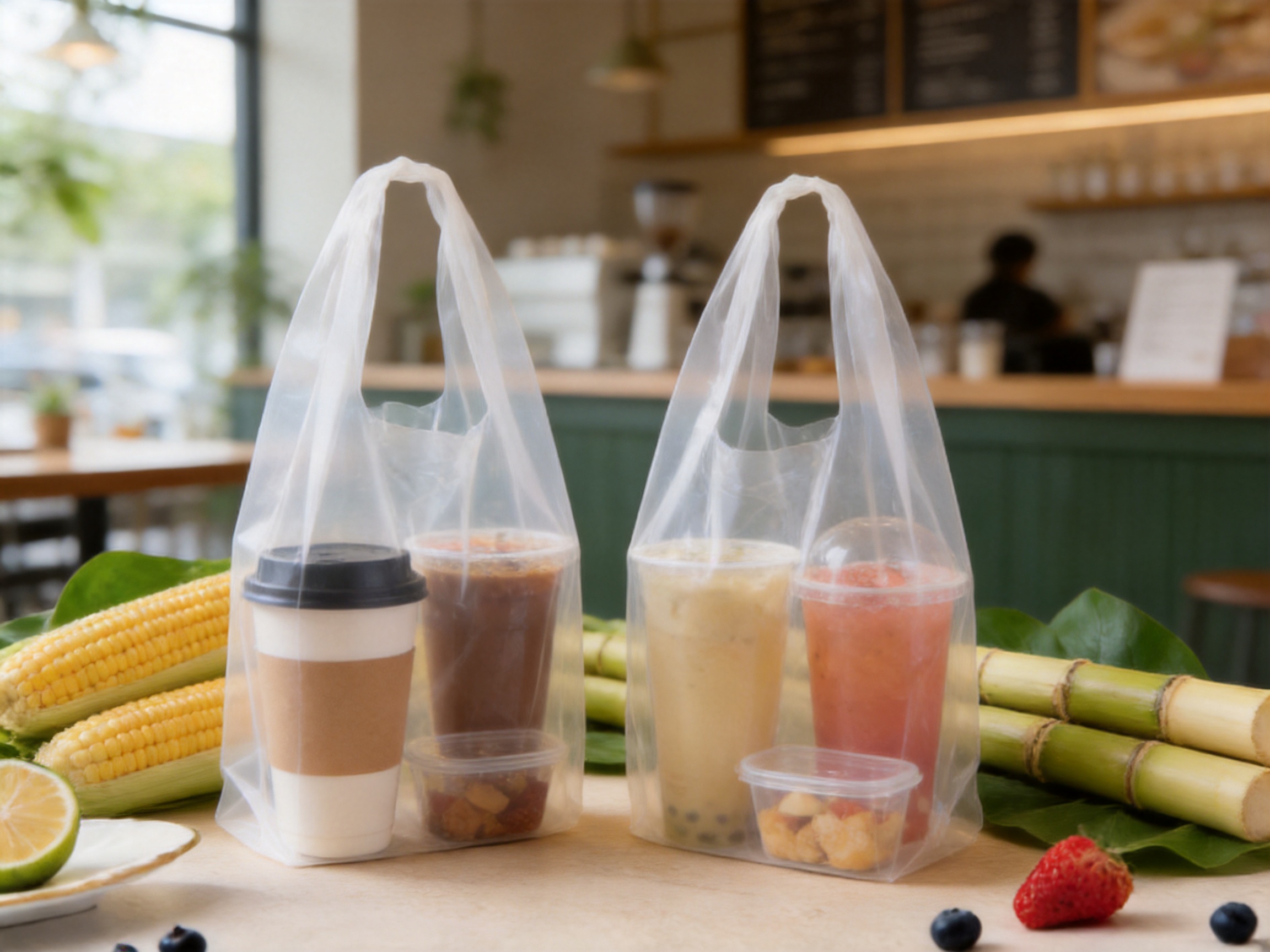
Made from polylactic acid, commonly known as PLA, these packaging bags combine renewable raw materials, functional performance, and flexible customization. PLA is a bio-based polymer generally produced from renewable agricultural resources such as corn starch, sugarcane, or other plant-derived materials. When properly managed through suitable end-of-life systems, PLA products can support broader efforts to reduce dependence on traditional fossil-based plastics.
For food-service businesses, packaging must do more than carry a product. It must be safe, convenient, durable, visually attractive, and compatible with a company’s brand image. A packaging bag that is too weak can fail during transportation. A bag that is poorly designed can make takeaway service inconvenient. A bag that does not meet food-contact expectations can create unnecessary safety concerns. Biodegradable PLA packaging bags address these requirements through a combination of material selection, structural design, customized sizing, and controlled manufacturing.
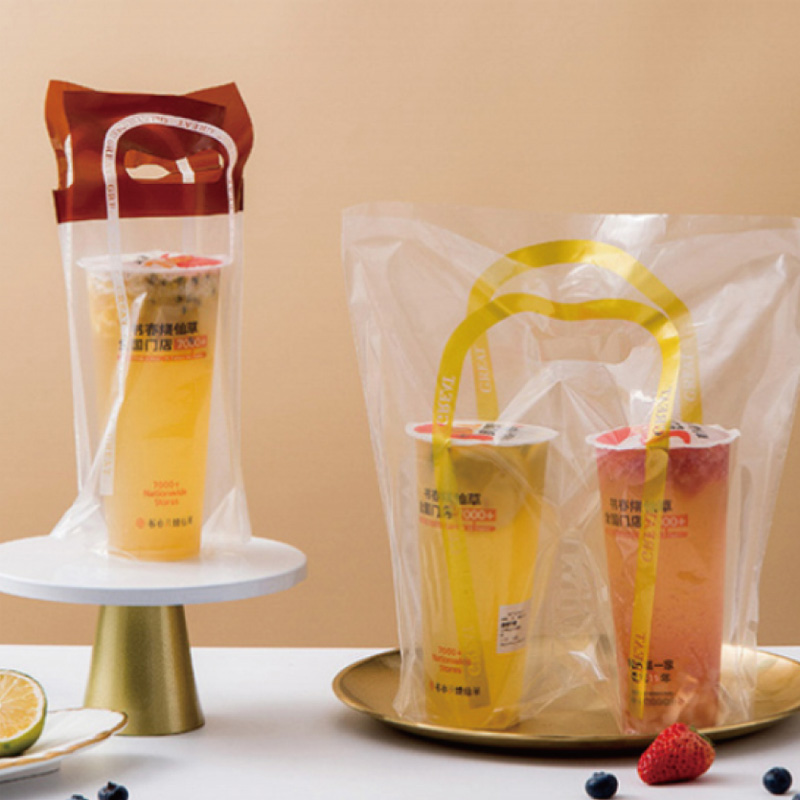
Yuqian Packaging Technology (Jiangsu) Co., Ltd. has developed a range of biodegradable PLA packaging bags for modern food packaging applications. The range includes single-cup flat bags, double-cup flat bags, single-cup tote bags, double-cup tote bags, four-cup tote bags, and other formats designed for different service requirements. Each type can be customized according to customer needs, allowing businesses to select suitable dimensions, carrying capacity, and packaging configuration.
Biodegradable PLA packaging bags are bags produced from PLA-based material rather than conventional petroleum-derived plastic film. PLA is a thermoplastic polymer made by processing lactic acid, which can be obtained from fermented plant-based carbohydrates. The material is valued for its origin from renewable resources, its clarity and smooth appearance, and its ability to be processed into films, containers, cups, and packaging accessories.
In the context of takeaway packaging, PLA bags can be manufactured in several shapes. A flat bag may be used to carry one or two cups with a simple opening and compact structure. A tote-style bag can include handles that make it easier for customers to transport beverages or food containers. Larger four-cup formats are suitable for group orders, delivery services, catering businesses, offices, and events.
The term biodegradable should be considered together with local waste-management conditions. PLA products are designed to break down under appropriate biological and industrial composting conditions, but the speed and extent of degradation depend on temperature, humidity, microorganisms, processing systems, and local infrastructure. Responsible packaging decisions should therefore include both the material and the disposal pathway available in the target market.
Even with this consideration, PLA offers an important alternative to conventional plastics. It is derived from renewable feedstocks, can help reduce reliance on fossil resources, and is suitable for businesses seeking to improve their packaging profile. When combined with efficient production, appropriate product design, and responsible waste management, PLA packaging can contribute to a more circular approach to food-service operations.
Why Sustainable Packaging Matters in Food Service
Food-service packaging is used in extremely high volumes. Coffee shops, tea stores, restaurants, bakeries, canteens, supermarkets, catering companies, and delivery platforms distribute millions of takeaway products every day. Many of these items are used for only a short time before being discarded. The short service life of disposable packaging makes material selection especially important.
Traditional plastic packaging has historically been popular because it is inexpensive, light, flexible, and easy to process. However, many conventional plastics are manufactured from non-renewable fossil resources and remain in the environment for long periods after disposal. Improperly managed plastic waste can enter waterways, accumulate in landfills, and contribute to environmental pollution.
Sustainable packaging does not mean sacrificing performance. Instead, it requires manufacturers to balance environmental objectives with functional needs. A bag must still be able to hold a cup securely, resist normal handling, maintain its shape, and support efficient service. It should also be easy for employees to use and comfortable for customers to carry.
Biodegradable PLA packaging bags help businesses respond to these challenges. They provide a visible environmental improvement compared with many conventional plastic alternatives while retaining the practicality expected from disposable food packaging. Their plant-based material origin can also support sustainability communication, provided that claims are made accurately and in accordance with applicable regulations.
Key Advantages of Biodegradable PLA Packaging Bags
Renewable Material Origin
One of the most important advantages of PLA is its bio-based origin. Traditional plastic is commonly produced from petroleum or natural gas. PLA, by contrast, can be produced from renewable agricultural resources. This difference supports the development of packaging systems that are less dependent on finite fossil resources.
Renewable material origin does not automatically mean that every product has no environmental impact. Agricultural production, processing energy, transportation, and end-of-life management must also be considered. Nevertheless, the use of plant-based feedstocks provides a meaningful foundation for reducing reliance on traditional petrochemical materials.
Biodegradable Characteristics
PLA is designed to biodegrade under suitable conditions, especially in industrial composting environments where elevated temperatures, controlled moisture, and active microbial processes are available. This characteristic distinguishes PLA from many conventional plastics that can persist for extended periods.
For food-service brands, the biodegradability of PLA can support waste-reduction strategies and sustainability programs. It may also help businesses align with packaging policies, customer expectations, and market trends that favor materials with improved end-of-life potential.
Suitable for Food-Service Applications
Food packaging requires careful attention to material purity and safety. The PLA packaging bags described in the product range are made from PLA material and are intended for food-service packaging uses. The product information emphasizes that the bags do not contain harmful chemicals and are designed to be non-toxic and harmless during normal use.
Food-contact compliance should always be confirmed according to the regulations of the destination market and the exact product specification. Different countries and regions may require particular migration tests, declarations, labeling, or certifications. A professional manufacturer can support customers by clarifying material details and arranging relevant documentation where required.
Lightweight and Convenient
PLA bags are lightweight, which helps reduce the amount of material used per carrying unit and makes them convenient for employees and customers. Their low weight can also support efficient storage and transportation when compared with heavier reusable or rigid packaging systems.
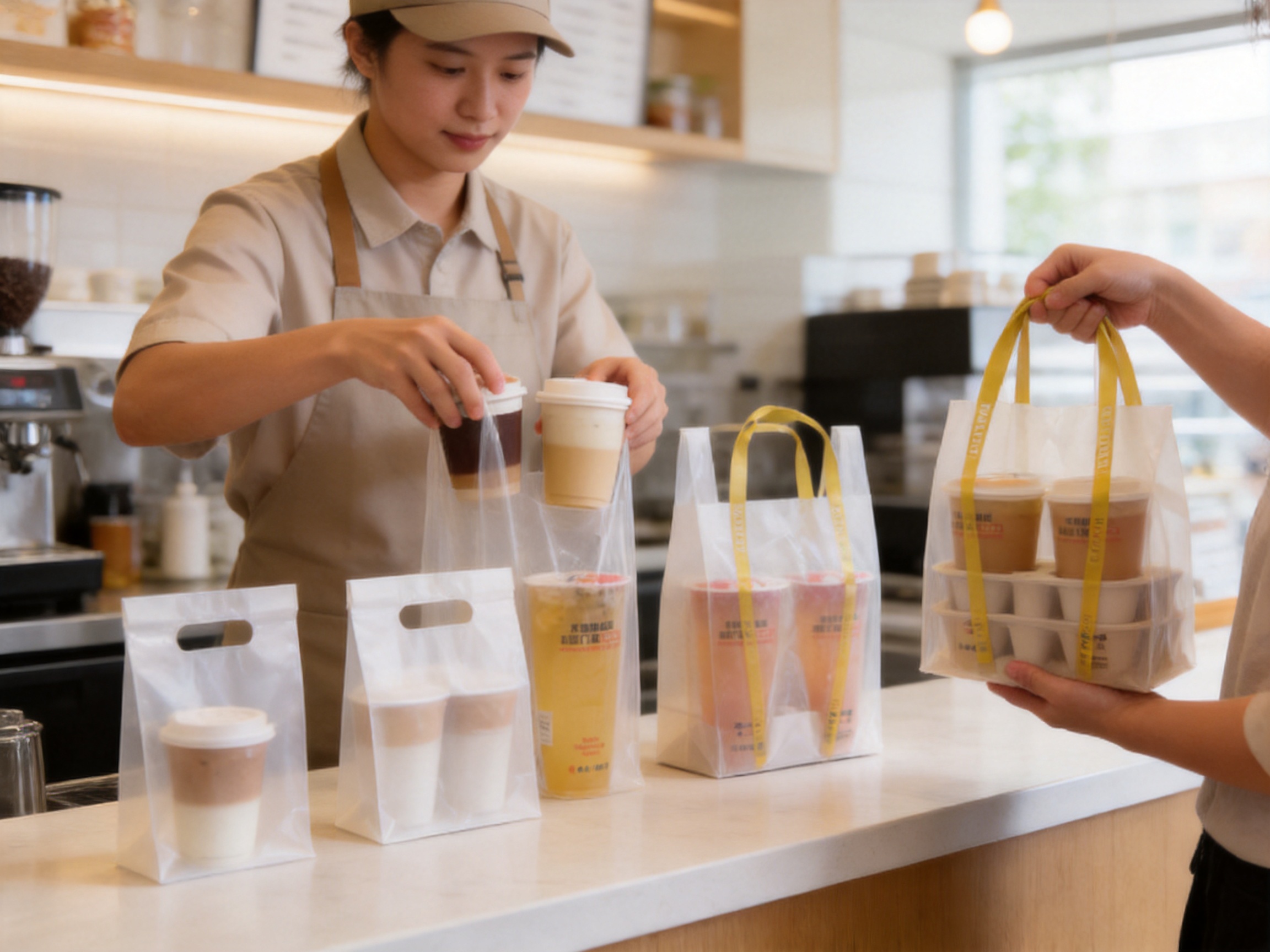
The lightweight structure is particularly useful in fast-service environments. Staff can place one or more cups into a bag quickly, while customers can carry their orders without needing additional packaging. This convenience is important for takeaway coffee, milk tea, fruit beverages, smoothies, juices, desserts, and other portable products.
Flexible Product Formats
Different orders require different packaging configurations. A single-cup order does not need the same bag as a large office delivery or a family beverage purchase. The product range includes multiple formats that allow businesses to select an appropriate solution.
Single-cup flat bags are compact and suitable for individual orders. Double-cup flat bags provide additional capacity while maintaining a simple design. Single-cup and double-cup tote bags offer handles for easier carrying. Four-cup tote bags are intended for larger orders and group service. These options can help businesses avoid over-packaging and select a format that matches the actual order size.
Customizable Dimensions
Packaging products are most effective when their dimensions match the items they carry. A bag that is too large may waste material and allow products to move excessively. A bag that is too small may be difficult to load or may place unnecessary stress on the film and seams.
Customized sizing allows customers to specify dimensions that correspond to their cups, bowls, containers, or service format. Customization may also help businesses optimize storage space, improve order presentation, and standardize their packaging procedures across multiple locations.
Product Formats and Their Applications
Bag format
Typical application
Main benefit
Single-cup flat bag
Individual beverage orders and small takeaway products
Compact, simple, and material-efficient
Double-cup flat bag
Two beverages or paired food-and-drink orders
Provides additional capacity in a flat format
Single-cup tote bag
One beverage requiring convenient carrying
Handle design improves portability
Double-cup tote bag
Two drinks for takeaway and delivery
Balances carrying comfort and capacity
Four-cup tote bag
Group orders, catering, offices, and events
Supports multiple-cup transportation
Customized formats
Special product sizes or unique service requirements
Allows closer integration with the customer’s packaging system
Single-Cup Flat Bags
Single-cup flat bags are intended for customers purchasing one drink or one small takeaway item. Their simple structure can support fast packing at busy counters. They are also convenient for businesses that want to minimize packaging volume for individual orders.
These bags may be suitable for coffee cups, tea cups, cold beverages, smoothies, or other products with compatible dimensions. The final size should be selected based on cup diameter, height, lid profile, and the preferred amount of clearance.
Double-Cup Flat Bags
Double-cup flat bags are designed for two-cup orders. They can be useful when customers purchase beverages for themselves and another person, or when a meal order includes multiple drinks. A properly designed double-cup bag helps keep the order together and reduces the need for separate individual bags.
For delivery and takeaway applications, the dimensions and internal arrangement should be matched to the cup size. Customers may also request adjustments based on cup shape, lid height, or the use of additional sleeves and accessories.
Single-Cup Tote Bags
Single-cup tote bags include a carrying structure that can make transportation more comfortable. Handles are particularly useful when customers are walking, carrying additional shopping bags, or using public transportation. The tote format can also create a more recognizable packaging appearance for beverage brands.
Handle strength, opening dimensions, and bag balance are important design considerations. The bag should allow the cup to be inserted easily while limiting unnecessary movement during normal carrying.
Double-Cup Tote Bags
Double-cup tote bags combine the capacity of a two-cup format with the convenience of handles. They are suitable for coffee shops, beverage chains, restaurants, and delivery services that regularly prepare paired beverage orders.
The bag structure can be customized to suit different cup sizes and carrying requirements. Depending on the order format, customers may select a design that provides additional side clearance, reinforced carrying areas, or a specific opening style.
Four-Cup Tote Bags
Four-cup tote bags are designed for larger orders. They can be valuable for catering, workplace beverage deliveries, parties, school events, conferences, and family purchases. By grouping several cups into one purpose-designed bag, businesses can simplify order handling and improve delivery efficiency.
A four-cup format must be designed with particular attention to load distribution. The film, seams, handle area, and overall dimensions should be selected according to the expected cup weight and order configuration. Custom production allows these factors to be reviewed during development.
Customization for Different Business Requirements
Packaging is an important part of a food-service brand’s daily operation. Even when the bag is primarily functional, its size, structure, and appearance influence how customers experience the order. A professional customization service allows businesses to adapt packaging to their exact requirements rather than relying only on standard off-the-shelf sizes.
Size Customization
Size is one of the most important customization factors. Customers may request different bag widths, heights, opening dimensions, handle lengths, or carrying capacities. The ideal dimensions depend on the cup diameter, cup height, lid shape, additional accessories, and the number of products packed together.
Correct sizing can improve material efficiency and reduce operational problems. Employees can pack orders more quickly when the bag opening is appropriate. Customers can carry products more securely when the bag provides sufficient support without excessive empty space.
Structural Customization
Flat bags and tote bags serve different purposes. A business that prioritizes compact storage may prefer a flat format. A business that emphasizes carrying convenience may select a tote design. Larger orders may require a multi-cup configuration with a stronger handle area or a wider base.
Structural customization can also include adjustments to the bottom design, side dimensions, opening style, and handle configuration. These details should be considered together because changes in one area may influence the performance of another.
Packaging Integration
Many food-service businesses use several packaging products at the same time, including cups, lids, bowls, straws, sleeves, and bags. A PLA packaging bag should fit into this broader system. For example, the bag opening should accommodate the cup and lid combination, while the internal space should be sufficient for any required napkins, utensils, or accessories.
Integration is especially important for businesses operating multiple stores. A consistent packaging system can help standardize employee training, reduce packing errors, and create a more unified customer experience.
Brand Presentation
Customized packaging can support brand presentation. Depending on the selected production process and specification, businesses may discuss visual requirements such as color, surface appearance, printed information, and logo placement with the manufacturer.
Environmental messaging should be accurate and clear. A brand should avoid unsupported claims such as “zero impact” or “completely disappears anywhere.” More responsible communication may explain that the bag is made from PLA, uses bio-based material, and is intended for appropriate biodegradable or composting pathways where available.
Manufacturing Process and Quality Control
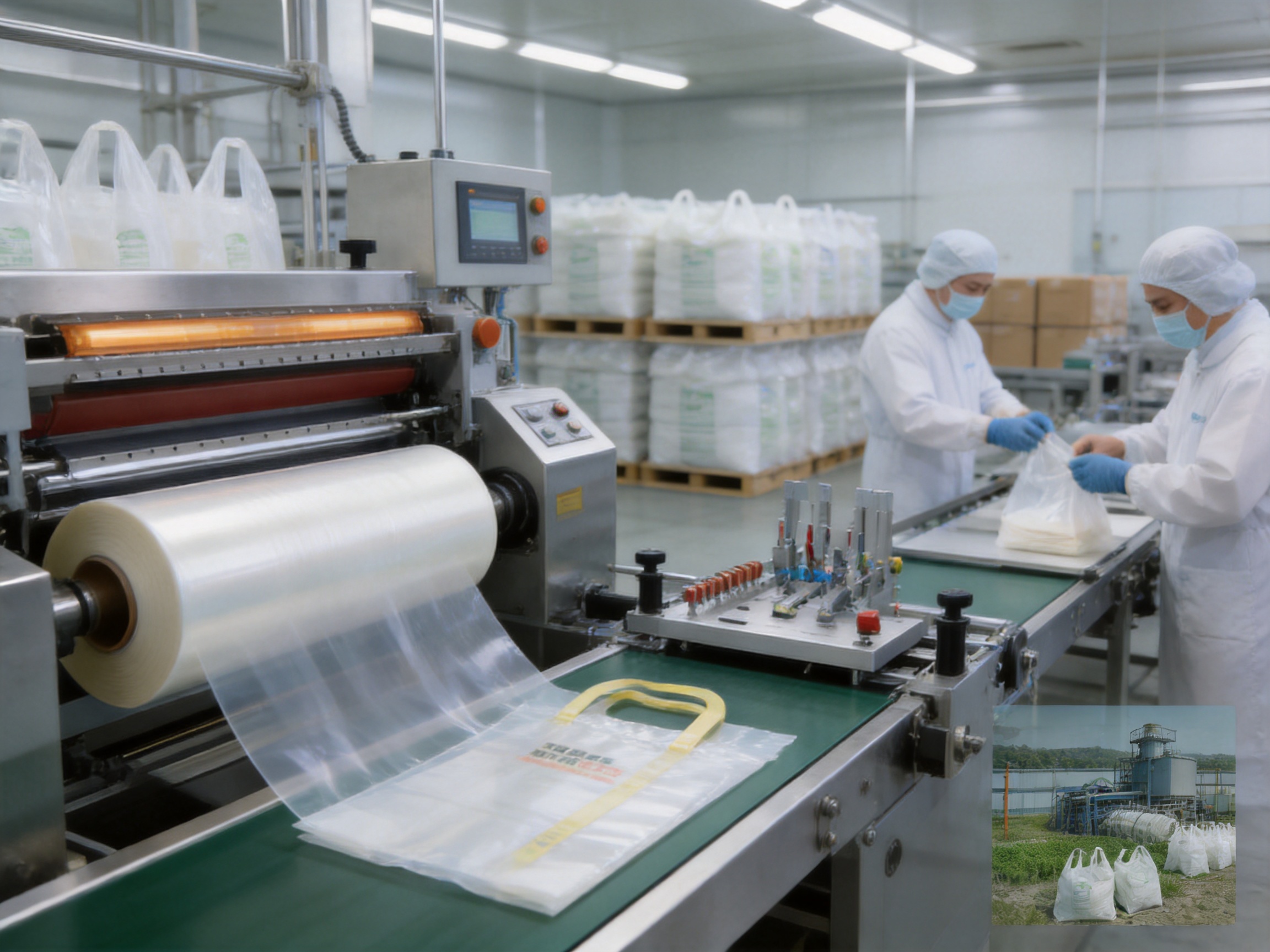
The performance of a biodegradable PLA packaging bag depends not only on the raw material but also on the manufacturing process. Consistent film quality, accurate forming, reliable sealing, and careful inspection are essential for producing packaging that performs correctly in real food-service conditions.
Material Selection
Manufacturing begins with the selection and preparation of PLA raw material. The material must be suitable for the intended film and bag application. Important considerations include material purity, processing characteristics, transparency or appearance requirements, mechanical performance, and compatibility with food-contact expectations.
Material storage is also important. PLA can be affected by moisture, so appropriate storage and handling procedures help protect processing stability. Controlling the condition of the raw material before production can contribute to more consistent film quality.
Film Processing
PLA is processed into film using controlled thermal and mechanical operations. During this stage, temperature, pressure, line speed, cooling, and thickness must be managed carefully. Stable processing helps produce film with consistent dimensions and suitable flexibility.
Film thickness should be matched to the bag format and expected load. A thin film may reduce material use but must still provide sufficient strength. A thicker film may improve durability but can increase material consumption. The appropriate balance depends on the size, structure, and application of the bag.
Bag Forming
Once the film is prepared, it can be converted into bags through cutting, folding, sealing, and forming operations. Flat bags and tote bags may require different production steps. Handle areas must be shaped accurately, and the opening must remain clean and consistent to support efficient packing.
Dimensional accuracy is particularly important for customized products. Even small variations can affect the fit of the bag around a cup or container. Controlled equipment and standardized operating procedures help maintain consistency across production batches.
Heat Sealing
Sealing is a critical stage in bag manufacturing. The seal must be strong enough to withstand the weight of the packed products and the normal movement associated with carrying and delivery. Seal temperature, pressure, dwell time, and material condition all influence the final result.
Under-sealing can result in weak joints, while excessive heat may deform the film or affect the appearance of the bag. Experienced production teams use controlled parameters and inspection procedures to achieve reliable sealing performance.
Inspection and Testing
Quality control may include checks for dimensions, film appearance, sealing integrity, handle strength, surface defects, and packaging cleanliness. Sampling procedures can help identify variation before products are shipped to customers.
For food-service packaging, product safety is also a major consideration. The company’s broader quality system includes industry certifications and testing credentials listed in its corporate information, including ISO9001 quality management certification, BRC certification, German DIN safety certification, EU RoHS-related testing, and the QS national industrial product production license. The exact applicability of any certificate should be confirmed for the specific product, material, market, and order.
Why Choose a Specialized PLA Packaging Manufacturer?
Purchasing biodegradable packaging from a specialized manufacturer offers advantages over selecting generic products from an unknown supplier. A specialized manufacturer understands the relationship between material behavior, bag structure, production parameters, and food-service requirements.
Technical Knowledge of Degradable Materials
PLA behaves differently from many conventional plastics. Processing temperature, moisture control, flexibility, sealing conditions, and storage requirements must be considered carefully. A supplier with experience in degradable materials can help customers select a suitable structure and avoid design choices that may cause unnecessary production or handling problems.
Research and Development Capability
Yuqian Packaging Technology (Jiangsu) Co., Ltd. was established in 2010 as a high-technology enterprise focused on the research, development, production, and sales of new food packaging materials and products. Its ongoing work with biodegradable materials supports the development of packaging products that respond to changing market expectations.
Research and development capability is especially valuable when customers require non-standard dimensions or unique packaging formats. Instead of simply offering a fixed catalog product, an experienced manufacturer can review the intended use, recommend a suitable format, and coordinate sample development before mass production.
Large-Scale Production Facility
The company operates a plant area of approximately 30,000 square meters in Taizhou City, Jiangsu Province. A substantial production facility can support organized material management, dedicated manufacturing areas, quality inspection, and efficient order coordination.
Production scale is important for customers that need stable supply. Restaurants and beverage chains often require regular repeat orders, consistent dimensions, and predictable delivery schedules. A manufacturer with established infrastructure is better positioned to support these ongoing requirements.
Quality Management
Quality management helps ensure that products manufactured at different times remain consistent. Standardized procedures can cover raw-material inspection, process control, equipment maintenance, finished-product inspection, packaging, and shipment preparation.
For businesses using disposable packaging at multiple locations, consistency is essential. A variation in bag dimensions or sealing strength may create problems for store employees and customers. A structured quality system reduces the likelihood of such variation.
OEM and Custom Manufacturing
OEM capability allows customers to develop products according to their own packaging requirements. This can include customized dimensions, bag types, carrying capacity, and other design details. OEM production is useful for beverage chains, food-service distributors, importers, wholesalers, and brands seeking differentiated packaging.
Customization can begin with a technical discussion and product drawings, followed by sample production and evaluation. Customers can test the bags with their actual cups or containers before confirming a larger order. This approach helps identify issues related to fit, loading, carrying, storage, and delivery.
Export and Business Support
Yuqian Packaging Technology (Jiangsu) Co., Ltd. also established a Shanghai branch to improve service quality and expand business channels. For international customers, responsive communication and organized order support are important parts of supplier performance.
International buyers may need assistance with specifications, documentation, packaging quantities, shipping arrangements, and market-specific requirements. A professional manufacturer can help clarify these items during the quotation and production process.
Competitive Advantages Compared with Conventional Plastic Bags
Conventional plastic bags remain widely available, but biodegradable PLA packaging bags offer several advantages for businesses that prioritize renewable materials and environmental responsibility.
Improved Sustainability Positioning
PLA bags can help a business demonstrate a clearer commitment to sustainable packaging. The use of a bio-based material provides a meaningful difference from packaging made entirely from conventional fossil-based plastic.
This difference can be important for brands serving environmentally conscious customers, participating in sustainability programs, or responding to packaging policies. However, sustainability claims should be supported by accurate product information and responsible disposal guidance.
Reduced Dependence on Fossil-Based Resources
PLA is derived from renewable resources, while many traditional plastic bags depend on petroleum-based feedstocks. Choosing PLA can therefore help diversify material sourcing and reduce dependence on finite fossil resources.
The environmental value of this benefit is strongest when it is combined with efficient production, lightweight design, optimized transportation, and appropriate waste management. No single material solves every packaging challenge, but PLA is an important part of the broader transition toward renewable material systems.
Better Alignment with Emerging Regulations
Governments and industry organizations in many markets are introducing measures to reduce single-use plastic pollution and encourage alternative packaging materials. PLA packaging may help businesses prepare for evolving requirements, although local regulations differ significantly.
Before placing an order, customers should verify whether PLA is accepted for their intended application and disposal system. They should also confirm labeling, composting, food-contact, and recycling requirements in the destination market.
Flexible Design Options
Some low-cost packaging products are available only in limited sizes and formats. The biodegradable PLA product range described here offers multiple bag styles and customized dimensions. This flexibility enables customers to select a product that is better suited to their operational needs.
Design flexibility can reduce unnecessary packaging. A properly sized bag can provide adequate protection and carrying convenience without using substantially more material than required.
Environmental Considerations and Responsible Use
Biodegradable packaging should be viewed as one component of a complete sustainability strategy. Material selection is important, but other factors also influence environmental performance.
Use the Correct Disposal Pathway
PLA products generally perform best in suitable industrial composting systems rather than uncontrolled natural environments. Customers should identify the disposal infrastructure available in their market before making environmental claims or selecting PLA for a large-scale program.
Where industrial composting is not available, the product may not degrade as expected. Clear customer guidance and cooperation with local waste-management providers can improve the effectiveness of the packaging strategy.
Avoid Unnecessary Over-Packaging
The most sustainable bag is often one that is correctly sized and used only when necessary. Businesses can reduce material consumption by selecting single-cup bags for single-cup orders, double-cup bags for paired orders, and larger tote bags only for larger orders.
Accurate sizing also reduces empty space, improves transportation efficiency, and creates a more professional presentation. Custom dimensions can therefore support both environmental and operational goals.
Consider the Full Product Life Cycle
Life-cycle considerations include raw-material production, manufacturing energy, transportation, customer use, and disposal. PLA packaging may offer environmental advantages because of its renewable origin and biodegradability under suitable conditions, but those advantages should be evaluated across the complete life cycle.
Manufacturers and buyers can improve performance through lightweight design, efficient production, responsible sourcing, optimized shipping, and clear end-of-life instructions. A full-system approach is more reliable than focusing on a single material characteristic.
Ordering and Product Development Process
A structured ordering process helps ensure that the final packaging product matches the customer’s actual requirements.
Step One: Define the Application
The customer should first identify what the bag will carry. Important information includes the number of cups, cup dimensions, lid height, expected product weight, use environment, and whether the bag will be used at a store counter, for delivery, or for catering.
Step Two: Select the Bag Format
Based on the application, the customer can select a single-cup flat bag, double-cup flat bag, single-cup tote bag, double-cup tote bag, four-cup tote bag, or another customized format.
Step Three: Confirm Dimensions
Precise measurements help the manufacturer recommend suitable dimensions. Customers should provide cup diameter, height, lid size, handle preferences, and any additional packaging components that will be placed inside the bag.
Step Four: Review Samples
Samples allow customers to test the actual product in realistic conditions. The review should include loading speed, cup stability, handle comfort, seal strength, storage, and appearance. It is better to identify and correct design issues during sampling than after mass production.
Step Five: Confirm Production Specifications
After sample approval, the customer and manufacturer should confirm material, dimensions, bag format, quantity, packaging method, inspection requirements, and shipping details. Written specifications help maintain consistency for repeat orders.
Step Six: Arrange Production and Delivery
Once the order is confirmed, production can be scheduled. Customers should discuss lead times, minimum order quantities, quality-control procedures, and delivery arrangements in advance. Proper planning is especially important for seasonal campaigns, new-store openings, and large catering programs.
Applications Across Food and Beverage Businesses
Biodegradable PLA packaging bags can support a wide range of food-service operations. Coffee shops may use them for hot or cold beverage orders, depending on the selected bag design and application requirements. Tea stores and juice bars can use them for single-cup and multi-cup takeaway orders. Restaurants may use the bags to carry drinks alongside takeaway meals.
Bakeries and dessert shops can benefit from customized formats that accommodate cups, small containers, or packaged treats. Catering companies can select larger tote designs for group orders. Offices and event organizers may use four-cup bags to distribute beverages efficiently to multiple people.
Delivery businesses can also benefit from bag formats that keep orders organized during short-distance transportation. The correct dimensions and carrying structure can reduce movement inside the bag and improve order presentation when the customer receives the product.
Frequently Asked Questions
What is PLA?
PLA, or polylactic acid, is a bio-based polymer commonly produced from renewable resources such as corn starch, sugarcane, or other plant-derived materials. It can be processed into films, bags, cups, and other packaging products.
Are PLA packaging bags suitable for food packaging?
PLA packaging bags are designed for food-service applications, and the product information describes them as non-toxic and harmless during normal use. Customers should confirm the exact food-contact documentation and regulatory requirements for their intended market and application.
Are these bags completely biodegradable in any environment?
No. Biodegradation depends on specific conditions, including temperature, moisture, microorganisms, and processing time. PLA products generally require suitable industrial composting conditions for effective degradation. Customers should follow local disposal guidance.
What types of bags are available?
Available formats include single-cup flat bags, double-cup flat bags, single-cup tote bags, double-cup tote bags, four-cup tote bags, and other customized configurations.
Can the bag size be customized?
Yes. The product range supports customized dimensions according to customer needs. Size can be developed according to cup diameter, cup height, lid dimensions, order quantity, and carrying requirements.
Can customers order bags for different cup sizes?
Yes. Customers can discuss different cup sizes and packaging configurations with the manufacturer. Sampling is recommended when several cup sizes or unusual container shapes will be used.
Are tote bags stronger than flat bags?
Flat bags and tote bags are designed for different uses. Tote bags include a carrying structure and may be more convenient for transportation, while flat bags offer a compact and simple format. The appropriate choice depends on order size, cup weight, and handling conditions.
Are four-cup tote bags suitable for delivery?
Four-cup tote bags are designed for larger orders and can be suitable for delivery, catering, offices, and events. The final specification should be matched to the cup weight, lid design, expected carrying distance, and transportation conditions.
Can PLA bags replace every conventional plastic bag?
PLA bags are a strong option for many takeaway and food-service applications, but they may not be appropriate for every product or environment. Temperature, moisture, load, storage, disposal infrastructure, and regulatory requirements should be evaluated before substitution.
How should businesses choose the correct size?
Businesses should measure the cup or container diameter, height, lid profile, and total order weight. They should also consider whether napkins, utensils, sleeves, or multiple products will be packed together. A sample test can confirm the best dimensions.
Does the company provide OEM services?
Yes. The company provides OEM and customized biodegradable PLA packaging bag services. Customers can discuss format, size, capacity, and other specifications for a product developed around their packaging requirements.
What quality credentials does the company have?
The company’s corporate information lists QS national industrial product production licensing, ISO9001 quality management system certification, BRC certification, German DIN safety certification, and EU RoHS-related testing. Customers should confirm which documents apply to the specific product and destination market.
Where is the manufacturer located?
Yuqian Packaging Technology (Jiangsu) Co., Ltd. is located in Taizhou City, Jiangsu Province, China. The company operates a manufacturing facility with an area of approximately 30,000 square meters and also maintains a Shanghai branch.
Conclusion
Biodegradable PLA packaging bags provide food-service businesses with a practical way to improve packaging sustainability without abandoning convenience or customization. Their renewable material origin, biodegradable characteristics under suitable conditions, lightweight structure, and broad range of formats make them suitable for beverage shops, restaurants, bakeries, catering companies, delivery services, offices, and events.
The available product formats include single-cup flat bags, double-cup flat bags, single-cup tote bags, double-cup tote bags, and four-cup tote bags. Customized sizing allows each business to select packaging that matches its cups, containers, order volumes, and service procedures.
The value of these bags extends beyond the material itself. Reliable packaging depends on controlled film processing, accurate forming, strong sealing, quality inspection, and professional technical support. With experience in new food packaging materials, OEM development, quality management, and customized production, Yuqian Packaging Technology (Jiangsu) Co., Ltd. is positioned to support customers seeking dependable PLA packaging solutions.
For the best result, buyers should evaluate the complete packaging system. They should select an appropriate bag type, verify dimensions through samples, confirm food-contact requirements, review applicable certifications, and establish a responsible end-of-life pathway. When these factors are managed together, biodegradable PLA packaging bags can help businesses reduce dependence on conventional plastic, improve customer convenience, and contribute to a more sustainable future for food packaging.
References
1. Information supplied for the biodegradable PLA packaging bag product range, including product formats, material characteristics, customization options, and intended applications.
2. Information supplied by Yuqian Packaging Technology (Jiangsu) Co., Ltd. regarding company history, manufacturing capability, research and development activities, quality systems, certifications, and factory operations.
3. General technical literature on polylactic acid, bio-based polymers, biodegradable materials, and compostable packaging systems.
4. General food-packaging guidance concerning material selection, food-contact safety, packaging design, quality control, and regulatory verification.
5. General life-cycle principles for sustainable packaging, including renewable feedstocks, manufacturing efficiency, transportation, product use, and end-of-life management.



 English
 Español
 عربى