English
 Español
 عربى
Content
- 1 Why Recycled Paper Packaging Bags Matter in Modern Food Service
- 2 Product Overview and Main Applications
- 3 Key Product Advantages
- 4 Product Specifications
- 5 Manufacturing Strengths and Production Process
- 6 Advantages Compared with Conventional Plastic Carriers
- 7 Customization Options for Different Brands
- 8 How to Select the Right Recycled Paper Bag
- 9 Company Manufacturing Capability
- 10 Environmental and Commercial Value
- 11 Quality, Safety, and Responsible Procurement
- 12 Ordering and Custom Project Workflow
- 13 Q&A: Recycled Paper Packaging Bags
- 13.1 What is a recycled paper packaging bag used for?
- 13.2 What sizes are available?
- 13.3 What materials can be selected?
- 13.4 Can the bag carry more than one cup?
- 13.5 Can a company print its logo on the bag?
- 13.6 Are recycled paper bags durable?
- 13.7 Are these bags biodegradable and recyclable?
- 13.8 Can the bag be used with cold beverages?
- 13.9 How should a customer choose between white paper and kraft paper?
- 13.10 Does the company manufacture other food packaging products?
- 13.11 What certifications does the company report?
- 13.12 Can the company provide a customized packaging solution?
- 14 Conclusion
- 15 References
- 16 Product: Recycle Paper packaging bag
As food service businesses, beverage retailers, caterers, delivery platforms, and consumers place greater importance on sustainable packaging, recycled paper packaging bags have become a practical alternative to conventional plastic carriers. A well-designed paper bag must do more than communicate an environmental message. It must protect beverages and food containers, support the required load, remain comfortable to carry, resist tearing, and provide enough surface area for effective branding.
Recycled paper packaging bags are designed to answer these needs through a combination of responsible material selection, reinforced construction, flexible sizing, and advanced printing technology. They can be produced for one cup, two cups, four cups, or other packaging combinations, allowing food and beverage businesses to match the bag to different purchasing occasions. White paper and kraft paper options provide different visual effects, while customized dimensions, colors, patterns, and logos help businesses create packaging that is consistent with their identity.
Yuqian Packaging Technology (Jiangsu) Co., Ltd. develops and manufactures food packaging materials and related products for customers in domestic and international markets. The company combines research and development, production, quality management, printing, and sales support to provide packaging solutions for modern food service applications. Its production capabilities and certification background support the manufacture of paper bags and other disposable food packaging products with a strong focus on safety, consistency, and environmental performance.
Why Recycled Paper Packaging Bags Matter in Modern Food Service
Packaging has become an important part of the customer experience. A takeaway coffee, cold drink, snack, or prepared meal is often carried through public spaces before it reaches its destination. The packaging must therefore provide stability and convenience while also representing the values of the business that supplied it.
Traditional plastic bags have been widely used because they are inexpensive and lightweight. However, many plastic bags are difficult to recycle, may persist in the environment for long periods, and are increasingly restricted by environmental regulations. These concerns have encouraged businesses to look for alternatives made from renewable, recyclable, or biodegradable materials.
Recycled paper packaging bags use paper as their primary material. Depending on the selected grade and production specification, paper fibers can be recovered, processed, formed, printed, and converted into new packaging products. When disposed of through suitable waste-management systems, paper packaging may be easier to recover than many conventional plastic alternatives.
The environmental value of a paper bag depends on several factors, including the recycled content, the source of the fiber, the energy used during production, printing inks, adhesives, transport, and the effectiveness of local recycling systems. Responsible manufacturers therefore need to consider the complete product structure rather than focusing on material claims alone. A well-made bag that can be used repeatedly during a customer’s journey and recycled after use can help reduce the need for less sustainable carrying solutions.
For food service operators, the transition to recycled paper packaging also provides a communication opportunity. A clean paper surface, a visible natural kraft appearance, or a clearly printed environmental message can reinforce a company’s sustainability strategy. At the same time, the bag remains a functional product that supports daily operations.
Product Overview and Main Applications
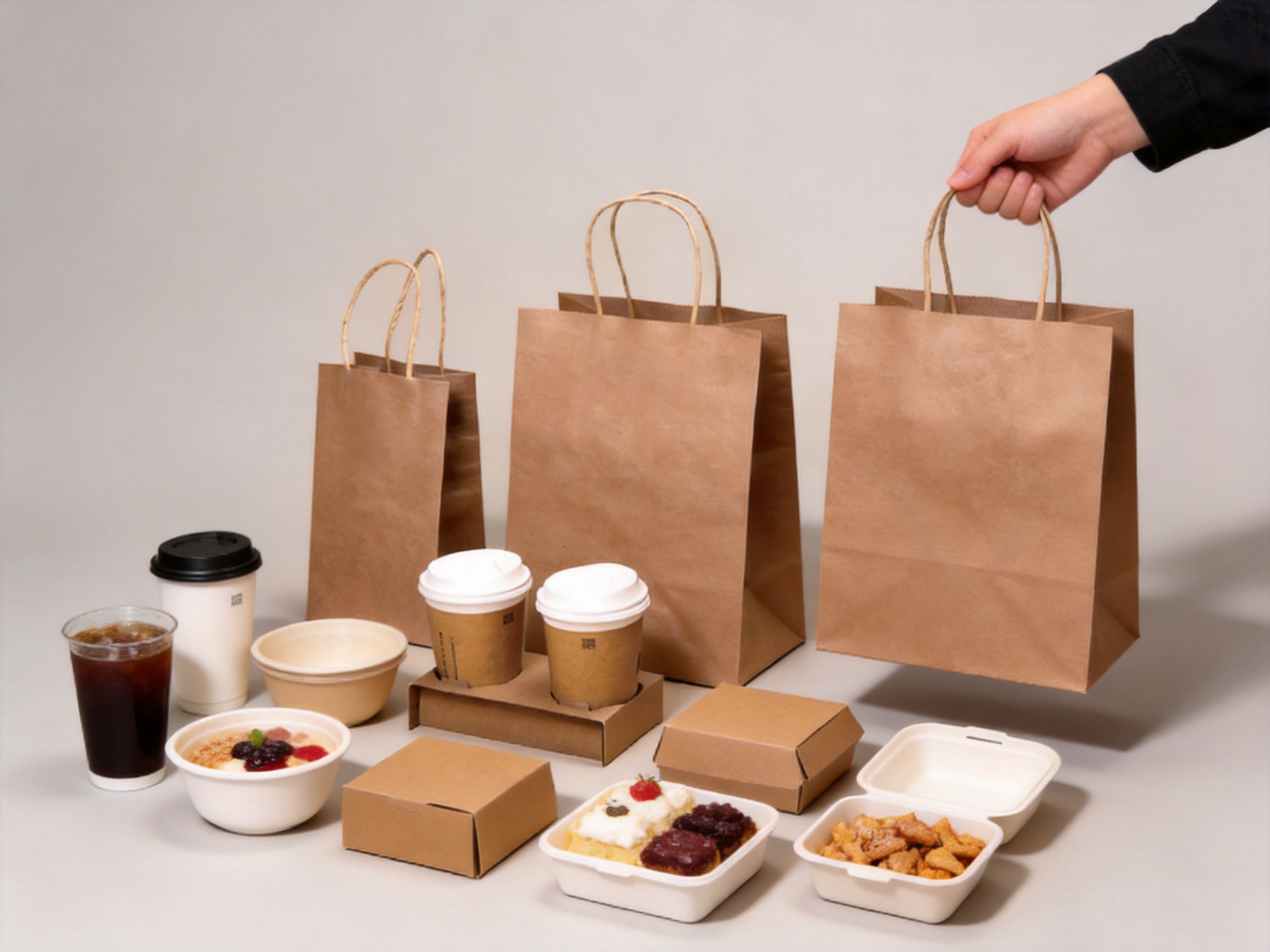
The recycled paper packaging bag is designed for transporting beverage cups and other lightweight food service products. Its primary applications include coffee shops, tea shops, juice bars, bakeries, restaurants, takeaway counters, food courts, catering companies, convenience stores, and delivery businesses.
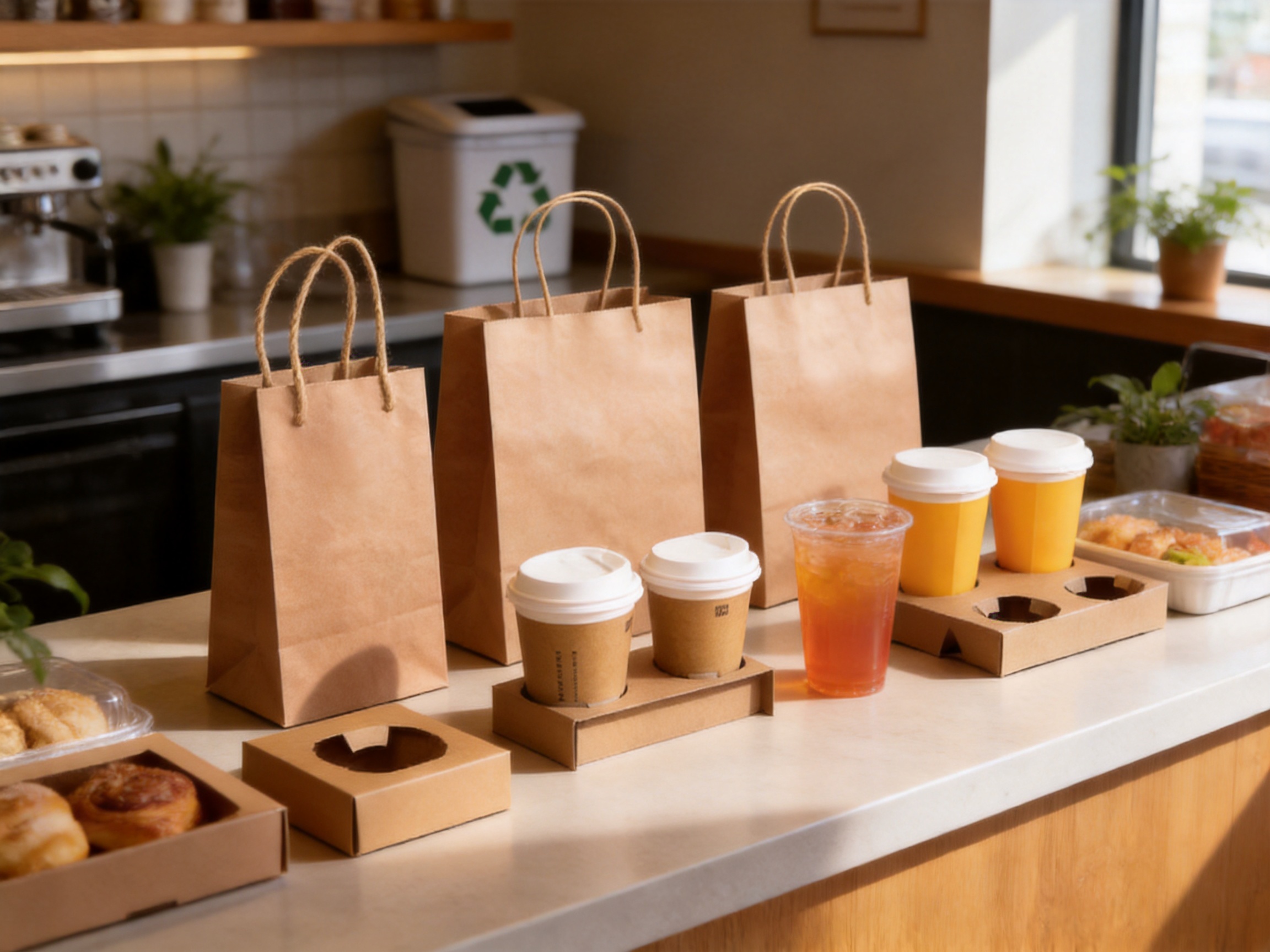
The bag may be configured as a single-cup paper bag, double-cup paper bag, or four-cup paper bag. These formats help businesses select the appropriate carrying capacity without using an unnecessarily large package. Matching the bag to the order improves material efficiency, reduces movement inside the bag, and helps maintain a neat customer presentation.
In addition to cups, the bags may be used with compatible takeaway bowls, food containers, snack boxes, dessert packages, and other small food service products. The final application should be assessed according to the size, weight, shape, temperature, and moisture level of the contents. Paper bags are especially suitable when the carried products are already sealed or placed inside separate food containers.
The bags are available in white paper and kraft paper. White paper offers a clean, bright, and highly printable background that can display detailed graphics, colorful brand elements, promotional messages, or product information. Kraft paper provides a natural appearance that is often associated with simplicity, sustainability, handmade products, organic foods, and environmentally responsible business practices.
| Product format | Typical application | Material options | Main benefit |
| Single-cup paper bag | One beverage or compact takeaway order | White paper or kraft paper | Compact and convenient for individual purchases |
| Double-cup paper bag | Two beverages or a small shared order | White paper or kraft paper | Supports common two-drink takeaway orders |
| Four-cup paper bag | Group orders, meetings, families, and events | White paper or kraft paper | Allows several cups to be carried together |

Recycle Paper packaging bag
Key Product Advantages
Recyclable and Environmentally Responsible Material
The most visible advantage of recycled paper packaging bags is their paper-based construction. Paper is a familiar packaging material with established collection, processing, and recycling pathways in many regions. Using recycled paper can reduce the demand for newly sourced raw materials and support the circulation of recovered fibers within the packaging economy.
The product is also positioned as a biodegradable and environmentally friendly packaging option. When compared with conventional single-use plastic carriers, a paper bag may offer a more suitable end-of-life profile where appropriate disposal and recycling infrastructure is available. This makes it attractive to businesses that want to reduce their dependence on plastic and demonstrate measurable progress toward more responsible packaging.
Environmental performance should always be considered together with product durability. A bag that tears immediately may require replacement, create waste, and damage the customer experience. The advantage of a well-designed recycled paper bag is that it balances environmental goals with practical strength. By using suitable paper grades, accurate folding, secure bonding, and reinforced handles, the bag can provide reliable performance during normal use.
Wear Resistance and Tear Resistance
Food and beverage orders can place stress on a paper bag. The contents may shift while being carried, and the handles may receive concentrated force. Moisture from chilled cups, condensation, or food containers can also create additional challenges. The product is therefore designed with durability in mind.
Wear-resistant paper helps the outer surface remain presentable during transportation. Tear-resistant construction reduces the risk of sudden failure at the side seams, bottom folds, and handle attachment points. Proper material selection is particularly important for double-cup and four-cup formats because these bags commonly carry heavier loads than single-cup versions.
Durability also supports operational efficiency. Employees spend less time replacing damaged bags, customers experience fewer spills, and businesses reduce complaints associated with failed packaging. A stronger bag may provide better value over its complete service life even when its initial unit price is not the lowest available.
Reinforced Handles for Load-Bearing Performance
The handle is one of the most important structural elements of a takeaway paper bag. If the handle is weak, improperly bonded, or poorly positioned, the entire package may fail even when the paper body is strong. Recycled paper packaging bags can be produced with reinforced handles that improve load distribution and reduce the possibility of damage during carrying.
Reinforcement can be achieved through suitable paper layers, attachment structures, bonding methods, and precise conversion processes. The exact design depends on the bag size, intended load, handle style, and customer requirements. For businesses carrying two or four cups, handle strength is especially important because the order may be lifted from a counter, placed in a vehicle, or carried over a longer distance.
A reinforced handle also improves customer confidence. Customers are more likely to carry a bag naturally when it feels stable and secure. This makes the packaging more convenient and reduces the tendency to hold the bag from the bottom or support individual cups by hand.
Comfortable and Practical Carrying Experience
Packaging is part of the user experience, and comfort matters. A handle that is too narrow, too sharp, too short, or badly positioned can make a full bag difficult to carry. A comfortable handle allows customers to transport beverages and food with less effort and greater control.
The bag structure can be selected according to the order type. A single-cup bag can remain compact for quick purchases, while a multi-cup bag can provide a broader base and handle arrangement that helps keep the contents upright. The objective is not simply to increase capacity but to make the package easy to understand and use.
Comfort also supports brand perception. When a package works smoothly, customers may associate that convenience with the quality of the business. A well-designed bag can make a busy takeaway transaction feel more organized and professional.
Flexible Capacity for Different Consumption Scenarios
Food service businesses rarely have only one type of customer order. An individual may purchase one drink, a couple may purchase two drinks, and a family or office may order four beverages at the same time. Offering different bag specifications allows the business to select the right package for each scenario.
The single-cup paper bag is suitable for an individual beverage and can help minimize excess material. The double-cup paper bag is appropriate for common two-person orders or for a drink combined with a small food item. The four-cup paper bag is useful for group orders, meetings, family purchases, and catering situations.
This product range can simplify stock planning. A business can maintain a small number of standard formats while still serving a variety of orders. It may also reduce the need to place multiple cups inside an oversized general-purpose bag, improving stability and presentation.
Custom Printing and Brand Visibility
Paper bags offer a valuable printable surface. Yuqian Packaging Technology is equipped with advanced Polytype printing equipment, enabling the printing of customer logos, patterns, promotional messages, and other specific information on packaging. This capability supports both simple single-color designs and more developed visual identities, depending on the selected specifications.
Custom printing turns an ordinary carrying bag into a mobile communication tool. Customers may carry the bag through streets, offices, shopping centers, schools, and public transportation areas. Each printed bag can increase recognition and remind customers of the business after the purchase has ended.
Printing can also communicate product information. Businesses may include a slogan, social media identifier, seasonal message, recycling reminder, loyalty campaign, or serving instruction. The printed area can be designed to support brand colors and maintain visual consistency with cups, lids, takeaway bowls, paper boxes, and other packaging products.
For environmentally focused brands, the artwork may use natural colors, simple illustrations, recycled-material messaging, or educational content. For premium beverage brands, a minimalist design on white or kraft paper may create a more refined appearance. The flexibility of customized printing allows one basic bag structure to serve many different market positions.
Product Specifications
The standard specifications provided for the recycled paper packaging bag are shown below. Dimensions are expressed in millimeters. Final dimensions, paper grade, handle structure, printing coverage, and packaging method can be discussed according to the customer’s product and order requirements.
| Specification | Size | Material |
| Single-cup paper bag | 115 × 90 × 290 mm | White paper or kraft paper |
| Double-cup paper bag | 195 × 105 × 300 mm | White paper or kraft paper |
| Four-cup paper bag | 200 × 190 × 340 mm | White paper or kraft paper |
These dimensions provide a reference for common beverage carrying applications. The correct selection should consider the outside dimensions of the cups, lids, sleeves, bowls, food containers, and any internal dividers or supporting components. A bag that is too tight may be difficult to load, while a bag that is too large may allow the contents to move excessively.
Businesses can evaluate the complete packaging system rather than treating the bag as an isolated item. Cup diameter, cup height, lid profile, product temperature, condensation, order weight, and transportation distance can all influence the preferred bag specification.
Manufacturing Strengths and Production Process
Material Selection and Preparation
Manufacturing begins with the selection of paper suitable for food service carrying applications. White paper and kraft paper have different visual and performance characteristics, so the choice depends on the customer’s design objectives, required strength, printing needs, and sustainability positioning.
Paper must be handled and stored in conditions that protect it from excessive moisture, contamination, and deformation. Stable material preparation supports consistent printing, cutting, folding, and bonding. Paper properties such as thickness, surface smoothness, fiber direction, stiffness, and tensile performance affect the final bag.
For a product intended to carry cups and takeaway food, material selection must balance strength and weight. Excessively thin paper may reduce load-bearing performance, while unnecessarily heavy paper may increase material consumption and shipping costs. A professional manufacturer evaluates the intended application and selects a suitable construction rather than applying one specification to every order.
Printing and Surface Preparation
Printing is an important production stage because it affects both visual quality and brand communication. The printing process must maintain accurate color reproduction, clear text, sharp logos, and consistent registration across large production runs.
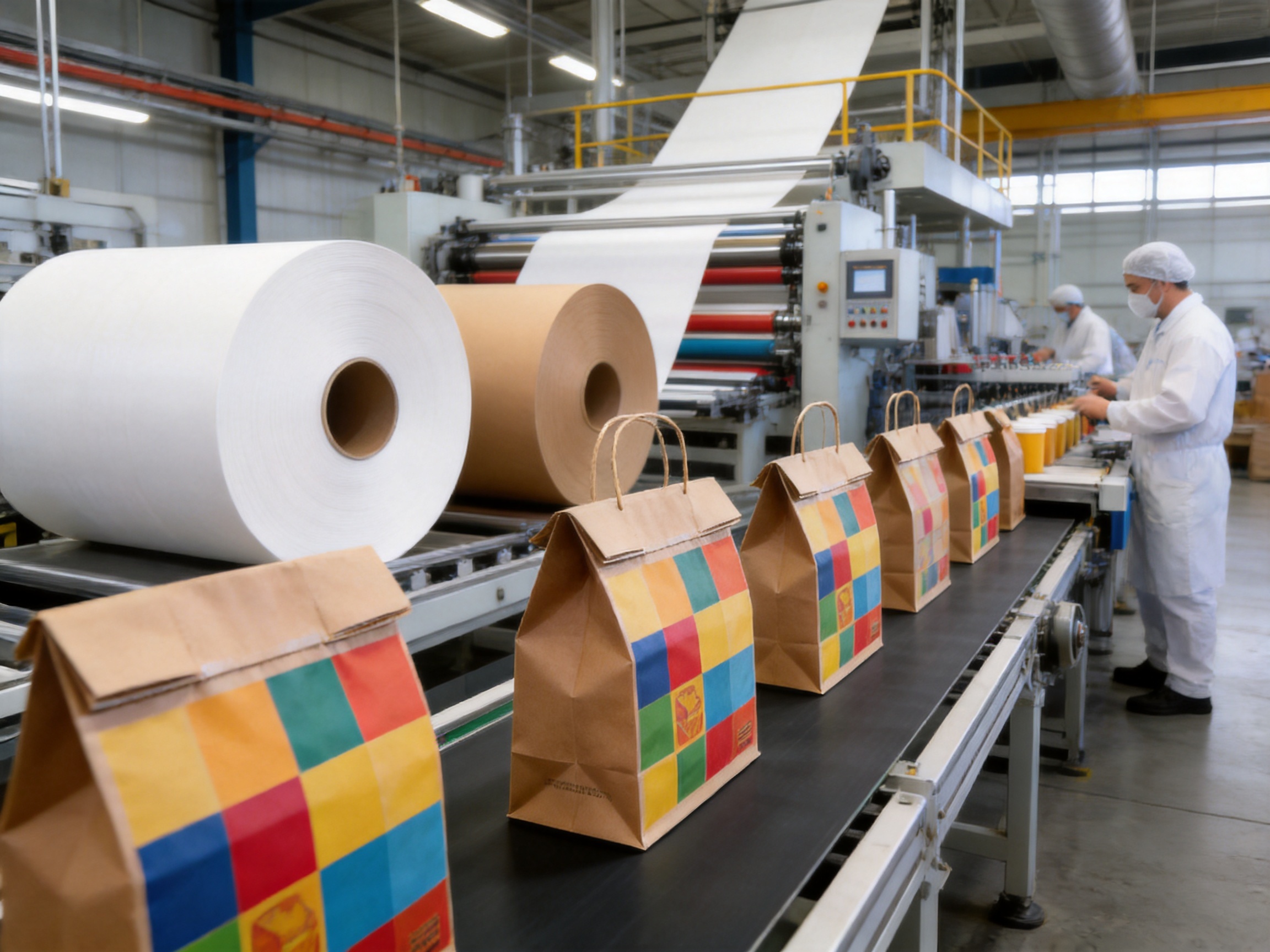
Yuqian uses advanced Polytype printing equipment to support customized packaging production. Such equipment helps the manufacturer handle customer artwork with greater precision and repeatability. Before full production, artwork may be reviewed for dimensions, bleed, color separation, text clarity, and compatibility with the selected paper surface.
A professional printing workflow helps prevent common problems such as blurred small text, uneven ink coverage, incorrect logo proportions, and color variation between batches. It also makes it easier to produce packaging for seasonal campaigns, product launches, franchise systems, and multiple retail locations.
Cutting, Folding, and Forming
After printing, the paper is converted into bag components through cutting and forming operations. Accurate cutting is essential because even small dimensional errors can influence the final shape, handle alignment, bottom stability, and stacking performance.
Folding lines must be positioned precisely to create clean side panels and a stable base. The body of the bag needs to open easily while retaining enough structure to protect its contents. For multi-cup formats, the geometry must support the larger width and depth required for several cups.
Consistent forming also improves warehouse handling. Bags that maintain a predictable shape can be packed, counted, stored, and distributed more efficiently. This is especially helpful for businesses that manage high daily order volumes or supply packaging to multiple branches.
Bonding and Handle Reinforcement
Adhesive application and bonding are critical to the bag’s structural integrity. Side seams, bottom sections, and handle connections must remain secure during normal carrying. The amount and placement of adhesive should be controlled to achieve strong bonding without creating unwanted surface marks or affecting the appearance of printed areas.
Handle reinforcement requires particular attention. The handle must be attached to a suitable area of the bag and supported in a way that distributes force. Production controls should verify that the handle is straight, firmly bonded, and compatible with the expected load.
Where customer requirements call for additional strength, the bag design may incorporate reinforced patches, heavier paper, modified folding structures, or other suitable construction features. The exact solution depends on the size and weight of the carried products.
Inspection and Quality Control
Quality control should cover raw materials, printing, dimensions, forming, bonding, handles, cleanliness, and finished packaging. Inspection procedures help identify defects before products are shipped to customers.
Typical quality checks may include visual inspection for print clarity and surface damage, dimensional measurement, seam evaluation, handle attachment assessment, bottom structure review, and sampling for load-bearing performance. The objective is to confirm that the bags match the approved specification and remain suitable for their intended use.
Quality consistency is particularly important for custom packaging. A customer’s logo and brand colors must appear consistently from one production batch to another. If the physical dimensions change unexpectedly, the bag may no longer fit the cups or food containers used at the customer’s locations.
Yuqian Packaging Technology has developed a quality and certification framework that includes QS national industrial product production licensing and ISO9001 quality management system certification. The company also reports BRC certification, German authoritative safety DIN certification, and European Union ROHS testing. These credentials reflect the company’s attention to controlled manufacturing, product safety, and compliance requirements. Customers should confirm the certification scope and current validity for the specific product and market before placing an order.
Advantages Compared with Conventional Plastic Carriers
Recycled paper packaging bags offer several advantages over traditional plastic carriers, although the most suitable choice depends on the application. Their strongest competitive benefits are material perception, printability, structural presentation, and compatibility with sustainability programs.
Improved Environmental Positioning
Paper bags are widely recognized by consumers as an alternative to single-use plastic. Recycled paper construction can help businesses communicate an effort to reduce the use of virgin resources and support more circular material flows. This is especially relevant in markets where customers actively look for recyclable or biodegradable packaging.
A paper bag may also help businesses align with internal environmental targets, retailer requirements, and government policies designed to reduce plastic waste. The environmental message is more credible when the bag is genuinely durable, appropriately sized, and supported by responsible disposal guidance.
Better Branding Surface
Plastic carriers can be printed, but paper often provides a more natural, tactile, and premium surface for food service branding. Kraft paper is especially effective for businesses that want to emphasize natural ingredients, handmade production, organic products, or environmental responsibility. White paper is suitable for bright colors, detailed illustrations, and clean modern designs.
Because the bag is carried in public, its printed surface can create repeated brand exposure. This makes the package valuable for independent cafés, restaurant groups, beverage chains, event organizers, and delivery businesses seeking inexpensive offline visibility.
More Structured Presentation
Paper bags generally have a more structured body than very thin plastic carriers. A stable base and defined side panels can help cups and food containers remain organized. This structure can improve the appearance of the order when it is handed to the customer or delivered to an office or home.
With suitable reinforcement, the paper bag can provide both a responsible material profile and practical strength. This combination helps it compete not only on environmental grounds but also on the quality of the customer experience.
Customization Options for Different Brands
Customization is one of the central strengths of this product category. A food service brand may need a bag that reflects its visual identity, fits a specific cup series, or supports a particular promotional campaign. Standard products provide efficiency, but customized products can improve recognition and functional compatibility.
Size Customization
Although single-cup, double-cup, and four-cup formats cover many common applications, some businesses may require special dimensions. For example, a dessert shop may need a wider opening, a catering company may require a larger base, or a beverage retailer may use cups with unusual heights.
Size customization should be developed around the complete order. The design team should consider the dimensions of the contents, the number of items, the desired clearance, the carrying method, and the expected load. This avoids creating a bag that is technically large enough but inconvenient in daily use.
Material and Appearance Customization
White paper and kraft paper create different impressions. White paper supports high-contrast artwork, photographic graphics, colorful brand systems, and highly visible product information. Kraft paper communicates a natural and understated aesthetic and may be preferred for eco-conscious or artisanal businesses.
Customers may also discuss paper weight, surface treatment, handle design, and structural reinforcement. The appropriate choice depends on appearance, strength, budget, and environmental objectives.
Graphic and Information Customization
Custom printing can include logos, illustrations, business names, slogans, product descriptions, contact information, recycling guidance, event messages, and promotional campaigns. Design teams should ensure that important information remains readable at the final print size.
Good packaging design uses the available surface strategically. The logo should be visible when the bag is carried, while supporting information can be placed on side panels or secondary surfaces. Colors should be selected with the paper background in mind, particularly when printing on natural kraft material.
Multi-Location and Seasonal Programs
Restaurant groups and beverage chains may use the same bag design across multiple locations. A centralized purchasing program can help maintain brand consistency and simplify quality control. At the same time, customized seasonal artwork can create limited campaigns for holidays, new product launches, store openings, or special events.
A manufacturer with integrated printing and production capabilities can help coordinate these requirements. The customer can discuss artwork, dimensions, quantities, packaging methods, and delivery schedules within one supply relationship.
How to Select the Right Recycled Paper Bag
Before ordering, customers should evaluate the product requirements carefully. The correct selection can improve packaging performance, reduce waste, and avoid unnecessary costs.
First, determine the number and type of items that the bag will carry. A one-cup purchase should not automatically receive a four-cup package. Similarly, a group order may require additional width, base support, or handle reinforcement.
Second, measure the cups and food containers. Include lids, sleeves, bowl rims, boxes, and any other components that affect the outside dimensions. Allow enough clearance for easy loading but avoid excessive empty space that permits the contents to move.
Third, assess the expected weight. Beverage volume, bowl size, food density, and the number of items all influence the load. If the bag will be carried over long distances or used for delivery, additional structural strength may be appropriate.
Fourth, consider moisture. Cold drinks can create condensation, and some food products may release steam or grease. The contents should be adequately sealed and separated from the paper bag when necessary. Customers should discuss the application with the manufacturer if moisture exposure is expected to be significant.
Fifth, define the brand requirements. Decide whether the preferred appearance is natural kraft or bright white paper, identify the required colors, prepare vector artwork where possible, and determine whether the bag should carry promotional or recycling information.
Finally, establish quality, compliance, packing, and delivery expectations. Customers serving different countries may need documentation related to food packaging, recycling claims, chemical restrictions, or local labeling requirements.
| Selection factor | Questions to consider | Why it matters |
| Capacity | How many cups or food containers will be carried? | Determines the most suitable bag format |
| Dimensions | What are the total outside dimensions of the packaged products? | Prevents excessive movement or difficult loading |
| Load | What is the expected total weight? | Guides paper grade and handle reinforcement |
| Moisture | Will condensation or food residue contact the bag? | Helps determine suitable packaging arrangements |
| Branding | What logo, colors, and information must be printed? | Supports recognition and communication |
| Compliance | What market-specific documentation is required? | Supports responsible procurement and market entry |
Company Manufacturing Capability
Yuqian Packaging Technology (Jiangsu) Co., Ltd. was established in 2010 and is located in Taizhou City, Jiangsu Province, China. The company operates a plant area of approximately 30,000 square meters and integrates research and development, production, and sales of new food packaging materials and products.
This integrated structure provides several advantages for customers. Research and development personnel can participate in product improvement and customized design. Production teams can convert approved designs into finished packaging. Sales and technical personnel can coordinate requirements, documentation, and delivery communication. The result is a more complete service than simply purchasing an unprinted standard bag from an unrelated trading channel.
The company serves the wider food packaging industry, including plastic cups, plastic cup lids, takeaway bowls, disposable straws, recycled bags, peripheral products, and injection film lining cup and bowl boxes. This product range enables customers to explore coordinated packaging solutions rather than sourcing every item from a different supplier.
The company reports that it took the lead in passing QS national industrial product production licensing and ISO9001 quality management system certification within the packaging industry. It also reports BRC certification, German authoritative safety DIN certification, and European Union ROHS testing. These quality and compliance achievements are important for customers that require controlled production and documented supplier capability.
To improve service quality and expand business channels, the company established a Shanghai branch in January 2019. Its equipment, professional research and development team, printing resources, and production experience support customized packaging programs for domestic and overseas customers.
Environmental and Commercial Value
The value of recycled paper packaging bags is both environmental and commercial. From an environmental perspective, the product can help replace some conventional plastic carriers and promote the use of recyclable paper materials. From a commercial perspective, it can improve brand visibility, support customer convenience, and create a consistent appearance across takeaway operations.
Packaging sustainability is increasingly connected to purchasing decisions. Consumers may compare businesses based on the materials used for cups, lids, bags, boxes, and utensils. A paper carrier cannot solve every environmental challenge, but it can form part of a broader packaging strategy that includes material reduction, recyclable design, responsible sourcing, and efficient logistics.
Right-sizing is especially important. A smaller bag for a single item can reduce unnecessary material use, while a correctly designed four-cup bag can prevent customers from needing several separate carriers. A durable bag that performs successfully on the first use also avoids the waste associated with failed packaging and replacement products.
Businesses should communicate environmental benefits accurately and avoid unsupported claims. Recyclability depends on local collection facilities, contamination levels, coatings, inks, adhesives, and municipal rules. A responsible manufacturer can provide material information and help customers develop suitable product communication.
Quality, Safety, and Responsible Procurement
Food packaging procurement requires more than a visual comparison of samples. Customers should examine material documentation, production controls, factory capabilities, print quality, structural performance, and delivery reliability.
Safety considerations include the suitability of the paper and printing materials for the intended application, the cleanliness of the finished product, and the prevention of contamination during storage and transportation. Even when the bag does not directly contact food, it forms part of the food service packaging system and should be handled responsibly.
Quality management systems can help establish repeatable procedures for purchasing, production, inspection, nonconformity handling, and corrective action. ISO9001 certification is commonly associated with this type of structured management framework. Other certifications and tests may address food packaging quality, material restrictions, or market-specific requirements.
Customers should request current documentation and confirm that it applies to the product being purchased. They should also approve a production sample or pre-production artwork where appropriate. Sample evaluation can reveal whether the bag fits the actual cups, whether the handle feels comfortable, whether the print matches expectations, and whether the bottom remains stable during use.
Ordering and Custom Project Workflow
A successful custom packaging project usually begins with a product brief. The brief should identify the bag format, intended contents, dimensions, material preference, estimated order quantity, printing requirements, delivery destination, and required certifications or documents.
The manufacturer can then review the application and recommend a suitable structure. This stage may include questions about cup diameter, beverage volume, product weight, condensation, carrying distance, stacking, storage conditions, and expected production frequency.
Artwork is prepared and checked against the selected bag dimensions. The printing area, folding lines, handle location, seam positions, and bottom structure must be considered together. A design that looks attractive on a flat sheet may require adjustment when converted into a three-dimensional bag.
After artwork approval, a sample or proof may be produced for confirmation. The customer should inspect the visual appearance, physical dimensions, handle attachment, opening size, base stability, and compatibility with the intended products. Any changes should be completed before mass production.
During production, quality checks help maintain consistency. Finished bags are counted, packed, and prepared for shipment according to the agreed requirements. Clear communication about lead time, packaging method, shipping marks, and delivery documentation supports a smoother supply process.
Q&A: Recycled Paper Packaging Bags
What is a recycled paper packaging bag used for?
It is mainly used to carry takeaway beverages, food containers, snacks, desserts, and related food service products. Common applications include cafés, restaurants, tea shops, bakeries, catering businesses, convenience stores, and delivery orders.
What sizes are available?
The listed standard formats include a single-cup paper bag measuring 115 × 90 × 290 millimeters, a double-cup paper bag measuring 195 × 105 × 300 millimeters, and a four-cup paper bag measuring 200 × 190 × 340 millimeters. Customized dimensions may be discussed according to the customer’s products and order requirements.
What materials can be selected?
The standard material options are white paper and kraft paper. White paper provides a bright and clean printing background, while kraft paper creates a natural appearance commonly associated with environmentally responsible packaging.
Can the bag carry more than one cup?
Yes. The product range includes double-cup and four-cup formats. The correct choice depends on cup dimensions, total order weight, handle requirements, and the way the customer intends to transport the order.
Can a company print its logo on the bag?
Yes. Logos, patterns, brand colors, promotional information, and other specific content can be printed according to the approved artwork. Yuqian Packaging Technology uses advanced Polytype printing equipment to support customized packaging production.
Are recycled paper bags durable?
They are designed to provide wear resistance and tear resistance for normal takeaway applications. Reinforced handles and suitable paper construction improve load-bearing performance. The final capacity should always be selected according to the weight and dimensions of the intended contents.
Are these bags biodegradable and recyclable?
The product is made from paper materials and is positioned as a biodegradable and recyclable packaging option. Actual recycling and biodegradation depend on the paper composition, printing and adhesive systems, local waste-management facilities, contamination, and applicable regulations.
Can the bag be used with cold beverages?
It can be used for takeaway beverages when the cups are properly sealed and the expected condensation is appropriately managed. Customers with high moisture exposure or special product conditions should discuss the application with the manufacturer before finalizing the specification.
How should a customer choose between white paper and kraft paper?
White paper is suitable for bright colors, detailed graphics, and a clean modern appearance. Kraft paper is suitable for a natural, simple, and environmentally oriented visual style. The decision should consider branding, print design, customer expectations, and the desired market position.
Does the company manufacture other food packaging products?
Yes. The company’s product scope includes plastic cups, plastic cup lids, takeaway bowls, disposable straws, recycled bags, peripheral products, and injection film lining cup and bowl boxes. This broader range can support coordinated purchasing for food and beverage packaging programs.
What certifications does the company report?
The company reports QS national industrial product production licensing, ISO9001 quality management system certification, BRC certification, German authoritative safety DIN certification, and European Union ROHS testing. Customers should request current documentation and verify the applicable scope for their specific order and market.
Can the company provide a customized packaging solution?
Yes. Customization may include dimensions, material selection, printing artwork, logo placement, handle construction, and packaging requirements. The final solution should be developed after reviewing the customer’s products, intended load, branding, order volume, and market requirements.
Conclusion
Recycled paper packaging bags provide a practical combination of sustainability, carrying convenience, structural performance, and brand visibility. Their paper-based construction supports the movement away from conventional plastic carriers, while reinforced handles, tear-resistant design, and multiple capacity options make them suitable for real food service operations.
The availability of single-cup, double-cup, and four-cup formats allows businesses to match packaging with different purchasing scenarios. White paper and kraft paper provide distinct visual styles, and customized printing transforms the bag into an effective marketing surface. Advanced Polytype printing equipment supports the production of branded packaging with clear logos, patterns, and customer-specific information.
Yuqian Packaging Technology (Jiangsu) Co., Ltd. combines research and development, manufacturing, quality management, printing capability, and sales support. Its experience in food packaging materials, reported certifications, production facilities, and broad product range make it a suitable partner for businesses seeking coordinated and customized packaging solutions.
For the best result, customers should evaluate the entire application before ordering. Cup dimensions, total load, moisture exposure, carrying distance, material preference, artwork, compliance requirements, and delivery conditions all influence the final product. When these factors are addressed through careful design and controlled production, recycled paper packaging bags can support both operational efficiency and a more responsible brand image.
References
1. Yuqian Packaging Technology (Jiangsu) Co., Ltd. Product information for recycled paper packaging bags, including materials, specifications, applications, and customization capabilities.
2. Yuqian Packaging Technology (Jiangsu) Co., Ltd. Company profile and manufacturing information concerning research and development, production facilities, certifications, and food packaging products.
3. International Organization for Standardization. ISO 9001 quality management systems: requirements and guidance for controlled organizational processes.
4. British Retail Consortium. Global Standard for Packaging Materials and Packaging, principles concerning product safety, quality, legality, and manufacturing controls.
5. European Union. Restriction of Hazardous Substances principles and related requirements for restricted substances in applicable products and materials.
6. General literature on paper recycling, recovered fiber utilization, packaging design, responsible material selection, and sustainable food service packaging.