English
 Español
 عربى
Content
- 1 Why Recyclable Paper Packaging Bags Matter
- 2 Product Overview
- 3 Standard Product Specifications
- 4 Material Selection: White Paper and Kraft Paper
- 5 Core Product Advantages
- 6 Advantages Compared with Conventional Plastic Carriers
- 7 Manufacturing Capabilities and Production Strengths
- 8 Production Process for Paper Packaging Bags
- 9 Customization for Different Business Models
- 10 Design Considerations for Better Performance
- 11 Operational Benefits for Foodservice Customers
- 12 Why Choose a Specialized Manufacturer
- 13 Ordering and Development Recommendations
- 14 Quality and Sustainability in Long-Term Supply
- 15 Frequently Asked Questions
- 15.1 What products can be carried in these paper packaging bags?
- 15.2 What sizes are available?
- 15.3 Are both white paper and kraft paper available?
- 15.4 Can the bag be printed with a company logo?
- 15.5 Are the handles reinforced?
- 15.6 Are these bags suitable for wet products?
- 15.7 Are the bags recyclable?
- 15.8 Are the bags made from recycled paper?
- 15.9 Can the company produce custom shapes or capacities?
- 15.10 What certifications does the company have?
- 15.11 What information should be included in a quotation request?
- 16 Conclusion
- 17 References
- 18 Product: Recycle Paper packaging bag

Packaging has become an important part of the customer experience, especially in foodservice, beverage retail, shopping, takeaway dining, and delivery. A packaging bag must protect products, support convenient transport, communicate a brand message, and respond to growing expectations for environmental responsibility. Recyclable paper packaging bags provide a practical solution for businesses that want to reduce their dependence on conventional plastic carriers while maintaining reliable performance and an attractive appearance.
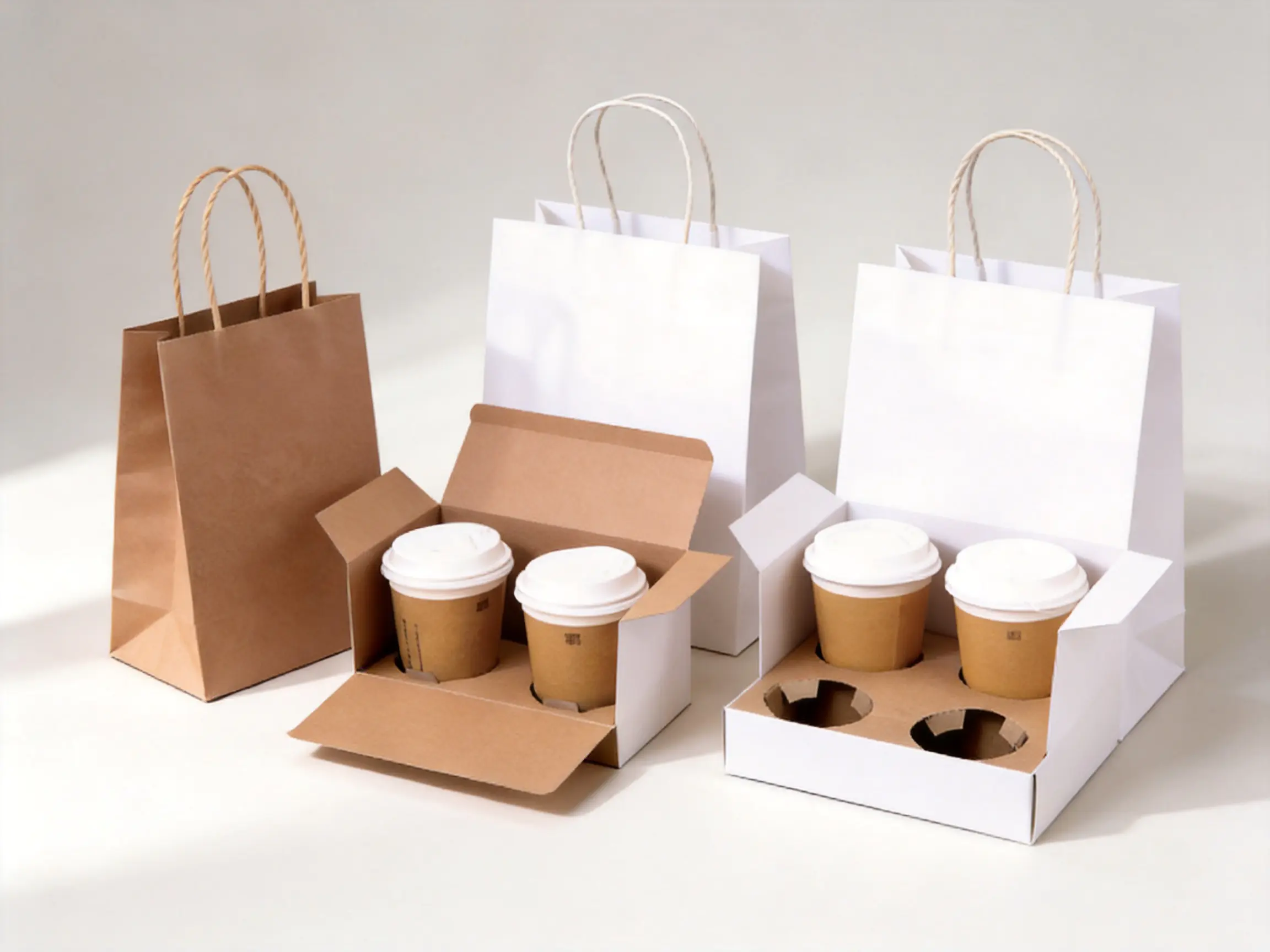
Designed for carrying cups, takeaway beverages, small food containers, and other lightweight products, paper packaging bags combine structural strength with a natural and recognizable material appearance. They can be produced in white paper or kraft paper, supplied in single-cup, double-cup, and four-cup formats, and customized with logos, illustrations, colors, promotional messages, or other brand information.
Yuqian Packaging Technology (Jiangsu) Co., Ltd. develops and manufactures food packaging materials and related products for domestic and international customers. With research and development, production, printing, quality management, and sales capabilities, the company provides customized paper packaging solutions for businesses seeking dependable products and flexible design support.
Why Recyclable Paper Packaging Bags Matter
The demand for environmentally responsible packaging continues to increase across the global market. Consumers are paying closer attention to the materials used for takeaway products, and foodservice operators are reviewing packaging choices as part of their sustainability strategies. Retailers, restaurants, cafés, beverage shops, bakeries, catering businesses, and delivery companies are all looking for packaging that combines usability with a lower environmental impact.
Paper bags are widely recognized as an alternative to traditional single-use plastic bags. When properly collected and handled through suitable recycling systems, paper packaging can be processed and reused as a material for new paper products. Paper is also capable of natural degradation under appropriate environmental conditions, while its fiber-based structure provides a familiar and versatile basis for packaging design.
However, environmental value alone is not enough. A foodservice bag must also resist tearing, support the intended load, remain stable during transportation, and be comfortable for customers to carry. A bag that fails under normal use can create product loss, customer dissatisfaction, and unnecessary waste. For this reason, the performance of a recyclable paper bag depends on material selection, structural design, printing quality, handle reinforcement, converting precision, and quality control.
The paper packaging bags described in this article are developed to address these practical requirements. They offer a balance of environmental positioning, durability, carrying convenience, customization, and suitability for beverage and takeaway applications.
Product Overview
Recyclable paper packaging bags are paper carriers designed to transport cups and other compact foodservice items. The standard product range includes white paper and kraft paper options. The bag structure can be adapted to hold one cup, two cups, four cups, or other configurations according to the customer’s packaging requirements.
The product is particularly suitable for takeaway beverage brands that need a convenient method for customers to carry drinks from a store to a vehicle, office, home, or other destination. It can also be used for cafés, restaurants, dessert shops, bakeries, catering services, convenience stores, promotional events, and retail applications requiring compact paper carriers.
Paper packaging bags can be manufactured according to the required dimensions, cup arrangement, printing area, handle style, and product quantity. This flexibility enables businesses to select a practical solution for different consumption scenarios rather than using one standard size for every order.
| Product Attribute | Available Option | Application Benefit |
| Material | White paper or kraft paper | Supports different visual styles and environmental packaging programs |
| Capacity | Single cup, double cup, four cup, and customized formats | Matches different order sizes and takeaway requirements |
| Printing | Customized logo, pattern, color, and product information | Improves brand recognition and communication |
| Handle | Comfortable, reinforced carrying handles | Improves load-bearing performance and carrying comfort |
| Design | Customized dimensions and packaging structure | Supports different cups, products, and service models |
Standard Product Specifications
The standard range includes three commonly used configurations. The single-cup paper bag is designed for individual beverage orders and compact carrying requirements. The double-cup paper bag is suitable for customers purchasing two drinks or for businesses that need additional space for small accessories. The four-cup paper bag is intended for larger takeaway orders, group purchases, family orders, office deliveries, and catering scenarios.
| Specification | Size in Millimeters | Material |
| Single-cup paper bag | 115 × 90 × 290 | White paper or kraft paper |
| Double-cup paper bag | 195 × 105 × 300 | White paper or kraft paper |
| Four-cup paper bag | 200 × 190 × 340 | White paper or kraft paper |
These dimensions provide a starting point for standard production. Actual packaging requirements can vary according to cup diameter, cup height, lid shape, beverage volume, carrier configuration, product weight, and the space needed for additional food items. Customers can discuss these requirements with the manufacturer before production so that the final structure is appropriate for the intended application.
For foodservice operators, choosing the correct size is essential. A bag that is too narrow may make cup placement difficult, while a bag that is too large may allow excessive movement during transport. Proper sizing helps improve stability, reduce product shifting, and create a more organized customer experience.
Material Selection: White Paper and Kraft Paper
White Paper
White paper provides a clean, bright, and highly printable surface. It is suitable for businesses that want vivid colors, clear text, detailed graphics, or a modern visual appearance. Logos and promotional artwork can be displayed with strong contrast, making white paper a practical option for cafés, beverage chains, restaurants, and businesses with carefully controlled brand colors.
The smooth visual surface of white paper also supports the presentation of product information, campaign messages, seasonal illustrations, and customer instructions. A well-printed white paper bag can function as a mobile advertising surface as customers carry it through shopping areas, offices, streets, and public transportation locations.
Kraft Paper
Kraft paper offers a natural, warm, and widely recognized environmental appearance. Its brown tone is often associated with simplicity, responsible consumption, handmade products, organic foods, and sustainable retail concepts. It is especially suitable for brands that want a minimal or natural packaging style.
Kraft paper can be used with simple one-color printing, carefully selected multicolor graphics, or a restrained logo design. The material’s natural appearance can help businesses communicate a straightforward packaging message without relying on excessive decoration.
The choice between white paper and kraft paper depends on the customer’s brand identity, printing requirements, target market, product positioning, and environmental communication strategy. Both materials can be incorporated into customized paper bag solutions when the structure and specifications are properly selected.
Core Product Advantages
1. Durable and Tear-Resistant Construction
A takeaway bag must withstand ordinary handling from the point of sale to the final destination. Customers may carry the bag by hand, place it on a counter, move it into a vehicle, or transport it through a busy shopping environment. Wear resistance and tear resistance are therefore essential performance characteristics.
The paper packaging bag is designed to provide a durable carrier structure that is less likely to break during normal use. Material selection, folded construction, handle attachment, and reinforced stress areas all contribute to the bag’s performance. These details are particularly important when the bag contains multiple cups or a combination of beverages and lightweight food products.
Compared with low-strength paper carriers, a properly engineered bag offers better reliability and reduces the risk of sudden failure. This can help foodservice operators avoid spilled beverages, damaged orders, replacement packaging, and negative customer experiences.
2. Recyclable and Environmentally Responsible Material Positioning
Paper packaging can support a business’s move toward more environmentally responsible operations. Paper fibers can enter established recycling systems where appropriate, and paper products can also degrade more readily than many conventional plastic alternatives under suitable conditions.
Using paper packaging does not eliminate the importance of responsible waste management. Recycling performance depends on local collection systems, contamination levels, coatings, inks, and processing facilities. Nevertheless, recyclable paper bags provide businesses with a practical material choice for reducing their reliance on traditional plastic carriers.
The bags can be integrated into wider environmental initiatives, including reduced plastic use, responsible material sourcing, recycling education, and sustainability-focused brand communication. Businesses should present environmental claims accurately and explain disposal instructions according to local regulations and recycling infrastructure.
3. Multiple Capacity Options
Different takeaway situations require different carrying capacities. A single customer purchasing one drink has different needs from an office ordering four beverages or a family purchasing several takeaway products. The availability of single-cup, double-cup, and four-cup configurations allows businesses to match the carrier with the order.
Multiple capacity options can also improve operational efficiency. Staff members can select a bag according to the number of cups without using unnecessary material. The correct bag size can support better product organization and reduce the possibility of cups moving inside a space that is too large.
Customized formats may also be developed for special cup sizes, seasonal menus, promotional bundles, or mixed food and beverage orders. This is an advantage over suppliers that only provide one fixed design.
4. Reinforced Handles for Better Load-Bearing Performance
The handle is one of the most important stress points in a paper bag. When a customer lifts a bag, the weight of the contents transfers through the handle into the upper section of the bag. If the handle area is weak or poorly attached, tearing can occur even when the main body of the bag is strong.
Reinforced handles help distribute lifting forces and improve the bag’s ability to carry the intended load. The reinforcement design can be selected according to the bag size, material, product weight, and expected handling conditions. This feature is especially valuable for double-cup and four-cup carriers, which may experience greater load stress than single-cup bags.
Improved handle strength contributes to customer confidence. Customers are more likely to carry the bag comfortably when the handle feels secure and stable. For businesses, reinforced handles can help reduce packaging failures during busy service periods.
5. Comfortable Carrying Experience
Packaging is not only a protective tool; it is also a product that customers physically interact with. A handle that is too thin, too sharp, poorly positioned, or difficult to grip may create discomfort, particularly when the bag is carried for an extended period.
Comfortable handle design helps make the takeaway experience easier. The handle can be developed with consideration for grip size, hand position, bag balance, and the distance between the handle and the product area. When the structure is correctly matched to the load, the bag is easier to hold and less likely to swing excessively.
A comfortable carrier is especially useful in cafés, food courts, transport hubs, delivery services, and shopping environments where customers may need to carry several items at once.
6. Custom Printing and Brand Communication
Paper packaging bags provide a valuable printed surface for brand communication. Logos, slogans, icons, illustrations, social media information, product messages, seasonal graphics, and store details can be added according to the customer’s design requirements.
Yuqian Packaging Technology is equipped with advanced Polytype printing equipment, supporting the production of customized packaging graphics. High-quality printing can improve logo visibility, maintain a consistent visual identity, and make the carrier more distinctive in a crowded market.
Customized printing also enables businesses to use packaging for limited campaigns. A beverage company may print a summer promotion, a bakery may add holiday artwork, and a restaurant may communicate a new menu or delivery message. This flexibility helps transform a basic carrier into a low-cost marketing tool.
Advantages Compared with Conventional Plastic Carriers
Traditional plastic bags have often been selected because they are lightweight, inexpensive, and moisture-resistant. However, concerns about plastic waste, long-term persistence, resource consumption, and changing regulations have encouraged businesses to evaluate alternatives.
Recyclable paper packaging bags offer several competitive advantages in this changing environment. Their paper-based appearance can communicate a more responsible and natural brand image. Their printable surface supports strong visual branding. Their structure can be customized for one or more cups, and their handles can be reinforced to improve carrying performance.
Paper bags can also provide a more substantial customer experience than very thin plastic carriers. The visible texture and stiffness of paper may help convey quality, care, and attention to packaging details. For premium cafés, specialty beverage stores, artisan bakeries, and environmentally focused retailers, this tactile impression can complement the product itself.
Paper does have limitations. It may require more careful protection from excessive moisture, and its performance depends on the selected paper grade and structural design. Businesses should therefore choose the material according to the product environment. For ordinary takeaway beverage carrying, proper paper selection and design can provide an effective balance between usability and environmental objectives.
The principal competitive advantage is not simply that paper replaces plastic. It is that the paper bag combines a recyclable material direction with durability, capacity flexibility, comfortable handling, and customized brand communication.

Recycle Paper packaging bag
Manufacturing Capabilities and Production Strengths
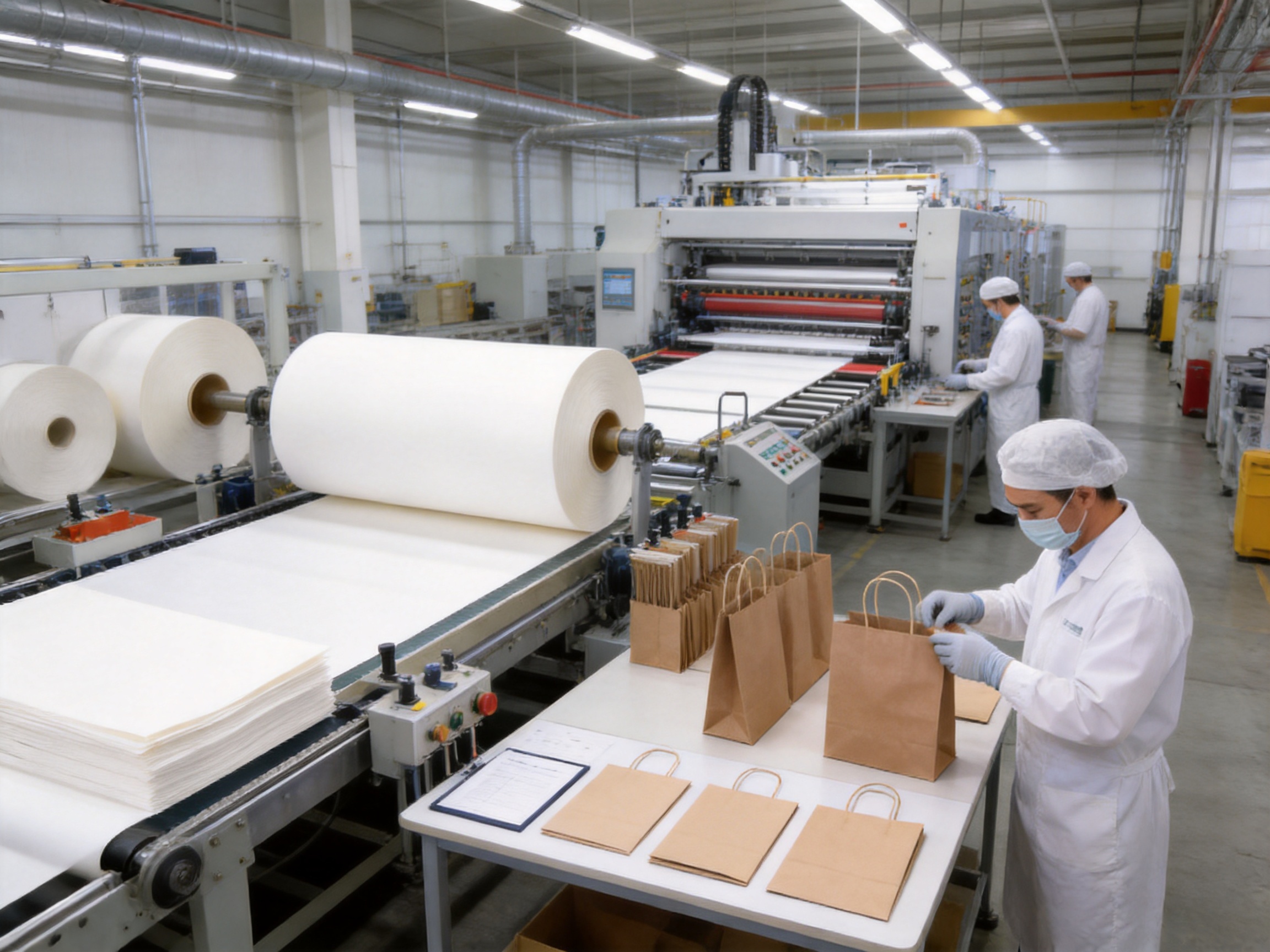
The quality of a paper packaging bag depends on more than the visible finished product. Reliable production requires coordinated control of raw materials, printing, cutting, folding, gluing or assembly, handle reinforcement, inspection, packing, and delivery. A manufacturer with integrated technical and operational capabilities can better manage these stages and respond to customer requirements.
Yuqian Packaging Technology (Jiangsu) Co., Ltd. was established in 2010 and is located in Taizhou City, Jiangsu Province, China. The company operates a plant area of approximately 30,000 square meters and integrates research and development, production, and sales of new food packaging materials and products.
This integrated structure enables the company to work with customers from the early design stage through mass production. Instead of treating printing, converting, quality control, and delivery as separate activities, the company can coordinate them as parts of one packaging development process.
Research and Development Support
Packaging requirements are not identical across all markets. A beverage chain may need a standardized carrier for high-volume use, while a small specialty brand may require an unusual size and highly customized artwork. Research and development capabilities help manufacturers adapt materials and structures to different practical conditions.
Yuqian’s professional research and development team focuses on food packaging materials and products. This technical foundation supports improvements in design, material use, printing coordination, dimensional accuracy, and product performance.
Research and development can also assist customers with selecting appropriate dimensions. By reviewing cup size, order quantity, expected load, carrying method, and visual requirements, the manufacturer can help develop a bag that is more suitable than a generic off-the-shelf option.
Advanced Printing Equipment
Printing quality has a direct influence on brand presentation. Uneven ink coverage, poor registration, unclear text, or inconsistent colors can reduce the perceived value of packaging. Advanced printing equipment helps manufacturers produce sharper graphics and more controlled visual results.
The company’s Polytype printing equipment supports customized artwork, including customer logos, patterns, and specific information. This capability is useful for businesses that require consistent packaging across multiple stores or markets.
Printing production should be coordinated with the paper surface, artwork format, ink selection, color requirements, and final folding structure. Important brand elements must be positioned so that they remain visible after the bag is formed. Production planning is therefore essential for achieving an attractive final result.
Quality Management
Yuqian Packaging Technology has passed ISO9001 Quality Management System certification and has experience operating within formal quality management requirements. A quality management system provides a framework for documenting processes, managing production consistency, reviewing customer requirements, and addressing nonconformities.
Quality control for recyclable paper bags may include inspection of paper appearance, basis weight, dimensions, printing clarity, color consistency, folding accuracy, handle attachment, adhesive performance, surface cleanliness, and overall construction.
Inspection criteria should be related to the product’s intended use. A single-cup bag may require different load and dimensional checks from a four-cup carrier. By establishing suitable standards for each specification, the manufacturer can improve consistency across production batches.
Compliance and Certification Experience
The company has reported certifications and testing experience that include the QS national industrial product production license, ISO9001 Quality Management System certification, BRC certification, German authoritative safety DIN certification, and European Union RoHS testing.
These qualifications and testing experiences demonstrate an established focus on manufacturing management, product safety, and compliance requirements. Specific certification applicability should always be confirmed for the individual product, material, production batch, and target market. Customers may request relevant documentation during the purchasing and approval process.
Certification experience is particularly valuable for international customers, because different markets may have different expectations concerning food-contact packaging, restricted substances, production management, and environmental claims. A manufacturer familiar with documentation requirements can help make the procurement process more organized.
Production Process for Paper Packaging Bags
Step 1: Requirement Review
Production begins with a review of the customer’s requirements. This stage may include the target bag capacity, cup dimensions, paper type, bag size, handle style, printing colors, logo files, expected order quantity, packaging method, and delivery schedule.
It is important to confirm whether the bag will carry only cups or also include food containers, napkins, utensils, or other items. The contents influence the internal space, structural strength, and handle load requirements.
Step 2: Structural and Artwork Preparation
After the product requirements are confirmed, the bag structure and artwork can be prepared. Structural planning determines the body dimensions, side folds, bottom construction, handle location, reinforcement method, and printed areas.
Artwork preparation ensures that logos and graphics are positioned correctly on the finished bag. Design files should account for folding lines, seams, handle areas, and the visible front and side panels. This helps avoid distortion or hidden graphics after conversion.
Step 3: Paper and Material Preparation
White paper or kraft paper is selected according to the required appearance, strength, printing result, and application. Material preparation includes checking the paper condition, surface quality, dimensions, and suitability for the selected production process.
Paper storage is also important. Excessive humidity or unsuitable storage conditions can affect flatness, printing, folding, and adhesive performance. Controlled handling before production helps maintain more stable converting results.
Step 4: Printing
The approved artwork is printed onto the selected paper. During this stage, operators monitor registration, color appearance, ink coverage, image clarity, and the placement of important information.
For brands with strict visual standards, color references and approved samples can support production consistency. The printing stage should also consider how the paper will appear after folding, especially when natural kraft paper changes the visual effect of certain colors.
Step 5: Cutting and Folding
Printed paper is converted into the required bag shape through cutting, creasing, folding, and related processes. Accurate dimensions are essential for ensuring that the finished bag can accommodate the intended cups and maintain a stable form.
Creasing helps guide folds and supports cleaner production. Cutting accuracy affects the alignment of panels, the appearance of edges, and the final dimensions. Folding must be controlled so that the bag remains symmetrical and functional.
Step 6: Handle Reinforcement and Assembly
The handle area is assembled and reinforced according to the product design. The reinforcement method should correspond to the expected load. The attachment points must be positioned consistently, and the finished handle should be checked for secure connection and comfortable use.
For larger bags, such as four-cup carriers, the handle and upper bag structure may require additional attention because the expected load is higher. Assembly quality has a direct impact on carrying reliability.
Step 7: Inspection and Packing
Finished bags are inspected according to established quality requirements. Defective products may include bags with printing problems, incorrect dimensions, open seams, weak handles, damaged edges, excessive wrinkles, or other construction issues.
Approved products are counted, packed, and prepared for shipment. Suitable packing helps protect the bags from compression, moisture, dust, and deformation during storage and transportation.
Customization for Different Business Models
One of the most important advantages of working with a professional manufacturer is the ability to develop packaging around a specific business model. A paper bag for a high-volume beverage chain may require a standardized design and efficient packing configuration. A local café may prioritize a distinctive logo and natural kraft appearance. A catering company may need a larger carrier for group orders.
Cafés and Beverage Shops
Cafés and beverage shops commonly require single-cup and double-cup bags. The packaging should accommodate the shop’s cup sizes and support fast service during busy periods. Printed bags can display the store logo and help strengthen brand visibility outside the shop.
Restaurants and Takeaway Counters
Restaurants may use paper bags for drinks, small food containers, desserts, or combination orders. A customized bag can be designed with sufficient space for the required items while maintaining a stable structure during transport.
Bakeries and Dessert Businesses
Bakeries and dessert brands often seek packaging that communicates freshness, craftsmanship, and quality. Kraft paper may complement a natural or handmade brand style, while white paper can support colorful illustrations and premium graphics.
Catering and Office Orders
Catering and office orders frequently involve multiple beverages. Four-cup bags can help organize group orders and make it easier for one person to carry several drinks. The bag may also be customized with event information, company details, or promotional messages.
Retail and Promotional Events
Retailers and event organizers can use printed paper bags to increase exposure during campaigns, product launches, exhibitions, or seasonal promotions. A customized carrier can extend brand communication beyond the point of purchase.
Design Considerations for Better Performance
Good packaging design should balance appearance, performance, cost, and environmental objectives. The following considerations can help customers prepare a more effective paper bag specification.
First, the bag dimensions should correspond closely to the cups or products being carried. Measurements should include cup diameter, height, lid shape, and the arrangement of multiple cups. If accessories such as straws, napkins, or food containers are included, additional internal space may be required.
Second, the center of gravity should be considered. A bag with an uneven load may tilt or swing during carrying. Appropriate spacing and internal arrangement can improve stability.
Third, the handle should be matched to the expected load. A light single-cup bag may require a simpler handle, while a four-cup bag benefits from stronger reinforcement and careful attachment.
Fourth, printed elements should be designed for the final folded shape. Important logos should remain visible from the most common viewing angles. Text should be large enough to read and placed away from areas likely to be covered by folds or handles.
Fifth, environmental claims should be specific and accurate. If the product is recyclable, businesses should communicate recycling instructions in accordance with local systems. If recycled fiber content is required, that requirement should be specified separately and confirmed with the manufacturer.
Operational Benefits for Foodservice Customers
Recyclable paper packaging bags can support more than environmental communication. They can also improve daily operational efficiency. Standardized bag sizes help staff select packaging quickly and reduce confusion during busy service periods.
Multiple capacity options can reduce the need to overfill one bag or use several smaller bags unnecessarily. A properly sized carrier supports better order organization and can make handoff faster at the counter.
Printed packaging can reduce the need for separate promotional materials. A bag can communicate the business name, visual identity, campaign information, and selected customer messages while performing its primary carrying function.
Paper bags can also support a consistent brand experience across physical stores, delivery orders, catering services, and promotional events. When the same visual language appears on cups, lids, bags, and other packaging, customers are more likely to recognize the brand.
Why Choose a Specialized Manufacturer
Purchasing a customized paper packaging bag from a specialized manufacturer offers several advantages over selecting a generic product from an unknown source. A specialized supplier can review the design, assess the structure, coordinate printing, and establish quality requirements before mass production.
Yuqian Packaging Technology combines manufacturing experience, technical development, printing capability, and certification experience. The company’s high-tech enterprise status and focus on new food packaging materials support its ability to serve customers seeking customized solutions.
The company’s production base in Jiangsu provides a dedicated environment for research, manufacturing, quality management, and order fulfillment. Its Shanghai branch, established in January 2019, supports the company’s efforts to improve service quality and expand business channels.
For domestic and international customers, communication and documentation are important parts of the supply relationship. A professional manufacturer can help clarify specifications, artwork, samples, production schedules, packaging methods, and inspection expectations before the order is finalized.
Ordering and Development Recommendations
Customers preparing an inquiry should provide as much practical information as possible. Useful details include the number of cups to be carried, cup dimensions, expected product weight, preferred paper type, bag size, handle requirements, printing colors, logo files, estimated order quantity, and intended market.
If the final product will be used for a specific beverage cup or food container, sending accurate dimensions or physical samples can improve the design process. The manufacturer can then evaluate the fit and recommend an appropriate structure.
Customers should also decide whether they require a standard specification or a fully customized bag. Standard sizes may support faster development, while custom dimensions can provide a closer fit and better presentation.
Before mass production, customers may request a design proof or sample for review. Sample evaluation should consider appearance, cup fit, handle comfort, bag stability, load performance, printing quality, and overall convenience.
It is also useful to confirm whether the customer needs certificates, test reports, material declarations, packaging documentation, or market-specific compliance information. Early confirmation can reduce delays later in the purchasing process.
Quality and Sustainability in Long-Term Supply
A successful packaging program depends on consistency over time. A bag that looks attractive in the first order but changes significantly in later batches can create problems for businesses with multiple stores or long-term promotional campaigns.
Consistent material specifications, printing references, structural drawings, inspection standards, and production records can help maintain product uniformity. Ongoing communication between the customer and manufacturer is especially important when designs are updated or production volumes increase.
Sustainability should also be viewed as a long-term process. Businesses can monitor the number of paper bags used, improve order sizing, encourage appropriate recycling, reduce unnecessary packaging, and select bag formats that minimize excess material. Manufacturers can support these goals through material research, efficient production, and design optimization.
The most responsible packaging solution is one that performs effectively, is used appropriately, and can enter a suitable waste-management pathway after use. Recyclable paper bags provide a practical platform for this approach when combined with accurate communication and responsible disposal practices.
Frequently Asked Questions
What products can be carried in these paper packaging bags?
The bags are primarily designed for takeaway cups and beverages. Depending on the selected dimensions and structure, they may also carry lightweight food containers, desserts, bakery items, napkins, utensils, or other small takeaway products. The contents and total weight should be confirmed before production.
What sizes are available?
Standard options include a single-cup bag measuring approximately 115 × 90 × 290 millimeters, a double-cup bag measuring approximately 195 × 105 × 300 millimeters, and a four-cup bag measuring approximately 200 × 190 × 340 millimeters. Custom dimensions can be discussed for different cups and products.
Are both white paper and kraft paper available?
Yes. The product range includes white paper and kraft paper. White paper supports a bright, clean, and highly printable appearance, while kraft paper offers a natural and understated visual style.
Can the bag be printed with a company logo?
Yes. Customer logos, patterns, colors, promotional messages, and other information can be printed on the bag. The company uses advanced Polytype printing equipment to support customized packaging graphics.
Are the handles reinforced?
The bags can be designed with reinforced handles to improve load-bearing performance. Handle specifications should be matched to the bag size, number of cups, product weight, and expected carrying conditions.
Are these bags suitable for wet products?
They are mainly intended for carrying cups and takeaway items rather than directly containing liquids. The beverage containers should be properly closed with suitable lids. Customers should discuss moisture exposure, paper grade, and any special requirements with the manufacturer before ordering.
Are the bags recyclable?
The bags are designed around recyclable paper packaging materials. Actual recycling depends on local collection facilities, contamination levels, coatings, inks, and disposal rules. Businesses should provide recycling guidance that is accurate for their local market.
Are the bags made from recycled paper?
The standard material options are described as white paper and kraft paper. If a customer specifically requires a certain percentage of recycled fiber content, that requirement should be stated separately and confirmed with the manufacturer before production.
Can the company produce custom shapes or capacities?
Customization is available for dimensions, capacity, printing, and packaging structure. Customers should provide product measurements and usage requirements so the manufacturer can evaluate the proposed design.
What certifications does the company have?
The company reports QS national industrial product production license, ISO9001 Quality Management System certification, BRC certification, German authoritative safety DIN certification, and European Union RoHS testing experience. The applicability of any certificate or test report should be confirmed for the specific product and destination market.
What information should be included in a quotation request?
A quotation request should include the required bag type, dimensions, paper material, printing design, order quantity, handle requirements, delivery destination, and intended application. Cup samples, drawings, or product photos can also help the manufacturer provide a more accurate recommendation.
Conclusion
Recyclable paper packaging bags provide a practical and adaptable solution for cafés, beverage shops, restaurants, bakeries, caterers, retailers, and other businesses that need convenient takeaway carriers. Their main strengths include durable paper construction, tear resistance, recyclable material positioning, multiple capacity choices, reinforced handles, comfortable carrying, and customized printing.
The availability of single-cup, double-cup, and four-cup formats allows businesses to match packaging with different order sizes and service scenarios. White paper and kraft paper provide alternative visual directions, while customized graphics help transform a functional carrier into a recognizable brand communication tool.
Yuqian Packaging Technology (Jiangsu) Co., Ltd. supports these products through integrated research and development, production, printing, quality management, and sales capabilities. Its advanced Polytype printing equipment, professional technical team, manufacturing base, certification experience, and customization services enable the company to provide packaging solutions for domestic and international customers.
For businesses seeking an alternative to conventional plastic carriers, the most effective approach is to evaluate the complete packaging requirement: material, dimensions, load, handle design, printing, product fit, compliance, and disposal pathway. When these elements are properly coordinated, recyclable paper packaging bags can deliver dependable performance while supporting a more responsible and recognizable packaging strategy.
References
1. Yuqian Packaging Technology (Jiangsu) Co., Ltd. Product information for recyclable paper packaging bags, including materials, specifications, applications, and customization capabilities.
2. Yuqian Packaging Technology (Jiangsu) Co., Ltd. Corporate information concerning research and development, manufacturing operations, certifications, printing equipment, and food packaging products.
3. International Organization for Standardization. ISO 9001 Quality Management Systems: Requirements.
4. British Retail Consortium. Global Standard for Packaging Materials and Packaging.
5. International Organization for Standardization. Environmental management and sustainable production principles for packaging-related operations.
6. General technical guidance on paper packaging design, fiber-based material recycling, product carrying performance, and responsible packaging communication.