English
 Español
 عربى
عربىContent
- 1 Product Overview
- 2 Technical Specification Table
- 3 Why Four-Grid Packaging Matters in Hot Pot Takeaway
- 4 Material Advantages of PE and PP
- 5 Product Advantages Over Conventional Competitors
- 6 Advanced Manufacturing Strength
- 7 Process Control and Quality Management
- 8 Design for Catering Culture and Consumer Experience
- 9 Operational Benefits for Restaurants and Food Service Brands
- 10 Environmental Considerations and Responsible Production
- 11 Customization and OEM Service Capability
- 12 Applications Beyond Hot Pot
- 13 Comparison with Common Alternative Packaging
- 14 How the Container Supports Food Safety Practices
- 15 Supply Chain Reliability and Market Responsiveness
- 16 Packaging Design and Brand Value
- 17 Recommended Buyer Considerations
- 18 Q&A Section
- 18.1 What is the PE/PP four-grid plastic hot pot container mainly used for?
- 18.2 Why does the container use a four-grid design?
- 18.3 What are the main material benefits of PE and PP?
- 18.4 Is the container suitable for food contact?
- 18.5 What are the product dimensions?
- 18.6 How does this container compare with single-compartment bowls?
- 18.7 Can the container be customized?
- 18.8 What certifications support the manufacturer’s quality strength?
- 18.9 Why is transparency important in hot pot packaging?
- 18.10 Is the container useful only for hot pot restaurants?
- 19 Conclusion
- 20 References
- 21 Product: PE/PP four-grid plastic hot pot container
Hot pot has moved far beyond the traditional dine-in restaurant experience. Today, consumers expect the same variety, hygiene, temperature control, and visual appeal when they order hot pot for takeaway, delivery, outdoor dining, office meals, or family gatherings. This shift has created a strong demand for disposable food packaging that can separate ingredients, protect freshness, support safe handling, and present food in a clean and attractive way. The PE/PP four-grid plastic hot pot container is designed for this exact environment, combining practical compartmentalization with reliable food-grade material performance.
As a specialized takeaway bowl solution, this container is made from PE and PP materials, two widely used polymers in food packaging because of their toughness, chemical stability, impact resistance, and suitability for food contact applications. Its four-grid structure allows restaurants, hot pot chains, cloud kitchens, supermarkets, meal kit providers, and catering brands to package four different ingredients, seasonings, sauces, snacks, or side dishes in one organized container. This design improves food separation, reduces cross-contamination between flavors, and creates a more refined dining experience for consumers.
The product is especially valuable in the competitive disposable food packaging container market because it is not merely a simple bowl. It is a structured, partitioned, customizable, and visually appealing packaging solution. With a square shape, transparent material appearance, and practical dimensions, it supports a wide range of food service operations. Its 145 mm length, 145 mm width, 46 mm height, and 74.5 g grammage provide a balanced combination of capacity, strength, and handling convenience.
Yuqian Packaging Technology (Jiangsu) Co., Ltd. manufactures this PE/PP four-grid plastic hot pot container with strong emphasis on food safety, production consistency, material reliability, and custom design capability. Established in 2010 and located in Taizhou City, Jiangsu Province, the company operates as a high-tech enterprise focusing on the research, development, production, and sale of new food packaging materials and products. With a plant area of approximately 30,000 square meters, professional manufacturing capabilities, and certifications including QS, ISO9001, BRC, DIN safety certification, and EU ROHS+ testing, the company provides a credible production base for international and domestic food packaging needs.
PE/PP four-grid plastic hot pot container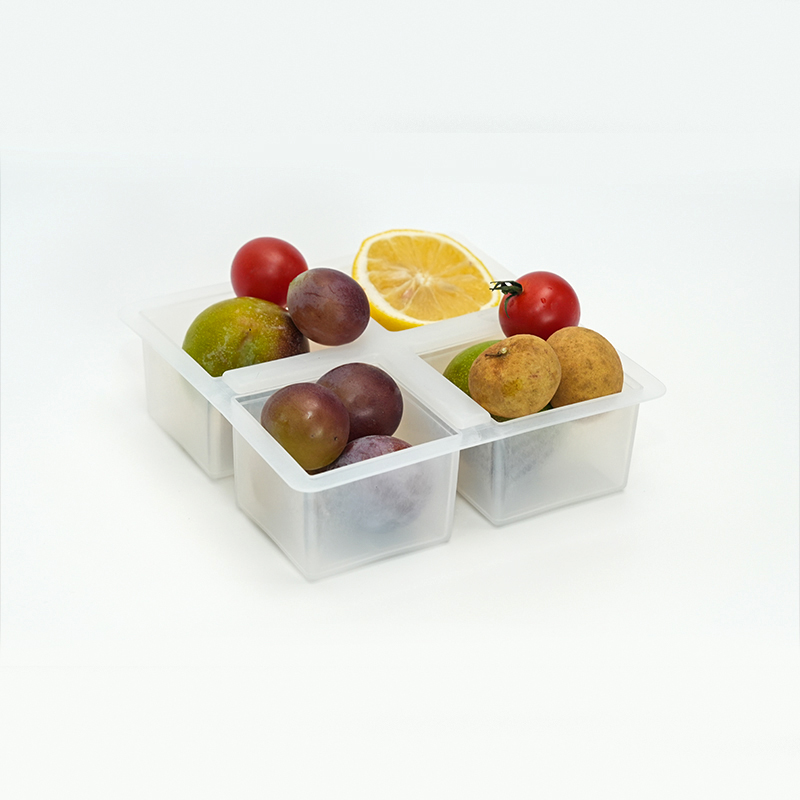
Product Overview
The PE/PP four-grid plastic hot pot container is a takeaway bowl designed for organized ingredient packaging. The four-grid layout is one of its most important features because it allows food businesses to separate different items without using multiple containers. For hot pot applications, this can mean separating meat slices, vegetables, tofu products, seafood, noodles, dipping ingredients, or condiments. For broader catering applications, it can also be used for salads, meal combinations, snack assortments, fruit portions, cooked foods, and prepared food kits.
Unlike conventional single-compartment disposable bowls, this product improves the structure of a takeaway meal. It reduces the need for additional small cups, bags, or trays, helping operators simplify packing procedures. When a meal is organized in one container, staff can assemble orders more quickly, reduce missing components, and present the food in a more professional way. This is especially important for hot pot delivery, where customer satisfaction depends not only on flavor but also on neat arrangement and ingredient integrity.
The container is produced with food-grade PE/PP raw materials. PE contributes flexibility and low-temperature resistance, while PP is known for rigidity, toughness, and good thermal performance in many food packaging applications. The combination supports a container that is durable, stable, non-toxic, odorless, and suitable for direct contact with food. The product is also designed to be resistant to deformation under normal handling and storage conditions, making it a reliable option for restaurants and food service distributors.
Its transparent appearance is another commercial advantage. High transparency allows customers to see the contents clearly, which enhances trust and appetite appeal. In food retailing and takeaway service, visibility has become a powerful packaging feature. Consumers prefer packaging that shows cleanliness, freshness, color, and ingredient quality. The PE/PP four-grid plastic hot pot container helps brands present food attractively without needing to open the package.
Technical Specification Table
| Product Name | Material | Length | Width | Height | Grammage | Structure |
| PE/PP Four-Grid Plastic Hot Pot Container | Food-grade PE/PP | 145 mm | 145 mm | 46 mm | 74.5 g | Four compartments |
The dimensions make the container compact yet functional. A 145 mm by 145 mm square footprint is easy to stack, transport, store, and display. The 46 mm height provides practical depth for many hot pot ingredients and side items. The 74.5 g grammage indicates a strong structure suitable for takeaway use while still supporting efficient disposable packaging economics.
Why Four-Grid Packaging Matters in Hot Pot Takeaway
Hot pot dining is based on diversity. Customers often select many ingredients in smaller quantities, and they expect these ingredients to remain separate before cooking or serving. If vegetables, meats, seafood, tofu, sauces, and noodles are packed together, liquids can mix, flavors can transfer, and delicate textures can be damaged. A four-grid container solves this challenge by preserving separation and order.
The four compartments also improve hygiene. Separate sections help reduce direct contact between raw and cooked items, dry and wet foods, strong-flavored and mild-flavored ingredients, or sauces and solid foods. While proper food safety management depends on the entire supply chain, packaging design plays a meaningful role in preventing unnecessary mixing during transport. For restaurant operators, this can help maintain product consistency and reduce complaints caused by messy presentation.
Another benefit is portion control. The grid design gives staff a clear visual structure for filling each section. This helps standardize serving sizes, reduce waste, and protect profit margins. In hot pot chains, franchised catering systems, and cloud kitchens, standardized packaging can support operational consistency across multiple locations. Customers receive a familiar and predictable experience, which strengthens brand trust.
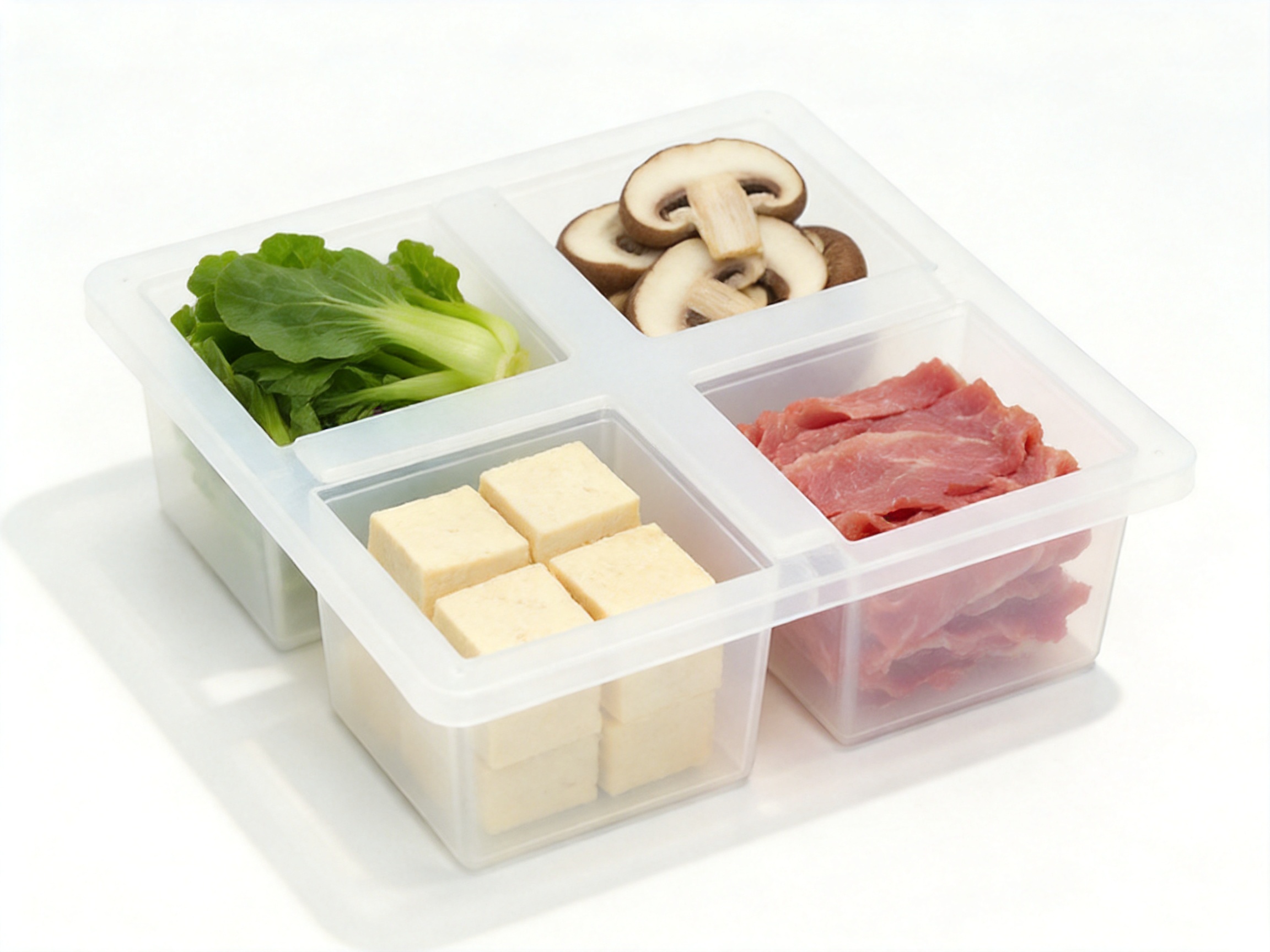
The container can also enhance meal creativity. Operators may use each grid for a different flavor profile, nutritional group, or visual color combination. For example, one section can contain leafy vegetables, another can contain mushrooms, another can contain meat rolls, and another can contain tofu or noodles. The result is a complete ingredient set that looks abundant, organized, and premium.
Material Advantages of PE and PP
PE, or polyethylene, is widely valued in packaging because of its flexibility, toughness, low-temperature resistance, and good moisture resistance. These properties are useful for takeaway containers that may be stored in chilled environments, transported through cold weather, or handled frequently before reaching the consumer. Low-temperature resistance helps the container maintain shape and reduce brittleness, which is important when food businesses pre-pack ingredients for later delivery or refrigerated display.
PP, or polypropylene, is another important food packaging material. It offers good rigidity, impact resistance, and chemical stability. In many food service applications, PP is chosen because it can maintain structural integrity under typical use conditions and resist many common food components, including oils and seasonings. For hot pot packaging, where ingredients may include sauces, chili oil, spices, and broth-related components, chemical stability is highly relevant.
The PE/PP material approach gives the container a balanced performance profile. It is tough enough for transportation, stable enough for food contact, and flexible enough to resist cracking during handling. The product is non-toxic and odorless, helping preserve the natural aroma of food. Packaging should not introduce unwanted smells, especially in hot pot applications where consumers expect strong but clean food aromas from spices, broth bases, and fresh ingredients.
Compared with low-quality generic plastic containers, food-grade PE/PP packaging offers stronger assurance in safety and consistency. Inferior containers may have inconsistent wall thickness, poor transparency, unpleasant odor, deformation problems, or weak partition strength. The PE/PP four-grid plastic hot pot container is manufactured to meet stricter expectations for food service use, helping buyers reduce risk and improve consumer satisfaction.
Product Advantages Over Conventional Competitors
The first advantage is compartment efficiency. Many competing disposable bowls use a single cavity, forcing restaurants to add extra sauce cups or small trays. This increases packaging cost, packing time, and order complexity. The four-grid hot pot container integrates multiple portions into one unit, improving workflow and reducing the need for scattered packaging components.
The second advantage is stable structure. The container is designed with good toughness and resistance to deformation. During takeaway operations, packaging must endure stacking, bagging, handling by couriers, vibration during transport, and customer handling. A container that easily bends or collapses can damage food presentation. The PE/PP four-grid plastic hot pot container is intended to maintain a dependable shape throughout these common handling steps.
The third advantage is improved presentation. Transparent PE/PP material helps showcase ingredients clearly. Many food service brands underestimate the power of visual packaging, but customers often judge product quality before tasting it. Fresh vegetables, colorful sauces, neatly arranged seafood, and portioned meat slices look more premium when visible through clean transparent packaging. This can support higher perceived value and stronger repeat purchases.
The fourth advantage is food safety credibility. The container is produced using food-grade raw materials and supported by a manufacturing enterprise with multiple certifications. Certifications such as QS, ISO9001, BRC, DIN safety certification, and EU ROHS+ testing reflect attention to production control, quality management, safety, and compliance. For buyers, certifications are not just symbols; they help reduce supplier selection risk and support documentation needs for procurement departments.
The fifth advantage is customization. Food packaging is no longer only a functional item; it is part of brand identity. The company can provide customized solutions with multiple sizes and design options to meet diverse market requirements. Customization can include adjustments in size, shape, material formulation, color tone, packaging style, and production planning depending on order requirements and technical feasibility. This makes the product suitable for independent restaurants, chain brands, distributors, supermarkets, and OEM projects.
Advanced Manufacturing Strength
Strong product performance depends on strong manufacturing. Yuqian Packaging Technology (Jiangsu) Co., Ltd. has built its capabilities around research, development, production, and sales of new food packaging materials and products. Since its establishment in 2010, the company has focused on the disposable food packaging field and developed manufacturing systems for plastic cups, plastic cup lids, takeaway bowls, disposable straws, recycle bags, peripheral products, and injection film lining cup and bowl box products.
The 30,000-square-meter plant area provides the physical foundation for scaled production. In food packaging manufacturing, factory size is important because it supports organized material storage, production zoning, mold and equipment management, quality inspection, finished goods warehousing, and logistics. A well-planned plant helps reduce contamination risk, improve workflow, and support stable delivery for large-volume orders.
The company’s production process begins with raw material selection. Food-grade PE and PP materials must be selected with attention to safety, consistency, melt behavior, color stability, and final product performance. Reliable raw material procurement is essential because even advanced equipment cannot compensate for poor materials. By using high-quality food-grade raw materials, the company helps ensure that the final container is non-toxic, odorless, tough, and suitable for food packaging.
Material preparation is followed by forming and molding processes. For partitioned containers, tooling accuracy is especially important. The four-grid structure requires consistent cavity depth, even wall distribution, smooth edges, and strong partition lines. If the mold is inaccurate or poorly maintained, the container may show uneven thickness, weak corners, irregular compartments, or stacking problems. Advanced manufacturing control helps achieve repeatable dimensions and stable product quality.
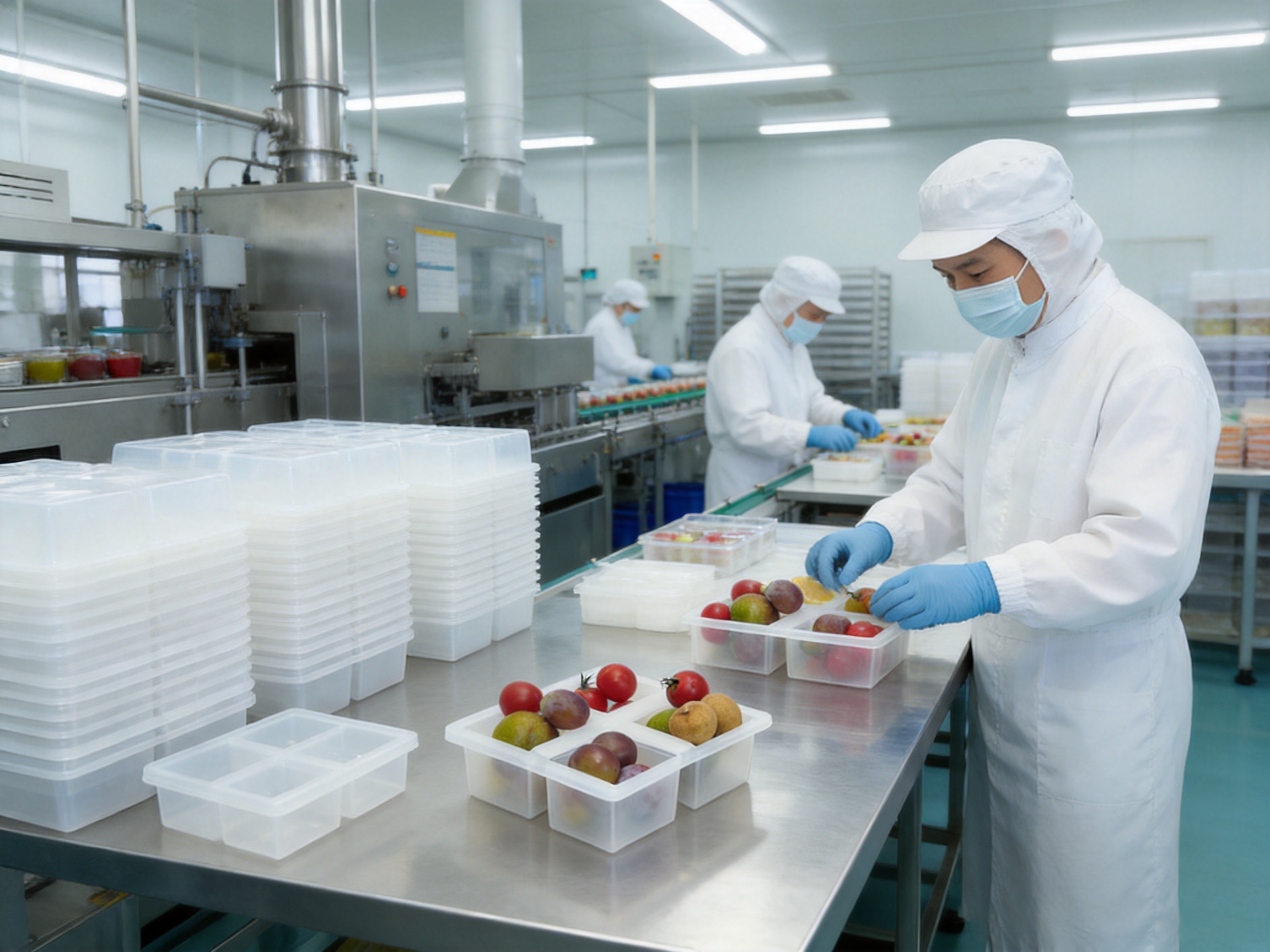
Quality inspection is integrated across the production chain. The company has established a complete quality management system covering raw material procurement, production and processing, and finished product inspection. This system helps ensure that each container meets specifications before shipment. Inspection may include visual appearance checks, dimensional measurement, weight control, structural evaluation, odor assessment, transparency assessment, and packaging cleanliness review.
Process Control and Quality Management
ISO9001 quality management certification indicates that the company operates with standardized quality procedures, documented processes, and continuous improvement principles. In disposable food packaging, such management is crucial because buyers require consistent quality across every batch. A restaurant chain cannot afford one shipment of strong containers and another shipment of weak or poorly formed containers. Consistency protects menu execution and customer experience.
BRC certification is also highly relevant to packaging supplied to food-related industries. It reflects attention to safety, hygiene, traceability, and production control. When packaging touches food directly, buyers increasingly expect suppliers to follow recognized standards that reduce risks in manufacturing and handling. This is particularly important for export-oriented business or large food service clients with strict supplier audit systems.
DIN safety certification and EU ROHS+ testing further strengthen confidence in material safety and regulatory awareness. While different markets have different requirements, international buyers often prefer suppliers that understand diverse compliance expectations. Certification capability helps simplify procurement discussions and supports long-term partnerships.
QS national industrial product production license compliance demonstrates that the company has met relevant production requirements in its domestic market. Combined with international quality certifications, this shows a broad commitment to safety and production discipline. For customers looking for an OEM hot pot container manufacturer or a disposable food packaging container factory, such qualifications are important decision factors.
Quality management also includes staff training and production discipline. Food packaging manufacturing requires careful handling, clean production behavior, proper storage, equipment maintenance, and packaging procedures that protect finished goods. The company’s professional quality inspection team and advanced testing equipment help ensure that each PE/PP four-grid plastic hot pot container meets or exceeds customer expectations.
Design for Catering Culture and Consumer Experience
Modern food packaging must fit the culture of dining. Hot pot is social, colorful, customizable, and ingredient-rich. Packaging for hot pot should reflect those qualities. The PE/PP four-grid plastic hot pot container supports this by giving food businesses a platform for visual arrangement and meal storytelling. Each compartment can become part of a curated dining experience.
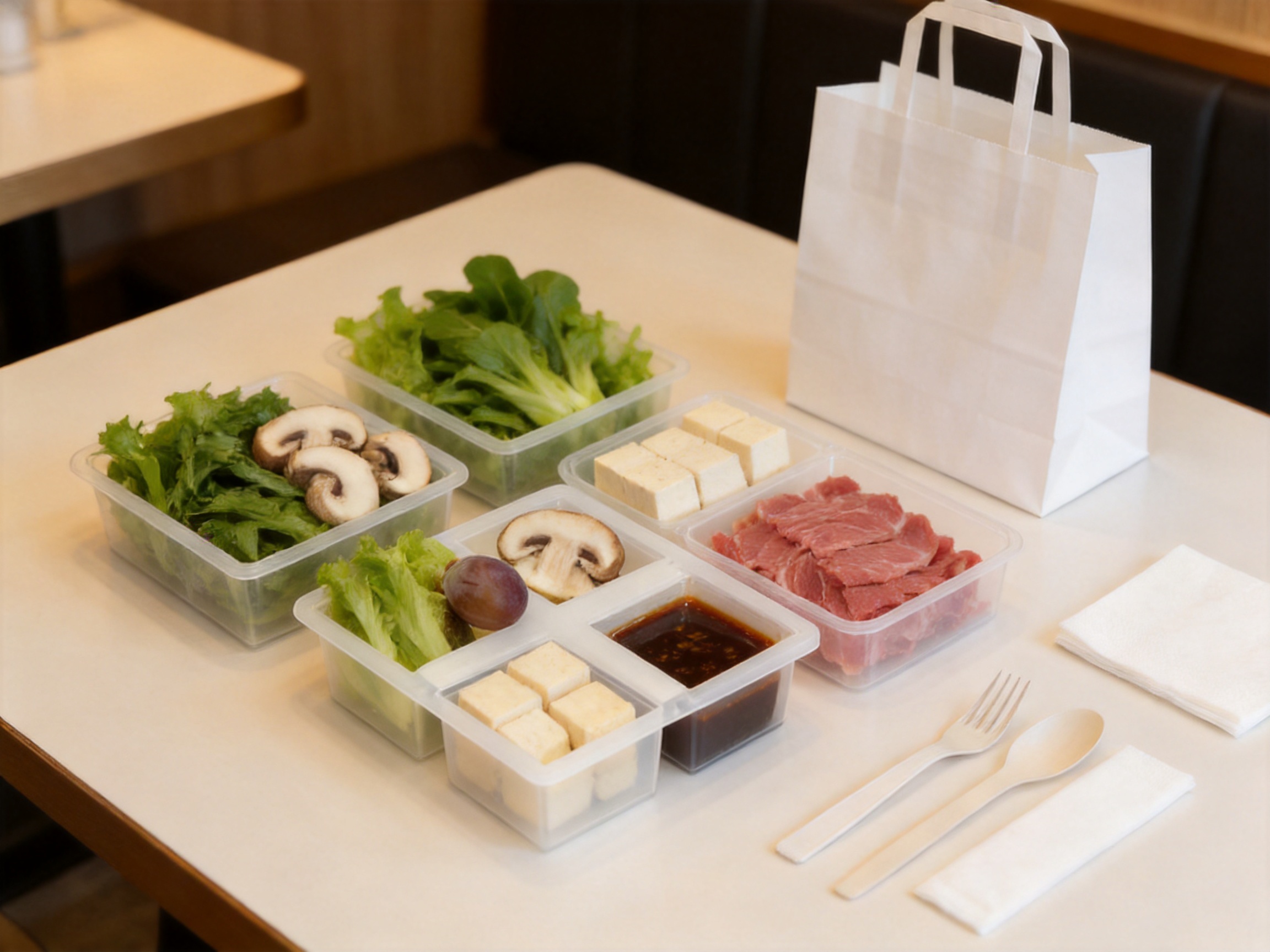
For example, a restaurant can design a “classic hot pot set” with vegetables in one grid, mushrooms in another grid, tofu products in the third grid, and meat or seafood in the fourth grid. Another brand may use the container for dipping sauce sets, with four flavors presented in one package. A supermarket may use it for pre-portioned fresh hot pot ingredients for family cooking. A catering provider may use it for picnic-style snack assortments or ready-to-eat meal combinations.
The container’s transparent appearance makes it suitable for visual merchandising. In retail display cases, customers can quickly identify product contents and compare options. In delivery, customers opening the bag see an organized and attractive meal. This immediate visual satisfaction can improve the perceived quality of the restaurant, even before the food is cooked or eaten.
The four-grid design also aligns with consumers’ increasing interest in hygiene and personalized meals. Consumers want more control over what they eat and how ingredients are combined. A compartmentalized container respects that preference by keeping items separate until the consumer decides to mix or cook them. This is especially important for people who dislike flavor transfer, follow dietary preferences, or want to inspect ingredients before use.
Operational Benefits for Restaurants and Food Service Brands
For restaurant operators, packaging affects labor efficiency. A single four-grid container can replace several smaller containers, reducing the number of packaging items staff must handle. During busy lunch and dinner periods, even small improvements in packing speed can make a difference. Faster packing means shorter waiting times, improved delivery timing, and better order accuracy.
The container also helps reduce storage complexity. Instead of stocking multiple small bowls for different ingredients, a business may use one standardized four-grid format for many meal combinations. This can simplify inventory management and reduce the risk of running out of specific packaging components. A square container is also easy to stack and store, supporting space efficiency in kitchens and warehouses.
Portion consistency is another operational advantage. The four compartments guide staff to fill standardized amounts. This helps control food cost, maintain nutritional consistency, and reduce customer complaints about uneven portions. For chain restaurants, this supports brand standardization across branches.
In delivery service, packaging strength matters. Food often passes through multiple hands: kitchen staff, front counter staff, couriers, building reception, and final consumers. A container with good toughness and stable shape helps protect food through this journey. Resistance to deformation reduces the chance of spills, crushed ingredients, and poor presentation.
For marketing, the container can also support premium positioning. Organized packaging suggests professionalism. When a customer receives neatly separated ingredients in a clear four-grid container, the meal feels more carefully prepared. This can help restaurants justify pricing, encourage repeat purchases, and strengthen brand reputation.
Environmental Considerations and Responsible Production
Consumers and governments are increasingly concerned about packaging waste. Disposable food packaging must therefore balance convenience, safety, cost, and environmental responsibility. PE and PP are widely recyclable plastic materials in many systems, although actual recycling depends on local collection, sorting, and contamination conditions. The company actively responds to environmental protection policies by using environmentally conscious PE and PP materials and reducing energy consumption and waste emissions during production.
The company is also committed to the research and development of biodegradable and recyclable hot pot container solutions. This direction is important because the food packaging industry is moving toward more sustainable material systems, lighter product design, improved recyclability, and reduced production waste. For buyers, working with a manufacturer that invests in material innovation can help future-proof packaging strategies.
Responsible production also involves efficiency. A well-designed container can reduce the total amount of packaging used in a meal by replacing several separate items. While a four-grid container has its own material weight, it may reduce the need for multiple small cups, bags, separators, or trays depending on the application. Smart packaging design can therefore contribute to operational and environmental efficiency at the same time.
Durability is another sustainability factor. If a weak container fails, food waste and replacement packaging may result. A container that protects food effectively helps reduce waste caused by leakage, breakage, or rejected orders. In food service sustainability, preventing food waste can be as important as reducing packaging weight.
Customization and OEM Service Capability
Customization is a core strength for manufacturers serving modern food brands. Yuqian Packaging Technology (Jiangsu) Co., Ltd. provides OEM manufacturing services for PE/PP four-grid plastic hot pot containers and other disposable food packaging containers. OEM capability means the company can cooperate with customers to create packaging solutions that fit specific brand, market, and operational requirements.
Customization may involve size adaptation for different menu formats. Some customers may need containers for individual hot pot sets, while others may need larger family portions or smaller tasting sets. The company’s flexible production lines and efficient supply chain management help it respond to varied customer needs from sample making to mass production.
Appearance customization is also important. While transparency is widely preferred, some brands may seek specific color effects, patterns, or visual styles that match their dining culture. Food packaging design increasingly integrates with brand identity, and customized containers can help catering brands stand out in a crowded market.
The company’s research and development team, composed of senior designers and engineers, supports ongoing exploration of new designs, materials, and processes. This R&D capability is valuable because packaging requirements change quickly. Delivery platforms, retail channels, sustainability regulations, and consumer expectations all influence packaging design. A supplier with R&D strength can provide more than a standard product; it can support product evolution.
From sample development to mass production, communication and technical alignment are essential. OEM buyers often need prototypes, performance confirmation, packaging tests, dimensional adjustments, and shipment planning. A manufacturer with experience in customized disposable food packaging can help reduce development time and improve project success rates.
Applications Beyond Hot Pot
Although designed as a hot pot container, the four-grid PE/PP structure can serve many food packaging scenarios. In takeaway meal sets, it can separate rice accompaniments, salads, pickles, sauces, and proteins. In supermarkets, it can package fruit assortments, snack combinations, fresh prepared ingredients, or meal-prep kits. In catering, it can hold appetizers, desserts, condiments, and tasting portions.
The container can also be useful for sauce and seasoning combinations. Hot pot customers often enjoy different dipping sauces, such as sesame sauce, chili oil, garlic sauce, soy-based sauce, vinegar blends, or herb seasonings. A four-grid container can organize these options neatly and reduce the need for several small cups.
For health-focused meal brands, the compartments can separate nutrition categories. One grid may contain protein, another vegetables, another grains, and another sauce or garnish. This supports balanced meal presentation and helps customers understand meal composition at a glance.
For food sampling and promotional sets, the container offers an attractive way to present multiple flavors. Brands can introduce four new items in one package, allowing consumers to compare tastes without mixing. The transparent material enhances the sampling experience by displaying color and texture.
Comparison with Common Alternative Packaging
Single-compartment bowls are simple and low cost, but they do not provide separation. For hot pot, this can result in mixed ingredients, reduced freshness, and less attractive presentation. Multi-container packing provides separation but increases the number of packaging pieces, labor steps, and waste points. Paper-based partition trays may offer an alternative in some applications, but they may not provide the same transparency or moisture resistance required for certain hot pot ingredients.
The PE/PP four-grid plastic hot pot container offers a balanced solution. It provides integrated separation, clear visibility, structural toughness, and operational convenience. Compared with cheaper low-grade plastic containers, it offers improved material safety, more stable quality, better odor control, and stronger manufacturing assurance. Compared with overly complex packaging systems, it remains practical and easy to use.
Another competitive advantage is its square shape. Square or rectangular packaging often uses storage space more efficiently than round packaging. It can be arranged neatly in cartons, refrigerators, display shelves, and delivery bags. This matters for large-scale food service operations where storage and transport efficiency directly affect cost.
The container’s grammage also supports a balance between strength and economy. Excessively light containers may deform too easily, while excessively heavy containers can increase material cost and transportation burden. A well-calibrated product weight helps deliver reliable performance without unnecessary material use.
How the Container Supports Food Safety Practices
Food safety depends on proper sourcing, preparation, temperature control, handling, and packaging. A container cannot replace good food safety management, but it can support it. The PE/PP four-grid plastic hot pot container helps by providing clean compartment separation and food-contact-safe material properties.
The non-toxic and odorless characteristics are important because packaging must not negatively affect the food. Strong plastic odor can undermine consumer confidence and may indicate poor material or processing quality. A properly produced food-grade PE/PP container helps preserve food aroma and reduces unwanted sensory interference.
Compartmentalization helps separate items that should remain apart before consumption. For example, sauces can be kept away from crisp vegetables, strong seasonings can be separated from mild ingredients, and different ingredient types can be organized more hygienically. In hot pot takeaway, where consumers may cook ingredients after delivery, maintaining separation before cooking improves the overall experience.
Manufacturing quality control further supports safety. Clean production management, raw material inspection, dimensional consistency, and finished product checks all contribute to reliable packaging. For food service buyers, selecting a certified manufacturer can be an important part of supplier risk management.
Supply Chain Reliability and Market Responsiveness
Packaging supply reliability is critical for food businesses. If a restaurant runs out of suitable containers, it may need to change menu packaging, delay orders, or use inferior substitutes. Yuqian Packaging Technology (Jiangsu) Co., Ltd. supports customers with flexible production lines and efficient supply chain management, enabling faster response from sample development to mass production.
The company’s Shanghai branch, established in January 2019, expands business channels and service reach. This reflects a broader strategy of improving customer service and market responsiveness. For domestic and international customers, effective communication, production planning, and logistics coordination are essential parts of the purchasing experience.
In OEM projects, responsiveness is especially important. Buyers may need quick sample iterations, technical confirmation, packaging design adjustments, and delivery scheduling. A supplier with integrated R&D, production, quality inspection, and sales service can reduce delays and improve coordination.
Stable supply also depends on experience. Since 2010, the company has accumulated knowledge in plastic food packaging manufacturing and has expanded across several related product categories. This experience helps it understand customer requirements across cups, lids, takeaway bowls, straws, recycle bags, peripheral packaging products, and injection film lining cup and bowl box applications.
Packaging Design and Brand Value
Packaging is often the first physical contact between a food brand and its customer. In delivery and takeaway service, it may replace restaurant atmosphere as the main brand impression. A well-designed container communicates cleanliness, care, and professionalism. The PE/PP four-grid plastic hot pot container supports this role through organized structure, transparent appearance, and dependable handling.
Brand value is built through repeated positive experiences. If a customer receives neatly separated hot pot ingredients in a strong, attractive container, they are more likely to associate the brand with reliability. If the container is weak, messy, or unpleasant-smelling, the opposite effect occurs. Packaging quality therefore directly influences customer perception.
Customized design can further strengthen branding. Even when the container itself remains transparent and simple, it can be paired with branded sleeves, labels, bags, sealing films, or outer packaging. The clean square shape provides a practical foundation for additional brand communication.
For premium hot pot brands, packaging may be part of a complete dining ritual. Separate ingredients, visible freshness, neat arrangement, and easy handling all make the takeaway experience feel closer to restaurant service. The four-grid container helps bridge the gap between dine-in presentation and delivery convenience.
Recommended Buyer Considerations
When selecting a PE/PP four-grid plastic hot pot container, buyers should consider material safety, structural strength, transparency, compartment design, supplier certification, customization options, and delivery reliability. Price is important, but the lowest-cost option is not always the best value if it leads to breakage, poor presentation, or customer complaints.
Buyers should also evaluate whether the container dimensions match their menu portions. The 145 mm length, 145 mm width, and 46 mm height are suitable for many ingredient sets, but different applications may require adjusted sizes. OEM support can help align packaging design with actual food volume and brand goals.
Quality consistency should be assessed through samples and trial use. Restaurants can test stacking, filling, transport, customer opening experience, and visual appeal. Distributors can evaluate carton packing, warehouse storage, and shipment stability. Food factories can test compatibility with their packing lines and storage conditions.
Regulatory and certification needs should be reviewed according to target markets. The company’s QS, ISO9001, BRC, DIN, and EU ROHS+ related qualifications provide a strong foundation, but buyers should still confirm documentation requirements for their specific country, channel, and product category.
Q&A Section
What is the PE/PP four-grid plastic hot pot container mainly used for?
It is mainly used for hot pot takeaway ingredients, sauces, seasonings, and meal combinations that need to remain separated. It can also be used for salads, fruit assortments, snack sets, prepared foods, supermarket meal kits, and catering portions.
Why does the container use a four-grid design?
The four-grid design separates different foods in one container. This helps preserve flavor, improve hygiene, prevent unwanted mixing, support portion control, and create a more organized presentation for customers.
What are the main material benefits of PE and PP?
PE offers flexibility, toughness, and low-temperature resistance, while PP provides rigidity, impact resistance, and chemical stability. Together, they help create a durable, food-grade, non-toxic, odorless, and practical takeaway container.
Is the container suitable for food contact?
Yes. The product is made from high-quality food-grade raw materials and is designed to be non-toxic and odorless. The manufacturer also operates under recognized quality and safety certifications that support food packaging production control.
What are the product dimensions?
The standard listed specification is 145 mm in length, 145 mm in width, 46 mm in height, and 74.5 g in grammage.
How does this container compare with single-compartment bowls?
Single-compartment bowls are simpler but do not separate foods. The four-grid container improves organization, presentation, portion control, and convenience by allowing four different ingredients or seasonings to be packed in one container.
Can the container be customized?
Yes. The manufacturer provides customized solutions with multiple size and design options, supporting customers from sample making to mass production according to project needs.
What certifications support the manufacturer’s quality strength?
The company has passed or obtained certifications and tests including QS national industrial product production license, ISO9001 Quality Management System certification, BRC certification, German DIN safety certification, and EU ROHS+ testing.
Why is transparency important in hot pot packaging?
Transparency allows customers to see the food clearly, improving trust, freshness perception, and visual appeal. It also helps retailers and restaurants display ingredients attractively.
Is the container useful only for hot pot restaurants?
No. Although it is designed for hot pot applications, it is also suitable for takeaway meals, supermarkets, catering services, snack assortments, sauce sets, fresh food kits, and prepared food packaging.
Conclusion
The PE/PP four-grid plastic hot pot container is a practical and competitive disposable food packaging solution for the modern takeaway and delivery market. Its food-grade PE/PP material, low-temperature resistance, toughness, odorless quality, transparent appearance, and four-compartment structure make it especially suitable for hot pot ingredients and multi-item meal packaging. It helps restaurants and food service brands improve presentation, hygiene, order accuracy, portion control, and customer satisfaction.
Compared with conventional single-compartment bowls or low-quality generic containers, this product provides stronger organization, better visual value, more reliable material performance, and greater suitability for professional catering operations. Its square dimensions and integrated grid design support efficient storage, stacking, transport, and meal assembly.
Yuqian Packaging Technology (Jiangsu) Co., Ltd. strengthens the product’s value through advanced manufacturing capability, a 30,000-square-meter production base, food packaging expertise, quality management systems, R&D strength, OEM customization service, and recognized certifications. The company’s commitment to green production, recyclable and biodegradable material research, and continuous product innovation positions it as a reliable manufacturer for businesses seeking high-quality disposable food packaging containers.
As hot pot takeaway and prepared food markets continue to grow, packaging will remain a key factor in consumer experience and brand differentiation. The PE/PP four-grid plastic hot pot container answers this market demand with a combination of safety, structure, visibility, convenience, and customization potential. For restaurants, distributors, supermarkets, and catering brands seeking dependable packaging for diverse food combinations, it offers a strong balance of performance and commercial value.
References
Food Packaging Materials: Principles, Properties, and Applications. Industry Technical Handbook.
ISO 9001 Quality Management Systems: Requirements and Implementation Guidance.
BRC Global Standard for Packaging Materials: Safety and Quality Management Principles.
Polypropylene and Polyethylene in Food Contact Applications. Polymer Packaging Technical Review.
Disposable Food Packaging and Sustainability Trends. Food Service Packaging Market Report.