English
 Español
 عربى
عربىContent
- 1 1. Product Overview: A Practical Container for Multi-Ingredient Hot Pot Service
- 2 2. Basic Product Specification
- 3 3. Why Four Compartments Matter in Hot Pot Packaging
- 4 4. Material Advantages of PE and PP
- 5 5. Competitive Advantages Over Ordinary Takeaway Containers
- 6 6. Applications Beyond Hot Pot
- 7 7. Customization and Design Value
- 8 8. Manufacturing Strength: From Raw Material to Finished Container
- 9 9. Quality Certifications and International Market Confidence
- 10 10. Environmental Considerations and Responsible Production
- 11 11. The Role of Packaging in Customer Experience
- 12 12. Operational Benefits for Restaurants and Food Brands
- 13 13. Why Professional OEM Manufacturing Matters
- 14 14. Advanced Manufacturing Processes as a Competitive Strength
- 15 15. Design Details That Improve Performance
- 16 16. Food Safety and Odor Control
- 17 17. Market Trends Supporting Four-Grid Hot Pot Containers
- 18 18. Recommended Use Scenarios
- 19 19. How the Container Helps Build a Stronger Catering Brand
- 20 20. Cost Efficiency and Total Value
- 21 21. Supply Chain Reliability
- 22 22. Quality Control From Customer Requirement to Delivery
- 23 23. Comparison With Alternative Packaging Types
- 24 24. Buyer Considerations Before Ordering
- 25 25. Q&A Section
- 25.1 Q1: What is the PE/PP four-grid plastic hot pot container mainly used for?
- 25.2 Q2: What are the main advantages of the four-grid design?
- 25.3 Q3: Is the container made from food-grade material?
- 25.4 Q4: What is the standard size of the container?
- 25.5 Q5: Can the container be customized?
- 25.6 Q6: Why is transparency important?
- 25.7 Q7: What certifications support product quality?
- 25.8 Q8: Is this container suitable for cold storage?
- 25.9 Q9: How does this container help restaurants reduce operational problems?
- 25.10 Q10: Why choose an OEM manufacturer for this product?
- 26 26. Conclusion
- 27 References
In modern takeaway dining, packaging is no longer a simple shell around food. It has become part of the customer experience, part of food safety management, part of brand presentation, and part of operational efficiency. For hot pot restaurants, meal-kit suppliers, catering chains, convenience food providers, and food delivery brands, the container must do more than hold ingredients. It must separate flavors, protect freshness, resist deformation, present food attractively, and support efficient packing at scale.
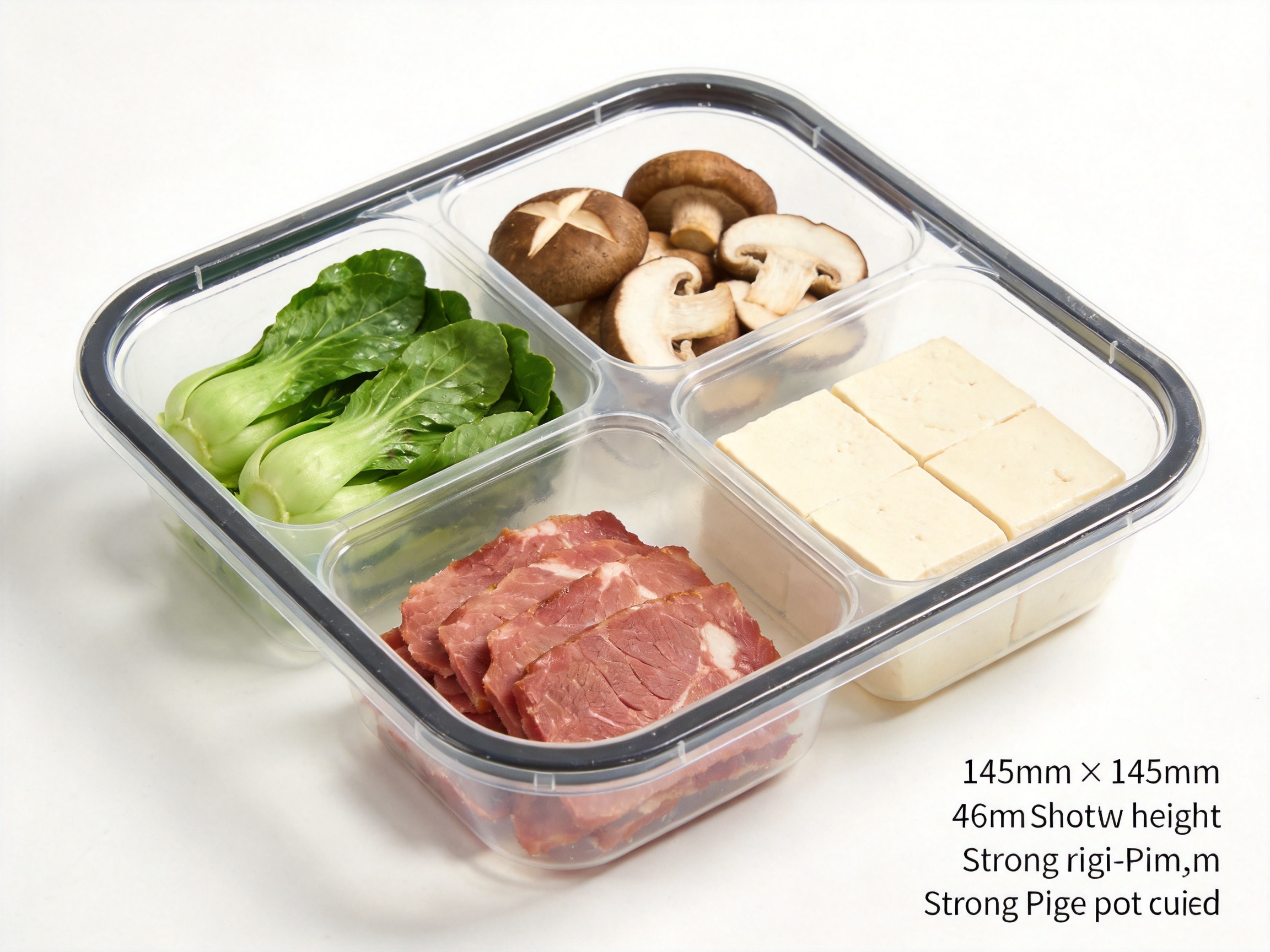
The PE/PP four-grid plastic hot pot container is designed for exactly this environment. Made from food-grade polyethylene and polypropylene materials, it combines toughness, stable structure, low-temperature resistance, odorless performance, and convenient four-compartment separation. Its 145 mm by 145 mm square format, 46 mm height, and approximately 74.5 g grammage create a practical balance between capacity, strength, portability, and presentation. The four-grid design allows different ingredients, seasonings, sauces, toppings, side dishes, or prepared hot pot elements to be packed in one unified container without unwanted mixing.
This article explores the product’s structure, material advantages, competitive strengths, manufacturing process, quality control system, customization value, and commercial applications. It also explains why a professional manufacturer such as Yuqian Packaging Technology (Jiangsu) Co., Ltd. can provide strong support for food packaging buyers seeking reliable, customized, and scalable disposable food packaging container solutions.
1. Product Overview: A Practical Container for Multi-Ingredient Hot Pot Service
The PE/PP four-grid plastic hot pot container is a disposable takeaway bowl-style container developed for partitioned food packaging. It is especially suitable for hot pot-related takeaway service because hot pot meals often include multiple ingredients that should be kept separate before cooking or eating. Vegetables, mushrooms, meat slices, bean products, seafood, sauces, spices, and side dishes may all have different moisture levels, flavors, textures, and colors. If they are packed together without separation, the visual appeal and eating quality can quickly decline.
The four-grid structure solves this problem by dividing the internal space into four independent compartments. This allows restaurants and food brands to package a complete ingredient set in a clean, orderly, and attractive way. Customers can open one container and immediately see a well-arranged meal selection. This improves convenience, hygiene, and perceived value.
The product is positioned within the takeaway bowls category, but its function extends beyond ordinary bowls. Unlike a single-compartment bowl, the four-grid hot pot container supports portion control, menu standardization, ingredient separation, and customized meal combinations. For takeaway businesses, these features help reduce packing complexity and support a more consistent customer experience.
The material combination of PE and PP provides a strong foundation for food-contact packaging. Polyethylene contributes flexibility, toughness, and low-temperature performance, while polypropylene is widely recognized for its rigidity, heat tolerance, chemical stability, and food packaging suitability. Depending on customer requirements and specific production configuration, material selection can be optimized to achieve the desired balance of transparency, stiffness, impact resistance, and processing performance.
2. Basic Product Specification
The following table summarizes the available specification provided for the PE/PP four-grid plastic hot pot container.
| Product Name | Length | Width | Height | Grammage | Material | Structure |
|---|---|---|---|---|---|---|
| Four-Grid Hot Pot Container | 145 mm | 145 mm | 46 mm | 74.5 g | Food-grade PE/PP | Four separated compartments |
The square 145 mm format is compact enough for easy stacking, delivery bag placement, and retail display, while the 46 mm height provides usable depth for ingredients and sauces. The 74.5 g grammage reflects a durable construction that is designed to resist easy deformation during packing, handling, transportation, and customer use.
3. Why Four Compartments Matter in Hot Pot Packaging
Hot pot is a dining format built around variety. A single meal may include many ingredients, and the pleasure of hot pot often comes from combining these items at the right time. Packaging therefore needs to preserve separation until the customer is ready to cook or eat. The four-grid hot pot container supports this requirement by creating four zones within one container.
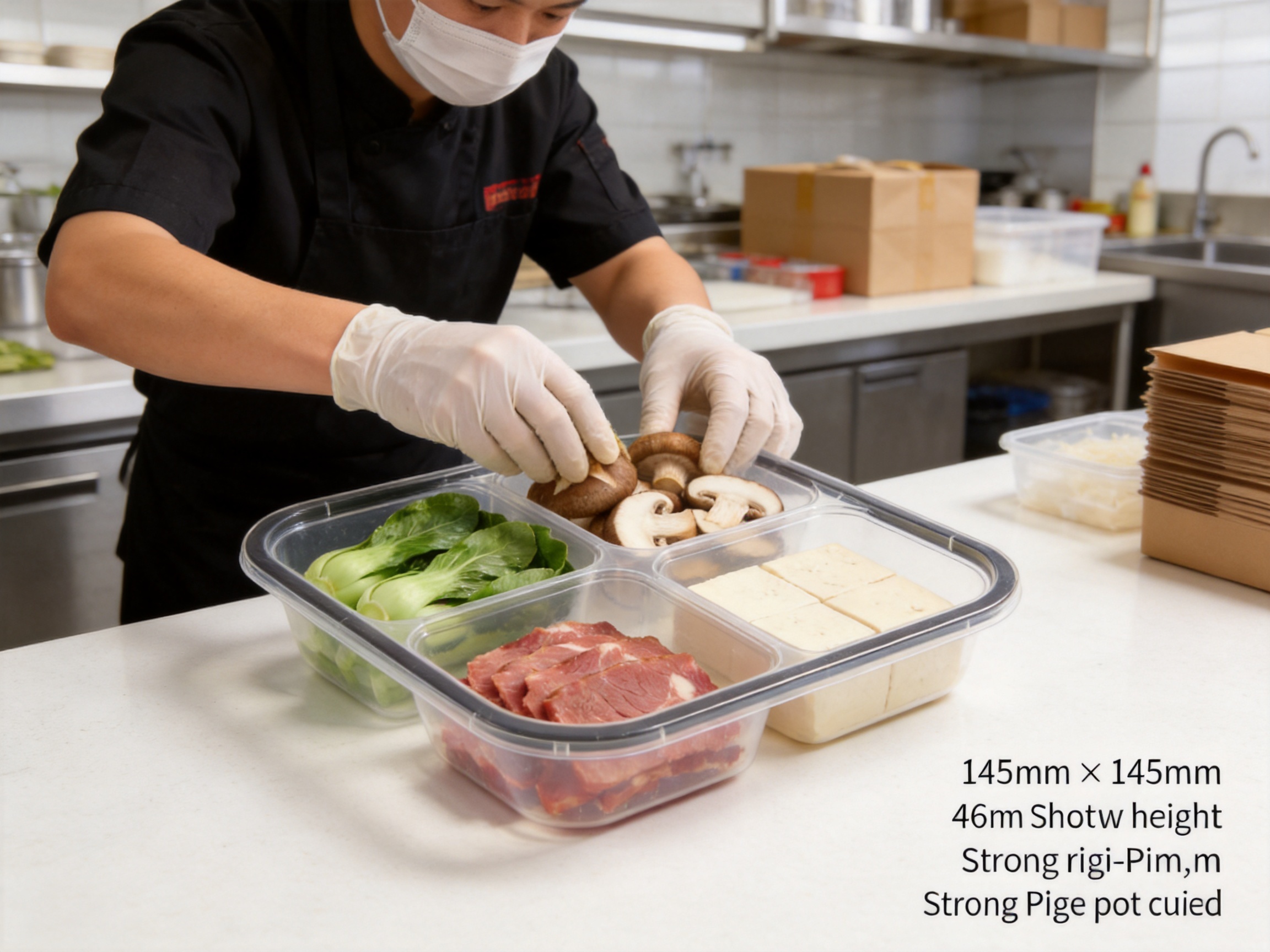
For restaurants, this design can simplify set meal preparation. One compartment can hold leafy vegetables, another can hold mushrooms, another can hold meat or seafood, and the last can hold tofu products, noodles, condiments, or garnishes. For snack and side-dish businesses, the same container can hold four sauces, four toppings, four cold dishes, or four small meal portions. The structure supports flexible menu development without requiring multiple separate bowls.
Compared with packaging ingredients in several individual cups or bags, a four-grid container reduces the number of separate units handled during packing. This can save labor time, reduce the risk of missing items, and create a neater delivery package. It also improves customer perception because the meal looks organized and intentional rather than fragmented.
The compartment structure also helps maintain hygiene. When ingredients are separated, liquid migration is reduced, strong flavors are less likely to contaminate mild items, and wet ingredients are less likely to soften dry or crisp components. This is especially important in delivery scenarios where food may be transported for an extended period before being opened.
4. Material Advantages of PE and PP
PE and PP are two of the most widely used plastics in food packaging because they offer practical safety, processing, and performance advantages. When properly produced from food-grade raw materials, they are suitable for food-contact applications and can meet strict quality expectations for disposable packaging.
4.1 Food-Grade Safety
The PE/PP four-grid plastic hot pot container is made from high-quality food-grade raw materials. The product is designed to be non-toxic and odorless, which is essential for food packaging. A container should not introduce unpleasant smells, taste interference, or visible contamination. For hot pot ingredients, where fresh aroma and natural color are important, neutral packaging performance is a major advantage.
Food-grade materials also support compliance with food safety management requirements. For catering brands, using packaging from a certified manufacturer helps reduce operational risk and supports customer trust. Yuqian Packaging Technology (Jiangsu) Co., Ltd. has obtained multiple certifications and testing qualifications, including QS national industrial product production license, ISO9001 quality management system certification, BRC certification, German DIN safety certification, and EU ROHS+ testing support. These qualifications reflect a structured approach to production control, product safety, and quality consistency.
4.2 Toughness and Deformation Resistance
A disposable food container must survive real-world handling. It may be stacked in cartons, moved through warehouses, filled quickly in restaurant kitchens, sealed, transported in delivery bags, and handled by consumers. Weak containers may bend, crack, collapse, or leak due to poor structure or low-quality material. The PE/PP hot pot container is designed with good toughness and stable shape retention, helping it resist deformation during normal use.
This toughness is especially valuable for four-grid containers because internal partitions must remain stable. If the partitions deform, ingredients can mix and the main functional benefit of the product is reduced. A well-designed container maintains its grid shape so that each compartment continues to perform as intended.
4.3 Low-Temperature Resistance
Hot pot takeaway ingredients are often prepared in advance and stored under chilled conditions before delivery or sale. PE/PP materials offer good low-temperature resistance, allowing the container to maintain stable performance in cold environments. This reduces the risk of brittleness, cracking, or shape failure during cold storage or winter transportation.
For food manufacturers and restaurant chains that operate across seasons and regions, low-temperature resistance is important. Packaging that works well in summer but becomes brittle in winter can create quality problems. A container with reliable cold-weather toughness supports more stable operations.
4.4 Chemical Stability
Hot pot meals may include oily sauces, spicy bases, fermented seasonings, vegetables with natural acids, and ingredients containing salt or moisture. Packaging material must remain stable when in contact with these foods. PE and PP are known for good chemical stability, which helps reduce unwanted reactions with common food components.
This stability contributes to food safety, odor control, and appearance retention. It also helps protect the container from weakening when exposed to oily or seasoned ingredients during normal holding times.
4.5 Transparency and Presentation
High transparency material improves the beauty and ornamental value of the product. In food retail and takeaway, visual appeal matters. Customers often judge freshness and value before tasting. A clear or highly transparent container allows ingredients to be displayed attractively, especially when the four compartments are filled with colorful foods.
For hot pot sets, contrast is important: green vegetables, red chili sauce, white tofu, dark mushrooms, sliced meat, and golden corn can create a premium visual impression when neatly arranged. Transparent packaging supports this effect and can improve the perceived quality of the meal.
5. Competitive Advantages Over Ordinary Takeaway Containers
The PE/PP four-grid plastic hot pot container provides several advantages compared with many standard disposable bowls, single-compartment trays, low-cost thin containers, and multi-piece packaging combinations.
5.1 Better Ingredient Separation
Ordinary bowls mix all food components together. This may be acceptable for soups or rice bowls, but it is not ideal for hot pot ingredients, meal kits, sauces, or multi-component snacks. The four-grid structure provides a built-in solution for separation. It helps keep different ingredients clean, identifiable, and ready for use.
This is a direct competitive advantage because it improves both function and appearance without requiring extra containers. A restaurant can serve a more organized product while using one main packaging unit.
5.2 Improved Portion Control
Portion control is vital for catering profitability. Each grid can be used as a measuring zone, helping kitchen staff pack consistent quantities. This reduces overfilling, improves cost management, and ensures customers receive a standardized meal. For chain restaurants and franchise systems, standardized packaging can support standardized service.
5.3 Cleaner Delivery Experience
During delivery, containers may tilt, shift, or experience vibration. Compartment packaging helps reduce ingredient movement, especially when paired with a compatible lid. Even when foods move slightly, each item remains mostly within its own grid. This helps the customer receive a cleaner and more appealing product.
5.4 Fewer Packaging Components
Some businesses use four separate small containers to hold four ingredients. This approach can increase material use, packing time, storage complexity, and customer inconvenience. A four-grid container integrates four spaces into one unit. This can simplify inventory management and reduce the number of items packed per order.
5.5 Stronger Brand Presentation
Packaging shape and structure contribute to brand image. A neatly designed four-grid container communicates professionalism and care. When combined with customized sizing, color, pattern, or branded outer packaging, it can help a catering brand stand out in a competitive delivery market.
5.6 Better Suitability for Hot Pot Culture
Hot pot dining emphasizes selection, freshness, sharing, and interaction. A four-grid container fits this culture better than a plain bowl because it supports variety and presentation. It allows consumers to enjoy a more personalized dining experience, even when eating at home or in an office rather than inside a restaurant.
6. Applications Beyond Hot Pot
Although the product is designed as a hot pot container, its functional structure makes it useful across many food packaging scenarios.
It can be used for sauce combinations, condiment sets, salad toppings, fruit assortments, children’s meals, snack platters, breakfast combinations, deli samples, pickled vegetables, meal-prep portions, convenience store food, airline-style portioned meals, and catering event packaging. The four compartments provide flexibility for any food business that needs to keep components separated.
For example, a salad brand can use the container to separate lettuce, protein, toppings, and dressing. A dessert shop can pack four small sweets in one container. A restaurant can provide dipping sauces and garnishes. A meal-prep supplier can create balanced portions of vegetables, protein, carbohydrates, and condiments. This versatility increases the commercial value of the container because one packaging design can support multiple menu categories.
7. Customization and Design Value
Modern food packaging buyers increasingly require personalized design. Standard containers are useful, but custom packaging can help a brand express identity, improve fit with food products, and optimize operational needs. Yuqian Packaging Technology (Jiangsu) Co., Ltd. provides customized solutions with multiple sizes and design options to meet diverse needs.
Customization can include dimensions, compartment ratio, material thickness, color, transparency level, matching lid style, stacking structure, embossing, label compatibility, and carton packing method. For large catering chains, a customized container can be designed around exact menu portions. For food manufacturers, the container can be optimized for automated filling lines or retail shelf display. For takeaway restaurants, custom design can improve delivery performance and customer satisfaction.
The company’s research and development team consists of experienced designers and engineers who explore new designs, new materials, and new processes for plastic food packaging. This engineering support is important because successful packaging must balance many factors at once: material cost, mold feasibility, strength, clarity, stackability, sealing compatibility, food safety, production speed, and transportation efficiency.
A container that looks good in a drawing may fail in mass production if the mold design is weak, the wall thickness is uneven, or the material flow is not properly controlled. A professional manufacturer’s technical knowledge helps transform a packaging idea into a reliable commercial product.
8. Manufacturing Strength: From Raw Material to Finished Container
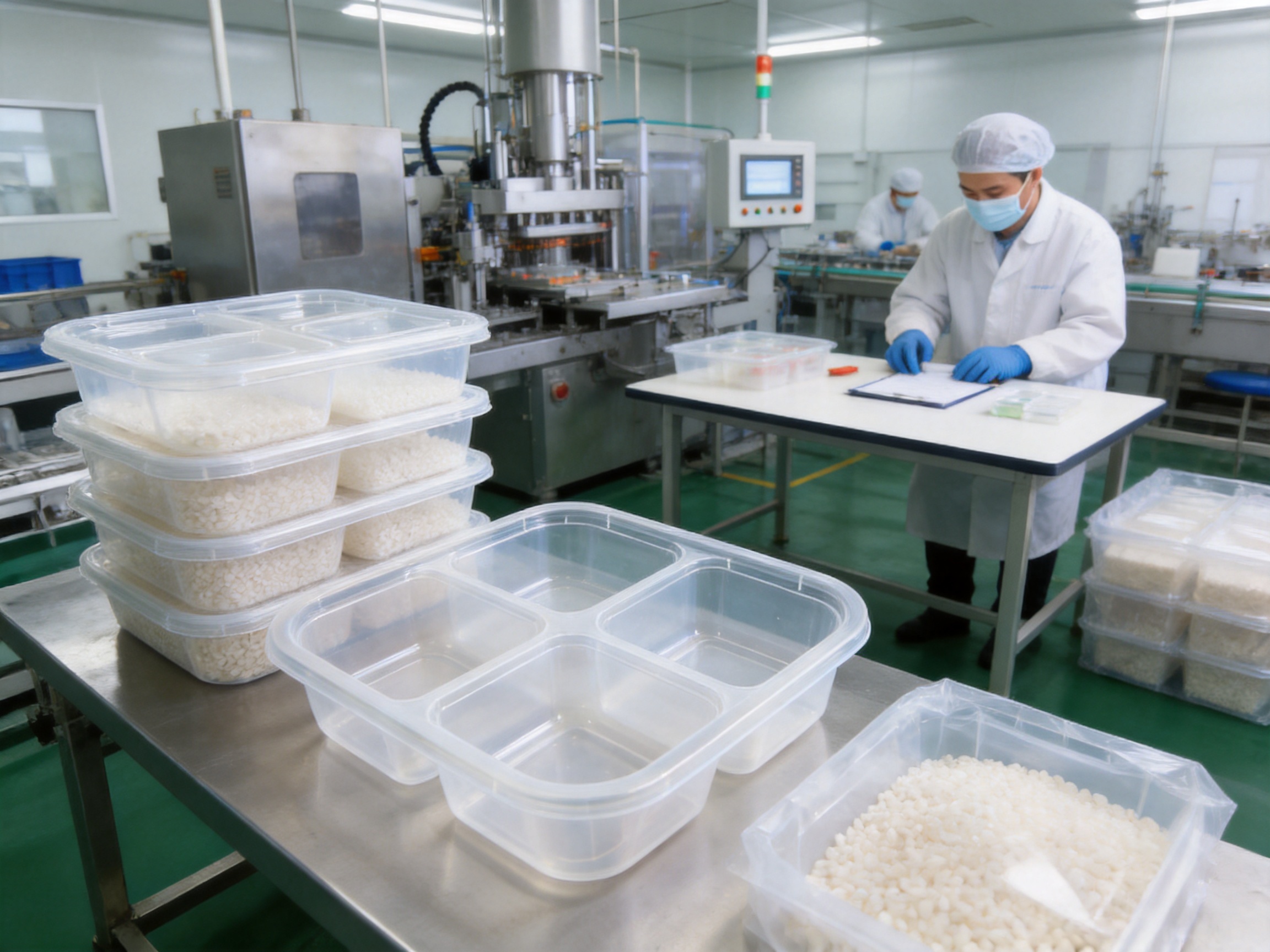
Advanced manufacturing is one of the key reasons the PE/PP four-grid hot pot container can compete effectively in the food packaging market. The manufacturing process requires more than simply forming plastic into a shape. It involves raw material selection, material preparation, mold design, forming process control, trimming, inspection, packaging, and traceability.
8.1 Food-Grade Raw Material Procurement
Quality begins with raw materials. The company selects high-quality food-grade PE and PP materials suitable for disposable food packaging. Raw materials must be clean, stable, and consistent from batch to batch. Proper procurement helps ensure that the final container has stable color, transparency, toughness, and safety performance.
Incoming materials should be checked according to internal quality standards. This may include supplier qualification, documentation review, appearance inspection, melt flow performance, and food-contact compliance verification. Stable material supply is especially important for OEM production because customers expect consistent products across repeated orders.
8.2 Material Preparation and Process Control
Before forming, plastic materials must be prepared under controlled conditions. Moisture, contamination, incorrect mixing, or poor temperature management can affect final product quality. Professional production lines use controlled feeding, heating, and forming parameters to ensure stable performance.
For PE/PP containers, temperature control is critical. If processing temperature is too low, material flow may be poor and forming details may be incomplete. If temperature is too high, material properties or appearance may be affected. A skilled production team monitors these conditions to maintain stable output.
8.3 Mold and Structural Design
The four-grid hot pot container depends heavily on mold precision. The outer walls, bottom support, corners, and internal partitions must be formed accurately. The partitions need enough strength to separate ingredients, while the entire structure must be easy to stack and remove from stacks during packing.
Professional mold design also helps reduce stress concentration. Corners and partition intersections must be designed to reduce cracking risk and improve material distribution. The 145 mm square structure requires uniform forming so that the container sits flat and maintains a neat appearance.
8.4 Forming and Production Efficiency
Efficient forming technology allows large-volume production while controlling unit cost. For disposable food packaging, production efficiency is essential because buyers often require competitive prices, stable delivery schedules, and consistent supply. Yuqian Packaging Technology (Jiangsu) Co., Ltd. operates as a professional OEM manufacturer with flexible production lines and efficient supply chain management, enabling it to respond quickly to customer needs from sample development to mass production.
Flexibility is particularly important for customized packaging. Different customers may require different dimensions, materials, colors, or lid combinations. A factory with adaptable production capability can support both standard product supply and project-based customization.
8.5 Trimming, Finishing, and Clean Handling
After forming, containers must be trimmed and finished to remove excess material and achieve clean edges. Smooth edges improve safety and user experience. Rough edges or burrs can make packaging look low quality and may interfere with lid fit or stacking.
Clean handling is also essential. Because the product is used for food packaging, production and packing environments should minimize dust, contamination, and unnecessary human contact. Organized production areas, trained workers, and defined hygiene procedures contribute to reliable food-contact packaging quality.
8.6 Inspection and Quality Assurance
Finished containers should be inspected for appearance, dimensions, weight, deformation, cracks, odor, color consistency, stacking performance, and compartment integrity. Quality inspection helps prevent defective products from reaching customers. Advanced testing equipment and a professional quality inspection team support this process.
The company has established a complete quality management system covering raw material procurement, production and processing, finished product inspection, and customer requirement control. This systematic approach is a major strength for buyers who need dependable packaging supply rather than one-time low-cost products.
9. Quality Certifications and International Market Confidence
Certifications are important in the food packaging industry because they show that a manufacturer follows recognized standards. The PE/PP four-grid plastic hot pot container benefits from production under a company that has passed several important certifications and tests.
The QS national industrial product production license reflects qualification for industrial food-related product production in China. ISO9001 quality management system certification indicates that the company has structured management processes for quality control and continuous improvement. BRC certification is widely recognized in food-related supply chains and supports confidence among international buyers. German DIN safety certification and EU ROHS+ testing further demonstrate attention to product safety and restricted substance control.
For global importers, distributors, and food brands, these certifications reduce supplier evaluation pressure. Buyers can more confidently communicate with a manufacturer that understands documentation, traceability, inspection procedures, and compliance expectations. This is especially valuable for OEM and customized projects where product development must be supported by reliable process control.
10. Environmental Considerations and Responsible Production
Consumers are increasingly concerned about environmental impact. Food packaging manufacturers must respond with responsible material selection, resource-efficient production, waste reduction, and recyclable or biodegradable material research. Yuqian Packaging Technology (Jiangsu) Co., Ltd. actively responds to environmental protection policies and adheres to green production principles.
PE and PP materials are widely recyclable in many systems when collected and processed properly. Their light weight can also reduce transportation burden compared with heavier packaging alternatives. In production, efficient process control can reduce waste, energy consumption, and defective output. Waste reduction is not only environmentally responsible but also economically important because it helps control production cost.
The company is also committed to the research and development of biodegradable and recyclable hot pot containers. This is significant because the future of disposable food packaging will likely require multiple solutions, including recyclable mono-material designs, reduced-material structures, biodegradable materials for specific use cases, and improved collection systems. A manufacturer with research capability is better positioned to adapt to changing regulations and customer expectations.
Environmental performance should be discussed honestly. Disposable packaging has an environmental footprint, and responsible use depends on material choice, local recycling infrastructure, customer behavior, and waste management systems. However, improving design efficiency, using safe materials, reducing unnecessary packaging components, and exploring recyclable or biodegradable alternatives can all contribute to more sustainable food service packaging.
11. The Role of Packaging in Customer Experience
For takeaway food, the customer’s first physical interaction with the meal is often the packaging. Before tasting the food, the customer sees, touches, opens, and evaluates the container. If the package is clean, strong, transparent, and well organized, the customer is more likely to perceive the food as fresh and professionally prepared.
The PE/PP four-grid plastic hot pot container creates a positive opening experience. The separated ingredients appear orderly. The transparent material allows customers to see the contents clearly. The sturdy structure suggests care and reliability. These details can influence reviews, repeat purchases, and brand loyalty.
In the hot pot category, visual abundance is part of the appeal. Customers enjoy seeing multiple ingredients arranged together. A four-grid design supports this emotional experience by presenting variety in a compact format. It makes the meal feel complete and thoughtfully assembled.
12. Operational Benefits for Restaurants and Food Brands
Beyond customer experience, the container provides practical operational benefits for food service businesses.
12.1 Faster Packing
Kitchen staff can place different ingredients into designated compartments quickly. This reduces confusion and supports standardized packing routines. During peak hours, small time savings per order can become significant.
12.2 Reduced Packing Errors
When a set meal requires multiple components, separate small packages can be forgotten or mixed up. A four-grid container allows several components to be packed together, reducing the chance of missing items.
12.3 Better Inventory Control
Using one multi-compartment container can simplify packaging inventory. Restaurants may need fewer separate small bowls or sauce cups for certain menu sets. This can reduce storage complexity and purchasing management work.
12.4 More Consistent Menu Presentation
Compartment sizes can guide portioning and arrangement. This supports consistent presentation across different staff members, shifts, and locations. For chain brands, consistency is essential.
12.5 Delivery Compatibility
The compact square shape helps with stacking and transport. Square containers often use space efficiently in cartons, kitchen shelves, refrigerators, and delivery bags. Good stackability reduces clutter and supports organized operations.
13. Why Professional OEM Manufacturing Matters
Many buyers compare packaging suppliers mainly by price. Price is important, but food packaging quality depends on much more. A low-cost container that cracks, smells, deforms, leaks, or fails compliance can damage a food brand’s reputation and create hidden costs. Professional OEM manufacturing provides broader value.
Yuqian Packaging Technology (Jiangsu) Co., Ltd. was established in 2010 and is located in Taizhou City, Jiangsu Province, China. With a plant area of approximately 30,000 square meters, the company integrates research and development, production, and sales of new food packaging materials and products. It focuses on disposable food packaging containers, biodegradable new materials, plastic cups, cup lids, takeaway bowls, disposable straws, recycle bags, peripheral products, and injection film lining cup and bowl box solutions.
The company’s OEM capability is valuable for buyers who need packaging tailored to their own market. OEM service can support private-label projects, customized dimensions, special design features, and production planning for large orders. The company can provide a full range of services from sample making to mass production, helping customers reduce development difficulty and accelerate product launch.
Its Shanghai branch, established in 2019, further supports business expansion and service quality. For customers, this indicates a broader service structure and stronger commercial support.
14. Advanced Manufacturing Processes as a Competitive Strength
In the disposable food packaging industry, advanced manufacturing is not only about machines. It includes system thinking: design engineering, material science, production management, quality control, certification compliance, and supply chain coordination. The strength of a professional manufacturer lies in combining all these elements.
For the four-grid hot pot container, production precision is essential. The internal partitions must be uniform, the bottom must remain stable, the rim must support closure, the corners must resist cracking, and the whole container must maintain attractive clarity. Achieving this consistently across large production batches requires controlled processes.
Modern manufacturing also supports repeatability. A buyer ordering the same container month after month expects the same dimensions, weight, appearance, and performance. If each batch varies, restaurants may experience lid mismatch, stacking problems, or inconsistent portion appearance. A certified quality management system helps reduce such variation.
Production scale is another advantage. A 30,000-square-meter plant provides the physical foundation for large-volume manufacturing, equipment layout, warehouse management, and order fulfillment. For food packaging customers, capacity matters because supply interruptions can disrupt restaurant operations. A manufacturer with scale and supply chain management can better support seasonal demand, promotional campaigns, and chain expansion.
15. Design Details That Improve Performance
A good disposable container appears simple, but many design details influence performance.
The rim must be strong enough to resist bending and compatible with a matching lid if required. The side walls must balance flexibility and rigidity. The bottom must support the weight of food without bulging excessively. The partitions must reach an effective height to separate ingredients while allowing easy filling and access. The corners should be smooth for cleaning of molds, easy demolding, and user safety. The container should stack securely but separate easily during packing.
The 145 mm square footprint provides a stable base and efficient use of space. Square containers often align well in cartons and bags, reducing wasted space compared with some round containers. The 46 mm height provides a practical depth for various ingredients without making the package too bulky.
The grammage of 74.5 g suggests a focus on durability rather than ultra-thin disposable use. While lightweight packaging can reduce material use, excessive thinness may reduce performance. This product aims for a practical balance: strong enough for dependable use while still suitable for disposable food service.
16. Food Safety and Odor Control
Odor control is a critical but sometimes overlooked packaging feature. Poor-quality plastic containers may carry a chemical smell that affects customer perception. Even if the food itself is safe, an unpleasant packaging odor can reduce trust. The PE/PP four-grid hot pot container is designed to be non-toxic and odorless, helping preserve the natural aroma of ingredients.
Food safety also depends on clean production and proper storage. Containers should be packed and transported in a way that protects them from dust, moisture, and contamination. Professional manufacturers use standardized packaging and warehouse procedures to maintain product cleanliness before delivery to customers.
For buyers, food safety documentation and supplier transparency are important. Working with a manufacturer that has established certifications and inspection systems supports safer procurement and easier internal quality review.
17. Market Trends Supporting Four-Grid Hot Pot Containers
The demand for compartment food packaging is supported by several market trends.
First, takeaway and delivery continue to grow in many regions. Customers expect restaurant-quality experiences at home, which increases demand for packaging that preserves food quality and presentation.
Second, hot pot and similar customizable meal formats are popular because they allow personal choice. Packaging that supports ingredient variety naturally fits this trend.
Third, consumers are more attentive to hygiene. Separated compartments can make food look cleaner and better controlled.
Fourth, food brands increasingly use packaging as a differentiation tool. A distinctive four-grid container can help a product stand out in photos, delivery platforms, and retail displays.
Fifth, operational standardization is becoming more important for chain restaurants. Compartment containers help standardize portions and reduce service variation.
These trends suggest that the PE/PP four-grid hot pot container is not only a practical product for current needs but also aligned with broader developments in food service packaging.
18. Recommended Use Scenarios
The PE/PP four-grid plastic hot pot container is suitable for many business types and menu formats.
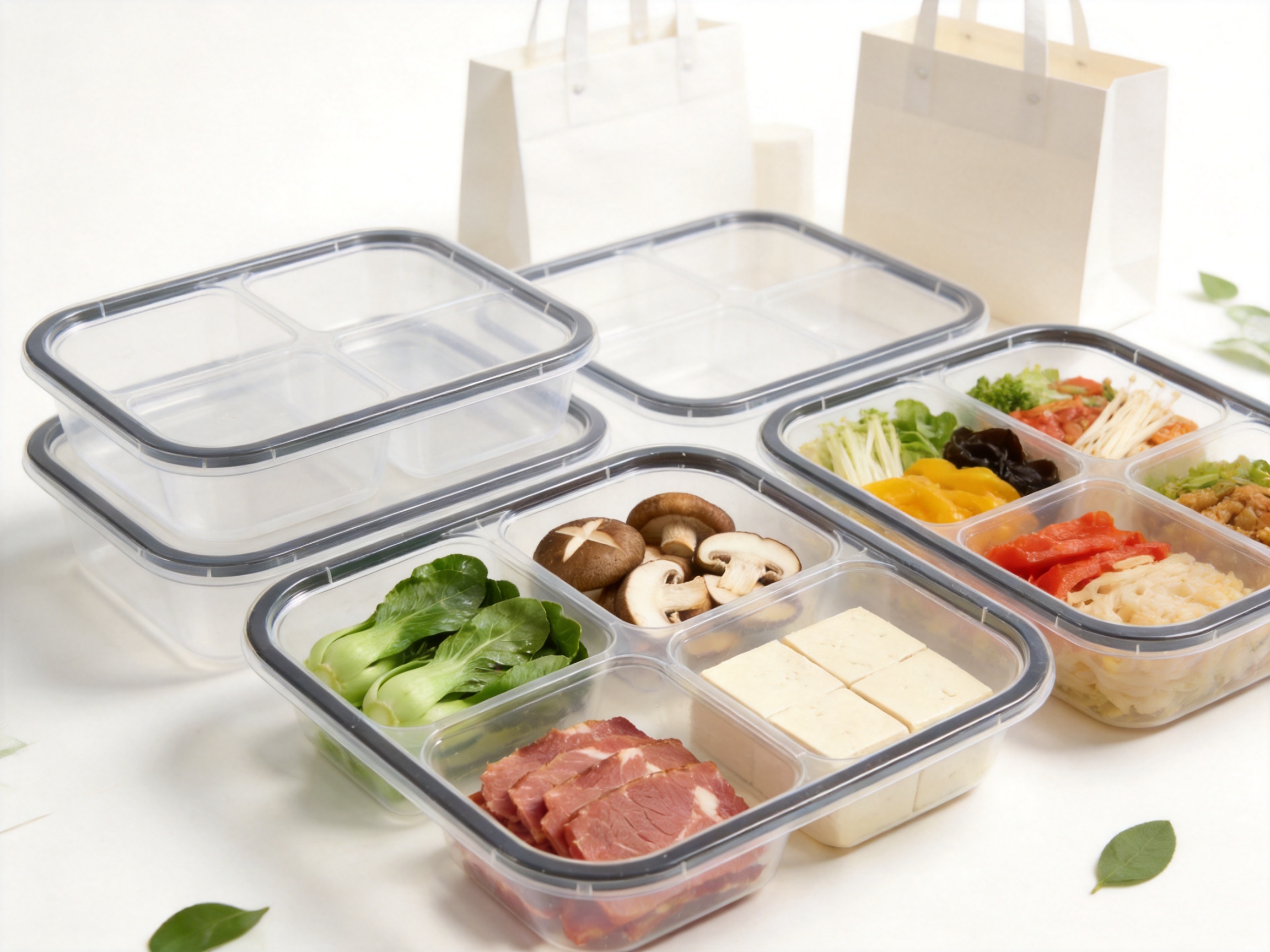
Hot pot restaurants can use it for ingredient sets, individual meal combinations, dipping sauce selections, or premium add-on packs. Cloud kitchens can use it to organize multi-component takeaway meals. Supermarkets and convenience stores can use it for ready-to-cook meal kits. Catering companies can use it for event portions and buffet accessories. Food factories can use it for chilled prepared ingredients. Sauce brands can use it for tasting sets or combination packs.
When selecting this container, buyers should consider the type of food, filling temperature, storage temperature, delivery time, lid requirements, sealing needs, and local food-contact regulations. For applications involving high heat, oily foods, or reheating, the exact material grade and performance specifications should be confirmed with the manufacturer. This ensures the packaging is matched correctly to the food and usage environment.
19. How the Container Helps Build a Stronger Catering Brand
Packaging can communicate brand values without words. A strong, clear, well-designed four-grid container tells customers that the business cares about organization, cleanliness, freshness, and convenience. These values are especially important for hot pot takeaway because customers need confidence in ingredient quality and hygiene.
Customized packaging can further strengthen brand identity. A restaurant may choose a specific color style, label design, or outer sleeve to match its visual system. A premium food brand may emphasize clarity and neat arrangement. A youth-oriented brand may use bright colors and creative graphics. A health-focused brand may highlight portion balance and ingredient separation.
The product’s high transparency helps brands show real food quality rather than hiding it. This can be powerful in markets where customers value freshness and authenticity. When ingredients look good through the package, the container becomes part of the selling point.
20. Cost Efficiency and Total Value
Packaging cost should be evaluated by total value, not only unit price. A cheaper container may increase costs if it causes product damage, customer complaints, repacking labor, leakage, poor stacking, or inconsistent presentation. The PE/PP four-grid hot pot container offers value through durability, compartment function, presentation quality, and operational convenience.
By combining four spaces into one container, it may reduce the need for multiple small packages in certain applications. By improving portion control, it can reduce ingredient waste. By supporting cleaner delivery, it can reduce customer complaints. By improving visual appeal, it can support higher perceived meal value. These benefits can outweigh small differences in packaging unit price.
For large-volume buyers, working with an OEM factory also creates opportunities for cost optimization through customized design. The container can be adjusted to match exact portion requirements, avoid unnecessary material use, and improve carton loading efficiency. Professional engineering can help achieve both performance and cost control.
21. Supply Chain Reliability
Food service businesses need packaging suppliers they can depend on. If packaging is delayed, restaurants may be unable to sell certain menu items. If quality changes unexpectedly, operations may be disrupted. Reliable supply chain management is therefore a major purchasing factor.
Yuqian Packaging Technology (Jiangsu) Co., Ltd. provides professional OEM production supported by flexible production lines and efficient supply chain management. This enables the company to respond to customer needs from sample production to mass manufacturing. Its experience in multiple product categories, including plastic cups, plastic cup lids, takeaway bowls, disposable straws, recycle bags, and peripheral products, also allows customers to source related packaging solutions from one manufacturer.
For buyers developing a complete food packaging system, this product-category range is useful. A hot pot brand may need ingredient containers, sauce cups, lids, straws, bags, and other supporting packaging. A manufacturer with broad capability can simplify procurement and improve consistency across packaging items.
22. Quality Control From Customer Requirement to Delivery
A strong quality control process begins before production. Customer requirements should be clearly confirmed, including product size, material, color, weight, transparency, packing quantity, carton specifications, labeling, compliance documents, and testing needs. Sample approval is an important step for customized projects.
During production, operators and quality inspectors monitor parameters and product appearance. Dimensional checks help ensure the container matches approved specifications. Weight checks support material consistency. Visual inspection identifies defects such as black spots, deformation, incomplete forming, rough edges, or color variation. Functional checks may include stacking, partition integrity, and lid matching.
After production, finished products are packed for protection during transport. Proper carton packing helps prevent crushing and contamination. Batch records and documentation support traceability. This complete process gives buyers confidence that products will arrive ready for food packaging use.
23. Comparison With Alternative Packaging Types
Single-compartment plastic bowls are simple and often low cost, but they cannot separate ingredients. They are less suitable for hot pot sets and multi-component meals.
Paper boxes may offer a natural appearance, but they can absorb moisture, deform with wet ingredients, or require coatings that complicate recycling. They may not provide the same transparency for visual presentation.
Aluminum containers offer heat resistance but are not transparent and may not be ideal for ingredient display or microwave use. They can also be less suitable for cold transparent retail presentation.
Multiple small cups provide separation, but they increase packing time and the number of packaging pieces. They may also create a less unified customer experience.
The PE/PP four-grid plastic hot pot container offers a balanced solution: separation, visibility, toughness, food-contact suitability, stackability, and customization potential. For hot pot takeaway and meal-kit packaging, this combination is highly practical.
24. Buyer Considerations Before Ordering
Before ordering PE/PP four-grid hot pot containers, buyers should define their application clearly. Important questions include: What foods will be packed? Will the food be cold, room temperature, warm, or hot when filled? Is a lid required? Will the container be used for delivery, retail display, or both? How long will food remain in the container? Is transparency important? Are there local regulatory requirements? What carton quantity and pallet arrangement are needed? Is branding required?
Providing this information helps the manufacturer recommend the appropriate material, thickness, structure, and packaging solution. For customized orders, early communication can reduce development time and avoid design changes later.
25. Q&A Section
Q1: What is the PE/PP four-grid plastic hot pot container mainly used for?
It is mainly used for packaging hot pot ingredients, sauces, condiments, side dishes, meal kits, and other multi-component takeaway foods. Its four compartments keep different foods separated in one container.
Q2: What are the main advantages of the four-grid design?
The four-grid design improves ingredient separation, hygiene, portion control, visual presentation, and packing efficiency. It reduces unwanted mixing and helps create a cleaner customer experience.
Q3: Is the container made from food-grade material?
Yes. The container is made from high-quality food-grade PE/PP raw materials. It is designed to be non-toxic, odorless, tough, and suitable for disposable food packaging applications.
Q4: What is the standard size of the container?
The provided specification is 145 mm in length, 145 mm in width, 46 mm in height, and approximately 74.5 g in grammage.
Q5: Can the container be customized?
Yes. The manufacturer can provide customized solutions, including size, structure, material selection, color, transparency, and other design adjustments based on customer requirements.
Q6: Why is transparency important?
Transparency allows customers to see the food clearly, improving visual appeal and perceived freshness. It is especially useful for colorful hot pot ingredients, salad toppings, fruit, sauces, and meal kits.
Q7: What certifications support product quality?
The manufacturing company has passed QS national industrial product production license, ISO9001 quality management system certification, BRC certification, German DIN safety certification, and EU ROHS+ testing support.
Q8: Is this container suitable for cold storage?
Yes. PE/PP materials provide good low-temperature resistance, helping the container maintain stable shape and toughness in cold storage and cold-weather transportation conditions.
Q9: How does this container help restaurants reduce operational problems?
It supports faster packing, fewer missing items, better portion control, cleaner delivery, easier inventory management, and more consistent presentation across orders.
Q10: Why choose an OEM manufacturer for this product?
An OEM manufacturer can provide professional design support, sample development, mass production, quality control, customized specifications, and stable supply. This is valuable for food brands that need packaging matched to their menu and market.
26. Conclusion
The PE/PP four-grid plastic hot pot container is a practical and competitive packaging solution for modern takeaway food service. Its food-grade PE/PP material, four-compartment structure, toughness, low-temperature resistance, odorless performance, transparency, and customization potential make it especially suitable for hot pot ingredients and other multi-component meals.
Compared with ordinary single-compartment bowls or multiple separate small containers, it provides better organization, cleaner presentation, improved portion control, and greater operational efficiency. For restaurants, cloud kitchens, food manufacturers, supermarkets, and catering brands, these advantages can improve both daily workflow and customer satisfaction.
The product’s value is strengthened by the manufacturing capability of Yuqian Packaging Technology (Jiangsu) Co., Ltd. With a 30,000-square-meter plant, research and development strength, flexible OEM production, advanced quality management, and multiple certifications, the company is well positioned to provide reliable disposable food packaging container solutions. Its commitment to green production, recyclable and biodegradable material research, and customized service further supports the changing needs of the food packaging market.
As takeaway dining continues to develop, packaging that combines safety, functionality, presentation, and manufacturing reliability will become increasingly important. The PE/PP four-grid plastic hot pot container answers this demand with a balanced design that serves both businesses and consumers.
References
1. International Organization for Standardization. ISO 9001 Quality Management Systems: Requirements.
2. BRCGS. Global Standard for Packaging Materials.
3. European Commission. Guidance on Food Contact Materials and Plastic Packaging Safety.
4. DIN Standards Committee. Safety and Quality Standards for Consumer and Packaging Products.
5. Plastics Industry Association. Polypropylene and Polyethylene Applications in Food Packaging.
6. Food Packaging Forum. Scientific and Regulatory Considerations for Food Contact Plastics.
7. China National Food-Related Product Production Licensing Guidance for Industrial Packaging Materials.