English
 Español
 عربى
Content
- 1 Introduction
- 2 What Are Disposable PET Plastic Drink Cups?
- 3 Key Product Specifications
- 4 Food-Grade Material and Product Safety
- 5 Clarity and Visual Presentation
- 6 Structural Performance and Everyday Convenience
- 7 Advantages Compared with Competing Disposable Cup Materials
- 8 Customization and Product Design
- 9 Manufacturing Process and Technical Strength
- 10 Quality Management and Certifications
- 11 Research and Development Capabilities
- 12 Environmental Considerations for PET Cups
- 13 Applications Across the Beverage Industry
- 14 Benefits for Distributors and Commercial Buyers
- 15 How to Select the Right PET Cup
- 16 Recommended Quality-Control Checklist
- 17 Why Choose an Experienced OEM Manufacturer?
- 18 Q&A
- 18.1 What beverages are suitable for disposable PET plastic drink cups?
- 18.2 Are the cups transparent?
- 18.3 What standard capacities are available?
- 18.4 Can the cups be printed with a logo?
- 18.5 Can the cup design be customized?
- 18.6 Are PET cups stackable?
- 18.7 How should the cup and lid be matched?
- 18.8 Are PET cups recyclable?
- 18.9 How does PET compare with paper cups?
- 18.10 What quality certifications does the company have?
- 18.11 Can the company provide samples?
- 18.12 What information should be included in an inquiry?
- 19 Conclusion
- 20 Company and Contact Information
- 21 References
- 22 Product: Disposable PET plastic drink cup
Introduction
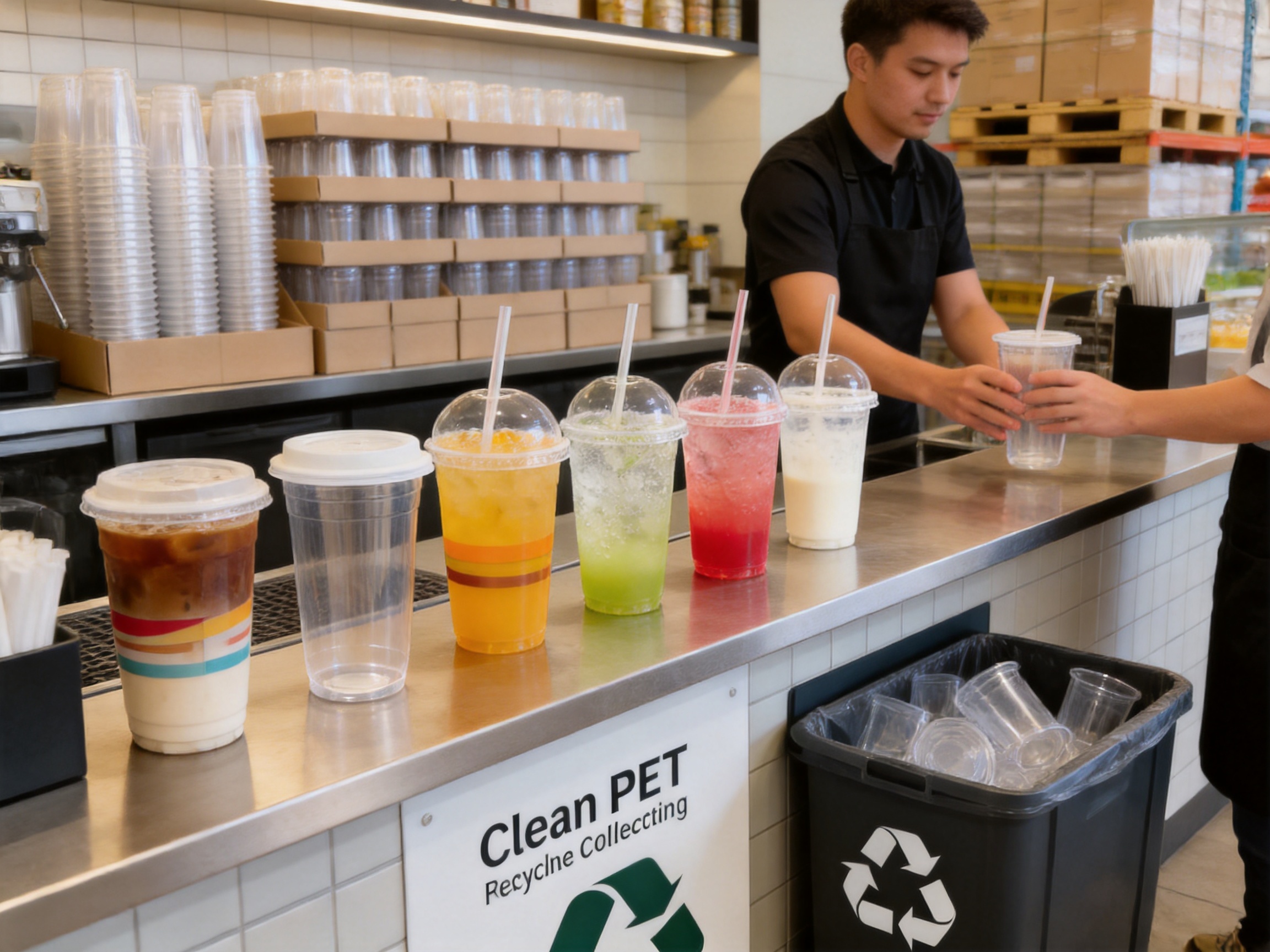
Disposable PET plastic drink cups have become an essential packaging solution for cafés, juice bars, beverage chains, restaurants, catering companies, convenience stores, event organizers, and food-service distributors. Their combination of transparency, light weight, toughness, stackability, and compatibility with cold beverages makes them suitable for a wide range of modern consumption scenarios. From iced coffee and fruit tea to smoothies, soft drinks, milk tea, and freshly prepared juices, PET cups provide a practical way to protect, present, transport, and serve beverages.
However, not every disposable cup delivers the same level of performance. Differences in raw-material quality, wall uniformity, forming precision, dimensional stability, printing capability, quality control, and customization support can directly affect the user experience and the reputation of a beverage brand. A cup that cracks during filling, becomes cloudy, deforms during transportation, or fails to fit a compatible lid can create unnecessary waste and customer dissatisfaction. For commercial buyers, choosing a capable manufacturer is therefore just as important as selecting the right material.
Disposable PET plastic drink cups manufactured by Yuqian Packaging Technology (Jiangsu) Co., Ltd. are designed to meet the practical and branding requirements of professional food and beverage businesses. The product line combines food-grade PET material, stable production technology, multiple capacity options, customizable appearance designs, and printing services. The company’s integrated research, production, and sales capabilities allow it to support customers from initial concept development through mass production and delivery.
This article examines the main features of disposable PET drink cups, their advantages compared with other commonly used disposable beverage containers, the manufacturing considerations that influence product quality, and the customization services available to international buyers. It also explains how a professional supplier can help beverage businesses achieve reliable packaging performance while strengthening visual brand recognition.

Disposable PET plastic drink cup
What Are Disposable PET Plastic Drink Cups?
PET is the common abbreviation for polyethylene terephthalate, a thermoplastic material widely used in food and beverage packaging. In cup production, PET is processed into clear, rigid, and lightweight containers that can hold cold beverages. The material is known for its high transparency, relatively good impact resistance, smooth surface, and ability to maintain an attractive appearance during storage and service.
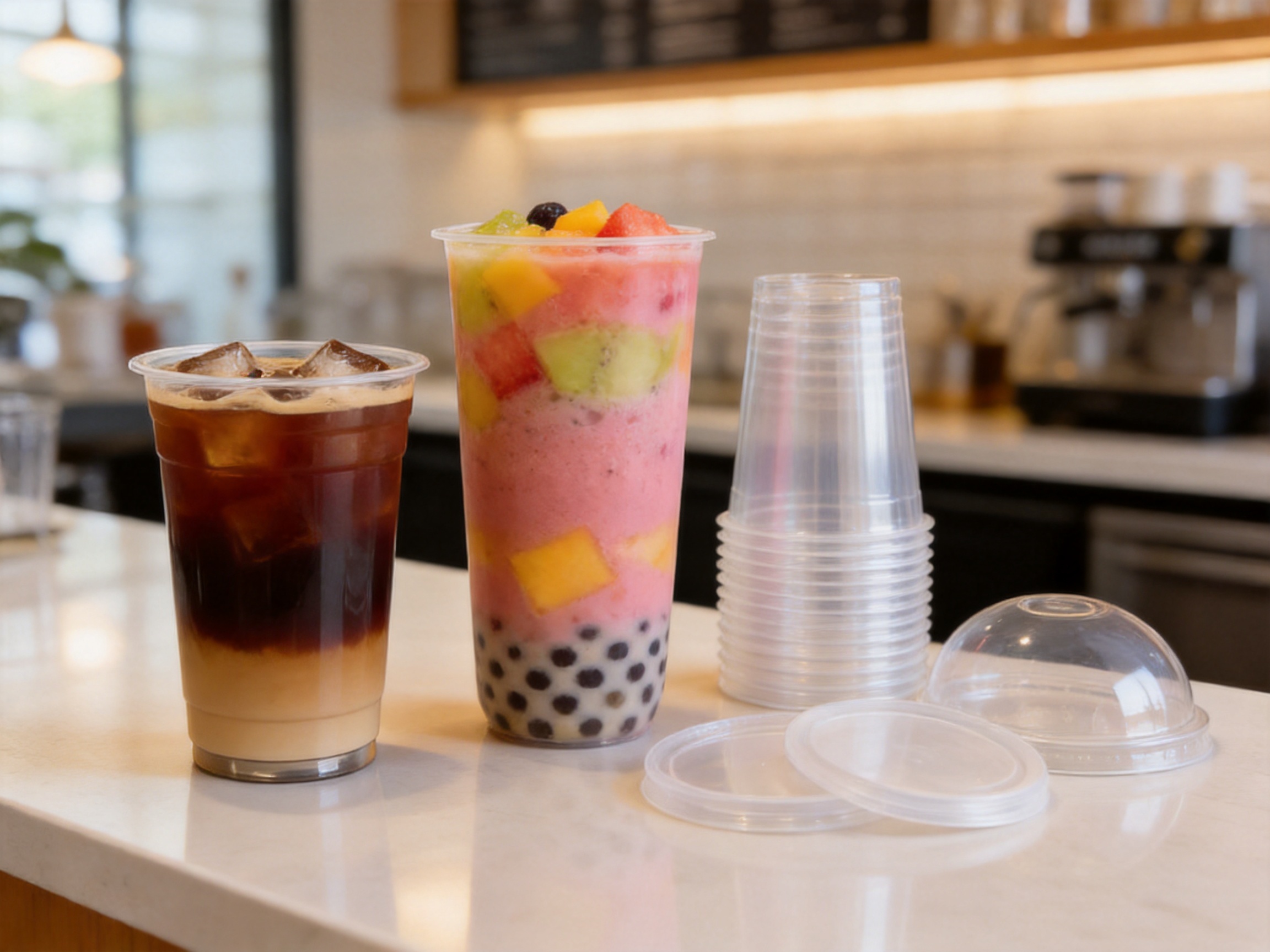
Unlike paper-based beverage cups, PET drink cups allow customers to see the color, layers, fruit pieces, ice, toppings, or other visual elements inside the container. This visibility is especially useful for drinks that rely on presentation, including colorful fruit beverages, layered coffee, milk tea, sparkling drinks, and specialty cocktails. Transparent packaging can also support impulse purchases because the product is visible before the customer opens or consumes it.
PET cups are commonly produced through a forming process that converts PET sheet or other suitable PET material into the required shape. The cup body can be designed with different diameters, heights, bases, wall structures, and rim profiles. Depending on the intended use, the cup may be paired with a flat lid, dome lid, straw slot lid, sealing film, or other compatible closure system.
For commercial applications, cup design is not limited to volume. The mouth diameter must correspond with the selected lid, while the height and base diameter influence stability, storage efficiency, and visual proportion. Wall thickness and grammage affect rigidity, material consumption, transportation cost, and resistance to handling. A professional manufacturer must balance these factors to provide a cup that is attractive, functional, and commercially efficient.
Key Product Specifications
The available disposable PET plastic drink cups include practical capacity and size options for common beverage applications. The following specifications represent two standard models described in the product information.
| Capacity (ml) | Mouth Diameter (mm) | Height (mm) | Bottom Diameter (mm) | Grammage (g) |
| 500 | 90 | 135 | 58 | 12 |
| 700 | 90 | 180 | 57 | 15 |
The 500 ml model is suitable for many everyday cold beverages, including iced coffee, fruit tea, soft drinks, and standard takeaway juices. The 700 ml model provides additional capacity for large drinks, blended beverages, extra ice, toppings, and promotional servings. Both models have a 90 mm mouth diameter, allowing buyers to coordinate lid procurement and streamline packaging operations when multiple capacities are used in the same product range.
Dimensions and grammage may be adjusted for customized projects, subject to product design, material requirements, tooling considerations, and production evaluation. Buyers should confirm the final drawings, capacity, rim dimensions, lid compatibility, printing area, packing method, and performance requirements before mass production begins.
Food-Grade Material and Product Safety
Food safety is one of the most important considerations when purchasing disposable beverage packaging. A cup may look attractive, but its suitability for commercial use depends on the quality and traceability of the raw materials, production environment, process control, and finished-product inspection.
These disposable PET drink cups are made from food-grade material intended for beverage packaging. The material is described as safe, non-toxic, and odorless when used appropriately. Food-grade PET provides a clean surface for cold drinks and helps reduce the possibility of unwanted odors affecting the beverage experience. It also supports a professional appearance because the material can maintain a clear and consistent visual finish.
Yuqian Packaging Technology emphasizes strict quality control and food-safety testing. According to the company information, its quality system covers the process from raw-material procurement to finished-product delivery. This type of full-process management is important because product quality can be affected at every stage, including material selection, storage, forming, trimming, printing, packing, and transportation.
Buyers should always select cup specifications according to the intended beverage temperature and application. Standard PET drink cups are generally associated with cold beverage service. If a customer requires packaging for hot liquids, high-temperature filling, microwave use, or unusual chemical exposure, the material and design must be evaluated separately before production.
Responsible procurement also involves confirming applicable food-contact requirements in the destination market. Different countries and regions may apply different rules concerning food-contact materials, migration testing, labeling, recycling marks, and packaging waste. An experienced export manufacturer can assist buyers in organizing relevant technical information and product documentation for their intended market.
Clarity and Visual Presentation
One of the strongest advantages of PET drink cups is their transparency. Clear packaging allows the beverage itself to become part of the product presentation. For cafés and beverage shops, this can be valuable because color, texture, ice, fruit, pearls, jelly, cream, and decorative layers can influence purchase decisions.
Transparent cups also make quality control easier for service staff and customers. The beverage level can be checked quickly, while the contents can be inspected for appearance before delivery. For takeaway orders, visibility helps customers identify their drinks, especially when several beverages are packed together.
Compared with opaque packaging, a clear PET cup can support menu differentiation. A beverage business may use the same basic cup format for several drinks while allowing the individual beverage colors and toppings to create variety. Printed logos, patterns, slogans, nutritional information, or promotional messages can then be added to build a consistent visual identity.
Clear PET has advantages over some low-clarity plastics because it can create a cleaner and more premium presentation. It also offers a firm structure that helps the cup maintain its shape during filling and service. The combination of transparency and rigidity is particularly useful for brands that want disposable packaging to look more refined without selecting a heavier or more expensive container.
Structural Performance and Everyday Convenience
Disposable beverage cups need to remain practical throughout the entire handling cycle. This includes filling at the beverage station, adding ice or toppings, applying the lid, carrying the drink, placing it into a delivery bag, and consuming it away from the store. PET cup design contributes to performance at each of these points.
The cups are lightweight, which helps reduce the handling burden for staff and customers. Lower unit weight can also support more efficient transportation and storage when compared with heavier rigid containers. At the same time, appropriate PET formulation and forming control can provide sufficient rigidity for normal cold beverage service.
Stackability is another important feature. Empty cups that can be stacked efficiently occupy less space in warehouses, restaurants, cafés, and delivery vehicles. Better stacking can simplify inventory management and reduce the frequency of replenishment. It may also allow distributors to consolidate more units per carton or pallet, depending on the final packaging design.
A stable base is essential for takeaway beverages. The listed products use compact bottom dimensions designed to support practical storage and serving. The exact stability of a cup depends on the relationship between the base, height, mouth diameter, wall structure, liquid volume, lid design, and external handling conditions. These factors should be tested together when a customer develops a new customized format.
The rim of the cup must also be formed accurately. An even rim supports proper lid engagement and helps create a reliable drinking or sealing experience. Incompatible dimensions can lead to loose lids, difficult lid application, leakage, or inconsistent presentation. For this reason, cup and lid compatibility should be confirmed during development rather than assumed from nominal dimensions alone.
Advantages Compared with Competing Disposable Cup Materials
Food and beverage companies can choose from several disposable cup materials, including paperboard, polypropylene, polystyrene, PLA, and PET. Each material has specific strengths and limitations. PET drink cups stand out in applications where transparency, appearance, lightness, and dimensional consistency are priorities.
| Evaluation Factor | PET Drink Cups | Paperboard Cups | Opaque Plastic Cups | PLA Cups |
| Transparency | High | Low unless specially designed | Usually low | Can be clear, depending on grade |
| Visual beverage presentation | Excellent | Limited | Limited | Good in suitable applications |
| Light weight | Excellent | Good | Good | Good |
| Cold beverage suitability | Excellent | Good with suitable lining | Good | Good when conditions are suitable |
| Stackability | Excellent when properly designed | Good | Good | Good |
| Printing and branding options | Highly adaptable | Highly adaptable | Adaptable | Adaptable |
| Recyclability considerations | Established recycling stream in many markets | Depends on paper and lining separation | Depends on resin and local systems | Depends strongly on industrial composting infrastructure |
Compared with paper cups, PET cups provide significantly better visibility of the beverage. Paper cups may require internal coatings or additional structures to resist liquid penetration, while PET is inherently suitable for cold drink containment without a separate paper body. PET cups can also be useful for products whose appearance is a major selling point.
Compared with opaque plastic cups, transparent PET creates a more open and premium presentation. It allows businesses to display drink colors and ingredients instead of hiding them. This can be particularly beneficial for specialty beverage shops and brands that use visual product photography in menus, delivery platforms, and social media.
Compared with some biodegradable or compostable alternatives, PET currently benefits from established production knowledge and, in many regions, existing recycling infrastructure. However, environmental performance depends on local collection, sorting, recycling, and waste-management systems. PET should be used responsibly, and businesses should communicate appropriate disposal guidance where required.
PLA and other biodegradable materials may be suitable for customers with specific compostability objectives. Nevertheless, such materials often require controlled industrial composting conditions and may have different performance limits. A buyer should select the material according to the complete application, including beverage temperature, storage conditions, required clarity, product lifespan, disposal infrastructure, and regulatory requirements.
Customization and Product Design
Modern beverage businesses increasingly require packaging that reflects their individual identity. A standard transparent cup may provide basic functionality, but customized appearance and printing can help a product stand out in a crowded market. Yuqian Packaging Technology can provide a variety of appearance designs and develop products according to customer requirements.
Customization may include capacity, mouth diameter, height, base shape, wall profile, rim structure, decorative elements, and packaging configuration. The design should be developed around the customer’s beverage menu and operating process. For example, a thick smoothie may require a different cup structure from a light fruit drink, while a cup intended for sealing-film equipment may require precise rim and flange dimensions.
Brand printing is another important option. The company is equipped with advanced printing equipment that can print a customer’s logo, pattern, or specific information on the packaging. Printed information may include a brand name, product series, slogan, contact details, promotional graphics, recycling guidance, or seasonal artwork, subject to the selected printing method and regulatory requirements.
Well-designed printing can improve recognition at the point of sale and during delivery. When a customer carries a branded beverage through a shopping district, office building, school, or event venue, the cup can act as a small mobile advertisement. Repeated exposure to a consistent logo and color scheme can strengthen the connection between the packaging and the beverage experience.
Customization also allows businesses to create packaging for limited editions, festivals, sports events, restaurant openings, corporate activities, and promotional campaigns. A manufacturer with in-house or closely coordinated production resources can help reduce communication gaps between design, printing, forming, and packing teams.
Important Design Considerations
Before finalizing a customized cup, buyers should provide clear information about the intended product. Useful specifications include target capacity, beverage type, filling level, ice ratio, topping weight, lid type, straw size, sealing method, printing colors, annual demand, delivery market, carton requirements, and expected storage conditions.
Artwork should be supplied in an appropriate professional format, with clear dimensions and color requirements. The manufacturer may need to review the design for printable areas, curved-surface distortion, color overlap, minimum line thickness, logo position, and other production limitations. A physical sample or pre-production proof can help confirm the final appearance before mass production.
For international customers, it is also important to confirm whether packaging information must comply with local labeling laws. Printed claims, recycling symbols, food-contact statements, and disposal instructions should be reviewed before approval.
Manufacturing Process and Technical Strength
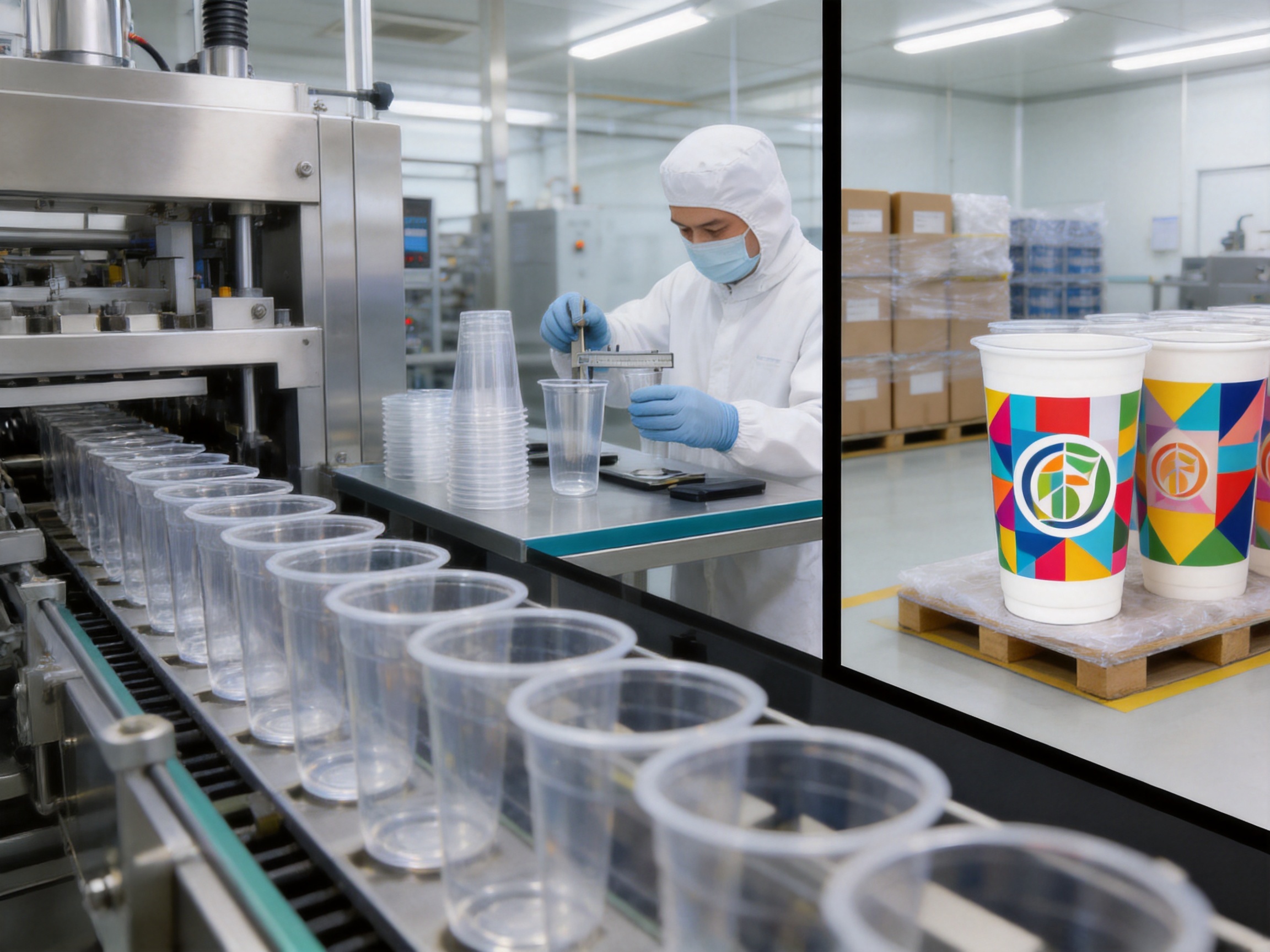
The quality of a disposable PET drink cup depends on more than the appearance of the finished item. Reliable manufacturing requires coordinated control of raw materials, equipment, tooling, forming conditions, trimming, printing, inspection, and packing. Yuqian Packaging Technology integrates research and development, production, and sales, allowing it to manage product development and manufacturing as connected activities.
Raw-Material Preparation
The process begins with the selection and management of suitable food-grade PET material. Raw materials must be received, identified, stored, and used according to internal quality procedures. Proper material handling helps maintain consistency in transparency, mechanical performance, color, and processing behavior.
Material control is especially important for customized products. Different cup weights, wall structures, and forming designs may require different process settings. A professional manufacturer evaluates the relationship between material characteristics and the requested product specifications before entering regular production.
Sheet or Forming Material Production
Depending on the production route, PET material is prepared in a form suitable for cup forming. Thickness uniformity is important because uneven material distribution can lead to weak areas, inconsistent appearance, poor stacking behavior, or dimensional variation. Stable processing equipment and controlled operating conditions help support consistent material performance.
For buyers, this manufacturing stage is not always visible, but it directly influences the finished cup. A high-quality forming process begins with material that is suitable for the intended design and controlled within the required technical range.
Thermoforming and Cup Formation
Thermoforming converts prepared PET material into the cup shape. Heat, forming pressure, tooling geometry, and cooling conditions must be coordinated to achieve the desired dimensions and wall distribution. If the process is not properly controlled, the cup may show deformation, uneven sidewalls, distorted rims, or variation in capacity.
Accurate tooling is essential for customized products. The mold determines the external shape, base structure, rim profile, and other important features. A professional manufacturer reviews the design and tooling requirements to ensure that the cup can be formed efficiently and consistently at the required production volume.
Trimming and Edge Finishing
After forming, the cup is trimmed to remove excess material and create a clean, repeatable edge. The trimming process affects the mouth diameter, rim smoothness, visual appearance, and lid compatibility. Precise trimming is especially important for cups that will be sealed with film or paired with specific lids.
Finished edges should be inspected for sharp projections, irregular cutting, deformation, or excessive variation. Consistent trimming supports both customer safety and efficient downstream packing operations.
Printing and Decoration
When printed customization is requested, the cup surface must be prepared and handled in accordance with the selected printing process. Printing parameters may include ink compatibility, curing or drying conditions, registration accuracy, color consistency, and resistance to normal handling.
Advanced printing equipment allows the manufacturer to reproduce logos, patterns, and specific information with greater consistency than basic manual or poorly coordinated methods. The final result depends on the artwork, ink system, cup geometry, production settings, and inspection standards. Samples should be reviewed for color, position, clarity, and overall brand appearance before large-scale production.
Inspection and Packing
Quality inspection may cover appearance, dimensions, weight, clarity, rim condition, stacking behavior, printing quality, contamination control, and packing quantity. The inspection plan should reflect the customer’s product requirements and the intended application.
Packing is also part of product quality. Cups must be protected from dust, crushing, moisture, and unnecessary deformation during storage and transportation. Appropriate inner bags, cartons, palletization, and labeling help maintain product condition until delivery to the customer.
Quality Management and Certifications
Yuqian Packaging Technology (Jiangsu) Co., Ltd. was established in 2010 and operates in Taizhou City, Jiangsu Province, China. The company has a plant area of approximately 30,000 square meters and focuses on the research, development, production, and sales of new food packaging materials and products.
According to the company information, the business has passed or obtained several quality and product-related certifications and qualifications, including the QS national industrial product production license, ISO9001 Quality Management System certification, BRC certification, German DIN safety certification, and EU RoHS-related testing. The specific applicability of each certification may depend on the product, production site, market, and current certificate scope, so customers should request the latest documentation for their project.
ISO9001-based quality management helps establish systematic procedures for documentation, process control, corrective action, and continual improvement. BRC-related food-safety systems can support structured management of hygiene, traceability, risk assessment, and product safety. Product testing and market-specific compliance documentation help international customers evaluate whether a product is suitable for their intended region.
Certifications alone do not replace product-specific communication and testing. A responsible buyer should still confirm the exact material, specifications, test reports, packaging conditions, and application limits. Nevertheless, a documented quality system provides a stronger foundation than a production operation that relies only on visual inspection or informal experience.
Research and Development Capabilities
The disposable packaging market changes quickly. Beverage companies want lighter products, more attractive designs, more efficient packing, stronger brand differentiation, and improved environmental performance. A manufacturer that only repeats existing designs may struggle to meet these changing requirements.
Yuqian Packaging Technology maintains a professional research and development team dedicated to new packaging materials, product improvement, and design innovation. R&D work can include the development of new cup shapes, material structures, capacity options, printing solutions, and packaging concepts. The purpose is to improve product performance while responding to changes in food-service operations and market expectations.
Environmental considerations are also becoming more important. Consumers, retailers, governments, and brand owners increasingly examine the complete life cycle of packaging. This includes raw-material selection, production efficiency, transportation weight, product reuse or recycling potential, and end-of-life management.
The company states that it actively responds to environmental protection policies and is committed to promoting the green transformation of the packaging industry. For PET cups, environmental improvement may involve material efficiency, weight optimization, improved production yield, recyclable design, waste reduction, and support for responsible collection and recycling systems.
It is important to distinguish recyclability from guaranteed recycling. A PET product may be technically recyclable, but actual recovery depends on local infrastructure and consumer behavior. Customers should therefore consider both product design and market waste-management conditions when developing an environmental packaging strategy.
Environmental Considerations for PET Cups
Disposable packaging should be evaluated through a balanced approach. PET can offer material efficiency, light weight, and recyclability in many markets, but it remains a single-use product unless a suitable reuse program is specifically designed. Businesses should avoid unnecessary over-packaging and should select cup weight according to actual performance requirements.
Lightweighting can reduce material use and transportation weight, but excessive reduction may cause deformation, poor handling, or increased product waste. The best design is not always the lightest design; it is the design that achieves reliable performance with an appropriate amount of material.
Recycling guidance can be communicated through printed information or external brand communication where suitable. Businesses may also support collection programs, recycling partnerships, or customer education. Clear disposal messaging can help consumers understand the appropriate route for used cups in their region.
For buyers comparing PET with biodegradable or compostable products, the decision should be based on the actual disposal infrastructure available to the target market. A material labeled biodegradable may not break down effectively in ordinary landfill or street environments. Likewise, a recyclable material only provides environmental value when it is collected, sorted, and processed.
Yuqian’s R&D focus on new packaging materials and improved environmental performance may support customers seeking a more responsible packaging strategy. Specific environmental claims should be verified through technical documents, test reports, and applicable certification before they are used in advertising.
Applications Across the Beverage Industry
Disposable PET drink cups can serve a broad selection of cold beverage categories. Their clear appearance and practical structure make them suitable for independent businesses as well as large beverage chains.
Coffee and Café Drinks
Iced coffee, cold brew, iced lattes, flavored coffee, and other chilled café beverages can benefit from transparent PET packaging. Customers can see the beverage layers, milk contrast, ice level, and decorative toppings. A printed cup can also reinforce the café’s identity during takeaway and delivery.
Fruit Tea and Fresh Juice
Fruit tea and fresh juice often depend on natural color and visible ingredients. Clear cups allow the beverage to communicate freshness and flavor through its appearance. The 500 ml and 700 ml capacities can support standard and large serving formats, while customized printing can identify flavors or seasonal campaigns.
Milk Tea and Specialty Drinks
Milk tea, bubble tea, and other specialty beverages may include tapioca pearls, jellies, fruit pieces, cream, or colorful syrups. A rigid transparent cup can display these components while providing adequate room for ice and toppings. Buyers should ensure that the selected cup opening matches the required straw or lid system.
Soft Drinks and Sparkling Beverages
Carbonated or lightly sparkling cold drinks require suitable filling and closure practices. PET cups can be used for many beverage-service situations, but the complete package should be evaluated for the beverage’s carbonation, filling level, lid type, and expected handling. Customized graphics can help differentiate flavors and promotional products.
Catering and Events
For exhibitions, festivals, corporate events, outdoor catering, and promotional activities, disposable PET cups provide a convenient serving solution. Printed event information, sponsor logos, or campaign graphics can turn the cup into part of the event experience.
Delivery and Takeaway Services
Takeaway packaging must withstand repeated movement and temporary storage. A stackable cup with a properly fitted lid can simplify order assembly and reduce packing time. The cup can be placed in a carrier or delivery bag, while its printed design helps staff identify the brand and support customer recognition.
Benefits for Distributors and Commercial Buyers
Distributors and importers generally need more than a functional product. They require stable supply, clear specifications, repeatable quality, flexible customization, export coordination, and responsive communication. An integrated manufacturer can reduce the number of separate suppliers involved in product development.
Yuqian Packaging Technology combines R&D, production, and sales, which may simplify communication for customers seeking customized cups. Instead of coordinating separately with a designer, forming factory, printing company, and packaging supplier, a buyer can discuss the project with one primary manufacturer.
Long-term supply relationships benefit from standardized drawings, approved samples, quality specifications, packaging records, and production feedback. Once a product has been confirmed, these documents can help support repeat orders with fewer misunderstandings.
The company’s Shanghai branch, established in January 2019, was intended to improve service quality and expand business channels. The branch strengthens the company’s market influence and customer-service capabilities, offering customers an additional point of contact within China’s commercial and logistics environment.
International customers can communicate with the company regarding product specifications, customization, printing, packaging, order quantities, and delivery arrangements through the available business contacts. Before placing an order, buyers should request a complete quotation that clearly identifies tooling, sample fees, printing charges, packing method, lead time, shipping terms, and payment conditions.
How to Select the Right PET Cup
The correct cup is determined by the beverage, service method, brand objectives, and distribution environment. Buyers should not select a product based solely on capacity or appearance.
First, confirm the beverage type and target volume. A drink with a large quantity of ice or toppings may require more internal space than the nominal liquid volume suggests. The customer should also define the desired fill line and the amount of headspace needed for the lid.
Second, confirm the mouth diameter and lid system. A 90 mm opening may be suitable for many standard lid formats, but the exact lid profile, rim contact area, straw opening, and sealing method must still be tested together.
Third, assess rigidity and weight. A very light cup may reduce material and freight costs, but it must still perform reliably during filling, packing, transportation, and consumption. The selected grammage should correspond to the product’s actual service demands.
Fourth, evaluate printing requirements. Determine whether the design needs one color, multiple colors, full-surface decoration, variable information, or a simple logo. The printing area should be planned around the cup’s shape and the brand’s visual priorities.
Fifth, confirm environmental and compliance needs. Buyers should identify the relevant food-contact regulations, recycling marks, testing requirements, and documentation for the target market. If a customer needs a special material or environmental claim, this should be discussed before product development.
Finally, request samples. Samples allow buyers to inspect transparency, dimensions, rim quality, stacking, printing, lid fit, beverage appearance, and overall handling. A sample test is one of the most effective ways to reduce risk before mass production.
Recommended Quality-Control Checklist
| Inspection Area | Recommended Check |
| Material | Confirm food-grade specification, appearance, odor, and documentation |
| Capacity | Measure nominal volume and practical fill level |
| Dimensions | Check mouth diameter, height, base diameter, and tolerance |
| Weight | Verify average grammage and production consistency |
| Transparency | Inspect clarity, haze, color, and visible defects |
| Rim | Check smoothness, roundness, and lid compatibility |
| Structure | Evaluate rigidity, stacking, base stability, and deformation resistance |
| Printing | Check color, registration, adhesion, clarity, and position |
| Packaging | Confirm quantity, protection, labeling, carton strength, and cleanliness |
| Documentation | Review specifications, test reports, certifications, and approved samples |
Why Choose an Experienced OEM Manufacturer?
OEM manufacturing allows a buyer to develop packaging that reflects its own product strategy rather than relying only on standard catalog items. An experienced OEM partner can transform a concept into a practical product by coordinating material selection, tooling, forming, printing, inspection, and packing.
The main benefit is control. Buyers can specify capacity, appearance, dimensions, graphics, packing quantities, and performance expectations. A professional factory can then evaluate whether the proposed design is technically feasible and commercially reasonable.
Another benefit is repeatability. When a cup becomes part of a beverage brand’s daily operation, consistency is essential. Customers expect every cup to look and perform like the previous one. Stable production equipment, documented procedures, and trained personnel help reduce variation between batches.
Yuqian Packaging Technology’s experience since 2010, integrated business structure, professional R&D team, production base, printing capability, and quality-management systems provide a foundation for OEM disposable PET cup projects. The company’s focus on food packaging materials also means that product development can be discussed in the context of food safety, functionality, branding, and market requirements.
Q&A
What beverages are suitable for disposable PET plastic drink cups?
They are primarily suitable for cold beverages such as iced coffee, fruit tea, fresh juice, milk tea, soft drinks, smoothies, and other chilled takeaway drinks. The exact application should be reviewed according to beverage temperature, ingredients, filling conditions, lid type, and handling requirements.
Are the cups transparent?
Yes. PET is valued for its clear appearance, which allows customers to see beverage colors, ice, fruit, toppings, and layers. Transparency can improve product presentation and support visual brand marketing.
What standard capacities are available?
The listed standard options include 500 ml and 700 ml. Both models have a 90 mm mouth diameter. Customized capacities and dimensions may be discussed according to the customer’s design and production requirements.
Can the cups be printed with a logo?
Yes. The manufacturer can print customer logos, patterns, or specific information using advanced printing equipment. Artwork, colors, printing area, and final production details should be confirmed before approval.
Can the cup design be customized?
Yes. Customers may request different appearance designs, capacities, calibers, heights, bases, wall structures, and branding treatments. Technical evaluation and sampling are recommended before mass production.
Are PET cups stackable?
Yes. The listed products are designed to be stackable, helping save storage space and supporting efficient handling in cafés, warehouses, catering operations, and distribution centers.
How should the cup and lid be matched?
The mouth diameter, rim shape, lid profile, straw opening, and sealing method should be evaluated together. A sample fit test is recommended to confirm that the lid attaches securely and performs correctly during normal service.
Are PET cups recyclable?
PET is recyclable in many markets, but actual recycling depends on local collection, sorting, and processing infrastructure. Buyers should check regional requirements and provide appropriate disposal guidance where applicable.
How does PET compare with paper cups?
PET offers superior transparency and allows the beverage to remain visible. Paper cups may offer strong printing surfaces and can be suitable for different applications, but their liquid resistance commonly depends on a lining or coating. The best material depends on the beverage, branding, operating conditions, and environmental system.
What quality certifications does the company have?
The company information identifies QS national industrial product production licensing, ISO9001 Quality Management System certification, BRC certification, German DIN safety certification, and EU RoHS-related testing. Buyers should request current documents and verify their scope for the specific product and destination market.
Can the company provide samples?
Customers should contact the manufacturer to confirm sample availability, sample charges, customization conditions, and delivery time. Samples are recommended for checking dimensions, appearance, printing, lid fit, and practical beverage performance.
What information should be included in an inquiry?
An inquiry should include capacity, mouth diameter, height, base diameter, grammage, beverage type, lid or sealing method, printing artwork, estimated order quantity, destination country, packaging requirements, and desired delivery schedule. Providing complete information helps the manufacturer prepare a more accurate quotation and technical recommendation.
Conclusion
Disposable PET plastic drink cups offer a strong combination of transparency, lightweight construction, rigidity, stackability, and customization potential. They are particularly suitable for cold beverages whose appearance contributes to the customer experience. Standard 500 ml and 700 ml options provide practical choices for everyday beverage service, while customized dimensions and printed graphics allow businesses to develop packaging that better reflects their brand identity.
The advantages of PET cups become more meaningful when supported by reliable manufacturing. Food-grade material selection, forming precision, rim control, printing quality, inspection, and protective packing all influence the final performance of the product. A professional manufacturer must manage these factors as part of one connected production system.
Yuqian Packaging Technology (Jiangsu) Co., Ltd. brings together R&D, production, sales, printing capability, quality management, and OEM service. Its experience in food packaging, factory resources, certifications, and focus on environmental improvement position it as a suitable partner for customers seeking customized disposable PET beverage cups.
For buyers, the best procurement decision begins with a clear understanding of the beverage application and market requirements. By confirming specifications, testing samples, matching compatible lids, reviewing documentation, and communicating branding expectations in advance, businesses can obtain packaging that is attractive, functional, consistent, and commercially effective.
Company and Contact Information
Company: Yuqian Packaging Technology (Jiangsu) Co., Ltd.
Address: No. 8 Tongyang Road, Suchen Town, Taizhou City, Jiangsu Province, China
Telephone: 0086 15252423007
Fax: +0523 8608 3698
Email: [email protected]
The company also operates Shanghai Yuqian Packaging Technology (Jiangsu) Co., Ltd., established in January 2019 to strengthen customer service and business support.
References
1. Yuqian Packaging Technology (Jiangsu) Co., Ltd., Disposable PET Plastic Drink Cup Product Information and Technical Specifications.
2. Yuqian Packaging Technology (Jiangsu) Co., Ltd., Company Profile and Manufacturing Capabilities.
3. ISO 9001, Quality Management Systems—Requirements.
4. British Retail Consortium, Global Standard for Packaging Materials and Packaging.
5. General technical guidance on food-contact plastic packaging and beverage-container quality control.
6. General industry literature concerning polyethylene terephthalate properties, recycling, thermoforming, and beverage packaging design.