English
 Español
 عربى
عربىContent
- 1 The Role of Plastic Takeaway Bowls and Box Containers in Modern Foodservice
- 2 Product Overview: Plastic Takeaway Bowl and Box Container
- 3 Core Product Advantages Over Ordinary Containers
- 4 Specification Range
- 5 Customization and Design Advantages
- 6 Manufacturing Strengths and Process Control
- 7 Advanced Materials for Safety and Performance
- 8 Why This Container Competes Strongly in the Market
- 9 Applications Across Foodservice Scenarios
- 10 Food Safety and Certification Confidence
- 11 Design Details That Improve User Experience
- 12 Packaging as a Brand Communication Tool
- 13 Environmental Considerations and Responsible Production
- 14 OEM Manufacturing and Global Supply Support
- 15 How to Select the Right Container Size
- 16 Operational Benefits for Food Businesses
- 17 Quality Control from Raw Material to Finished Product
- 18 Advantages for Distributors and Wholesale Buyers
- 19 Q&A Section
- 19.1 What foods are these plastic takeaway bowls and box containers suitable for?
- 19.2 Can the containers be used in a microwave?
- 19.3 Can the containers be refrigerated?
- 19.4 What capacities are available?
- 19.5 Can the containers be customized?
- 19.6 Are the containers easy to stack?
- 19.7 What makes these containers different from ordinary disposable containers?
- 19.8 What certifications support the product and manufacturer?
- 19.9 Are environmentally friendly options available?
- 19.10 Who should use these disposable food packaging containers?
- 20 Contact and Company Information
- 21 Conclusion
- 22 References
Disposable food packaging containers have become essential tools for restaurants, catering companies, event organizers, supermarkets, meal-prep brands, and takeaway platforms. A well-designed plastic takeaway bowl or box is no longer just a simple vessel for holding food; it is part of the customer experience, the delivery system, the brand image, and the operational efficiency of a foodservice business. When a customer receives hot soup, chilled salad, rice dishes, noodles, desserts, or family-size meals in a container that is strong, secure, easy to handle, and visually consistent with the brand, the packaging helps protect both the food and the reputation of the seller.
The plastic takeaway bowl and box container described here is designed for practical foodservice use in demanding environments. It is suitable for a temperature range from -10℃ to 120℃, supporting refrigerated storage and microwave heating. It offers good toughness, resistance to deformation, easy stacking, convenient lid operation, multiple capacity options, and customization possibilities for capacity, color, shape, and printed information. These qualities make it a versatile disposable food packaging container for restaurants, chain stores, family gatherings, institutional dining, large events, and prepared-food businesses.
Yuqian Packaging Technology (Jiangsu) Co., Ltd. manufactures disposable food packaging containers with a strong emphasis on food safety, production consistency, environmental responsibility, and customized design. Established in 2010 and located in Taizhou City, Jiangsu Province, China, the company operates from a 30,000-square-meter plant and integrates research, development, production, and sales of new food packaging materials and products. Its capabilities include OEM manufacturing, advanced printing, strict quality management, and product development based on market needs.
The Role of Plastic Takeaway Bowls and Box Containers in Modern Foodservice
Modern catering is shaped by speed, portability, hygiene, consistency, and convenience. Food is no longer consumed only in restaurants. Customers expect meals to travel safely from kitchen to office, home, school, hotel, outdoor event, or transportation hub. This shift has made packaging one of the most important parts of foodservice operations. A disposable food packaging container must protect food from leakage, contamination, temperature loss, and physical damage during transportation.
Plastic takeaway bowls and boxes are widely adopted because they balance performance and cost. Compared with many traditional packaging materials, plastic containers are lightweight, tough, easy to stack, compatible with lids, and efficient to transport in bulk. They can be produced in a wide range of shapes and capacities, making them suitable for soups, rice bowls, salads, noodles, curries, pasta, fried foods, sauces, steamed dishes, desserts, and mixed meals.
For restaurant chains, packaging standardization is especially important. A chain brand may need the same container dimensions, lid fit, print layout, and stacking performance across many branches. When every outlet uses consistent packaging, kitchen staff can work faster, delivery partners can handle orders more reliably, and consumers receive a predictable experience. Custom disposable food packaging containers support this consistency while allowing brand identity to be visible on the package.
For independent restaurants, the container also works as a practical branding tool. A customized logo, color scheme, or label area can make a takeaway order more memorable. Even when the food is excellent, poor packaging can lead to leakage, deformation, or an unattractive presentation. A better container helps preserve the food’s texture, appearance, and perceived value.
Product Overview: Plastic Takeaway Bowl and Box Container
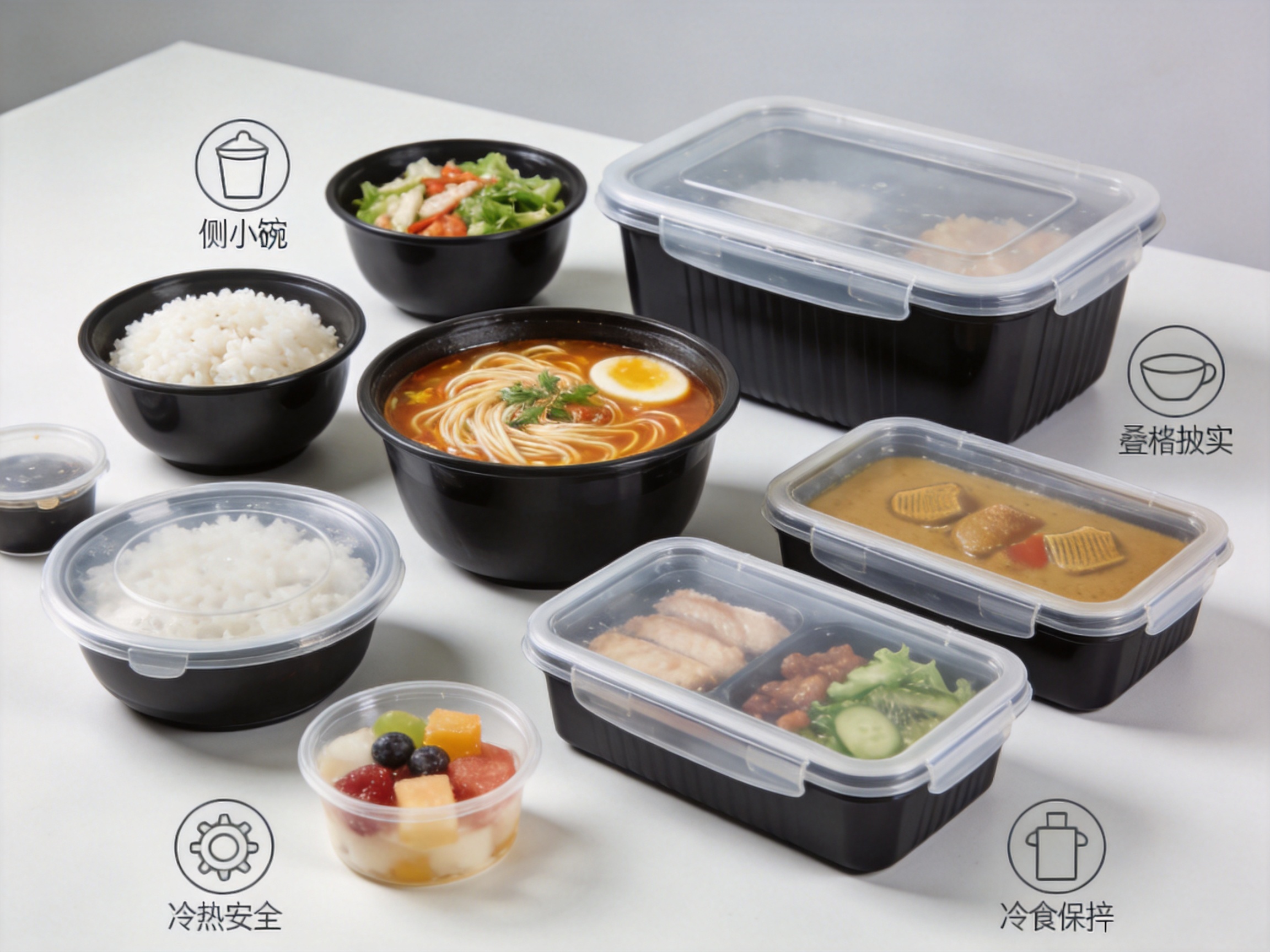
The plastic takeaway bowl and box container is designed for everyday commercial use where reliability is required. Its features include temperature resistance from -10℃ to 120℃, microwave and refrigeration suitability, good toughness, resistance to deformation, a convenient easy-lift lid design, stackability, and a broad selection of capacities from 360 ml to 1750 ml. These capacities cover small snacks, individual meals, large portions, sharing bowls, and event catering servings.
The container is suitable for both hot and cold foods. In refrigerated storage, the material maintains practical stability at low temperatures. In microwave heating, the container supports convenient reheating within the recommended temperature range. This dual capability is valuable for meal-prep companies, takeaway restaurants, convenience stores, and customers who want to store leftovers or heat meals later.
The lid design is another important feature. A lid that is difficult to open can frustrate customers and increase spillage risk. A lid that is too loose may cause leakage during transport. The easy-to-lift lid design aims to provide a balance between convenience and sealing. This design allows users to carry, open, and pour food more easily while maintaining a secure closure during normal handling.
The container’s stackable structure helps save space in warehouses, kitchens, delivery stations, and retail counters. Foodservice operations often need to store large quantities of packaging. Efficient stacking reduces storage pressure, improves inventory organization, and helps workers quickly access the correct size during busy hours.
Core Product Advantages Over Ordinary Containers
Temperature Range from -10℃ to 120℃
One of the most practical advantages of this disposable food packaging container is its suitability for use from -10℃ to 120℃. Many foodservice businesses need one container that can serve several functions: storing chilled ingredients, packaging cold foods, holding hot meals, and allowing customers to reheat food. A container that performs across this temperature range reduces the need for multiple packaging types and simplifies procurement.
In comparison with containers that are suitable only for room-temperature foods, this product offers greater flexibility. It can support refrigerated storage, which is important for salads, fruit, sauces, cold noodles, desserts, and pre-packed meals. It can also support microwave heating, which is essential for rice bowls, soups, stews, curries, pasta, and ready-to-eat meals that customers heat before consumption.
High-Quality Plastic Material
The container is made using high-quality plastic materials suitable for food packaging applications. Materials such as food-grade polypropylene and polyethylene are commonly used in plastic takeaway tableware because they provide heat resistance, cold resistance, toughness, and food contact safety when produced under proper standards. These materials help prevent unwanted reactions between food and the container, supporting the original flavor, appearance, and nutritional value of the meal.
Compared with low-grade packaging that may become brittle, soft, or distorted under stress, a well-engineered plastic container offers better dimensional stability. This is particularly important for hot foods, liquid foods, and stacked delivery orders. If a container deforms, the lid may loosen and leakage may occur. Good material selection and controlled production help reduce these risks.
Good Toughness and Resistance to Deformation
Takeaway packaging is exposed to many stresses. It may be filled quickly, covered by kitchen staff, stacked in bags, transported by delivery riders, carried by customers, stored in refrigerators, and reheated in microwaves. Toughness is therefore critical. The plastic takeaway bowl and box container is designed to be durable and not easily deformed, helping it maintain shape during handling and transport.
Compared with thin or poorly molded containers, this product can provide better user confidence. A container that feels too weak may reduce the perceived quality of the meal and create concern about leakage. A stronger container improves the tactile experience and supports safer delivery.
Convenient Easy-Lift Lid
The easy-to-lift lid design improves convenience. Customers often open takeaway meals in offices, cars, hotel rooms, public spaces, or at home. The lid must be secure but not difficult to remove. This product’s lid concept supports quick opening, carrying, and pouring while helping maintain sealing performance.
For restaurants, lid consistency also reduces packing time. When lids fit smoothly, staff can close orders faster and with fewer errors. This advantage becomes especially valuable during lunch and dinner peaks, when hundreds of containers may be used in a short period.
Multiple Capacity Options
The product line includes capacities from 360 ml to 1750 ml. This range gives foodservice businesses more freedom to match packaging to menu structure. A small 360 ml container may be suitable for sides, desserts, snacks, or sauces. Mid-size options such as 500 ml, 700 ml, 800 ml, 999 ml, and 1000 ml can serve individual meals. Larger options such as 1250 ml, 1500 ml, and 1750 ml are useful for family portions, shared dishes, catering, and large salads.
Having multiple capacity options from one manufacturer improves compatibility and supply-chain efficiency. Buyers can select a complete packaging system instead of sourcing different sizes from unrelated suppliers. This reduces inconsistency in material quality, color, style, and lid performance.
Stackable Design for Space Saving
Stackability is a simple but powerful advantage. Food packaging occupies valuable storage space. Restaurants, especially small shops, often have limited back-of-house space. Stackable containers allow more units to be stored in a smaller area and help employees keep different sizes organized.
During production and shipping, stackability also improves logistical efficiency. More units can be packed per carton or pallet, which may reduce handling complexity and transportation cost. This is one reason well-designed plastic packaging remains competitive in commercial foodservice.
Specification Range
The following table summarizes representative specifications for the takeaway bowl and box container range. Actual customization may be adjusted according to customer requirements, production feasibility, and application needs.
| Specification | Volume | Mouth Diameter | Height | Bottom Diameter | Grammage |
| M-360 | 360 ml | 120 mm | 52 mm | 75 mm | 9 g / 10 g |
| M-400 | 400 ml | 120 mm | 58 mm | 78 mm | 10 g |
| M-500 | 500 ml | 120 mm | 70 mm | 73 mm | 10 g / 13 g |
| M-700 | 700 ml | 142 mm | 69 mm | 91 mm | 13 g |
| M-850 | 850 ml | 142 mm | 81 mm | 91 mm | 16 g |
| M-999 | 999 ml | 142 mm | 95 mm | 95 mm | 19 g |
| M-1100 | 1100 ml | 179 mm | 82 mm | 120 mm | 21 g / 26 g |
| P-500 | 500 ml | 120 mm | 72 mm | 85 mm | 11 g |
| P-600 | 600 ml | 150 mm | 57 mm | 124 mm | 15 g |
| P-800 | 800 ml | 150 mm | 79 mm | 118 mm | 18 g |
| P-1000 | 1000 ml | 150 mm | 98 mm | 118 mm | 23 g |
| P-1250 | 1250 ml | 179 mm | 79.5 mm | 145 mm | 28 g / 35 g |
| P-1500A | 1500 ml | 179 mm | 98 mm | 128 mm | 30 g / 35 g |
| P-1750 | 1750 ml | 179 mm | 118 mm | 128 mm | 39 g |
The variety shown in the table demonstrates that the product range can serve different food types and portion sizes. The M series and P series provide different dimensional combinations, allowing customers to select packaging based on meal depth, surface area, stacking requirements, and presentation style. Wider-mouth containers are useful for foods that need visual display, while taller containers can support soups, noodles, stews, and larger servings.
Customization and Design Advantages
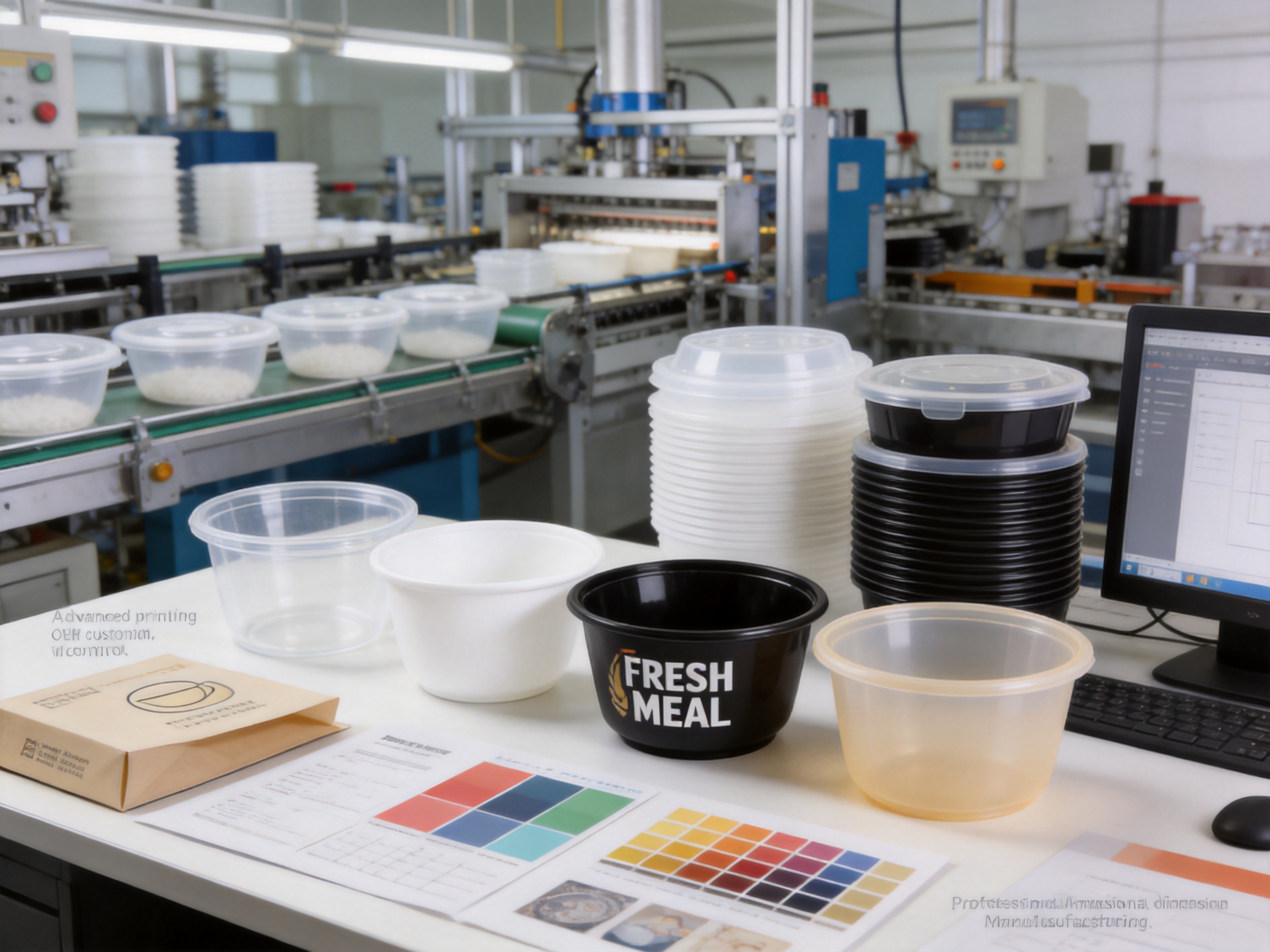
Customization is a major competitive advantage for modern disposable food packaging containers. Food brands want packaging that does more than hold food. They want packaging that carries identity, improves customer recognition, and differentiates their products in crowded markets. Yuqian Packaging Technology (Jiangsu) Co., Ltd. has a professional design team capable of providing personalized customization solutions based on customer needs and brand image.
Customization can include capacity adjustment, caliber adjustment, color selection, shape refinement, and printed brand information. For a restaurant chain, this may mean a unified container style across different menu categories. For a meal-prep company, it may mean size optimization for precise portion control. For an event caterer, it may mean a container with a more premium appearance. For a supermarket ready-meal supplier, it may mean clear labeling areas and reliable stacking for shelf display.
Advanced printing technology helps ensure the clarity and durability of logos, instructions, and packaging information. A logo that rubs off easily or appears blurry can damage brand perception. Clear and durable printing supports a more professional image. It also helps communicate practical information such as heating instructions, recycling guidance, product names, and promotional messages.
Customized color is another useful tool. Some brands prefer transparent containers to show food freshness and portion size. Others prefer white, black, or brand-specific colors to create a premium visual style. Color can also help distinguish product categories, such as hot meals, cold salads, family packs, or limited-edition seasonal menus.
Shape customization may also improve operational efficiency. A round bowl is often suitable for soups, rice bowls, noodles, salads, and mixed meals. A box shape may be preferred for stacked meals, combo dishes, or shelf display. The ability to adapt shape and structure allows packaging to match the food instead of forcing the food to fit unsuitable packaging.
Manufacturing Strengths and Process Control
High-quality disposable food packaging depends on more than raw material selection. It requires precise manufacturing processes, disciplined quality control, stable production capacity, and continuous improvement. Yuqian Packaging Technology (Jiangsu) Co., Ltd. combines research and development, manufacturing, and sales within a 30,000-square-meter production facility, giving the company the ability to support both standard product supply and customized OEM projects.
In food packaging manufacturing, consistency is critical. A small variation in rim diameter, wall thickness, lid fit, or material distribution can affect sealing, stacking, and user experience. Advanced manufacturing processes help keep dimensions stable. Controlled molding conditions, suitable tooling design, and regular inspection all contribute to reliable product batches.
The company’s production philosophy emphasizes technological innovation and quality improvement. Through continuous technological breakthroughs and process optimization, it has developed products with qualities such as high strength, high transparency, strong sealing performance, and heat resistance. These characteristics are directly connected to customer needs in the takeaway and disposable food packaging market.
Quality management begins with raw material selection. Materials must be appropriate for food contact and suitable for the intended application. Production then requires controlled processing to avoid defects such as uneven walls, weak rims, poor lid fit, sharp edges, black spots, warping, or inconsistent weight. Finished product inspection helps confirm that the containers meet relevant specifications before delivery.
The company has passed multiple certifications and compliance systems, including the QS national industrial product production license, ISO9001 Quality Management System certification, BRC certification, German authoritative safety DIN certification, and EU ROHS+ testing. These certifications reflect the company’s attention to production control, food safety expectations, international quality practices, and customer confidence.
Advanced Materials for Safety and Performance
Food packaging materials must be selected carefully because they come into direct or indirect contact with food. Plastic takeaway tableware containers commonly use high-quality materials such as food-grade polypropylene and polyethylene. These materials are valued for their practical heat resistance, cold resistance, durability, processability, and compatibility with common foodservice requirements.
Polypropylene is widely used in microwave-suitable food containers because it can offer strong heat resistance compared with many other plastics. It is also lightweight and tough, making it suitable for bowls, boxes, lids, and other disposable tableware products. Polyethylene is often used where flexibility and impact resistance are important. The correct material or material combination depends on the container design, intended use, and customer requirements.
The container’s ability to preserve food quality is an important advantage. Packaging should not negatively affect the original flavor, color, or texture of food when used correctly. It should support safe handling during transportation and storage. A well-made container helps protect against external contamination and physical damage while providing a hygienic barrier between the food and the outside environment.
As environmental awareness increases globally, the application of environmentally conscious materials is becoming more important. Yuqian Packaging Technology (Jiangsu) Co., Ltd. actively responds to environmental protection expectations by researching green production and environmentally friendly plastic takeaway tableware containers. The company explores options such as biodegradable plastics and works to reduce energy consumption and waste emissions during production.
Environmental improvement in plastic packaging is not limited to material replacement. It also includes optimized production processes, improved resource utilization, reduced scrap rates, efficient logistics, accurate weight control, and responsible product design. By improving these areas, a manufacturer can provide packaging that is more economical and more aligned with sustainable development goals.
Why This Container Competes Strongly in the Market
The disposable food packaging market is highly competitive. Many products look similar at first glance, but performance differences become clear during actual use. A container may fail because the lid does not fit, the wall collapses under heat, the rim cracks at low temperature, the stack becomes unstable, or the material feels too thin. The plastic takeaway bowl and box container described here is designed to address these practical pain points.
Compared with basic disposable containers, this product offers a broader usable temperature range, stronger toughness, multiple capacity options, and support for customization. These advantages make it more adaptable for restaurants and food brands that serve both hot and cold products. Instead of purchasing different containers for each food category, buyers can develop a more unified packaging solution.
Compared with packaging made without strict quality control, this container benefits from a manufacturer with established certifications and production management. Certifications such as ISO9001 and BRC indicate that the company follows structured quality and safety practices. For international buyers, chain restaurants, and distributors, this reduces risk and supports more predictable supply.
Compared with non-custom packaging, the product offers stronger branding potential. Custom printing and design allow the container to communicate brand identity directly to customers. In an era of online ordering and social media sharing, packaging appearance can influence customer perception and even repeat purchases. A customized disposable food packaging container can make takeaway meals feel more professional and carefully prepared.
Compared with heavy reusable packaging systems, disposable plastic containers provide strong convenience for takeaway, delivery, catering, and large events. Reusable systems may be suitable in some closed-loop environments, but they require collection, washing, tracking, and storage. For many foodservice scenarios, hygienic single-use packaging remains the most practical option, especially when paired with responsible material selection and proper waste management.
Applications Across Foodservice Scenarios
Restaurant Chains
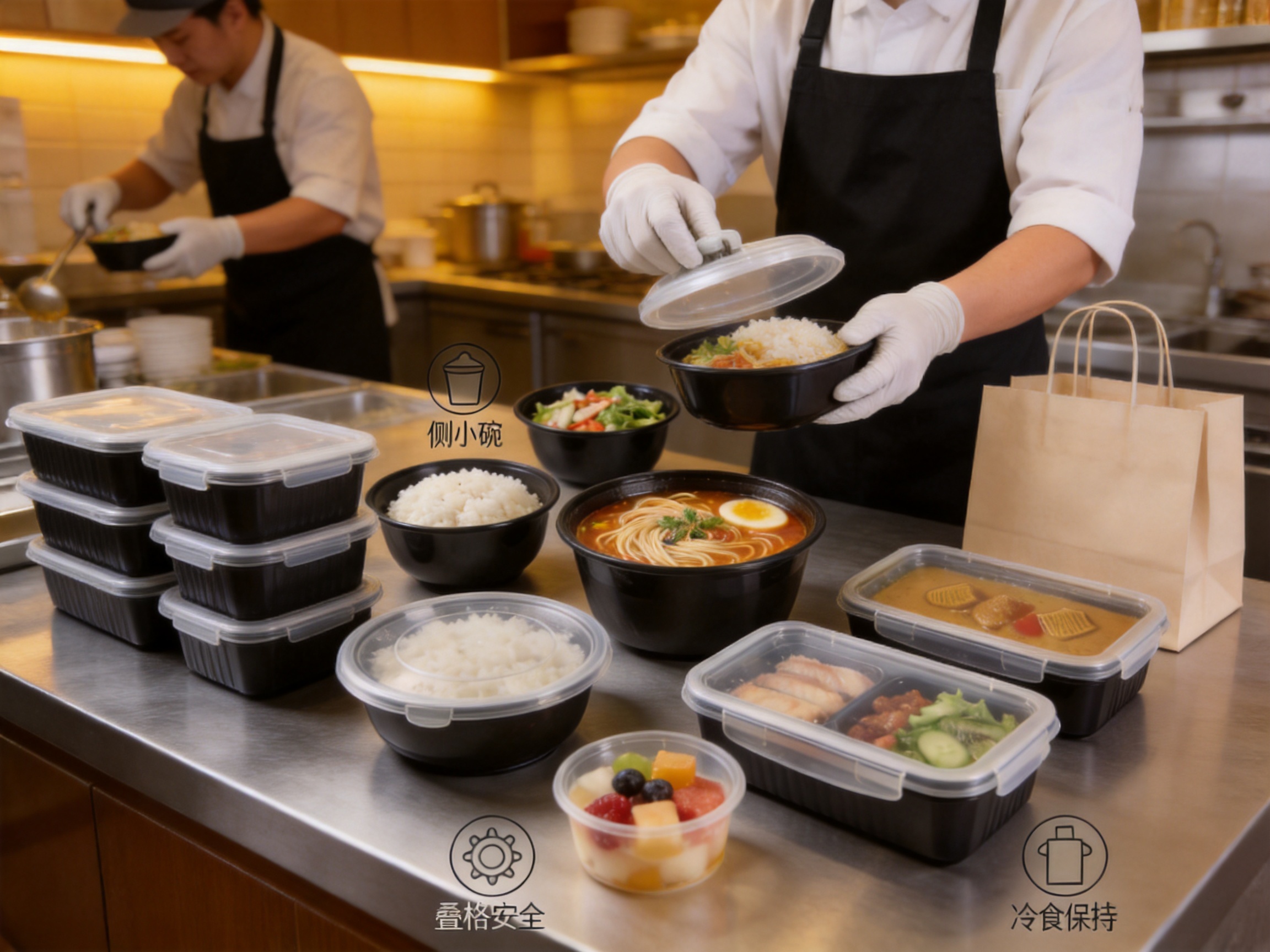
Restaurant chains need packaging that supports scale. A single branch may use hundreds of containers per day, while a regional chain may require millions of units annually. Consistent container dimensions, stable lid fit, and reliable supply are essential. The plastic takeaway bowl and box container range helps chain restaurants standardize packaging for rice bowls, noodle bowls, soups, salads, sides, desserts, and family packs.
Customization also supports chain branding. A printed logo, consistent color, or unified container design can create an integrated customer experience. When customers recognize the packaging immediately, brand memory becomes stronger. This is especially valuable for delivery orders, where the first physical interaction with the restaurant is often the package itself.
Independent Restaurants and Takeaway Shops
Independent restaurants need packaging that is cost-effective but still professional. A weak container can lead to negative reviews, even if the food is good. This product provides toughness, microwave suitability, refrigeration compatibility, and practical lid handling, helping smaller restaurants compete with larger brands.
The broad capacity range allows small restaurants to match containers to their menus without overcomplicating inventory. A shop may use 500 ml containers for side dishes, 850 ml containers for noodles, 1000 ml containers for rice bowls, and 1500 ml containers for family servings. This creates a flexible system while maintaining a consistent packaging style.
Family Gatherings and Social Events
For family gatherings, parties, and community events, disposable containers simplify serving, storage, and cleanup. Guests may take leftovers home, and organizers need packaging that can handle different food portions. Larger capacities such as 1250 ml, 1500 ml, and 1750 ml are suitable for shared dishes, while smaller capacities can be used for individual portions or desserts.
Microwave and refrigeration suitability add convenience after the event. Guests can store food in a refrigerator and reheat it later without transferring it to another container, provided they follow safe usage guidelines. This improves user satisfaction and reduces additional dishwashing.
Large-Scale Events and Catering
Large events require packaging that is easy to store, fast to use, and reliable during transport. Stackability helps caterers prepare in advance and manage packaging inventory efficiently. Toughness helps containers survive handling by staff and guests. Easy lids help speed up packing lines and reduce errors.
For festivals, conferences, schools, company meals, and outdoor catering, packaging consistency can significantly improve workflow. The ability to choose multiple capacities from one manufacturer allows event organizers to plan menus more effectively.
Meal Preparation and Ready-Meal Brands
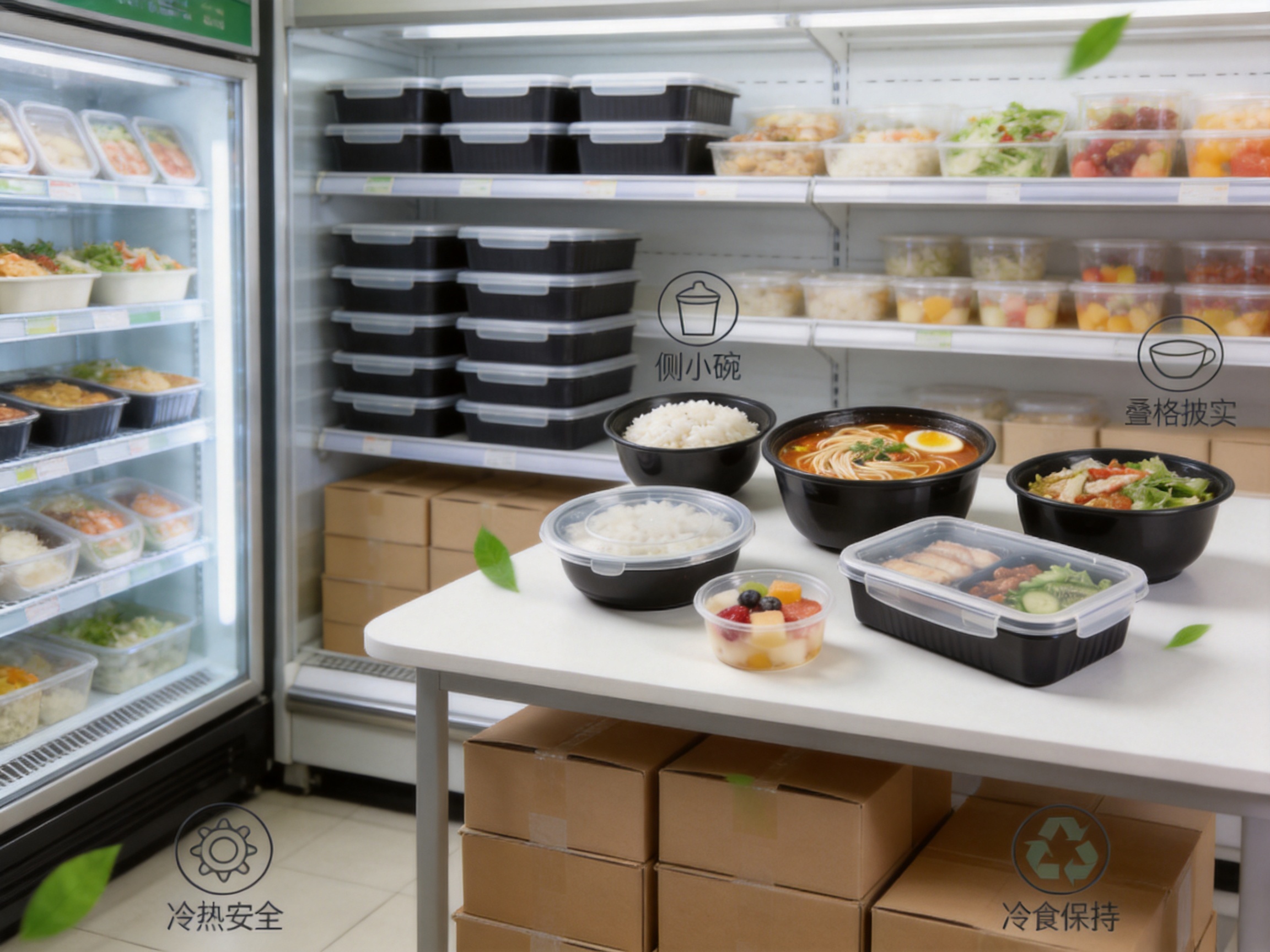
Meal-prep and ready-meal companies require containers that support refrigeration, portion control, reheating, and attractive presentation. A suitable container must withstand storage and customer handling while keeping meals organized. The product’s temperature range and variety of sizes make it useful for fresh meals, chilled meals, and microwave-ready products.
Custom printing can communicate heating instructions, nutrition-related information, brand identity, and product categories. This is particularly important for retail ready meals, where packaging must attract attention and provide clear information.
Food Safety and Certification Confidence
Food safety is a central requirement for disposable food packaging. Customers trust packaging to protect meals from contamination and maintain hygiene during transportation and storage. For business buyers, certification and process control are major factors in supplier selection. Yuqian Packaging Technology (Jiangsu) Co., Ltd. has passed the QS national industrial product production license, ISO9001 Quality Management System certification, BRC certification, German DIN safety certification, and EU ROHS+ testing.
The QS national industrial product production license indicates compliance with relevant production requirements in China. ISO9001 reflects a structured quality management system focused on consistent processes and continual improvement. BRC certification is recognized in the food and packaging industries as a strong framework for safety, legality, and quality. DIN-related safety certification and EU ROHS+ testing further demonstrate attention to international expectations and material compliance.
For buyers, these certifications reduce uncertainty. When packaging is purchased for food contact applications, customers need evidence that the supplier understands safety, traceability, material control, and documentation. Certification does not replace product testing for specific applications, but it provides a strong foundation for supplier confidence.
Design Details That Improve User Experience
Good packaging design is often noticed only when it fails. When a container leaks, bends, collapses, or is hard to open, customers immediately recognize the problem. When the design works well, the meal experience feels smooth and convenient. The plastic takeaway bowl and box container includes several user-centered design elements.
The mouth diameter supports easy filling and convenient eating. A wide opening makes it easier for kitchen staff to portion food quickly and for customers to access the meal. The bottom diameter contributes to stability and stackability. Height influences capacity and presentation. Grammage affects strength, cost, and handling feel. Each of these dimensions must be balanced for real-world use.
The easy-lift lid improves opening convenience. This feature matters for children, elderly users, office workers, and customers eating on the go. If a lid requires too much force, food can spill when it suddenly releases. A well-designed lid gives users more control.
Stacking design improves both storage and delivery. Containers that nest properly are easier to store before use. Filled containers that stack securely can improve delivery bag organization. Stable stacking reduces the chance of tilting, crushing, or lid displacement.
Packaging as a Brand Communication Tool
A disposable food packaging container can communicate quality before the customer tastes the food. Clean appearance, good transparency, stable structure, and clear printing all influence perception. If a container looks professional, customers are more likely to believe the food was prepared and handled carefully. If the container looks weak or poorly finished, the perceived value of the meal may decrease.
Custom design allows packaging to carry the brand beyond the restaurant. A customer may place the container on an office desk, share a meal photo, carry leftovers home, or give food to another person. Each interaction becomes a small brand exposure opportunity. For delivery businesses, this is especially important because customers may rarely visit the physical restaurant location.
Printed packaging can also serve functional communication. It may include microwave guidance, storage instructions, food category labels, environmental messages, promotional information, or customer service contacts. Clear printed information reduces confusion and improves the customer experience.
Environmental Considerations and Responsible Production
Environmental responsibility is increasingly important in food packaging. Consumers, regulators, and foodservice brands are paying more attention to material selection, waste reduction, recyclability, biodegradability, and production efficiency. Yuqian Packaging Technology (Jiangsu) Co., Ltd. actively responds to environmental protection expectations by focusing on green production and environmentally friendly plastic takeaway tableware containers.
The company uses environmentally conscious material options such as biodegradable plastics where appropriate and works to reduce energy consumption and waste emissions in production. It also optimizes production processes to improve resource utilization efficiency and reduce production cost. These practices help provide customers with packaging solutions that are both practical and more aligned with sustainable development.
Responsible environmental design should consider the entire packaging lifecycle. A container that is too weak may cause food waste through leakage or breakage. A container that is too heavy may consume unnecessary material. A well-balanced container uses suitable material weight to achieve reliable performance without unnecessary excess. This balance is important for both environmental and economic reasons.
Customers can further improve environmental outcomes by selecting appropriate container sizes, avoiding over-packaging, following local recycling or disposal regulations, and educating consumers on correct handling. Manufacturers and buyers share responsibility for building more sustainable packaging systems.
OEM Manufacturing and Global Supply Support
OEM manufacturing is essential for brands that need packaging designed around their own market positioning. Yuqian Packaging Technology (Jiangsu) Co., Ltd. has experience as an OEM manufacturer in the plastic takeaway tableware container field. The company can support customers with product design, capacity selection, appearance customization, printing, and production planning.
OEM projects often begin with understanding the customer’s food category, usage environment, order volume, packaging budget, and brand style. A soup restaurant may prioritize sealing and heat resistance. A salad brand may prioritize clarity and wide openings. A meal-prep company may prioritize stackability and microwave performance. An event caterer may prioritize large capacity and fast packing. The manufacturer’s design team can translate these requirements into practical packaging solutions.
Production capability is also important for OEM buyers. A supplier must maintain stable quality across repeated orders. It must control dimensions, colors, weight, print quality, and packaging count. It must also communicate clearly about lead times, minimum order quantities, tooling needs, and customization feasibility. A manufacturer with integrated production and quality systems is better positioned to support long-term cooperation.
How to Select the Right Container Size
Selecting the right disposable food packaging container requires careful consideration of food type, portion size, temperature, presentation, transport distance, and customer behavior. A container that is too small can lead to overfilling and leakage. A container that is too large may make portions look insufficient and waste material. The broad 360 ml to 1750 ml range gives buyers many practical choices.
For small sides, sauces, desserts, fruit, snacks, and sample portions, 360 ml to 500 ml containers may be suitable. These sizes are compact and easy to store. For standard individual meals, 700 ml to 1000 ml containers often provide enough space for rice, noodles, salads, pasta, stir-fried dishes, or mixed meals. For larger portions, family meals, event catering, and shared dishes, 1100 ml to 1750 ml containers may be preferred.
Mouth diameter matters when food presentation is important. A wider mouth allows better display and easier eating. Height matters for soups, noodles, and layered meals. Bottom diameter affects stability and stacking. Grammage influences strength and material cost. Buyers should test containers with their actual foods before finalizing a specification.
Operational Benefits for Food Businesses
The right packaging can improve daily operations in several ways. First, it reduces packing errors. When lids and containers fit reliably, staff can work faster and with fewer interruptions. Second, it reduces complaints related to leakage, deformation, or poor presentation. Third, it supports inventory management by offering multiple sizes within a consistent system. Fourth, it strengthens branding through customization.
Packaging also affects delivery platform ratings. Customers often review not only taste but also temperature, leakage, portion appearance, and convenience. A strong container helps protect these aspects of the experience. Even small improvements in packaging can reduce refunds, complaints, and negative reviews.
For high-volume kitchens, stackability and easy handling save labor time. Workers can quickly pull nested containers from stacks, fill them efficiently, apply lids, and organize completed orders. These seconds matter during peak service periods. A container designed for smooth workflow can contribute to overall kitchen productivity.
Quality Control from Raw Material to Finished Product
A strong quality control system covers the entire production chain. It begins with raw material verification, including material type, safety requirements, and supplier documentation. During production, operators and inspectors monitor forming conditions, product dimensions, appearance, weight, and structural integrity. After production, finished products are checked for defects, packed properly, and prepared for shipment.
Common quality concerns in disposable plastic containers include uneven wall thickness, poor lid compatibility, surface contamination, color inconsistency, weak rims, deformation, and inaccurate counts. A disciplined manufacturer uses process controls and inspection procedures to minimize these risks. The company’s ISO9001 quality management system provides a framework for continual improvement and consistent production practices.
For customized products, quality control must also cover printing clarity, logo positioning, color matching, and durability. Advanced printing technology helps ensure that branding remains clear and professional. Customers should provide accurate artwork and confirm samples before mass production to ensure the final packaging meets expectations.
Advantages for Distributors and Wholesale Buyers
Distributors need products that are marketable, reliable, and available in a practical range of specifications. This plastic takeaway bowl and box container line offers multiple capacities, broad application potential, and customization options, making it suitable for wholesale supply to restaurants, supermarkets, catering companies, and packaging retailers.
Because the containers serve many food categories, distributors can simplify their product portfolios while still meeting diverse customer needs. The same general product family can be sold to noodle shops, rice bowl restaurants, salad brands, dessert shops, catering companies, and event organizers. This flexibility improves sales potential and inventory turnover.
Certification and manufacturing strength also support distributor confidence. When distributors supply food packaging, they need suppliers that can provide stable quality and documentation. A manufacturer with recognized certifications and established production capacity is more suitable for long-term wholesale cooperation.
Q&A Section
What foods are these plastic takeaway bowls and box containers suitable for?
They are suitable for many hot and cold foods, including rice bowls, noodles, soups, salads, pasta, curries, stews, desserts, fruit, side dishes, meal-prep products, and family portions. The wide capacity range allows different menu items to be matched with suitable container sizes.
Can the containers be used in a microwave?
Yes, the containers are designed for use within a temperature range of -10℃ to 120℃ and can support microwave heating when used correctly. Users should follow safe heating practices, avoid overheating, and confirm specific usage requirements for the selected container model.
Can the containers be refrigerated?
Yes, the containers are suitable for refrigerated storage down to -10℃. This makes them useful for chilled meals, salads, desserts, prepared foods, and leftovers.
What capacities are available?
The product range includes capacities from 360 ml to 1750 ml. Available examples include 360 ml, 400 ml, 500 ml, 600 ml, 700 ml, 800 ml, 850 ml, 999 ml, 1000 ml, 1100 ml, 1250 ml, 1500 ml, and 1750 ml.
Can the containers be customized?
Yes. Customization can include capacity, caliber, color, shape, logo printing, and other design elements. The manufacturer’s professional design team can provide personalized packaging solutions based on brand image and functional requirements.
Are the containers easy to stack?
Yes. The containers are designed to be stackable, helping restaurants, distributors, and catering companies save storage space and improve operational efficiency.
What makes these containers different from ordinary disposable containers?
The main advantages include a broad temperature range, good toughness, resistance to deformation, convenient easy-lift lid design, multiple sizes, customization capability, advanced printing support, quality certifications, and production by an experienced food packaging manufacturer.
What certifications support the product and manufacturer?
The manufacturer has passed the QS national industrial product production license, ISO9001 Quality Management System certification, BRC certification, German DIN safety certification, and EU ROHS+ testing.
Are environmentally friendly options available?
The manufacturer focuses on green production and environmentally conscious packaging development, including the use of materials such as biodegradable plastics where suitable. It also works to reduce energy consumption, waste emissions, and production inefficiency.
Who should use these disposable food packaging containers?
They are suitable for restaurant chains, independent takeaway shops, supermarkets, meal-prep brands, family gatherings, catering companies, large-scale events, distributors, and OEM packaging buyers.
Contact and Company Information
Yuqian Packaging Technology (Jiangsu) Co., Ltd. is a high-tech enterprise specializing in the research, development, production, and sales of new food packaging materials and products. The company was established in 2010 and is located at No. 8 Tongyang Road, Suchen Town, Taizhou City, Jiangsu Province, China. Its plant area is approximately 30,000 square meters, and it has developed strong capabilities in biodegradable new materials, disposable food packaging products, OEM manufacturing, and customized packaging design.
The company established a Shanghai branch in January 2019 to improve service quality and expand business channels. Its contact phone number is 0086 15252423007, fax number is +0523 8608 3698, and email address is [email protected].
Conclusion
A plastic takeaway bowl or box container is a small product with a major impact on foodservice performance. It affects food safety, delivery reliability, customer convenience, brand presentation, storage efficiency, and operational speed. The disposable food packaging container described in this article offers a practical combination of temperature resistance, toughness, microwave and refrigeration suitability, easy-lift lid design, stackability, multiple capacities, and customization.
Yuqian Packaging Technology (Jiangsu) Co., Ltd. strengthens these product advantages with advanced manufacturing processes, a professional design team, strict quality management, recognized certifications, and a commitment to green production. For restaurants, catering companies, distributors, and OEM buyers seeking reliable and customizable takeaway packaging, this product range provides a strong foundation for modern food delivery and disposable food packaging needs.
References
1. Robertson, G. L. Food Packaging: Principles and Practice. CRC Press.
2. Marsh, K., and Bugusu, B. Food Packaging: Roles, Materials, and Environmental Issues. Journal of Food Science.
3. Yam, K. L. The Wiley Encyclopedia of Packaging Technology. Wiley.
4. ISO 9001 Quality Management Systems: Requirements. International Organization for Standardization.
5. BRCGS Packaging Materials Standard. Brand Reputation Compliance Global Standards.
6. Coles, R., McDowell, D., and Kirwan, M. J. Food Packaging Technology. Blackwell Publishing.